Chapter I
Weavers, centaurs and the half-spider in the stone
Tonight we follow the drider, the dark elf joined at the waist to the body of a great spider, from the old myths that foreshadowed its shape to the pages of the newest rulebooks. We'll walk through each age of the game in turn: the modules where it was born, the Forgotten Realms where it found a home, the novels, the video games, and the long argument over whether its shape is a curse or a gift. Along the way we'll spend most of our time in the dark places where driders live, among the webs, the goddess who made them and the people who fear them.
The drider was invented for Dungeons and Dragons, and no earlier myth contains it whole. Still, the idea of a person bound into a spider's body is old, and a few of those older stories make a good starting point. They give us the feeling of the creature before we meet the creature itself.
The oldest and best known of them belongs to a young woman named . The Roman poet tells her story in the sixth book of his Metamorphoses, the long poem about bodies changing into other bodies. Ovid uses the Roman name for the goddess of wisdom and craft, the one the Greeks called . Arachne lived in , in the hill country of what is now western Turkey. She was not born to anything grand. In some tellings her father was a shepherd and in others he was a dyer of wool, which suits her well, since her life was spent among threads and colours.
She began weaving when she was very young, and she was extraordinary at it. People came from the vineyards and the rivers to watch her work. Even the nymphs of the countryside left their haunts to see how she drew the raw wool into soft clouds of thread, spun it and set it on the loom. Everyone who watched supposed that Minerva herself must have taught her. Arachne would not have it. She said the skill was her own, and she said more than that. She claimed to be a better weaver than the goddess, and she said she would gladly weave against Minerva to prove it.
Minerva came to her in disguise, as an old woman with grey hair, leaning on a staff. She spoke kindly. She told Arachne that age brings some wisdom with it, that she was welcome to be the finest weaver among mortals, and that she should give way to the goddess and ask forgiveness for her proud words. Arachne answered sharply. She told the old woman that she had lived too long and that her wits had grown dim, and she said that if Minerva wanted her to stop, the goddess could come and say so herself.
So the goddess did. The old woman's shape fell away and Minerva stood in the room. The nymphs bowed. Arachne flushed red for a moment, then went pale, and still she did not back down. The two of them set up their looms side by side and began.
Minerva's tapestry showed her own contest with for the patronage of Athens, the gods seated in judgement, the sea god striking the rock and the goddess bringing forth the olive tree. In each corner she wove a small warning: scenes of mortals who had set themselves against the gods and been punished for it. Arachne wove something very different. Her tapestry showed the gods behaving badly, and Neptune and Apollo, and Saturn, each taking some disguise to deceive a mortal woman. It was a bold choice of subject, and her work was flawless. Ovid says that neither Minerva nor Envy itself could find a fault in it.
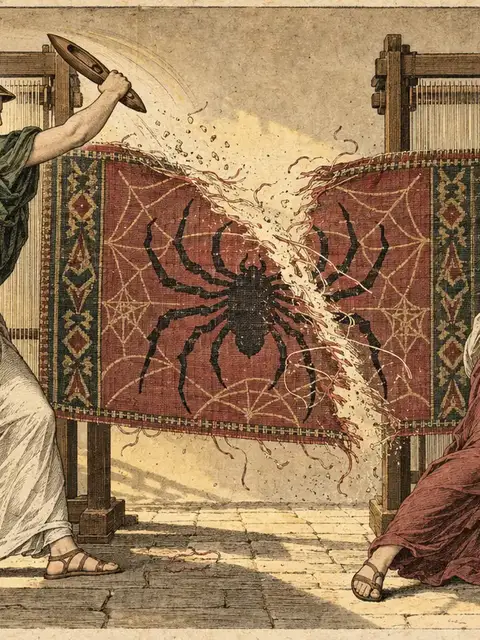
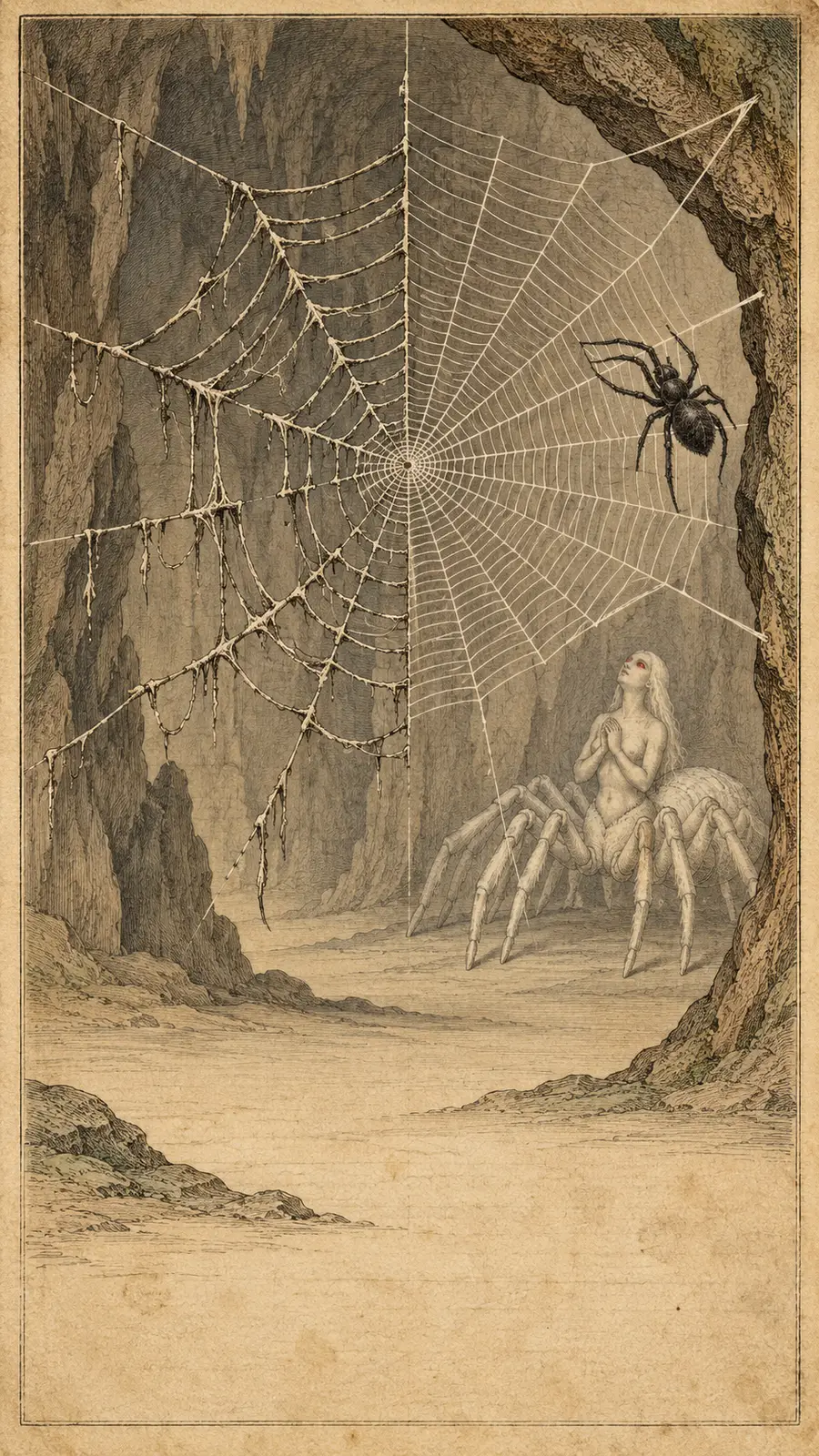
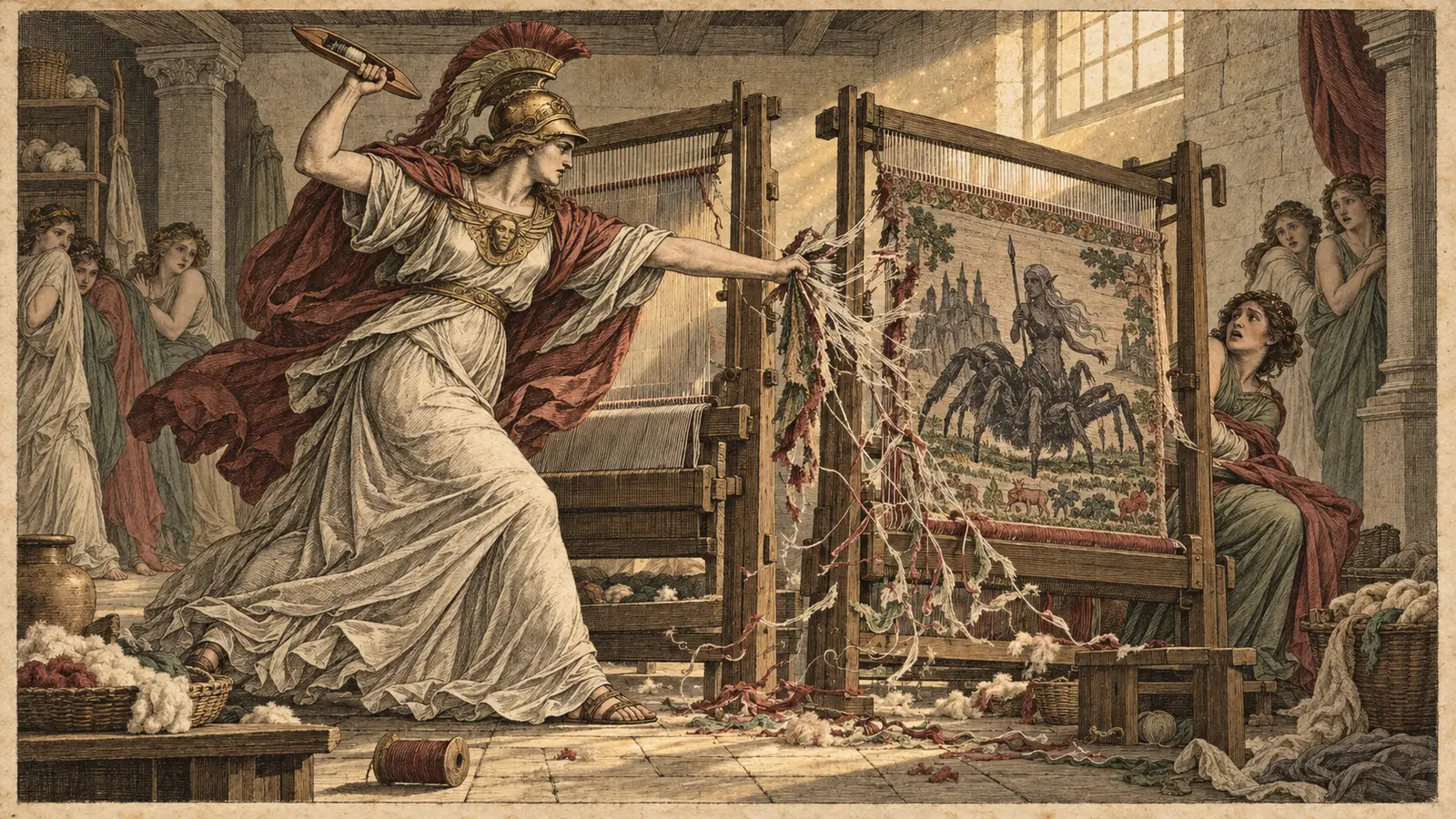
That was more than the goddess could bear. She tore the tapestry apart, and she struck Arachne on the head with the wooden shuttle from her loom. Arachne could not endure it. In her shame she hanged herself. Minerva, looking at her, felt a kind of pity, and the pity took a strange shape. She lifted Arachne and told her she would live, but hanging, and that her descendants would hang too, for all time. Then she sprinkled her with the juice of a magic herb. Arachne's hair fell away, and her nose and ears. Her head shrank very small, and her whole body grew tiny. Her slender fingers became legs along her sides, and the rest of her became a belly. From that belly she still draws thread, and she still weaves, as she always did.
You can see why this story sits at the beginning of any tale about driders, even though the people who made the drider never said they had Arachne in mind. Here is a gifted person who offends a goddess. Here is a contest of worth, a failure in the goddess's eyes, and a transformation that is both punishment and a strange kind of preservation. The gift survives, and so does the weaving. It simply belongs now to something that is no longer quite a person.
Some thirteen centuries after Ovid, the Italian poet took Arachne's story and froze it in a single moment. In the Purgatorio, the second part of his Divine Comedy, Dante climbs the mountain of Purgatory terrace by terrace. On the first terrace, where the proud are purified, the pavement under his feet is carved with scenes of pride brought low. Among them he sees Arachne, and the carving catches her halfway through her change.
In Italian the line is "O folle Aragne, sì vedea io te già mezza ragna," and the words that matter most are "già mezza ragna," already half spider. An older English translation by Henry Cary renders the passage this way: "O fond Arachne! thee I also saw, half spider now, in anguish, crawling up the unfinish'd web thou weaved'st to thy bane." A more modern rendering reads, "O mad Arachne, I saw you already half spider, wretched on the ragged remnants of work that you had wrought to your own hurt."
Half spider. Dante is describing the drider's silhouette centuries before anyone drew one. A being caught between two natures, neither fully what it was nor fully what it is becoming, crawling over the remains of its own work.
In the 1860s the French artist made a celebrated set of engravings for the Divine Comedy, and one of his plates for this canto shows that moment. In Doré's picture, Arachne has the upper body of a woman, and below the waist she rises out of the body of an enormous spider, its legs spread across the ground. Dante kneels nearby and watches her with what looks like compassion. The engraving is Romantic in feeling, more pitying than frightening, and if you set it beside a modern drawing of a drider the resemblance is close. It is about as near as any picture comes to being the drider's ancestor.
The other half of the drider's shape is borrowed from the centaurs of Greek myth, those beings with a human torso rising from where a horse's neck should be. One old story tells how they began. , a king of the , was invited to dine among the gods on Olympus, and there he fell into desire for , the queen of heaven. Zeus learned of it, and he shaped a cloud into Hera's likeness. That cloud was called . Ixion lay with the cloud, and from that union came a son named , who wandered to the slopes of Mount and mated with the wild mares there, and from them came the race of centaurs. Ixion himself was bound to a fiery wheel that turns without end.
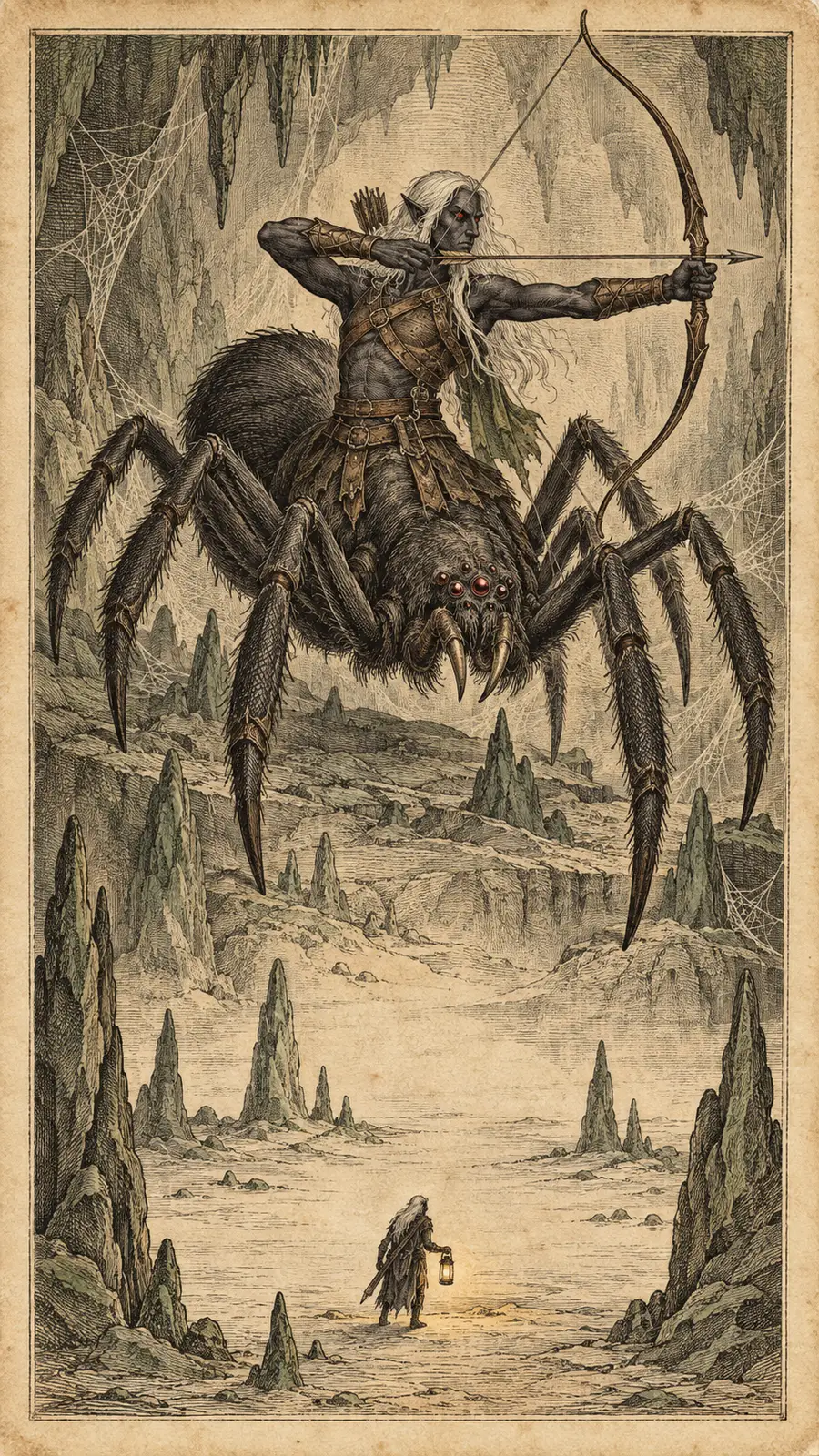
Every description of the drider you'll hear tonight calls it centaur-like, and that is exactly right. Take a centaur, keep the upper body, and replace the horse below with a spider. The torso stands upright at the front, with arms free for blades and bows, and the long legs carry it beneath. It is a clever, simple idea, and it explains why driders look the way they do in nearly every picture: tall, balanced, with a person standing where the spider's head should be.
Spiders that are partly people turn up in many places across the world, and not all of them are frightening. Among the people of present-day Ghana there is , the trickster, who is pictured as a spider, or as a man who is half spider, or as a spider with a clever human face. In his most famous tale he goes to the sky god and asks to buy all the stories in the world. Nyame names a price that seems impossible, a set of dangerous creatures to be captured and brought to him, and Anansi gathers them all through cunning, so that the stories become his. He is a figure of wit, sometimes kindly, sometimes mischievous. Far to the west, the tell of Grandmother Spider, a wise and helpful figure. These spiders remind us that the half-spider shape doesn't have to mean a curse. The drider's sadness is a choice its makers made.
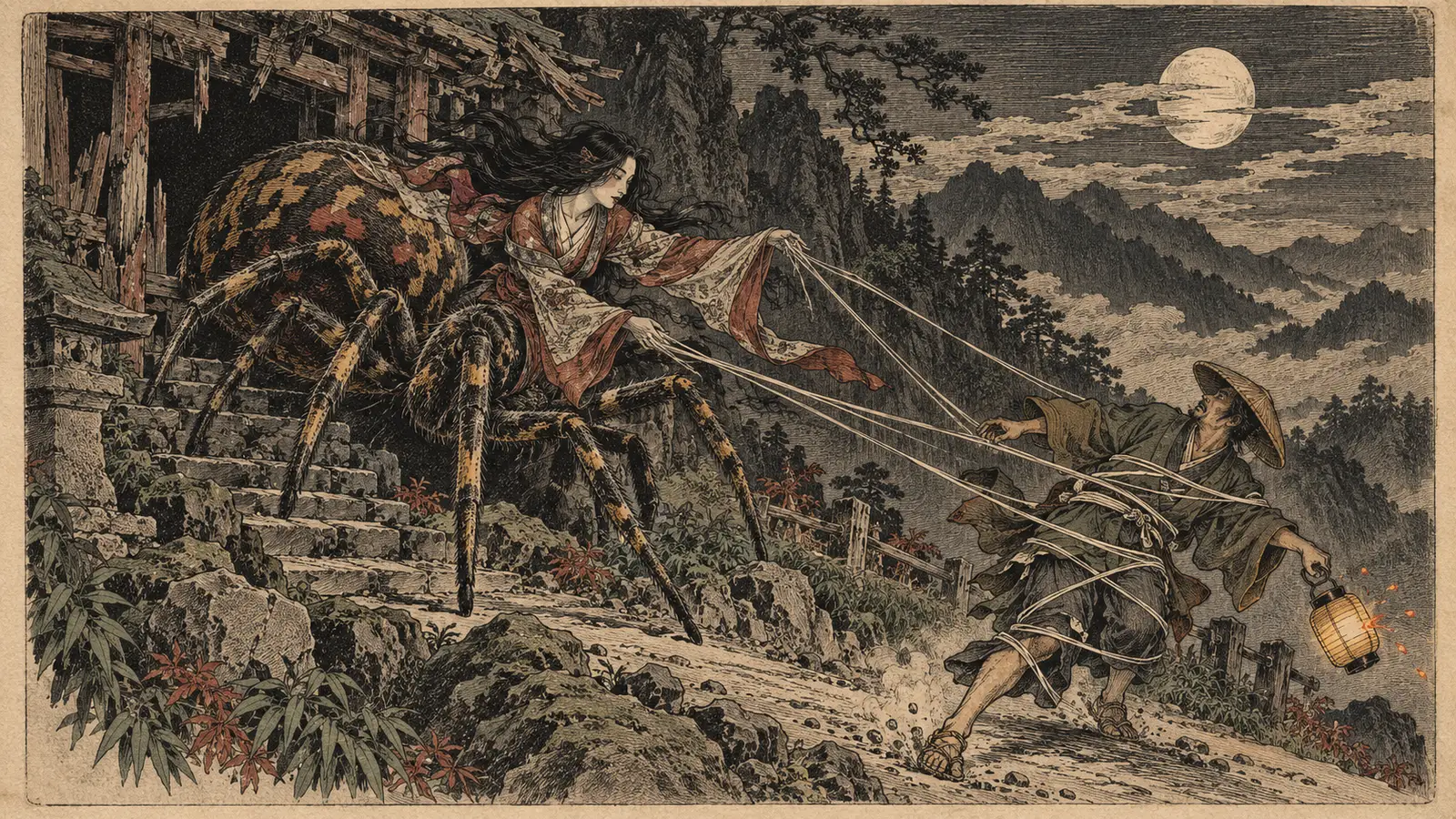
In Japan the old stories turn darker. There is the jorōgumo, a yōkai that grew out of the orb-weaving spider. In some tellings a spider that lives for around four hundred years gains magical power. It can take the form of a beautiful woman, and it calls to travellers from somewhere out of sight, or pretends to need help. When a man comes near, it binds him in silk strong enough to hold him fast, and its venom weakens him slowly, day by day. There is also the tsuchigumo, the earth spider. The name began as an insult in old chronicles for local clans who resisted the court, and over the centuries it became the name of a race of giant spider yōkai: long-lived shapeshifters, masters of illusion with a strong poison. A person above, a spider beneath or behind, silk and venom and a lure. Those are drider qualities too.
Closer to the game's own roots, there are the pulp writers who shaped so much of early Dungeons and Dragons. In 1934 Clark Ashton Smith published a story called "The Seven Geases," set in his ancient polar land of . In it a hapless magistrate is sent down through the caverns beneath Mount Voormithadreth, and there he meets , a huge spider with a face that is almost human, able to show expression. Atlach-Nacha spins an endless web across the gulfs of the underworld, a bridge that may never be finished. Picture that: a spider with a person's face, weaving forever in caverns under the earth. It is a parallel only. Nobody at TSR ever named Smith's spider as a source for the drider. But it sits comfortably beside our subject, down there in the dark.
You might expect Tolkien's spiders to be part of this family too, Shelob in her pass and the great spiders of Mirkwood. They were the most famous fantasy spiders in the world when the drider was born. Yet Gary was firm that , the spider goddess at the centre of our story, was strictly a creation of his own imagination and owed nothing to Shelob. So we'll leave Tolkien's spiders to their own mountains.
What all these stories give us, together, is a mood. Pride and a goddess. A contest and a failure. A body halfway between, a weaver bound to her thread. When the drider finally crawled into the game, it carried all of that with it, whether its makers intended it or not. And to find where it crawled in, we need to go down, beneath the hills of Greyhawk, into the deep places where the dark elves live.
Chapter II
The road down to the Demonweb
On an earlier evening we travelled the Underdark itself, from the old tales of hollow worlds to Gary 's great descent into the deep. We won't walk that whole road again tonight, but we need to retrace a few steps, because the drider was made for the end of it.
In the late 1970s, TSR published a chain of adventures that led players downward. They began among the giants, in the series called Against the Giants, where heroes discovered that the hill giants, frost giants and fire giants raiding the lands of men had been stirred up by someone else. Behind them stood the drow, the dark elves, who until then had been little more than a rumour in the rules. The trail led into the earth. In Descent into the Depths of the Earth the heroes followed the drow down through long tunnels, and there the name of first appeared. In Shrine of the Kuo-Toa they passed through the strange underground realm of the fish-folk. And in 1978, in Vault of the Drow, they came at last to the great cavern where the dark elves had built their city.
That city was Erelhei-Cinlu, a vast and decadent place under a glowing stone sky, surrounded by wild forests of fungus. It was ruled by noble houses locked in rivalry. The first of them in that year, which the calendar counts as 576, was House Eilservs, whose ruler was a priestess named . She wanted to be sole queen of the Vault, and she had turned away from Lolth to serve another power, the Elder Elemental God, binding her house in alliance with House Tormtor. On the other side stood the faithful of the spider goddess, and at the climax of the adventure the heroes could reach her Fane, the great temple of Lolth, and the Egg of Lolth beneath it, and there meet the demoness herself.
From there, a gateway led onward. It did not go deeper into the earth. It led out of the world entirely, to the plane where Lolth makes her home.
The drider had not yet appeared in any of this. In the Vault there were dark elves and their slaves, their spiders and their schemes, but no spider-elf. For that we have to step through the gate.
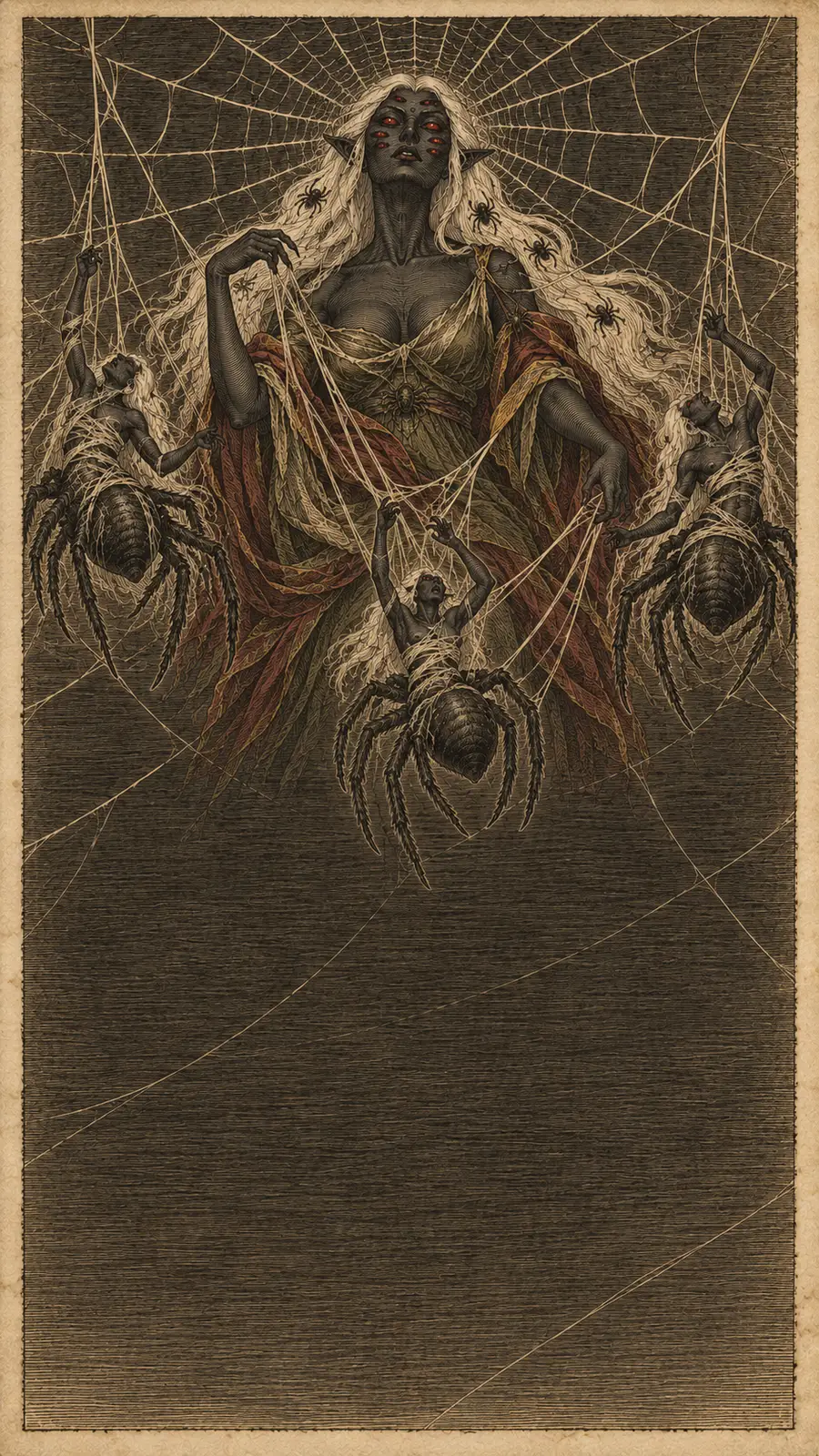
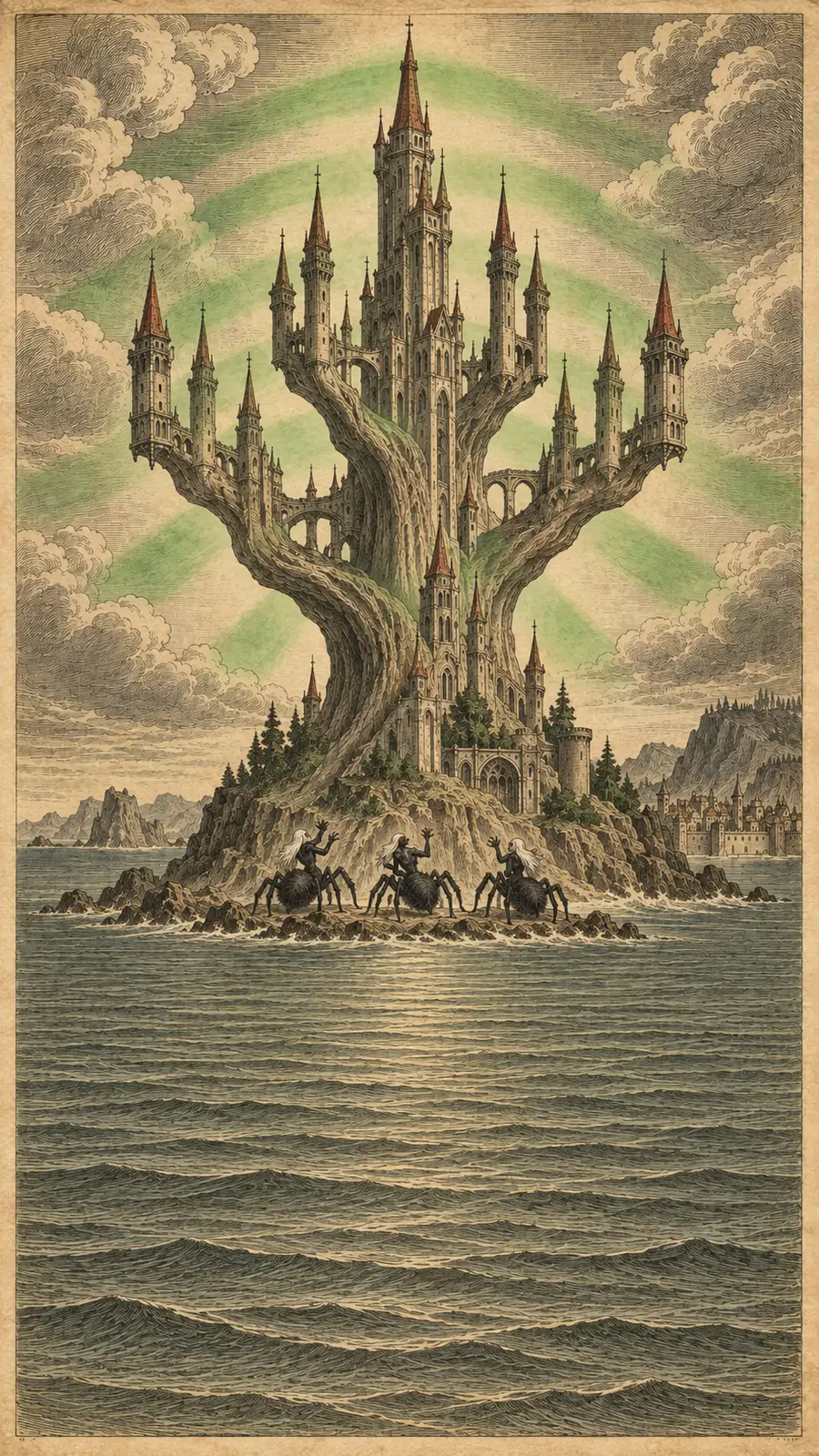
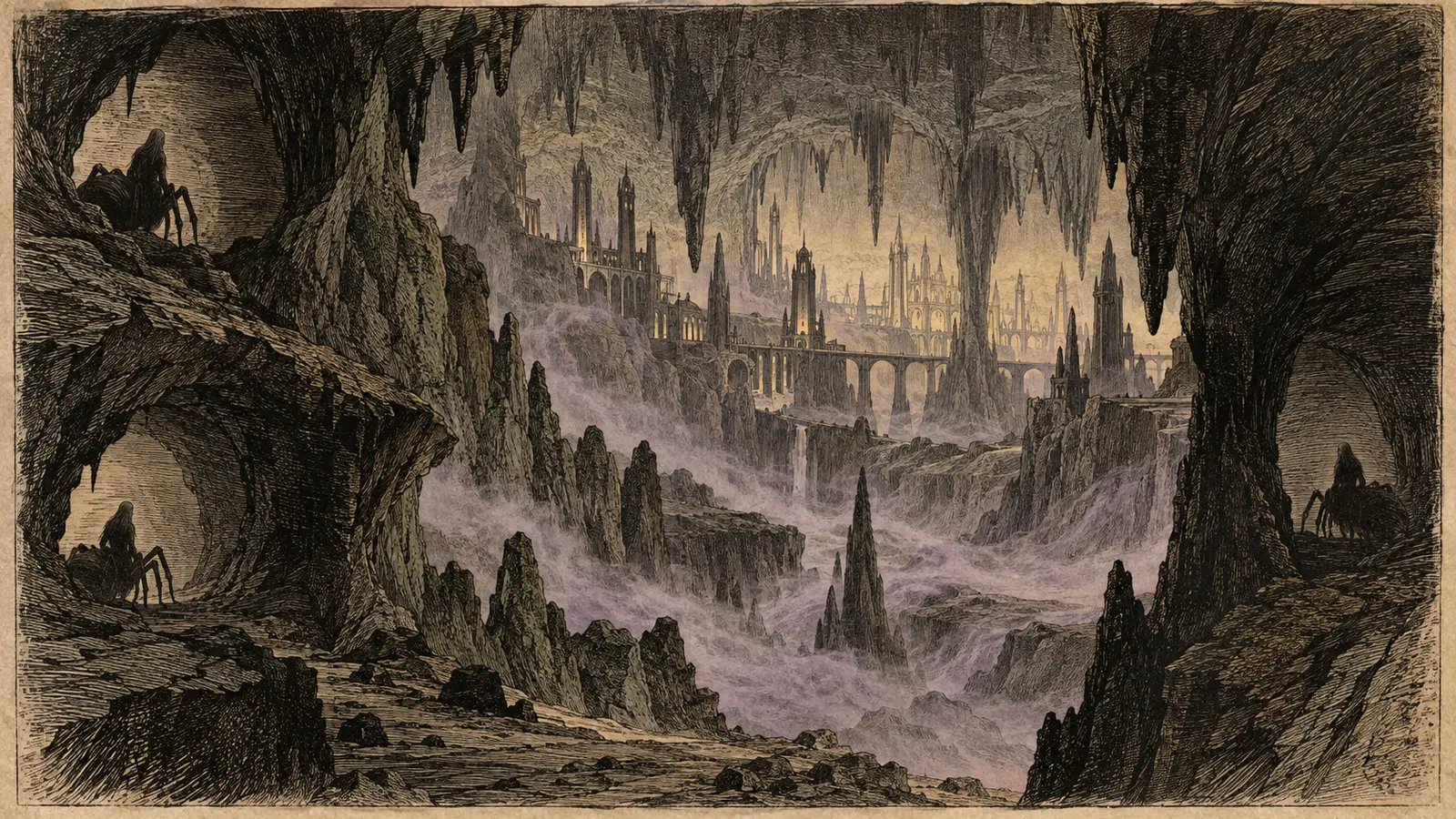
What lay beyond it was the , the endless chaotic realm of the demons, layer upon layer of it. And on one of those layers, traditionally the sixty-sixth, lay Lolth's own domain. It has been called Lolth's Web, or simply the Demonweb, but it is best known as the Demonweb Pits. In the long-told descriptions that later books would keep returning to, it is a vast web strung across emptiness, its strands spun out of planar matter itself. Some accounts say those strands are woven from the lost souls of the Abyss, and that they are wrapped in a grey, foul-smelling fog that closes around them like tunnels, so that a traveller walking along a strand is walking through a long, misty passage. Along these strands moves Lolth's palace, a great iron fortress built in the shape of a spider, crawling slowly across her web.
This is the place where driders are made. Everything we'll hear about them tonight, every test and every failure, comes back eventually to this web in the dark, and to the goddess who walks it.
Chapter III
A curse in the web: the drider's first appearance
The adventure that carried players through that gateway was called Queen of the Demonweb Pits. TSR published it in 1980 as the capstone of the whole long saga that had begun among the giants. Its cover bore two names, Gary and David C. III. Sutherland was one of TSR's early artists, the hand behind a great deal of the look of the first-edition game, and when Gygax later talked about where the drider came from, he gave the credit to Sutherland. So the drider began with an artist, which feels right for a creature that is, more than anything, a striking shape.
In this adventure stood as the final adversary, the queen at the centre of the web, and the heroes who had chased the drow from the giants' halls down to Erelhei-Cinlu now pursued the trouble to its source. Lolth's great treasure, the platinum egg that would surface again and again in later legends, was part of this world from the start. And among the creatures that filled her realm and its approaches, the players met something new.
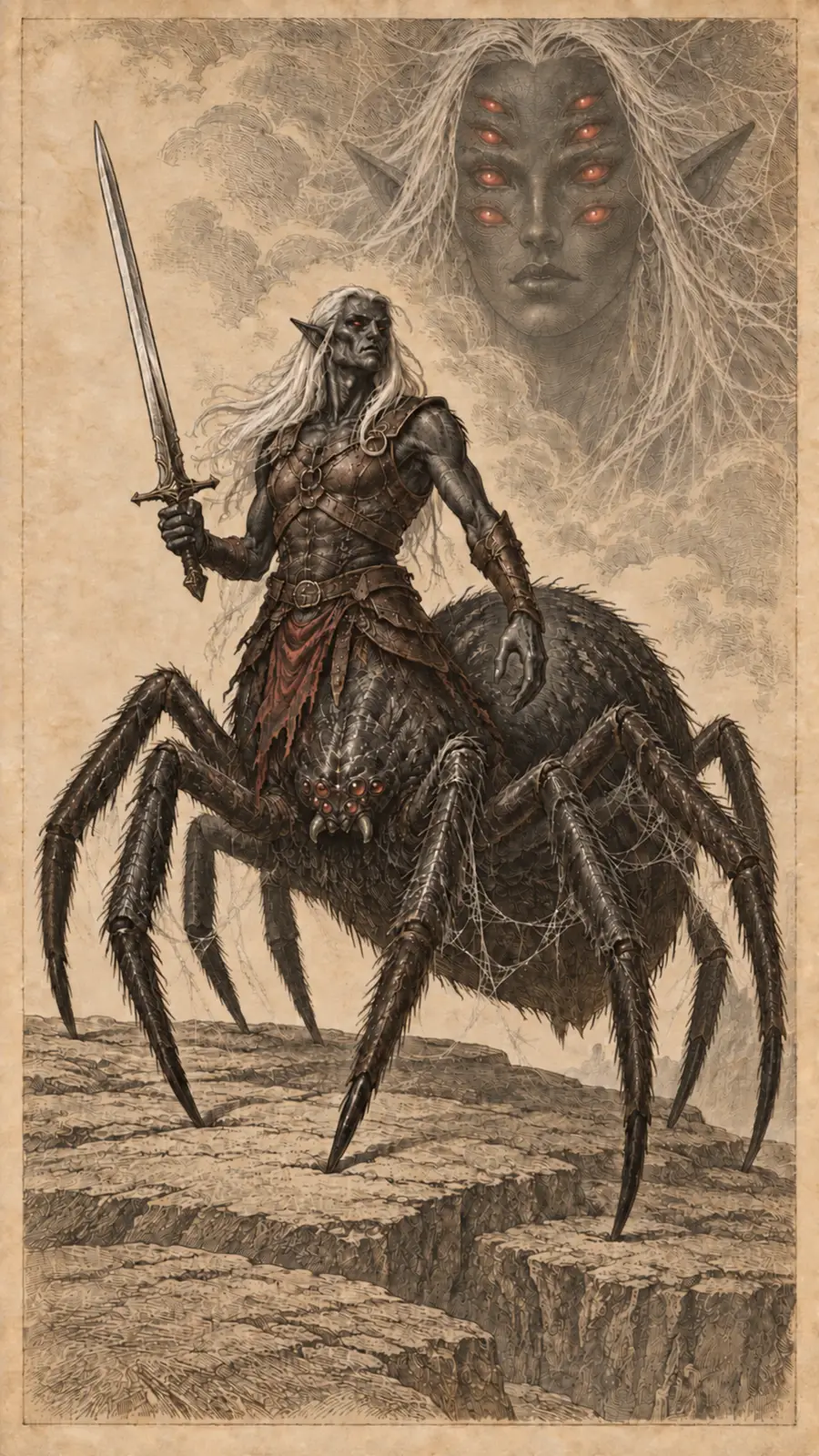
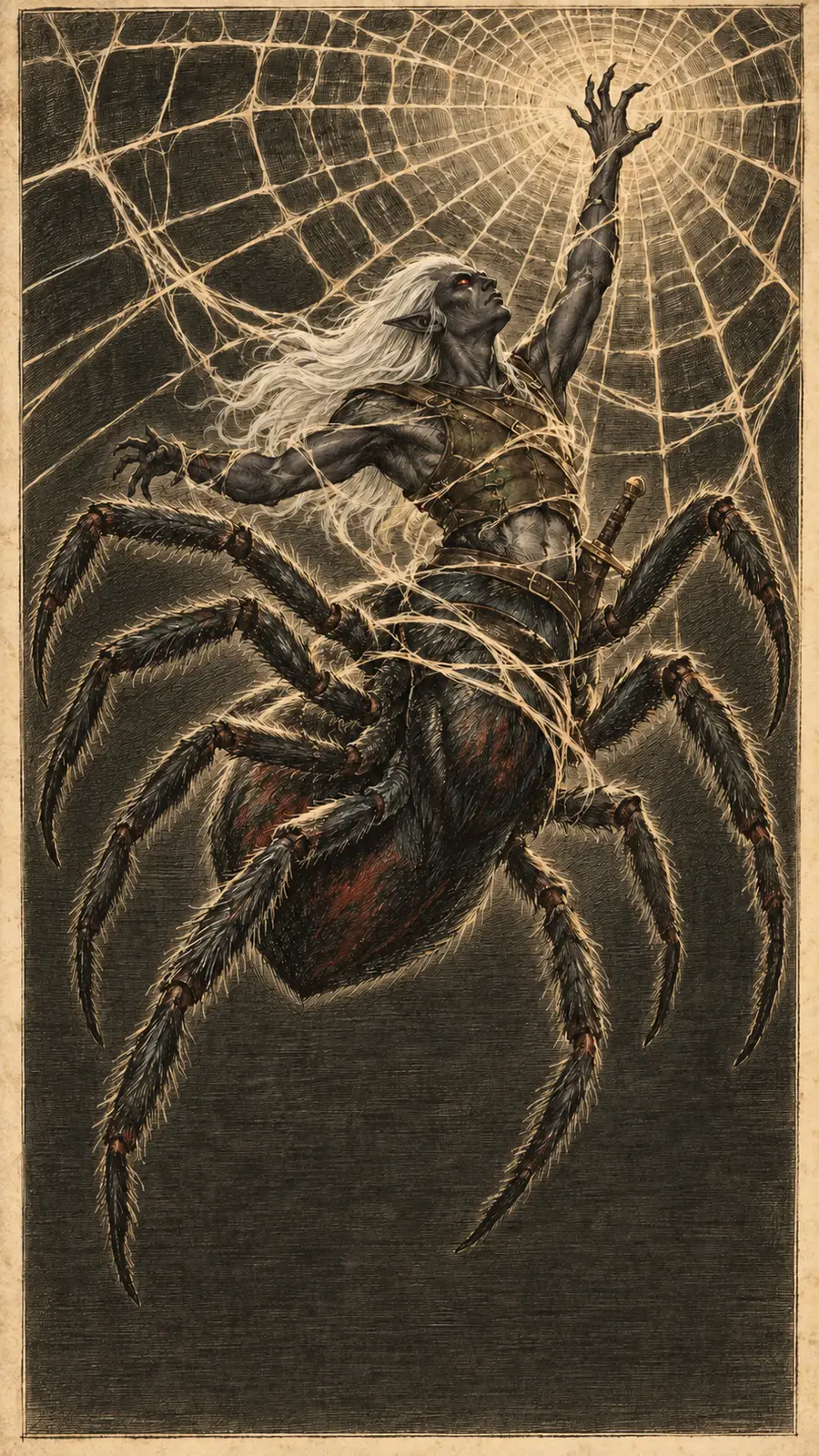
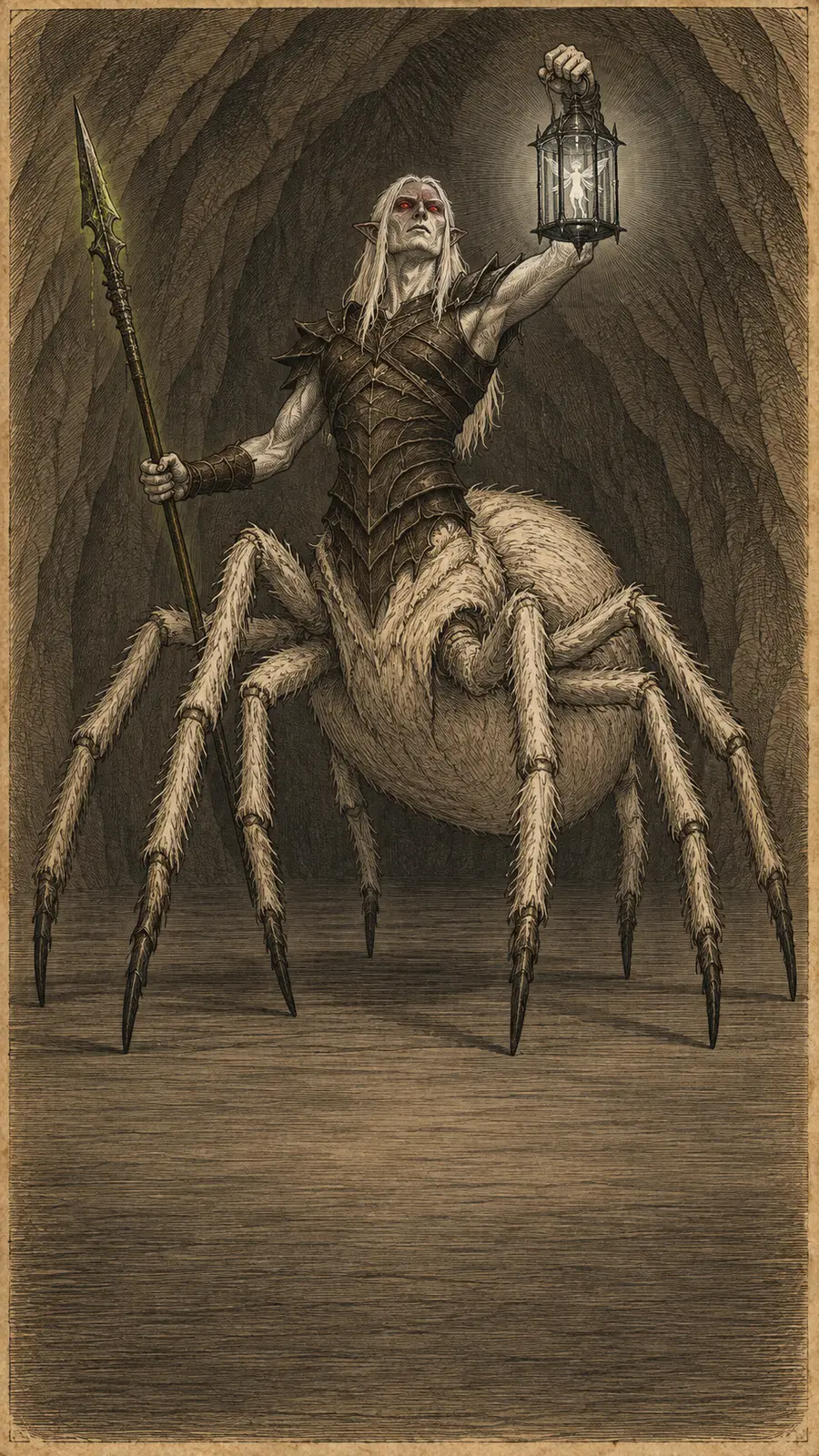
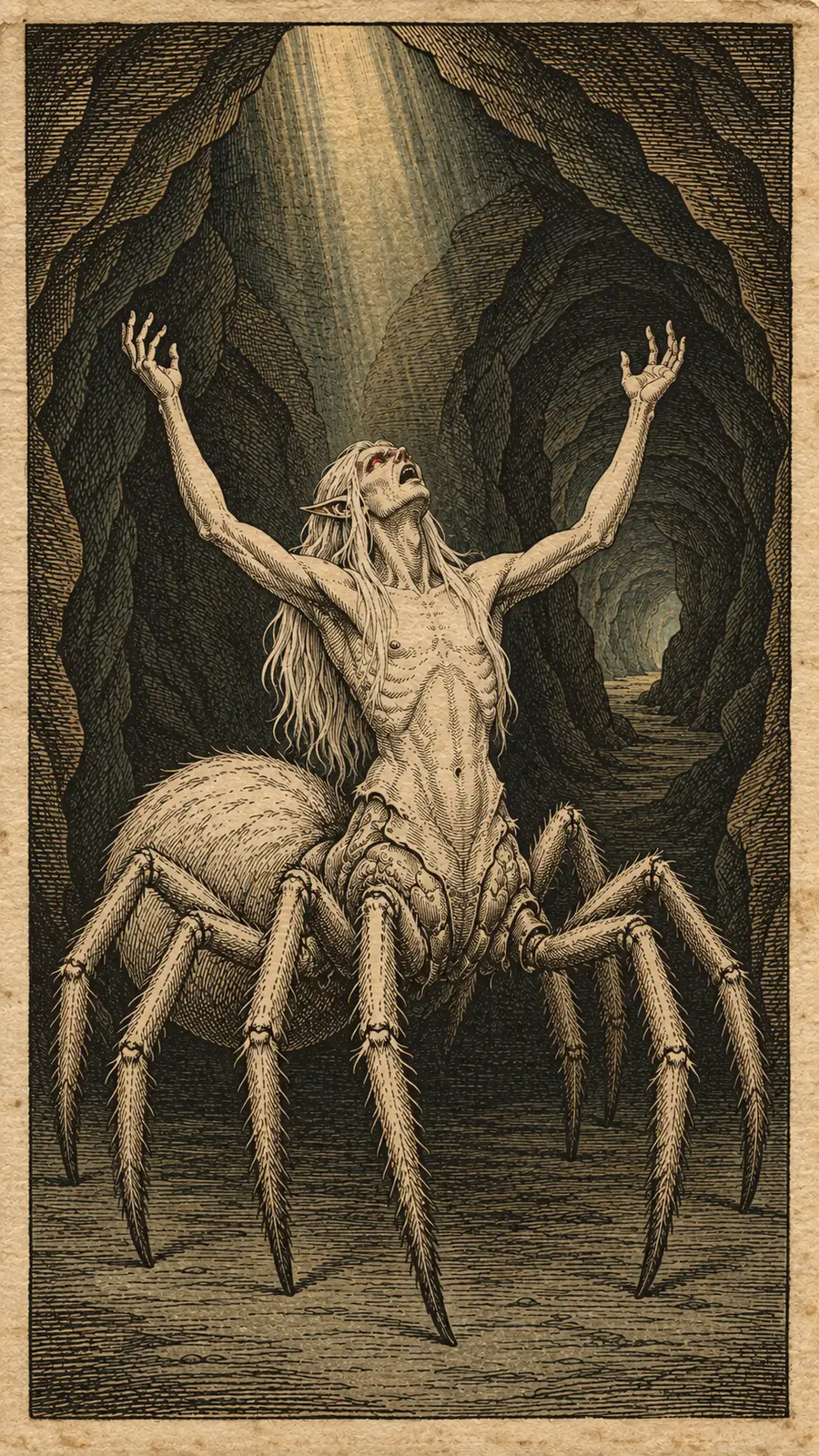
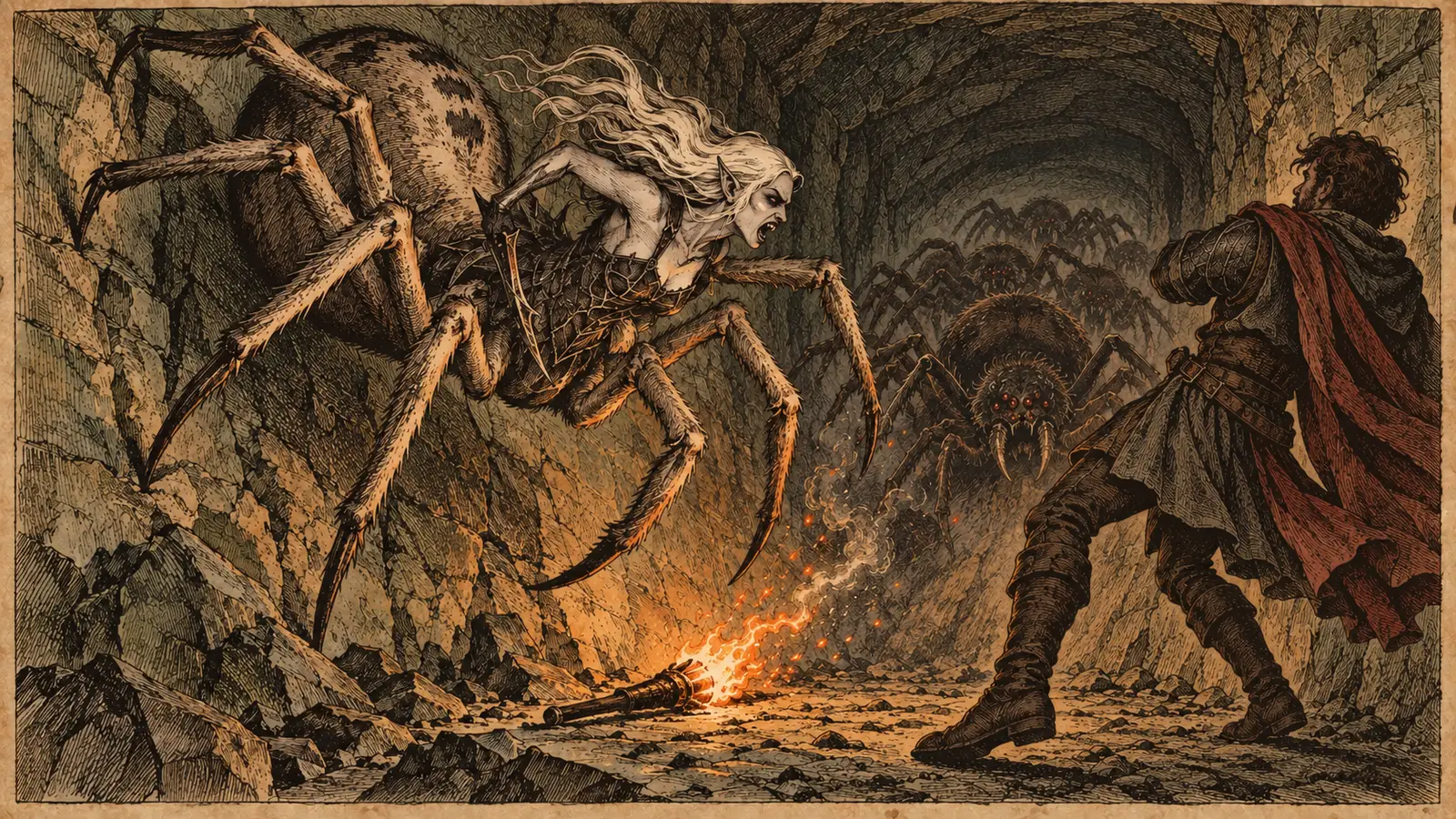
It was described quite simply. A drider had the upper body of a drow, and growing from it, the eight-legged lower body of a giant spider. The text called that upper half pale and bloated, a small, unsettling touch that suggests the change had not left the elf's body untouched above the waist either.
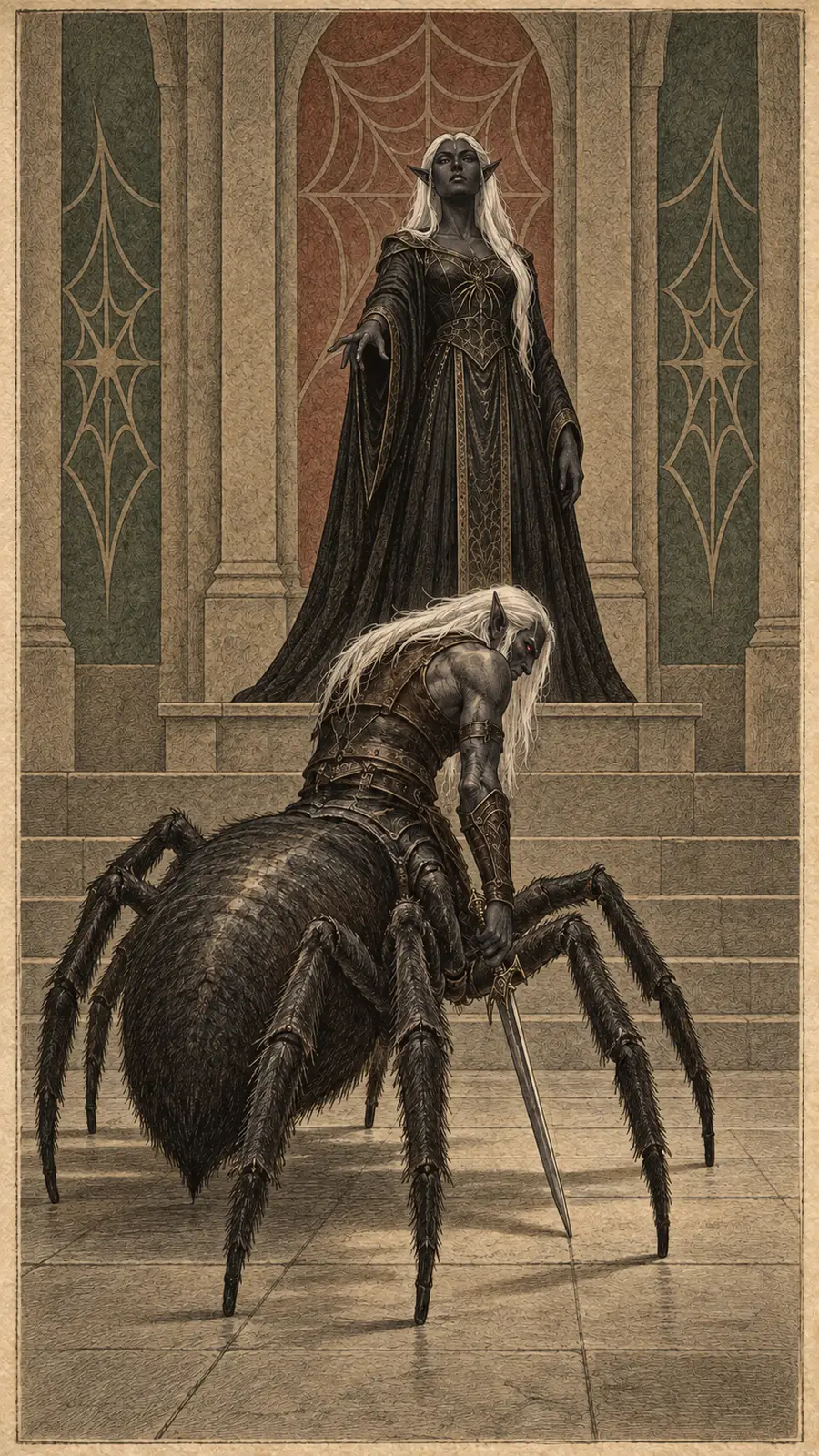
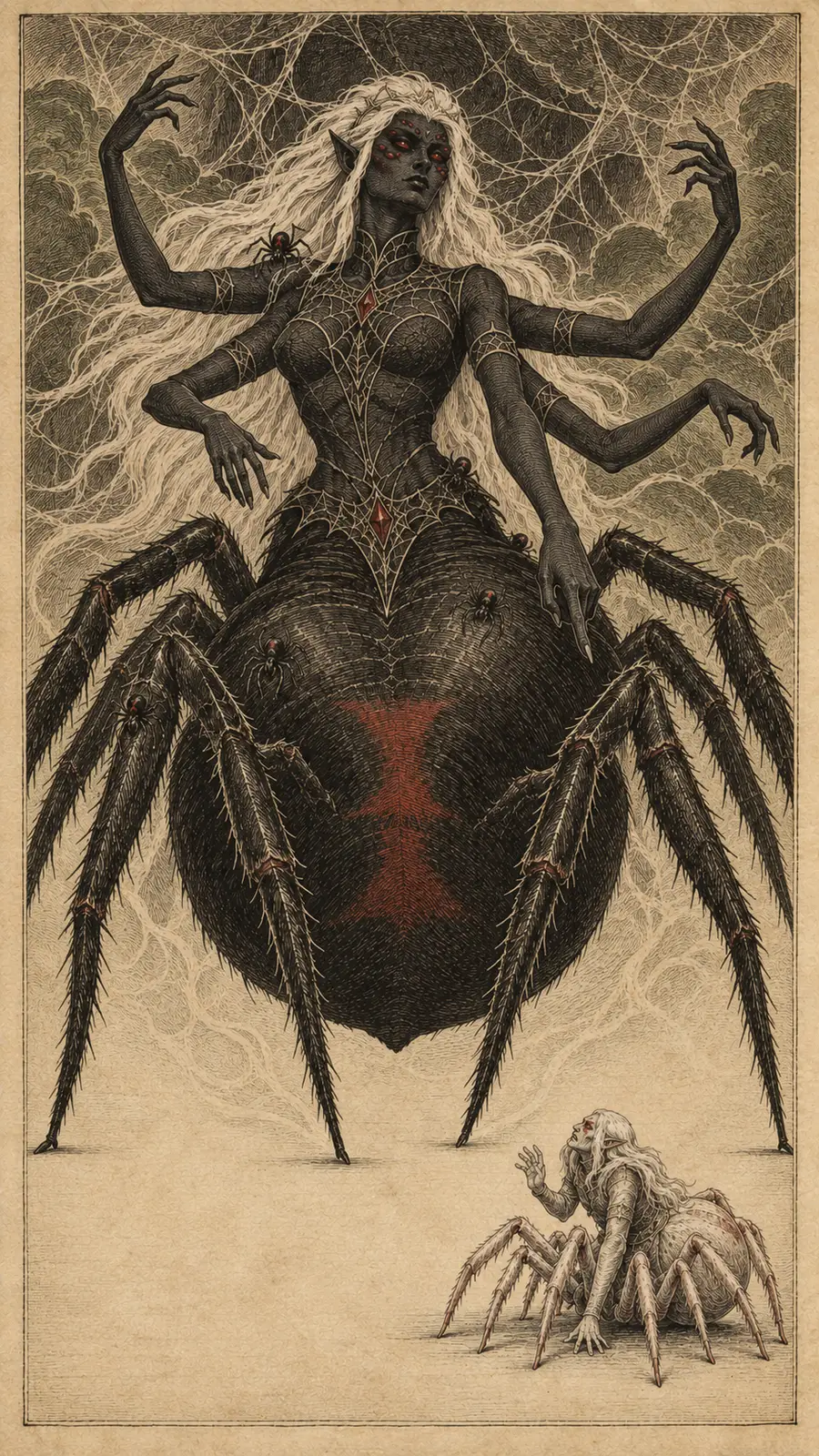
Most importantly, the adventure explained where driders came from, and the explanation has stayed at the heart of the creature ever since. Driders did not occur naturally. They were not born, and they did not breed. Lolth made them. When a drow showed promise, the goddess put that drow to a test of worthiness, and those who failed it were transformed. The drider, from its very first appearance, was a failed elf, remade by an unsatisfied goddess.
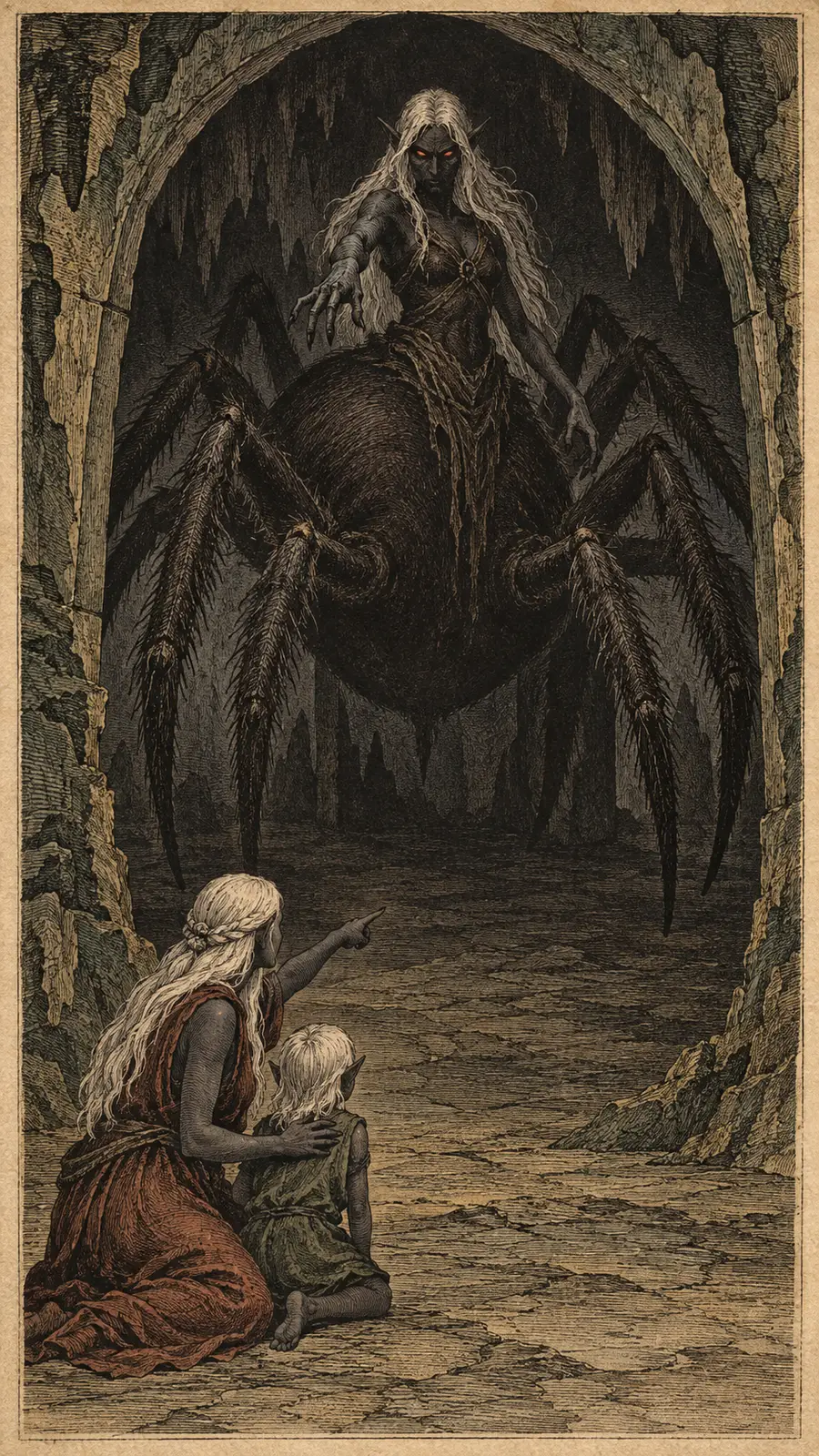
What happened after the change was just as stark. A drider was an outcast. The drow drove driders out of their society, if they did not kill them outright. Picture a drow who has spent a lifetime climbing the brutal ladder of a noble house, learning its poisons and its etiquette, studying magic or weapons, hoping for the goddess's favour. Then the test, and the failure, and the waking in a new body, and the doors of home closing behind.
Even among their own kind, driders found little company. They seldom lived with other driders. They preferred the company of huge spiders, and here the first-edition text offered one of the small, haunting details that make old monster entries so memorable. About one time in ten, a drider would be found with a small company of huge spiders around it, anywhere from two to a dozen. These spiders were described as Lolth's parting gift. Once a drider had claimed some stretch of the underworld as its own territory, the goddess sent it spiders. It's hard to know quite how to read that. Is it mercy, a final kindness to the creature she has ruined? Is it a reminder that even in exile it remains hers? Perhaps it's both. The goddess casts you out, and then she sends you company that looks like her.
In the rules of that first appearance, the drider was a capable foe, tough and well armoured, quick on its eight legs, and partly resistant to magic, as drow are. Its bite carried a poison that could leave a victim paralysed for a time, and driders used it to subdue their prey. That last detail matters to the picture. A drider did not simply fight. It hunted, and it brought its catch down still and helpless, the way a spider does with a fly that has stopped struggling.
If you'd met one in those early days, it would most likely have been somewhere in the deep tunnels or along the approaches to Lolth's realm, alone or with its handful of spiders, wary, embittered and dangerous. It would have known the drow tongue and the drow ways. It would have remembered, with whatever was left of its mind, the city it had lost. And it would have looked at you the way a hunter looks at something wandering into its lair.
That is the whole of the drider as it first appeared. It is a small entry, a few lines in an adventure filled with stranger and grander things, and yet nearly everything later writers did with driders grew from those lines. The test. The failure. The goddess's hand. The exile. The spiders as both companions and a mark of ownership. Over the next forty years and more, each age of the game would pick up these threads and weave them a little differently, but the first pattern was laid down here, in the web of the Demon Queen of Spiders.
From an adventure the drider moved to a rulebook, and there it became a little more particular, a little more of a person.
Chapter IV
Clerics and mages in spider form: the Monster Manual II
In 1983 TSR published the Monster Manual II, a large hardcover credited to Gary , with a cover painted by Jeff . It gathered many creatures that had first appeared in adventures and brought them into the core of the game, and the drider was among them. A couple of years earlier, the Fiend Folio had given the drow their own entry in a hardcover rulebook for the first time, but it had left the drider out. So the Monster Manual II was the drider's first home in a hardcover book, and from then on any Dungeon Master could place one anywhere in a campaign, not only on the road to the Demonweb.
The description carried over from Queen of the Demonweb Pits with very little change. The drider was still a drow from the waist up, joined to the body of a giant spider below. It was still made by from promising drow who had failed her test of worthiness. It was still an outcast, shunned and driven from drow society, if not killed outright. It still preferred spiders to company of any other kind.
The book added a few touches that sharpened the picture. It called driders very rare, and it placed them underground. And it gave them an alignment, chaotic evil, with a reason attached that I find quietly telling. Driders were chaotic evil, the book explained, because they were self-centred. Think about what the transformation would do to a person. Cast out of family and house, unwelcome even among others of their kind, a drider has nothing left to serve but itself. Its whole world shrinks to its territory, its spiders, its hunger and its grudge.
The most interesting addition concerned what a drider had been before. In the drow world, power is divided along lines of sex. The priesthood of Lolth belongs to women, and the high priestesses rule the great houses. Men may become wizards or warriors, but they live under the priestesses' authority. The Monster Manual II carried that division through the transformation. In its words, driders have magical or clerical ability, the type depending on whether they are male or female. A female drider had been a priestess, and she kept her clerical power, the spells of a cleric of some experience. A male drider had been a wizard, a magic-user in the language of the time, and kept his arcane spells.
This is a small rule with a large story in it. These driders were not ordinary drow who failed. They were the accomplished ones, the priestesses well along in Lolth's service, the wizards of real skill. That fits the old word "promising" in the first description. Lolth tested the drow who were rising, and those who fell carried everything they had learned down with them. A drider priestess might still pray, in her exile, to the goddess who had cursed her, and still receive spells. A drider wizard might still carry his spellbook's knowledge in his head, even if his hands now belonged to a body that could climb walls.
They kept the innate gifts of their race as well. Every drow in those days could call up a few small magics simply by being drow, and driders could too. They could summon dancing lights, little floating glows that drift through the dark. They could call darkness down over a place. They could sense magic, and they could outline a creature in faerie fire, a soft, cold glimmer that clings to the body and makes it impossible to hide. They could sense whether a creature's heart leaned toward good or evil, and they could levitate, rising slowly through the air. Picture a drider in its cavern lit by its own drifting dancing lights, or wrapping a passage in sudden darkness, or settling faerie fire over an intruder so that the soft glow marks out exactly where its arrows should go.
And, of course, the bite remained, with its paralysing venom. The Monster Manual II drider was a hunter that could pin its prey with a spell, a poison or a blade, and then take its time.
The first edition years left the drider with a strong, simple identity. It was the failed elite of drow society, a priestess or wizard who had not satisfied Lolth, cast out and living alone in the deep places with the spiders the goddess sent it. In , where it was born, it belonged to the wild margins around places like the Vault and the halls of the drow. But a new world was rising beside Greyhawk, one with its own vast underworld and its own cities of dark elves, and it was there that the drider would gain the most of its lore.
Chapter V
The dark goddess's test: second edition and the Forgotten Realms
The second edition of Advanced Dungeons and Dragons arrived in 1989, and with it came a new way of presenting monsters: the Monstrous Compendium, a set of loose-leaf binders that could be filled and rearranged. In the second volume of that series, the drider appeared, though in a modest way. It had no entry of its own and no picture. Instead, a few paragraphs about driders were tucked onto the end of the entry on the drow, as if the creature were a footnote to its people, a thing that sometimes happens to them.
Those paragraphs spoke with a certain reserve about the goddess. The drow's dark deity, they said, is called by some. Her priestesses held very high places in drow society. And this dark goddess made driders from promising drow who failed a test of their worthiness. Because they had failed, driders were outcasts from their own communities.
The second edition drider differed from the first in some interesting ways. The upper body, the text said, was almost always male. Before the change, most driders had been priests, around six in ten of them, and the rest had been mages. They kept whatever magical or clerical skill they had held before, and once a day each drider could still call upon the small magics that every drow possessed, the dancing lights and darkness, the detection of magic and the faerie fire, the sense for good and evil and the power to levitate.
The text also gave driders a stronger appetite. They were violent and aggressive, and of all foods they favoured blood. They stalked their victims tirelessly, waiting for the right moment to strike. Usually they were found alone, not with drow and not with other driders, and as in the old days there was a small chance of a company of huge spiders at the drider's side.
In 1993 TSR gathered its loose-leaf monsters into a single hardcover, the Monstrous Manual, and the drider came along, still tucked into the drow entry, with much the same words. For most players of that decade, this was where they'd find it: a few lines at the bottom of the page about the dark elves, a short, chilling paragraph about what happens to those who fail.
But the real growth of the drider in these years took place elsewhere, in the Forgotten Realms, the setting created by Ed that TSR had made its flagship. Beneath the Realms lay an underworld of enormous size, the Underdark, and in it lay cities of drow. In 1991 Greenwood wrote a sourcebook called The Drow of the Underdark, a long book that described these dark elves from top to bottom: their society and history, their crafts and runes and names, their spells and magic items, and above all their religion. It was the first book to set out Lolth's place in the Realms, and it described the gods around her as well: , the dancing goddess of the good drow who live in moonlight; , the masked lord of drow men who chafe under the priestesses; and , the ancient and hungry power that had called the Elder Elemental God.
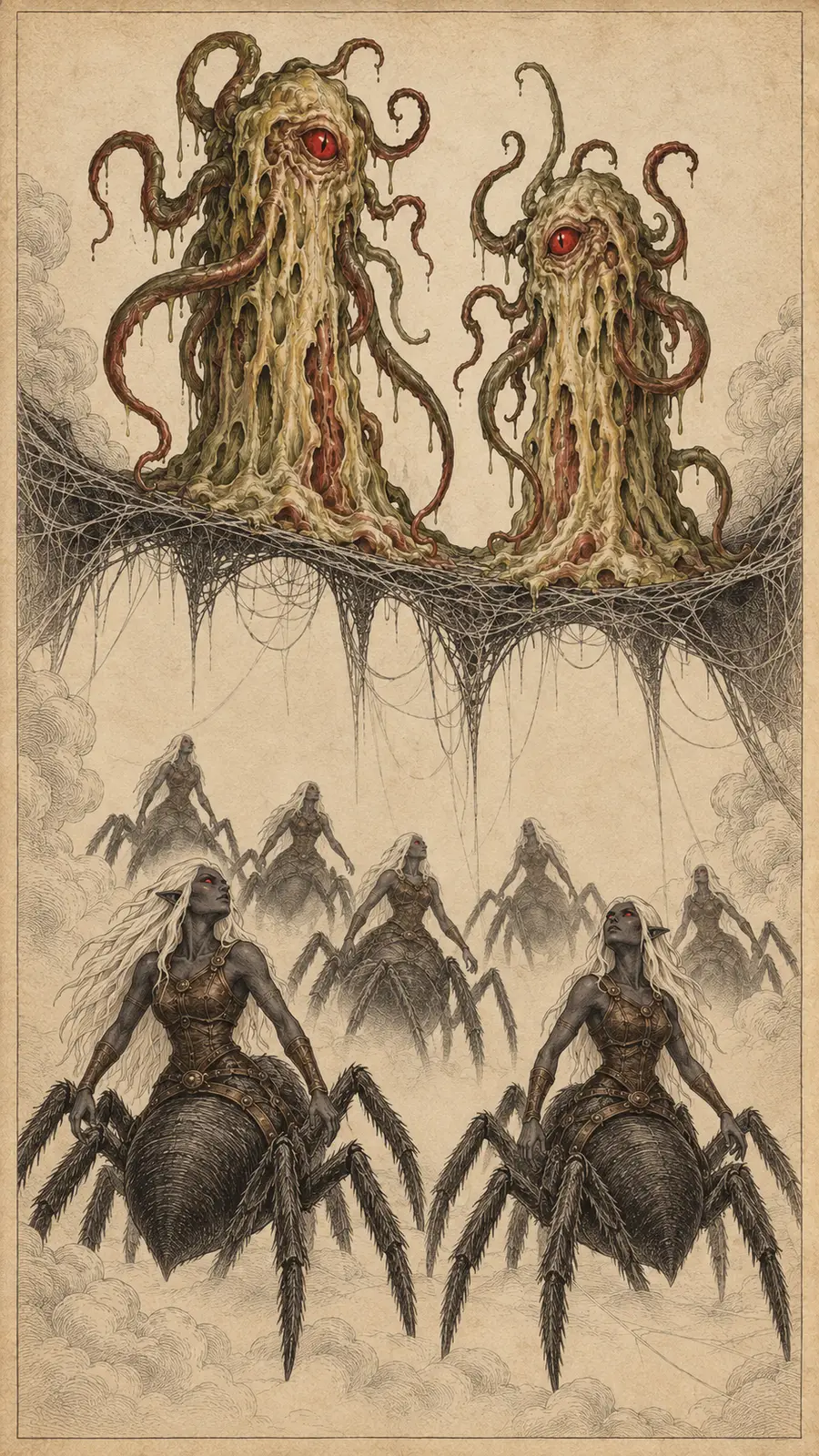
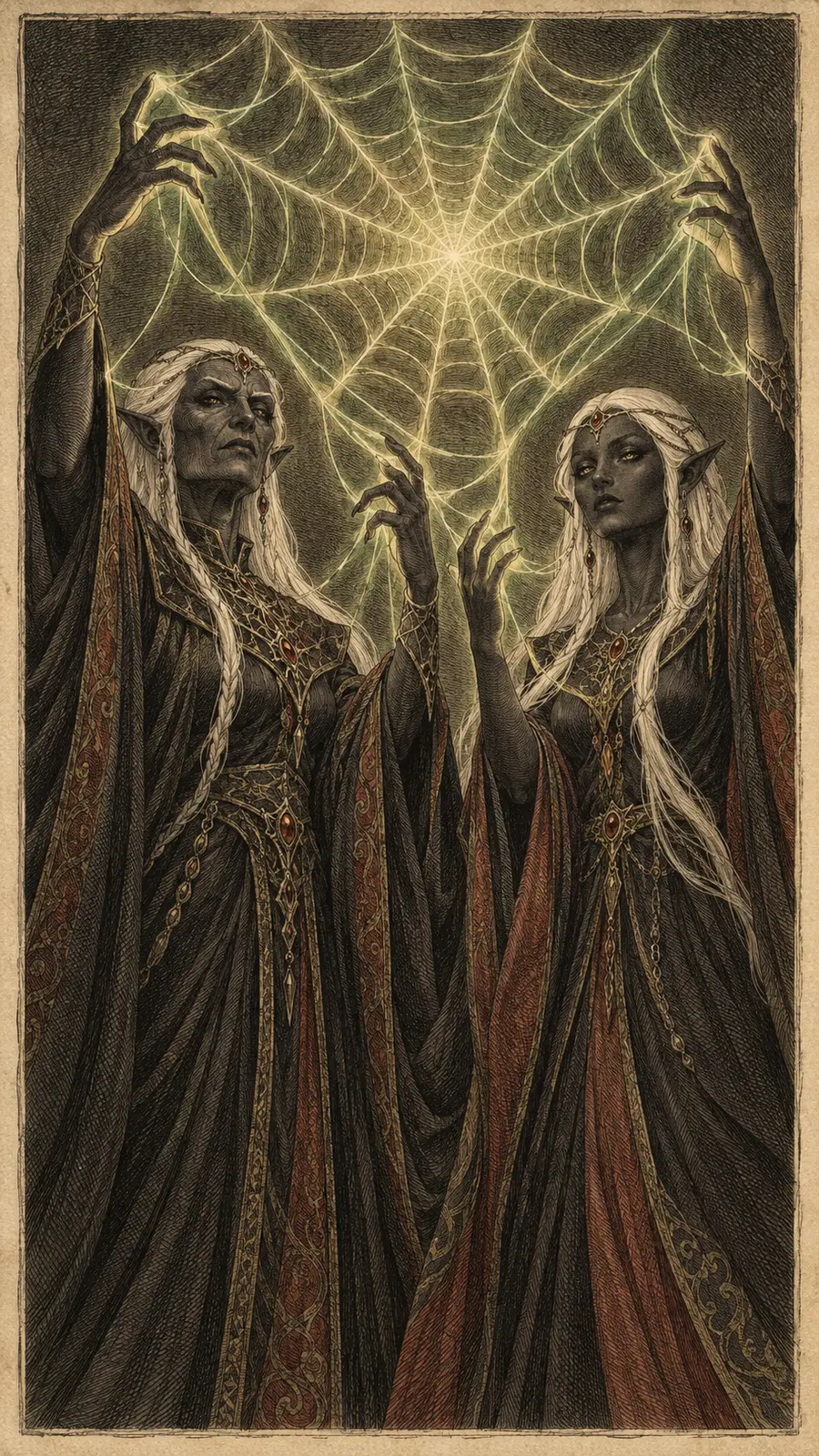
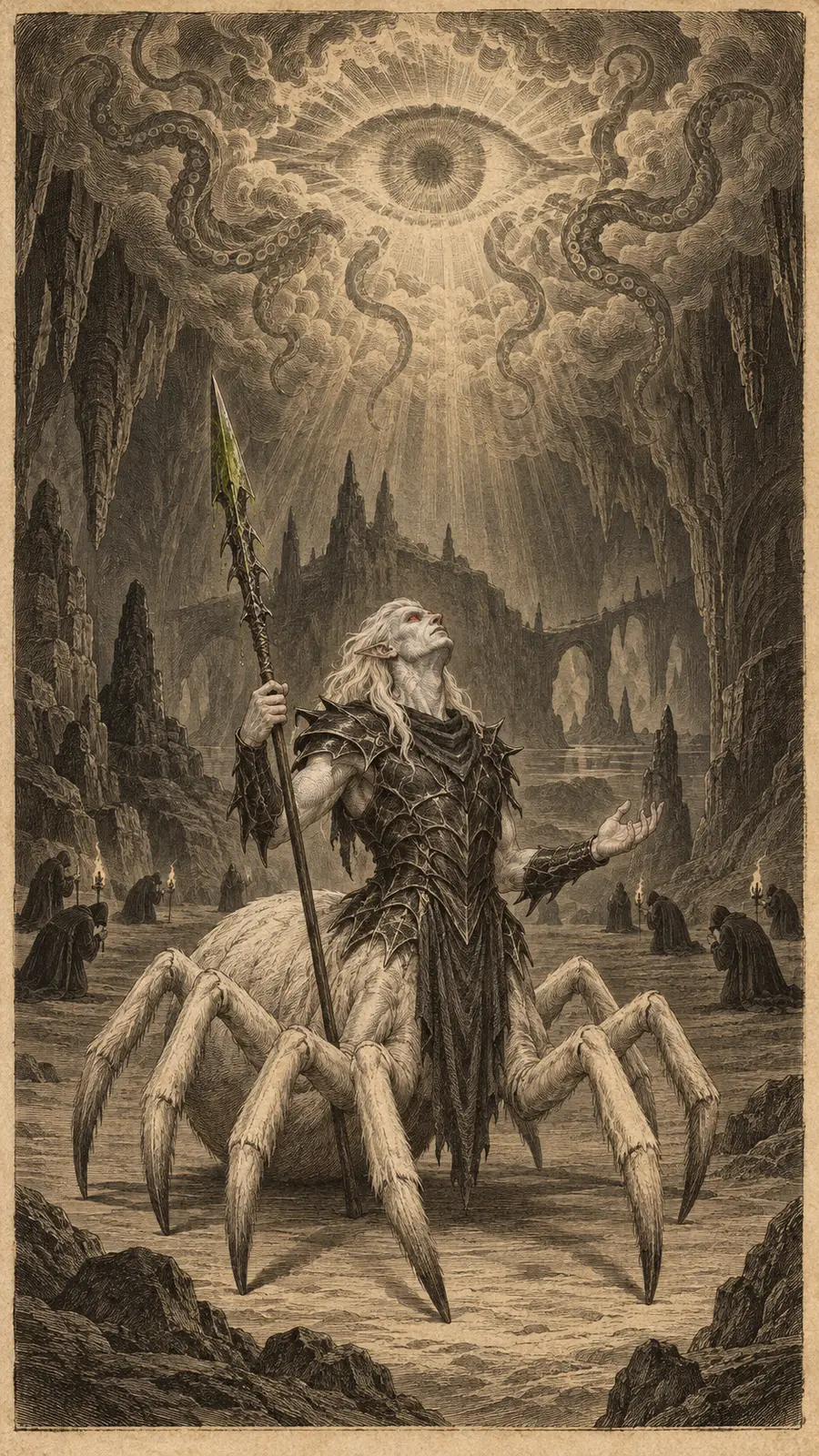
In that book the drider stepped into the centre of drow religion. Greenwood framed the transformation as a brutal punishment for drow who displeased Lolth. It was no longer quite as distant as a test administered somewhere in the . It was performed by her priestesses, there in the temples of the drow cities. And it was overseen by the yochlols, Lolth's handmaidens. The yochlols are demons of the Spider Queen's household. In their own form they are shapeless, sticky columns of matter with a single eye and long tentacles, though they often walk among the drow disguised as beautiful dark elves or as great spiders. To have them present at a transformation tells you how seriously the ceremony was taken. A drider was made under the eyes of the goddess's own servants.
The book offered something else too: the first simple ideas for playing a drider as a character. That's worth noticing. As early as 1991, people were wondering what it would be like to be the creature instead of fighting it.
And there was a thread of doubt in that book that later writers would pick up and pull. Younger drow, it said, sometimes wondered whether Lolth might be making powerful driders on purpose, as a kind of favour to their communities. In this view the drider would be a punishment to the individual drow, certainly, but also a gift to the city, a strong, frightening creature placed in its service. It is a small, uncertain idea, spoken by the young and restless, but it opens a door. If a drider can be a gift, then perhaps it is not only a curse. We'll see, much later, an entire edition walk through that door.
Over the years, the lore of the Realms gathered more around the drider, piece by piece, in the way that a long-running setting does. The tradition that grew up there is worth telling as one story.
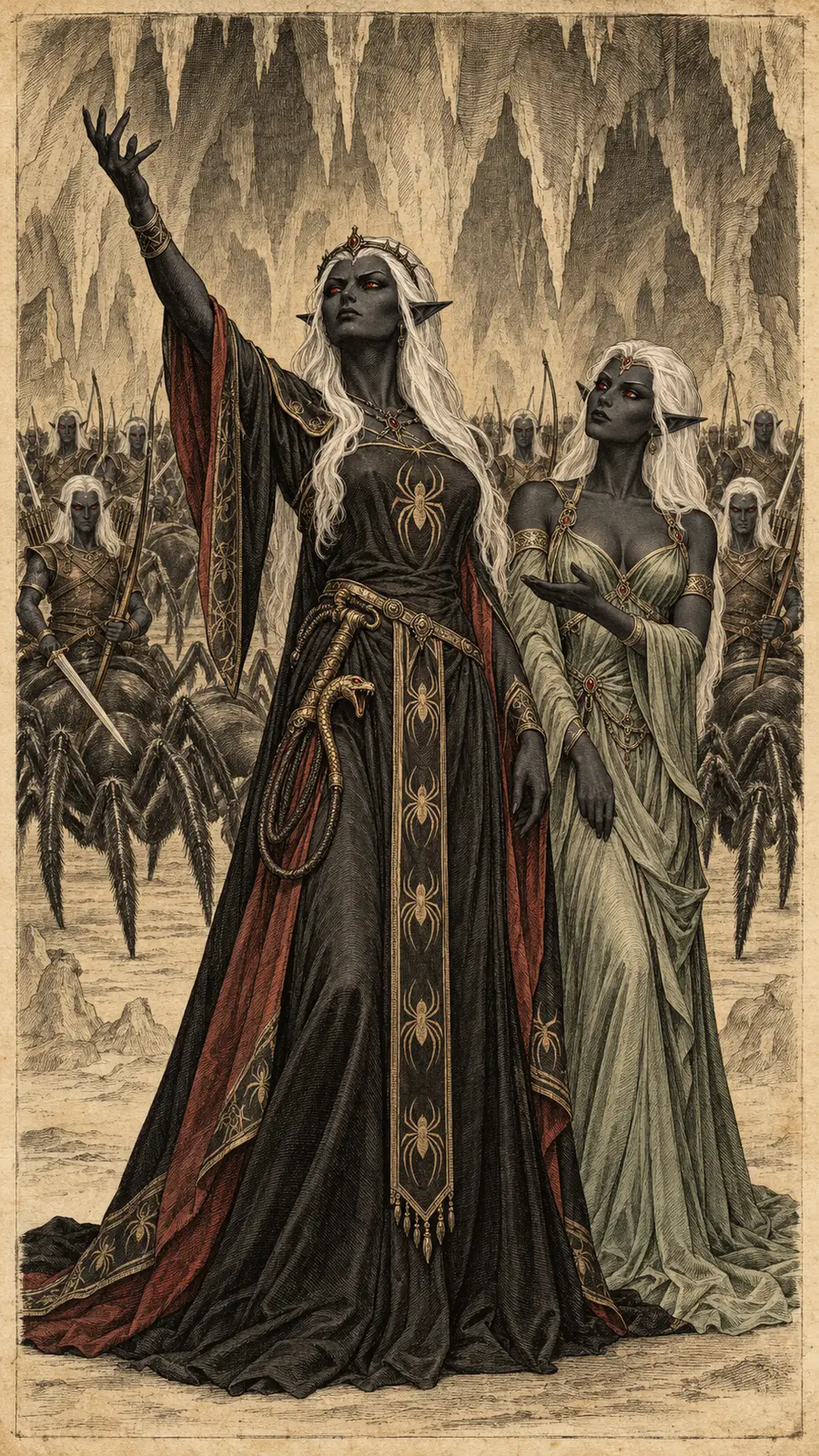
Only a high priestess, high in rank and in good standing with Lolth, could begin the transformation. A lesser priestess could not make a drider, and neither could a priestess who had fallen from favour. The change itself was slow and terribly painful, lasting at least half a day, twelve hours or more of the body being unmade and remade. When it was done, the drider had lost everything it had been. Its status in its house was gone, and its family ties and possessions with it. In the eyes of the city it had become a different kind of thing entirely.
And yet the drow did not simply forget their driders. In the Realms, driders became the bogeyman of drow society. Children were warned of them. Adults saw them and remembered what the goddess could do. A drider was the final warning to obey Lolth, carried about on eight legs. Drow and driders despised one another, but they often lived surprisingly close together, the driders lurking in the tunnels and outer caverns near a drow city. The drow even put them to use, letting driders weed out the weak, the careless and the unlucky who strayed too far from safety. Over time driders came to form their own caste, apart from drow society, but they still served Lolth's priestesses, sometimes willingly and sometimes with great reluctance.
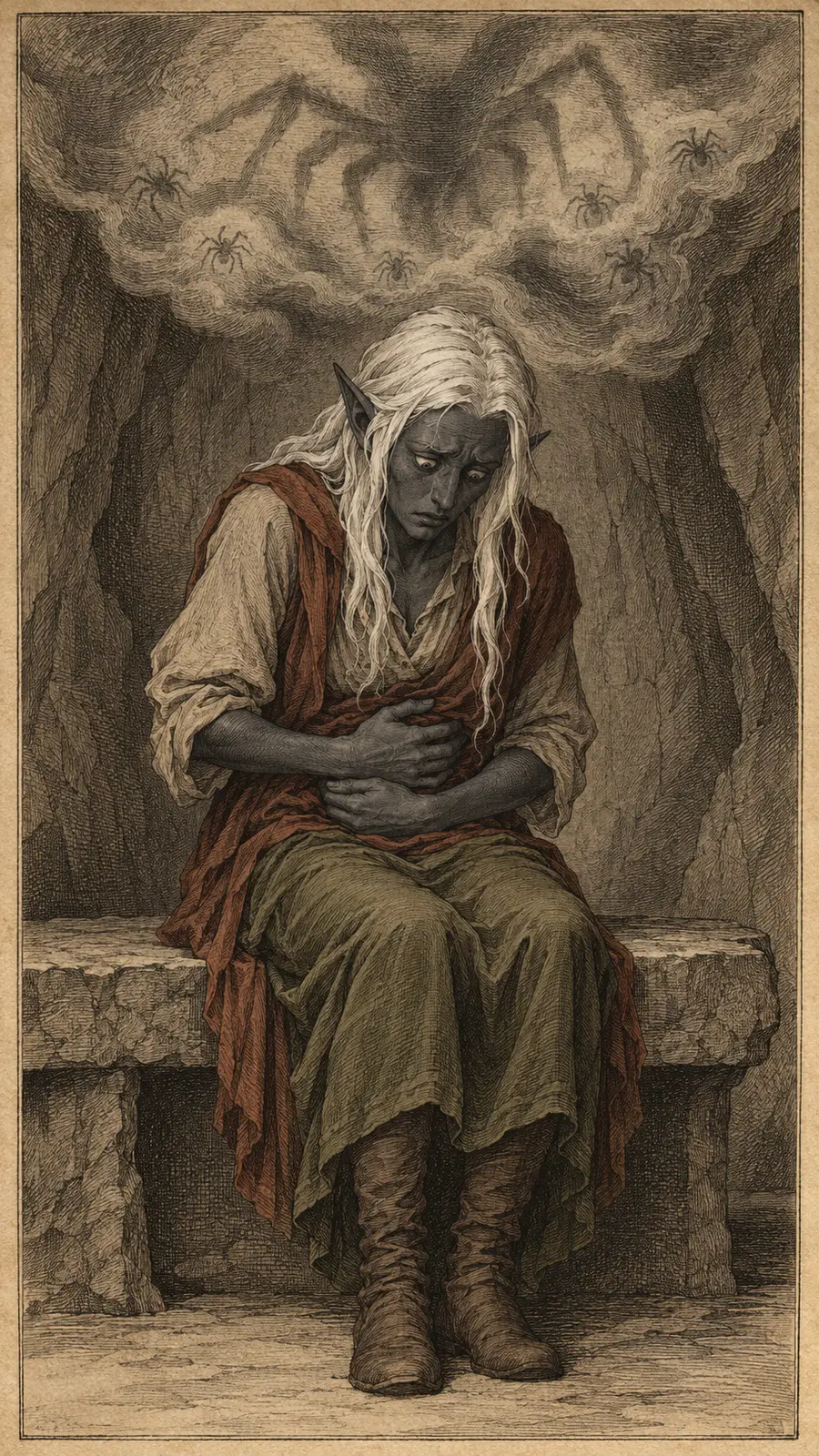
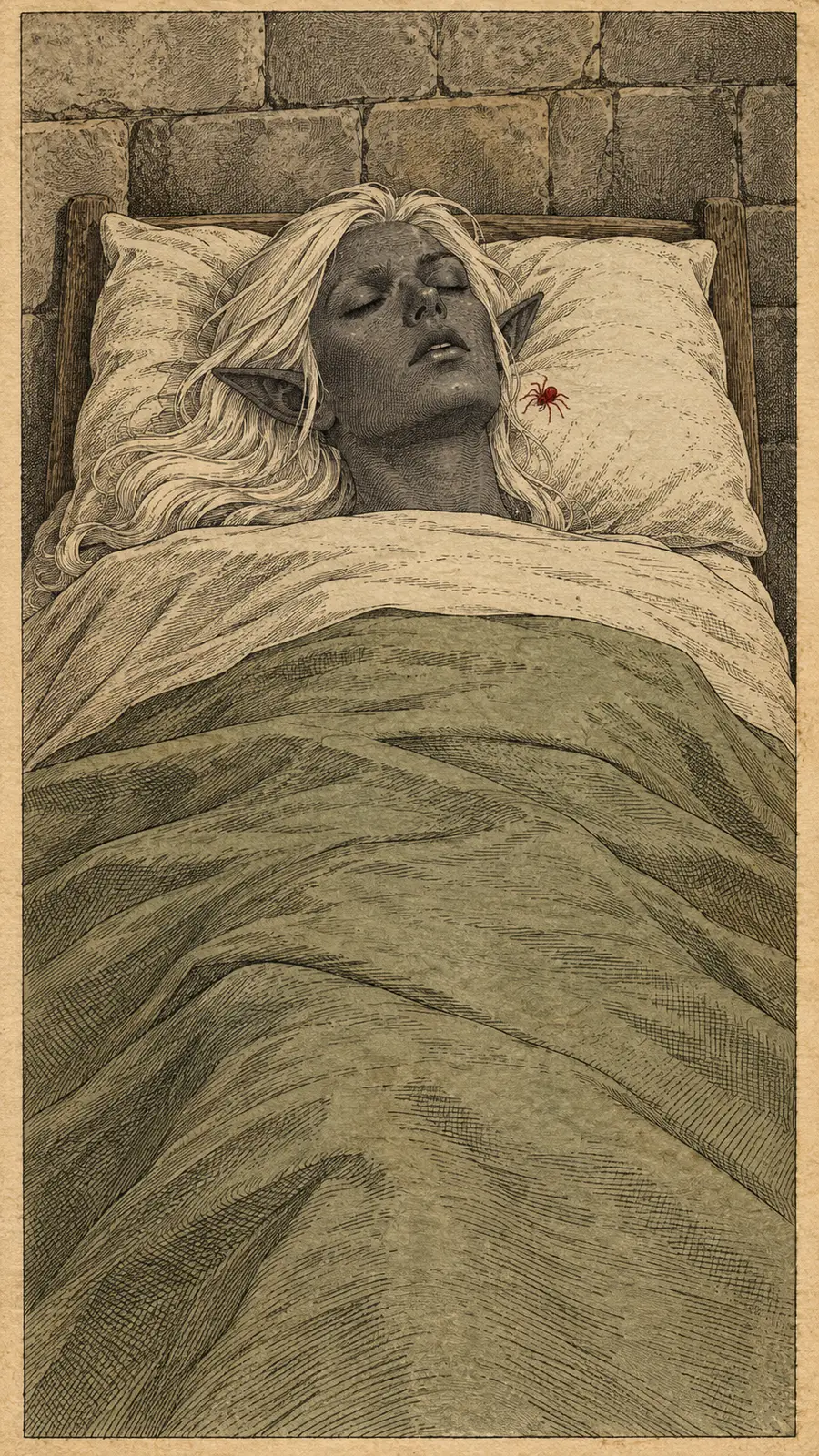
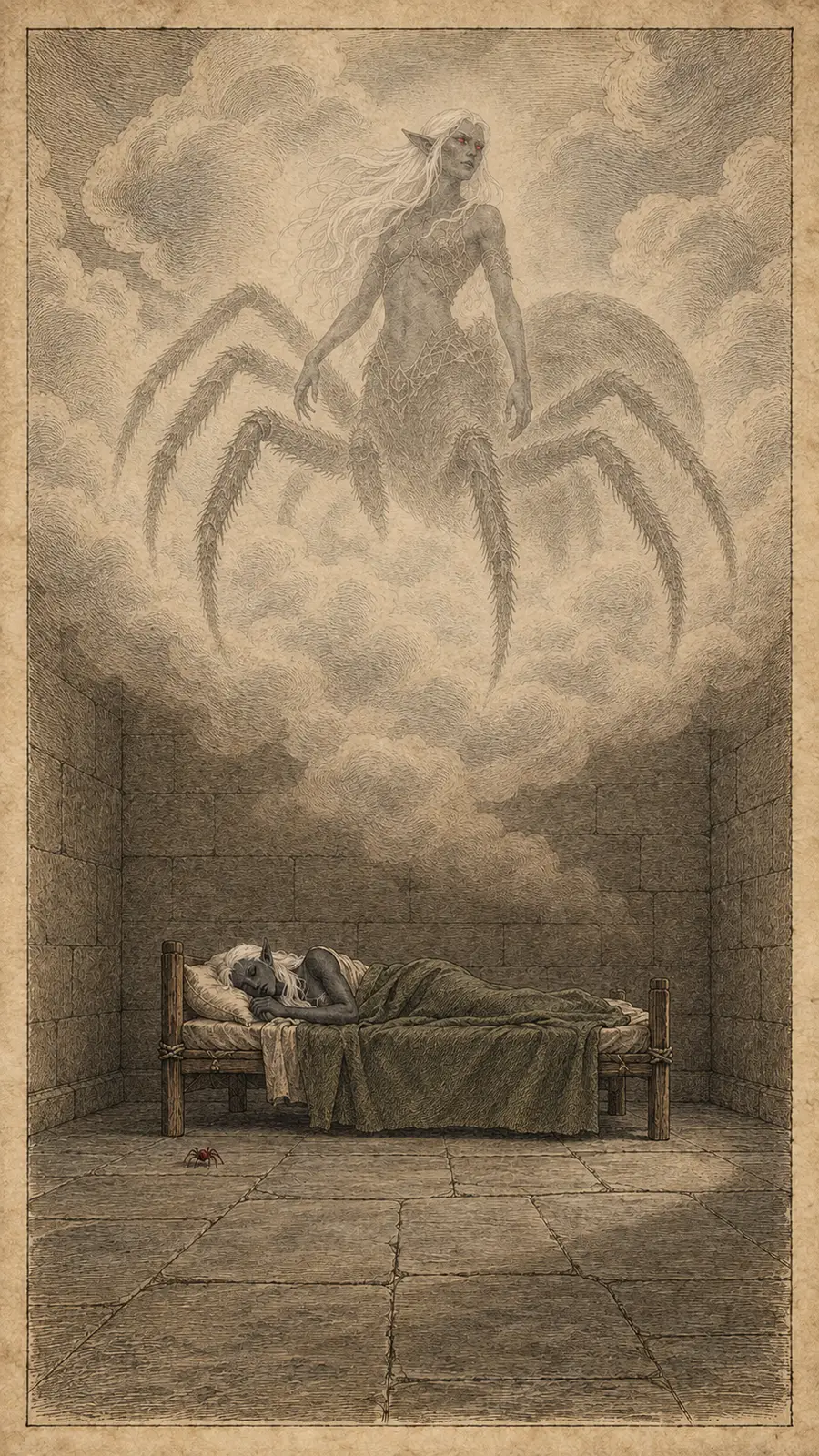
There is one more Realms legend, told about the testing itself, that I want to share, softly, because it is one of the most eerie pieces of drider lore there is. It speaks of a trial called the Test of the Drider, the Chwidridera. It begins, the tale says, with a feeling: the drow under test develops a sudden, irrational dread of being eaten from the inside by spiders. The fear grows and will not go away. Then, the next time that drow lies down to rest, a single tiny red spider appears, and it crawls into the sleeper's mouth. And with that, the change begins. You needn't picture it too closely. Just the little red spider, the quiet room, and the fear that came first, as though the body knew before the mind did.
A year after Greenwood's book, in 1992, Carl Sargent wrote Monster Mythology, a guide to the gods of the non-human peoples, and it gave Lolth and her priesthood a full portrait. It added a few details to the ritual side of drider lore. Lolth herself, in one of her avatars, would sometimes appear at the ceremonies where driders were made, so that the goddess could witness her judgement carried out. Her priestesses also practised a dark form of divination, a kind of arachnidomancy, in which omens were read in the inner workings of driders. We'll let that detail rest in the shadows, where it belongs. It says enough that the priestesses saw the driders as instruments of the goddess, even after their failure.
Also in 1992 came the Menzoberranzan boxed set, written by Ed Greenwood, R.A. and Douglas Niles. It set out the City of Spiders, the greatest drow city of the Realms, in three books, with its eighteen rival houses mapped out on a poster of alliances and feuds. Here, the city's priestesses demanded complete respect from everyone beneath them, and the box made clear what awaited those who failed their training in the city's academies. They died, or they were turned into driders, or something worse. That's all it said, and all it needed to say. In , becoming a drider was one of the ordinary ways a promising life could end.
The drider spread to other corners of the multiverse during these years. In 1994 the Planescape setting's Planes of Chaos described the Abyss in detail, and it placed driders among the legions serving , the drow goddess of vengeance and undeath, in her Abyssal city of Naratyr. Kiaransalee was one of Lolth's rivals, a cold and bitter goddess who preferred the dead to the living, and the presence of driders in her service suggests that not every outcast stayed loyal to the goddess who made it. A couple of years later, in On Hallowed Ground, one of Kiaransalee's proxies, her chosen agents in the planes, was a female drider called Anista of Eight Eyes. It is a good name, and it carries a whole story in it: a drider that left one dark goddess for another and was given a place of honour by the second.
In the pages of Dungeon magazine, too, a Realms adventure sent a party travelling with a fallen paladin to a spider-filled lair, where a drider named Karinza waited among her webs.
And during these same years, driders began to crawl onto computer screens. They turned up in the early Forgotten Realms computer games of the 1990s, in titles such as Eye of the Beholder and Treasures of the Savage Frontier, and in the old online Neverwinter Nights that ran on AOL from 1991. They appeared as well in Menzoberranzan, a 1994 game in which drow hunting the renegade raid the player's village, and the party follows them into the Underdark to bring the captives home. That name, Drizzt Do'Urden, brings us to the next part of our story, because by then the drow of the Realms had found their most famous storyteller.
Chapter VI
A brother in the shadows: Dinin Do'Urden and the novels
In 1988, R.A. published his first novel, The Crystal Shard, set in the frozen north of the Realms. Among its heroes was a dark elf named , a drow who had left the Underdark and its cruel goddess behind and now lived on the surface, a ranger with two scimitars and a great black panther companion. Readers took him to their hearts. Two years later, in 1990, Salvatore went back to tell where Drizzt had come from, in a novel called Homeland, the first book of what became the Dark Elf Trilogy. Its setting was , the City of Spiders.
We need Homeland for one reason tonight, which is that it introduces Drizzt's family, and one member of that family will become the best-known drider in all of fiction. His name was Do'Urden. He was Drizzt's elder brother.
The story begins on a night of war. House Do'Urden, an ambitious noble house, attacks House DeVir, one of its rivals, intending to wipe it out entirely, as the drow sometimes do. And in the confusion of that night, Dinin murders his own eldest brother, Nalfein, so that he himself can rise to the position of elder boy in the house. That murder has a strange consequence. Drow custom, in House Do'Urden, called for the third son to be sacrificed to . But with Nalfein dead, the newborn child born that night is no longer the third son, and so he lives. That child is Drizzt. So, in a way, Dinin's ruthless ambition saved his brother's life, before Drizzt had drawn his first breath.
As Drizzt grew, Dinin stayed near. He became a master at Melee-Magthere, the academy where the city's fighters are trained, and he watched over Drizzt on the patrols that young drow warriors make through the tunnels around the city. And when Drizzt graduated, it was his sister, the priestess , who was among those he refused, turning down a ritual his people expected of him. Even then, the young Drizzt had begun to step away from everything his family stood for.
Homeland has no driders. It's only the beginning. The drider tale comes later.
Some years after Drizzt fled the Underdark, House Do'Urden was destroyed. House Baenre, the first house of Menzoberranzan, brought it down in the year the Realms count as 1339. Nearly everyone was killed. But Dinin survived, because the mercenary spared him, on condition that he join Jarlaxle's band, Bregan D'aerthe. Jarlaxle is one of the great characters of these novels, a flamboyant, clever drow in a wide-brimmed hat who leads a company of houseless soldiers and spies. Dinin served him, and became one of his trusted lieutenants.
In 1992, Salvatore published The Legacy, the first book of a new series called Legacy of the Drow. And in that book Dinin's life took its darkest turn.
His sister Vierna had also survived the fall of their house, and now she came back to Menzoberranzan, under the protection of Matron Baenre, the mighty ruler of the first house. Vierna was full of a new and fierce zeal for Lolth, and she had one aim: to hunt down Drizzt, the brother who had betrayed their family and their goddess. She hired Jarlaxle and his mercenaries. She allied herself with Artemis , the human assassin who had long been Drizzt's deadliest enemy. Together they set their sights on Mithral Hall, the dwarven stronghold of Battlehammer, where Drizzt had found a home among friends. At that moment Mithral Hall was preparing for a wedding. , the great barbarian, was soon to marry , Bruenor's adopted human daughter.
Dinin did not share Vierna's passion. He doubted her plan. He had little faith in her, and little faith in Lolth. And in a drow city, doubt spoken aloud is dangerous.
Vierna answered his doubts by turning him into a drider.
The novel uses the standard Realms explanation of what a drider is: a creature that does not occur naturally, made by Lolth from promising drow who fail a test of their worthiness. In Dinin's case, the test was simple, and so was the failure. He doubted. And the transformation served two purposes at once. It punished him, and it showed off the power that Lolth had granted his sister. Here was a priestess in such favour with her goddess that she could unmake her own brother.
Dinin, as a drider, was something less than himself. He became a mindless slave, following his sister's orders. The ambitious young warrior who had murdered his way upward, the capable mercenary of Jarlaxle's company, had been reduced to a pair of hands and eight legs bent to someone else's purpose. It's a quietly horrible fate, and Salvatore does not dwell on it more than he needs to.
A small company of drow attacked Mithral Hall, and long battles followed in the tunnels beneath it. Wulfgar fell in those battles, giving his life to save his friends. And Dinin, in his drider body, met his end at the hands of Bruenor Battlehammer, the dwarf king, who cut him down in the fighting.
So for a long time that was the end of Dinin's story, and it was the end readers knew. The drider was where a drow's life went to finish. You could fall from your house, survive its destruction, find a new place among mercenaries, and still be undone, reduced and spent and killed far from home. In the novels of the 1990s, a drider was a terrible fate, and Dinin was its most famous example.
The Legacy series went on. In Siege of Darkness, Matron Baenre gathered the houses of Menzoberranzan and marched them against Mithral Hall during the Time of Troubles, when the gods themselves walked the Realms in mortal form, and the dwarves and their allies drove the drow back at a heavy cost. But Dinin was gone by then. Readers who had followed him would remember the brother who doubted, and what doubt had cost him.
Fans remembered him, too. Many years later they were still drawing him in his drider form, as the doomed brother of the Do'Urden house. And Salvatore himself had not entirely finished with him, though it would take nearly three decades before Dinin walked again. We'll come back to him, in his proper time.
For now, let's return to the game itself, which at the turn of the millennium was entering a new edition, and which would give the drider its own origin myth.
Chapter VII
Aberrations and silences: the third edition years
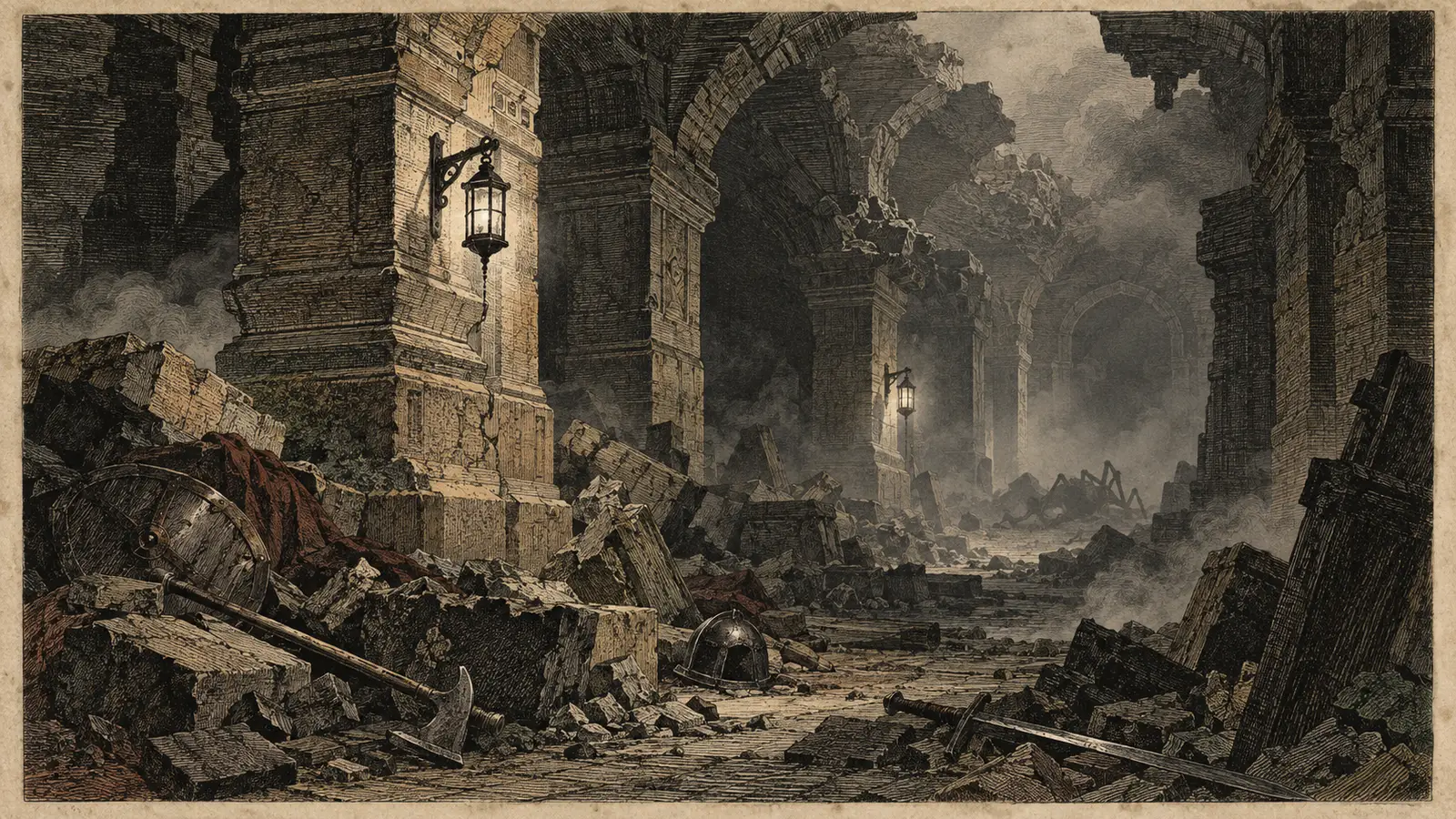
The third edition of Dungeons and Dragons arrived in 2000, published now by Wizards of the Coast, and its Monster Manual gave the drider a fresh place in the bestiary. A revised version followed in 2003, and the drider carried over into it. The creature was classed now as an aberration, the category for things that are unnatural, warped out of the proper order of the world. That is a fitting word for a drider. It is a being that is not supposed to exist, a body twisted out of one shape and into another.
In size, a drider was Large, a creature taller and heavier than any person, but its upper torso was still the size of a drow's. So it fought with weapons made for an ordinary person, a sword or bow sized for an elf, held in the hands of something enormous. And its magic had changed too. A third-edition drider cast spells as a cleric, a sorcerer or a wizard of modest experience, but it gained none of the other abilities that a member of that class would enjoy. It kept the magic and lost the rest. That's a neat way of telling a story through rules. The drider remembered its spells, but the life around those spells, the training and status and the rest of who it had been, was gone.
It also kept an array of drow powers, wider now than before. It could call darkness and faerie fire and dancing lights. It could levitate, dispel magic and suggest a course of action to a weak-willed mind. It could cast its senses far away to see and hear distant places. Its bite carried a poison that sapped the strength from a victim's body. In the Realms, driders roamed the Underdark and needed blood to live.
The test was fixed more firmly in these years. When a drow devoted to reached a certain level of power, the goddess herself administered the Test of Lolth. Those who failed it and survived became driders. Lolth's high priestesses, in good standing with her, performed the transformation, and the yochlols oversaw it. It took at least twelve hours, and it was terribly painful. And once done, it could not be undone, or nearly so. Nothing short of a wish, the mightiest spell a mortal can cast, or the direct intervention of a god could reverse it. Keep that in mind. The gate was locked, and the key was held by very few. One day, in the novels, someone would find another key.
In this era the drider also gained an origin story, a legend of the very first drider. His name was Duagloth. Centuries ago, the tale goes, Duagloth betrayed Lolth by trying to steal her platinum egg, the same egg that lay at the heart of her realm in Queen of the Demonweb Pits. The goddess caught him. As punishment, she transformed him into a creature half drow and half spider. And she was so pleased with the result that she made it the standard trial for all her most promising drow. Every test since, every failure, every drider, descends from that first act of punishment, and from a goddess who looked at what she had made and found it good.
It's worth pausing on that story. In the earliest version the drider was simply a punishment for failing a test. Here the test itself grew out of a theft, and the drider grew out of Lolth's delight. There's something chilling in the idea that driders exist because the goddess liked how the first one looked.
The Realms in these years drew the Underdark on a grand scale. In 2003 Bruce R. Cordell, Gwendolyn Kestrel and Jeff Quick wrote Underdark, a hardcover that described some sixty cities and sites in the deep places of the Realms and the many peoples who lived there, giving driders a vast world to haunt.
The year before, in 2002, Wizards of the Coast had held what it called the Year of the Drow, a season of books and games devoted to the dark elves. At its centre stood a series of six novels called War of the Spider Queen, each written by a different author, with R.A. guiding the whole. Richard Lee Byers began it with Dissolution, and it continued through Insurrection by Thomas M. Reid, Condemnation by Richard Baker, Extinction by Lisa Smedman and Annihilation by Philip Athans, ending with Resurrection by Paul S. Kemp in 2005.
The war in the title began with a silence. In the year the Realms count as 1372, Lolth fell quiet. She stopped answering the prayers of her priestesses and stopped granting them spells. In cities built entirely on the priestesses' power, the silence was terrifying. Rival houses saw weakness, slaves saw opportunity, and the old order began to crack. The novels followed a band of drow sent out to discover what had happened: Quenthel Baenre, a high priestess of the first house, the wizard Pharaun Mizzrym, the weapons master Ryld Argith, the scout Valas Hune, and others besides, who travelled from to the great web-city of Ched Nasad and onward, eventually, toward the Demonweb itself.
Among them walked a creature that it's worth setting beside the drider. His name was Jeggred Baenre, and he was a draegloth. A draegloth is the child of a demon and a high priestess of Lolth, a towering half-fiend with four arms, born in a ritual and treated as a sign of the goddess's favour. It is a hybrid, like the drider. But where the drider is the shape Lolth gives to failure, the draegloth is the shape she gives to favour. One is cast out, the other is cherished. Put them side by side and you can see how the drow thought about bodies: a changed form could be the highest honour or the deepest shame, depending on whose hand had changed it.
The Year of the Drow brought an adventure as well, City of the Spider Queen, by James Wyatt, set in the war-torn drow city of Maerimydra during that same troubled time.
And in 2003 the Underdark reached the computer screen again, in Hordes of the Underdark, an expansion to BioWare's Neverwinter Nights. It sent players from Waterdeep down into the deep places, to the city of Lith My'athar and into conflict with a drow ruler called the Valsharess, and when it was promoted, driders were named among the new creatures pulled straight out of the Underdark, alongside mind flayers and beholders.
In 2007, near the end of the third edition, two more books added to the drider's world. The first was Expedition to the Demonweb Pits, a great adventure built in homage to the old Queen of the Demonweb Pits. In it the demon lord proposes an alliance to Lolth, which he calls the Dark Pact, against their common rival , the demon prince of the undead. Lolth spurns him, and Graz'zt sets about undermining her. Adventurers travel from , the City of Doors at the centre of the planes, outward across the planes and at last into the heart of Lolth's domain.
That adventure contains one of the most striking pictures of driders in all the lore. Among the many doors of the Demonweb, one opens onto a world called Truegard. Driders have overrun that whole plane. They hold it entirely, and they have enslaved a nation of dwarves who live there. Imagine stepping through that door into a world where the outcasts have become the masters. In the Underdark, driders were hermits at the edges of drow cities. On Truegard they rule.
The second book was Drow of the Underdark, by Ari Marmell, Anthony Pryor, Robert J. Schwalb and Greg A. Vaughan, a study of drow society and the mysteries of Lolth, sharing a similar title with 's book from sixteen years before. And it repeated that old idea whispered by younger drow, the wondering whether Lolth might make powerful driders as a favour to the drow cities as well as a punishment for individuals. In this telling, a drider might be both an exile and an asset, a weapon given to the city at the cost of one person's life.
One more thread from this era belongs to the players. In 2003 a book called Savage Species opened the door for monsters of nearly every kind to be played as characters, and the drider was among them. A player could begin as something small and grow over several levels into a full drider, as though the transformation were happening slowly across a career. That idea, of a player walking around in a drider's body, would return many times in the years ahead.
By the end of the third edition, then, the drider had a first ancestor in Duagloth, a fixed and terrible test, a ritual with demons in attendance, a near-permanent curse, a world where its kind ruled, and a quiet, persistent question about whether it was only ever a punishment. The next edition would answer that question in the most surprising way.
Chapter VIII
The great inversion: fourth edition's chosen servants
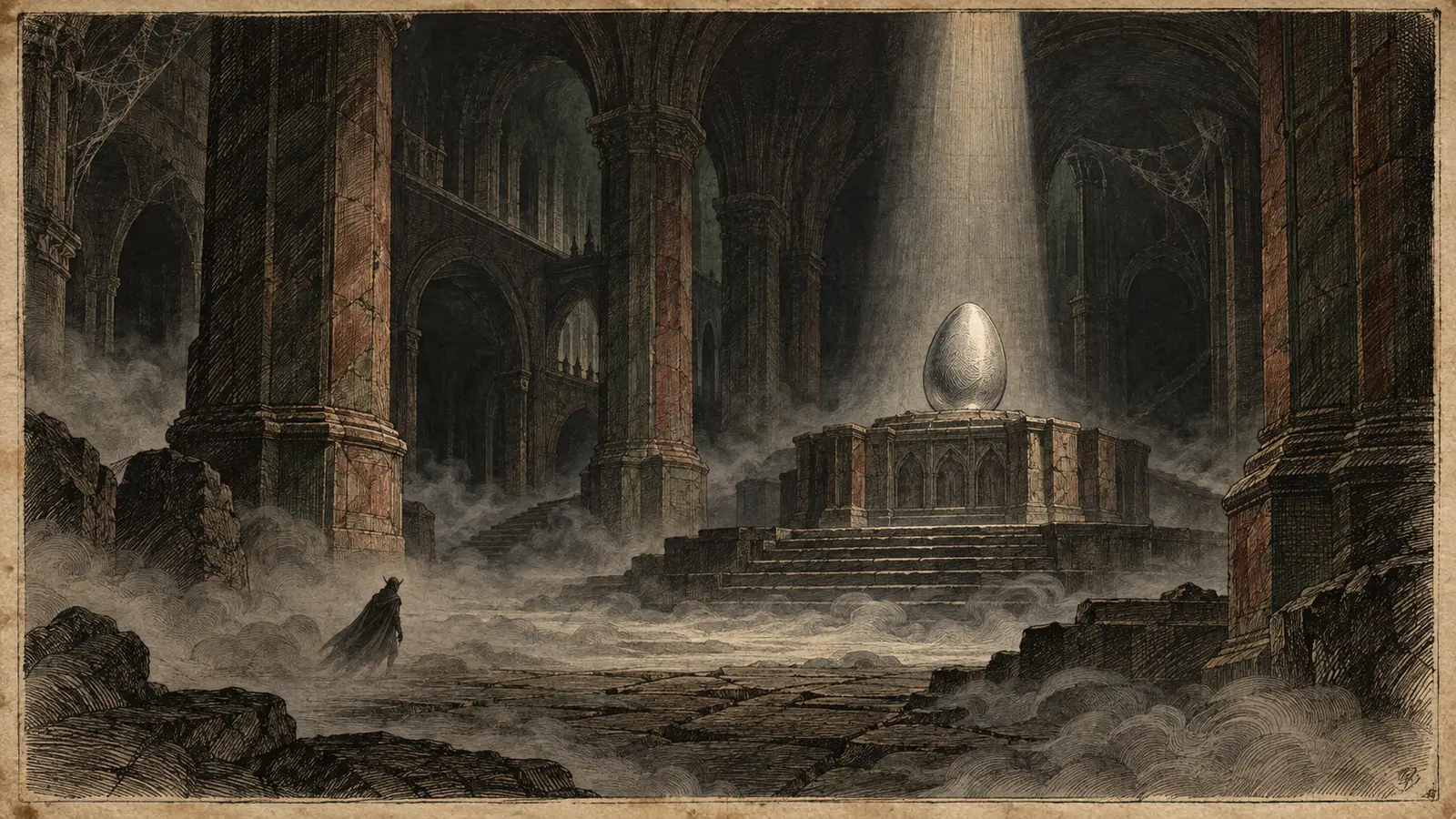
In 2008 Wizards of the Coast published the fourth edition of Dungeons and Dragons, and with it came a new Monster Manual in which many creatures were reimagined. Few changed more than the drider. For nearly thirty years it had been the shape of failure. Now it became the shape of success.
In the fourth edition, the strongest and bravest of the drow could choose to undergo a test of . It was a choice, sought rather than imposed. Those who passed the test were transformed into driders. Those who failed usually died. Failure no longer produced a drider at all. Only triumph did.
So driders became the gifted servants of the Spider Queen. Lolth rewarded their strength and devotion by granting them the form and stature of a spider, the image of the goddess herself. And their place in drow society changed completely. They were no longer outcasts lurking in the tunnels around the city. They were part of it, honoured and respected and feared, with an almost mythical standing among their people. When a drow war party saw a drider among its ranks, the warriors took it as a good omen. For a drow, becoming a drider was the high point of a whole life.
Think about how different that world feels. Picture a drow raiding party moving through the dark, and at its head, or towering at its flank, a drider in armour, with the warriors around it glancing up at it with something like awe. It is the same body, and the same goddess shaped it. But where once that body meant shame, now it meant glory.
The book showed this in the way it grouped its monsters. Driders appeared alongside drow in mixed companies, fighting side by side, and they appeared among spiders too, at home in both worlds. And it gave the drider two named forms, each with its own character.
The first was the drider fanglord. It was a hulking fighter, a warrior in leather armour with a greatsword, and it was terribly tough. Its bite carried a poison that kept working on its victim long after the fangs were gone. It could throw webs to hold an enemy in place, and it could call up a thing called darkfire, which burned away any invisibility or concealment an enemy wrapped itself in, leaving the foe exposed. Picture it in a cavern, a great armoured shape with its sword lifted, while the shadows that would hide you peel away under its strange dark light.
The second was the drider shadowspinner, and it was a different kind of creature entirely: a stealthy hunter, a skirmisher that darted in and out. It carried no poisonous bite. It fought with a short sword whose cuts carried a shadowy, deathly harm, and it could cast a spell called slashing darkness. Its strangest gift was the way shadow folded around it. When it moved far, it ended its movement wrapped in concealment, so that it seemed to vanish and reappear, and it struck hardest at foes who were caught off guard. If the fanglord was a knight, the shadowspinner was an assassin.
Both of them stood at a level of power that placed them among the deeper dangers of the game, foes for heroes who had already made their names. They were not lone monsters at the edges of a map anymore. They were the elite of the drow forces, their champions and commanders.
Over the next few years, more kinds of driders joined them. In 2009 the adventure Revenge of the Giants, which took heroes against the giants once more, added a drider battlelord, a war-leader among its kind. Dungeon magazine added a drider assassin as well.
In 2010 Wizards gathered many of its monsters into a boxed set called Monster Vault, and it reprinted the fanglord and the shadowspinner, along with more lore about where driders stood. In the drow hierarchy, the book said, driders formed a caste of their own. They ranked above most other drow, but they still served the priestesses of Lolth. And here, quietly, a crack appeared in the shining picture. Some driders resented that service. Some came to feel more kinship with spiders than with their fellow dark elves. Even in an age when the drider was a blessing, the old loneliness found its way back in. A creature honoured by its people could still feel that it no longer belonged among them.
And in the summer of 2012, near the end of the fourth edition, Dungeon magazine published an article called "Denizens of the Demonweb," which introduced an even more powerful kind of drider, the drider ghostwalker. Its origin was not a test at all. The ghostwalker was made from a male drow who had betrayed Lolth. With that, punishment returned to the lore. In one edition, the drider had been both the reward of the faithful and, in its strongest form, the fate of the traitor.
How do we hold these two pictures together? One way is to remember that the drider has always been read differently by the people who look at it. The young drow of 's book wondered whether driders were gifts. In the fourth edition, the whole of drow society seemed to answer yes. Perhaps, in the eyes of the drow, the body itself is neither good nor bad. It is Lolth's image, and what it means depends on the story told about it. For the length of one edition, the story told was one of glory.
That story would not last. When the fifth edition arrived, the drider would crawl back into the dark.
Chapter IX
Return of the outcast: fifth edition and the Rage of Demons
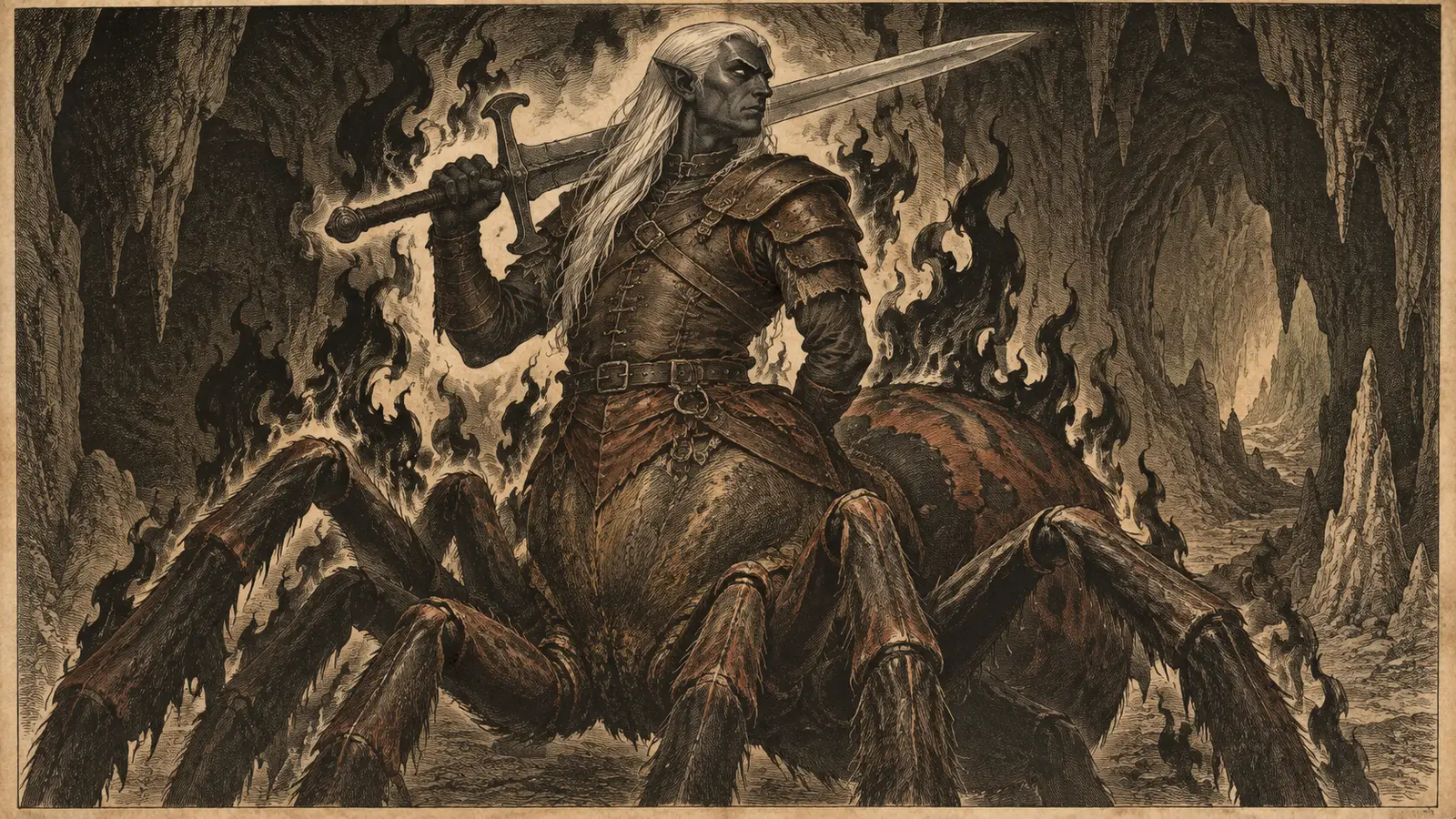
In 2014 Wizards of the Coast released the fifth edition of Dungeons and Dragons, and its Monster Manual gave the drider a full entry of its own, with a picture and a page of lore. It was classed as a monstrosity now, a creature of unnatural making, and the story it told was very close to the old one.
When a drow shows great promise, the book says, summons that drow to the Demonweb Pits for a test of faith and strength. Those who pass rise higher in the Spider Queen's favour. Those who fail become driders, and the book calls the result a horrid hybrid of a drow and a giant spider. Each one stands as a living reminder of Lolth's power. Only drow can become driders, and the power to make them belongs to Lolth alone.
The test here takes place in the Demonweb itself, in the goddess's own realm. We're back on that vast web strung across the emptiness, the strands wrapped in grey fog, the iron spider-palace crawling along them. Picture a promising young drow, perhaps a priestess or a wizard of a noble house, drawn up out of the Underdark and into that place, and standing alone before whatever trial the goddess has set. And picture, too, the ones who come back changed.
They return to the Material Plane, the book says, twisted and debased. Many are driven toward madness. They vanish into the Underdark to live as hermits and hunters. Some wander alone. Others lead packs of giant spiders, the old companions of their kind, as though the goddess's parting gift from the first edition had become a way of life.
And the drow? They fear and shun driders. They hold them lower than slaves. And yet they tolerate them, because a drider is a living representative of Lolth's will, and a reminder of what happens to those who fail the Spider Queen. So the drider is unwelcome and untouchable at once. It may not be harmed, perhaps, but it may not be loved.
This was a deliberate return. The fourth edition's honoured champions faded away, and the tragic outcast came back, closer to the creature of the old modules than to anything in between.
The fifth edition drider had a good many gifts. It still carried the fey blood of the elves, which made it hard to charm and impossible to put to sleep with magic. It could climb walls and walk upside down across ceilings, it could feel the tremor of anything that touched its webs, and it could move through webbing without hindrance, as a spider does. It saw far into darkness, and like all drow it was troubled by sunlight, which dazzled it and threw off its aim. It was stealthy, a natural ambusher. Its innate magic was smaller than before: it could call dancing lights whenever it liked, and once a day each it could summon darkness and settle faerie fire over its foes. In battle it struck three times in quick succession with sword or bow, and it could trade one of those strikes for a venomous bite.
And the old link to its former life survived as an option. A drider who had been a drow spellcaster, the book suggested, might still keep some of that magic. The example the book gives reads like a fallen priestess of Lolth, still holding onto her prayers: she can still spray poison from her hand, call small wonders out of the air, place a curse of doubt on her enemies, sense magic, and wrap herself in a protective sanctuary. Imagine her in her cave, still murmuring the rites she learned in the temple, to a goddess who judged her and found her lacking.
In the year after that book, the fifth edition went down into the Underdark in earnest. In September 2015 Wizards released Out of the Abyss, the centrepiece of a storyline called Rage of Demons, a long adventure set in the Underdark of the Realms.
It begins with the heroes as prisoners. They wake in Velkynvelve, a drow outpost where slaves are held before being sent to . It's a small place hung with webs, guarded by drow slavers and their giant spiders, with quaggoths, the pale, shaggy creatures of the deep, labouring as their thralls. The heroes escape, and the rest of the adventure follows them through the Underdark with a drow priestess, Mistress Ilvara of House Mizzrym, hunting them every step of the way.
But the Underdark they flee through is going wrong. Behind it lies a story we should tell. Baenre, the Archmage of Menzoberranzan, perhaps the most powerful male drow wizard alive, had grown tired of living under Lolth and her priestesses. He felt subjugated and betrayed. So he worked a great ritual, drawing on the faerzress, the strange ambient magic that runs through the stone of the Underdark, and he tried to summon Lolth herself and bind her. The ritual failed. And in failing, it tore open the way for the demon lords of the , who came pouring into the Underdark, each one a vast and terrible power loose in the deep places.
The truth, hidden from Gromph, was that Lolth had been using him all along. Releasing the demon lords into the Underdark served her purpose, emptying their realms and clearing her way to greater power in the Abyss. It's a very Lolth-like scheme, one in which even the rebellion against her turns out to be her own design.
Not everyone accepted this. An exiled drow archmage named Vizeran DeVir, a survivor of that very house that the Do'Urdens destroyed in 's novels so long ago, nursed his own long hatred of both Gromph and Lolth. His plan was to draw the demon lords back to Menzoberranzan, where they had first been summoned, and banish them all from there at once.
In this Underdark, filling with demons and riddled with drow and spiders, driders belong naturally. They are the shunned servants of the goddess whose scheme set everything in motion, and every one of them is a failure in her eyes. Feared and avoided by the drow, they are dangerous still, with their drow magic and their venom and their walking on webs, and they haunt the tunnels the heroes must cross.
A few years later, in 2018, Mordenkainen's Tome of Foes told an older story, one about the drow themselves, and it deepened everything around the drider. Long ago, it said, the elves were wild, changeable beings, like their creator , who could shift and alter their forms. Lolth persuaded them to take fixed shapes, much like the elves of today, and to turn from Corellon's ever-changing ways. The elves who revered her most became the drow and settled in the Underdark. The book spoke too of , Lolth's great enemy among the drow gods, whose worship the priestesses hide from their people.
There is something to sit with in that tale. Lolth is the goddess who once told the elves that a fixed form was better than change. And the drider is the creature she changes. The one who taught the elves to keep their shapes keeps for herself the right to take a shape away.
From here, for a while, the drider's story leaves the rulebooks and returns to the novels, to a brother we left in the shadows nearly thirty years before.
Chapter X
The unweaving: the Blaspheme and the drider army
In the late 2010s R.A. wrote a trilogy called Generations, and its final book, Relentless, was published in the summer of 2020. In those books, the drider's long story took a turn that no one in the game's long history had quite imagined.
It began with . Long after his death at 's hands, one of 's handmaidens, one of the yochlols, brought him back from the , still in his drider form. The ruined brother of the house walked the Underdark again, a creature still under the goddess's curse.
He was not alone. In the year the Realms call 1488, the Year of Dwarvenkind Reborn, two yochlols named Yiccardaria and Eskavidne summoned an entire army of driders out of the Demonweb Pits. It's an astonishing image. For all the centuries of Lolth's testing, the failed have gone somewhere, and where they went was her web. Now the handmaidens called them forth in their hundreds and gave them to Matron Zhindia Melarn, a fanatical priestess of a minor house, to serve as her weapon.
In Relentless, that drider army was brought to a halt by the magic of the Hosttower, the great wizards' tower of Luskan. And then something happened that the drow had always believed was impossible.
Two priestesses of House Baenre, Quenthel Baenre, who had led the expedition in the War of the Spider Queen, and Yvonnel Baenre, a young woman of strange and great power, wove a vast web of magic. It was a remove-curse spell on an enormous scale, strengthened by the birth magic of , the human woman who had once been about to marry so many years before and who was now a priestess in her own right. And this web undid the curse that Lolth had laid on the driders, the curse the drow called the curse of abomination.
Dinin leapt into the web. And he came out of it a drow again.
About eight hundred others came through with him. Eight hundred driders, failed and cast out and summoned as weapons, became dark elves once more. To the drow this was impossible, and also blasphemous. Nobody was supposed to be able to cure a drider without Lolth's will. Yet here they were, restored, and Quenthel Baenre invited them to join her house.
That same book uncovered an even deeper secret. The psionicist Kimmuriel, 's lieutenant, revealed that Lolth was not truly divine at all, but a kind of malevolent psychic infection, something lodged in the minds of the drow and posing as a goddess. Yvonnel and Quenthel turned from obedience to resistance. And the curing of the driders, more than anything else, set off open civil war in .
Salvatore followed the story in a new trilogy, The Way of the Drow, which ran from Starlight Enclave in 2021 through Glacier's Edge in 2022 to Lolth's Warrior in 2023. And here the restored driders became a force of their own. They banded together and took a name: the Blaspheme. It's a defiant name, taking the accusation of blasphemy and wearing it with pride. They fought against Lolth's clergy in the streets and caverns of Menzoberranzan.
Their leader was a fierce woman named Mal'a'voselle Amvas Tol, who went by Voselly. In the Demonweb Pits, when she was still a drider, she had led the drider contingent, and now that she walked again on two legs, she led them still. And beside her stood Dinin, who now called himself Dininae, as though taking a new name for a new life. Together they forged the Blaspheme into a united force.
The war that followed set the drow loyal to Lolth's chaos against the drow who, in Salvatore's words, demand more, demand better. Even House Baenre and its Matron Mother began to question Lolth and the old story of how the city was founded, stirred by the long legend of , the drow who had walked away.
Consider the whole arc of Dinin's life, as these books finally completed it. He was an ambitious younger son who murdered his brother to rise. He became a mercenary under Jarlaxle, then a drider and a mindless slave in his sister's hands, then a corpse at Bruenor's feet, a creature summoned back from the Abyss, a drow restored, and finally a rebel with a new name. No other drider in all the lore has travelled so far.
And with him, the meaning of the drider itself shifted. In these later novels, the drider was no longer a dead end. It became a symbol of the drow breaking free. If the curse could be undone, then Lolth's power was not absolute, and if her power was not absolute, then perhaps no drow had to live under it.
This part of the story reached players directly, too. In March 2023 the online game Neverwinter released a module called Menzoberranzan, written with R.A. Salvatore and his son Geno. For the first time players could walk the streets of the City of Spiders in that game, in the days between Glacier's Edge and Lolth's Warrior, with Drizzt among the characters. They slipped past drow patrols and assassins while the Lolth loyalists fought the Blaspheme, and a long-forgotten artifact threatened to tip the war in the goddess's favour. That summer a second module, Demonweb Pits, brought the story to its close, as the Material Plane and Lolth's realm merged, and demons and Lolth herself stepped into the Underdark.
That same summer, another game would give the world a very different drider, one who had been cast out of Lolth's favour and found, of all things, a new goddess.
Chapter XI
A guide on the shadowed road: Kar'niss in Baldur's Gate 3
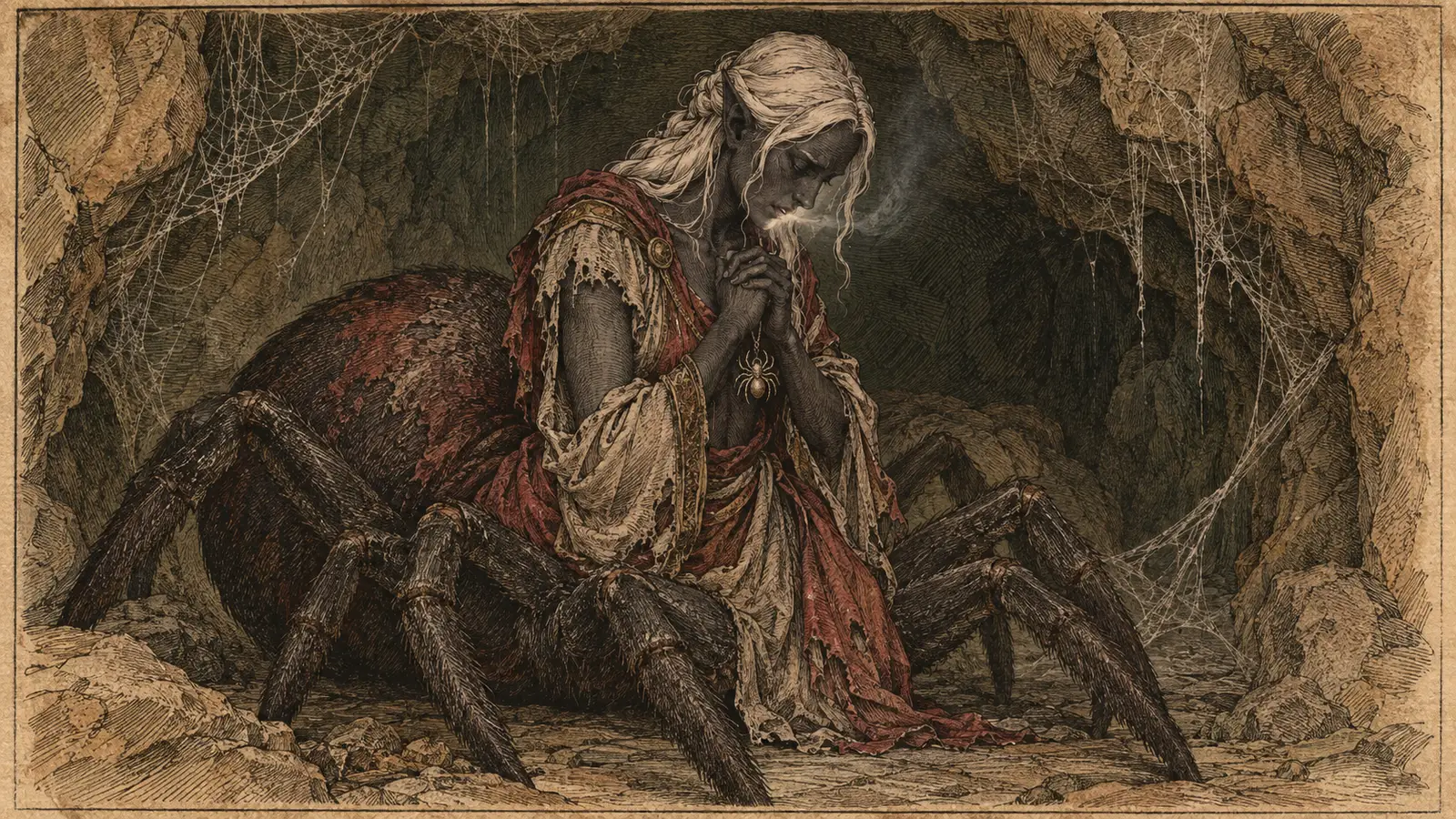
In August 2023, Larian Studios released Baldur's Gate 3, and it became one of the most widely played Dungeons and Dragons stories ever told. Many people who had never opened a rulebook met the Underdark there, and the drow, and in one long stretch of the journey they met a drider.
The game tells the old story of driders plainly. They are drow warped from the waist down into the body of a giant spider, made when a drow fails a test of . When Lolth sees promise in a drow, she summons them to the Demonweb Pits for a test of faith and strength. Those who pass rise in her favour. Those who fail become driders, kept as living reminders of her power.
In all of Baldur's Gate 3, there is only one drider. His name is .
He is pale, an albino drider, and he has a sad, strange history. Lolth found him lacking and cast him out. He did not die, and he did not simply vanish into the tunnels as a hermit. Instead, alone in his exile, he called out to a new god. And a new god answered. It was the Absolute, the mysterious power at the heart of the game's story, worshipped by a cult whose faithful carry mind flayer tadpoles in their heads. The Absolute took him in.
Kar'niss has given himself over to this new faith completely. He is the only character in the game who calls the Absolute "she," just as he once spoke of his old goddess. He calls it her Majesty. It's as though he simply lifted the shape of his old devotion off Lolth and set it down on the Absolute, the way a spider might rebuild a broken web in the same pattern in a new corner. And his mind is badly damaged. He speaks of himself as "we" and "us," and he will break off in the middle of a conversation to address the Absolute directly, as if it were always listening at his shoulder.
In the second part of the game, the story moves into a dark land called the Shadow-Cursed Lands, a region of the Western Heartlands where a curse of shadow hangs over everything and the darkness itself kills. Travellers cannot cross it safely without protection. Kar'niss is a guide for the cult. Its faithful, the True Souls, summon him by plucking a strange instrument called the Spider's Lyre, and he comes to lead them through the cursed land to Moonrise Towers, the cult's stronghold. The lyre was meant for , a drow paladin in the cult's service, and when the player's party plays it, Kar'niss takes them for her envoys, whether Minthara still lives or not. If the music is badly played, he makes a sharp remark about the noise, which is one of those small moments that make a character feel alive.
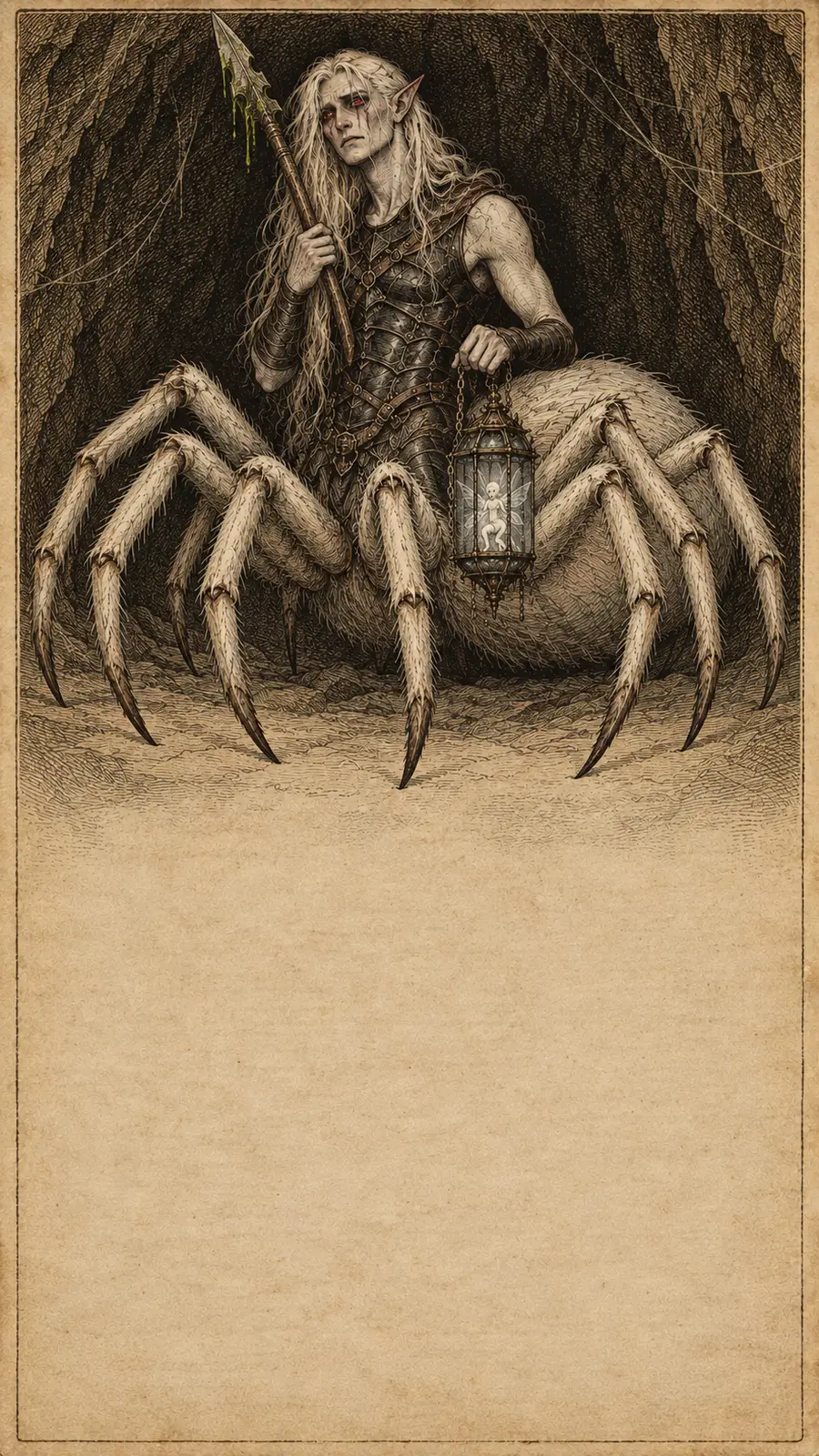
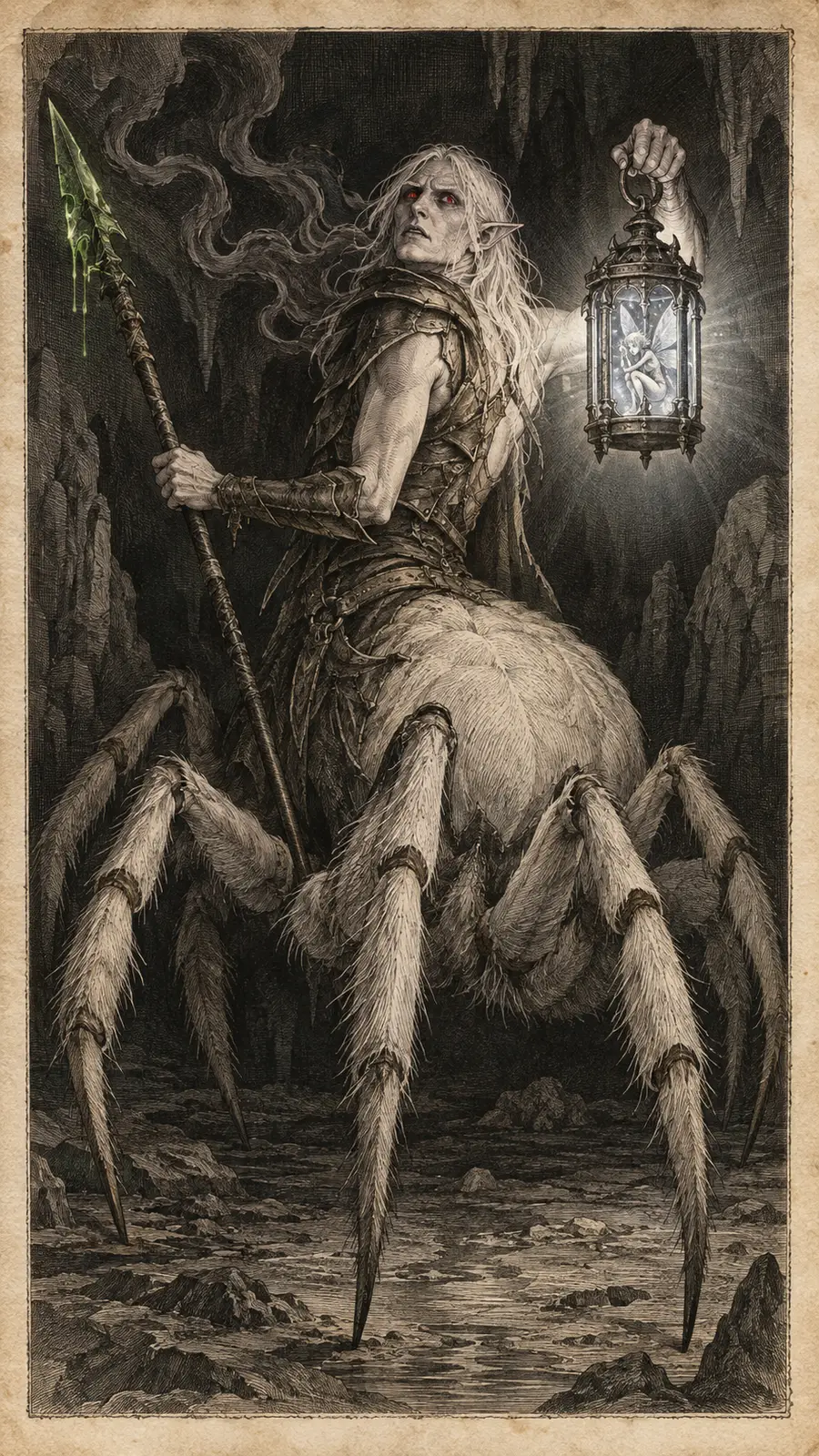
He carries with him the thing that makes safe passage possible, a Moonlantern. Inside it is trapped a pixie with the curious name of Dolly Dolly Dolly, and her light holds back the Shadow Curse within its glow. So the drider moves through the darkness wrapped in a small bubble of captured light, leading his convoy toward the towers. Kar'niss holds a belief of his own about the curse, too. He thinks that every death it claims makes it stronger, and so he is set against feeding it, against letting anyone die out there in the dark. There is something almost tender about that, in a broken creature.
Players can meet him in several ways. Some follow him and his convoy to Moonrise Towers, playing the part of faithful cultists. Some betray the convoy along the road, and some lie in wait with the Harpers, ambushing the procession in the shadowed lands. Many take his lantern from him, because they need its light. If he survives the road, he climbs Moonrise Towers to seek the Absolute's blessing, and when the heroes finally storm the towers at the end of that chapter, he fights beside , the cult's general, on the high rooftop.
And when he dies, if a player uses the spell Speak with Dead to hear his last words, they're these: "Lolth... cast out... Absolute... saved..."
Four broken phrases, and the whole of his life is in them. The goddess who made him and rejected him, the exile, the new faith, and his belief, right to the end, that he had been rescued.
Kar'niss is voiced by Joshua Sklar, and players grew surprisingly fond of him. Many regret how early in the story he can die, and he has been called a fan favourite, a monster with more heart than his part required. He went on to appear in Idle Champions of the Forgotten Realms as well.
What he shows us, more clearly than almost any other drider, is the hunger left behind when a goddess turns away. Every drider has been cast out by Lolth. Most simply go into the dark. Kar'niss went looking for someone else to belong to, and he found the Absolute, and he called it by the same name.
From these particular driders, let's step back a little and look at the wider family, the variants and cousins and descendants of the creature that Lolth first wove.
Chapter XII
Scorpions, alchemy and kin: variants and offshoots
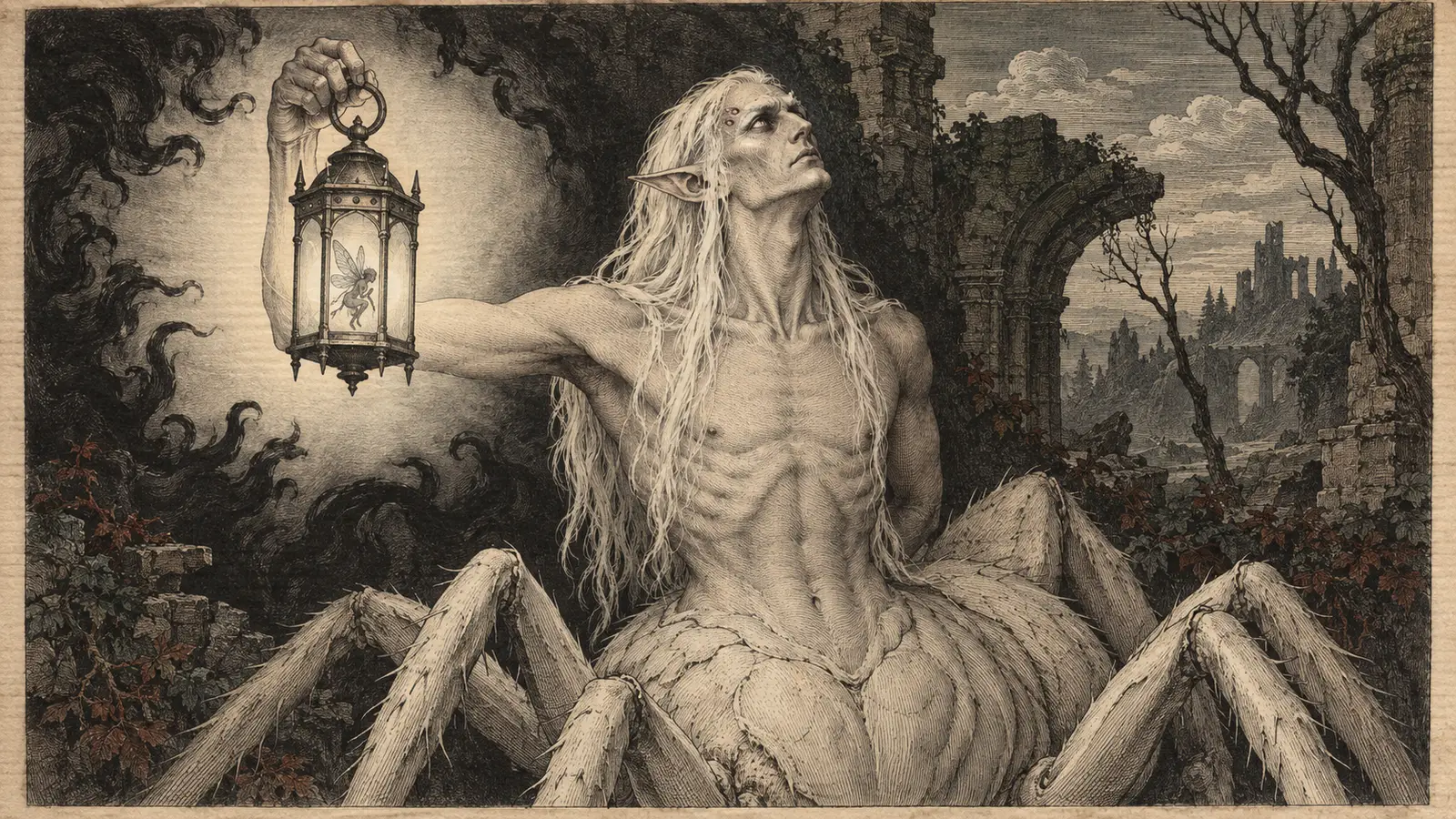
Over the decades the drider has worn many forms, and one of the oldest threads running through them is magic. The very first hardcover driders were priestesses and wizards in spider bodies, the females keeping their clerical power and the males their arcane art. In the second edition most had been priests and the rest mages. In the third, each drider cast spells as a cleric, sorcerer or wizard of middling skill, so that no two were quite alike. And in the fifth edition, a drider who had once been a spellcaster might keep that magic, like the fallen priestess still murmuring her prayers. Through all these ages the drider has been, among other things, a figure of lost learning, a scholar or priest who carried their knowledge into a body never meant for it.
The fourth edition, with its chosen champions, gave the drider the most named varieties: the armoured fanglord and the shadowy shadowspinner, the battlelord who leads them, the assassin, and the ghostwalker, born from betrayal. Online, Wizards has also offered named driders such as Alisandre, a drider priestess, and one called Zarothrax, the Web of Fate, a title that sounds like a story waiting to be told.
Other driders served other masters. We've already met the driders in the legions of , goddess of vengeance and undeath, in her Abyssal city of Naratyr, and her proxy Anista of Eight Eyes. It's a small, telling detail that a creature made by could end up serving one of Lolth's rivals. Once you have been cast out, perhaps any door that opens looks like home.
In the mainstream lore of the Realms only drow can become driders, and only Lolth can make them. But other worlds of Dungeons and Dragons have their own versions.
In , the world created by Keith Baker, there is a vast and mysterious continent called , all jungle and ruins and giant-haunted wilds. The drow who live there are a different people from the drow of the Realms. Many of them, the Vulkoori, worship a scorpion spirit named Vulkoor rather than a spider goddess. And in place of the drider they have the scorrow: a drow torso rising from the body of a giant scorpion, with great pincers where you would expect arms. The scorrow are not outcasts. The drow of Xen'drik revere them, even though the scorrow live in their own separate communities. Driders exist in Eberron as well, but they live apart from drow society. So in that world the old pattern turns on its head: the scorpion-elf is honoured and the spider-elf is distant. Picture a scorrow standing in the ruins of some giant's temple, pincers raised, its tail curled overhead, while the drow who pass by lower their heads.
In Pathfinder, the game Paizo built on the rules of the third edition, the drider came across with its body intact but its origin changed. Pathfinder's driders are not cursed by a goddess. Their own drow make them, through special poisons and elixirs that warp a drow body into a spider's form. It is alchemy rather than divine judgement. Pathfinder also gave its driders a striking difference between the sexes. A female drider has a sleek body like a black widow's, and keeps her beautiful drow face, though her mouth hides venomous fangs. A male drider has a bulky body like a tarantula's, and a face that has become more spider than elf, with mandibles. Two different shapes out of the same art.
Back in the Realms, the drider has relatives that share its blood or its meaning. We've met the draegloth already: the four-armed child of a glabrezu demon and a newly ordained high priestess of Lolth, standing seven feet tall and more, with a long, dog-like face, black skin under fine white fur and a pale yellowish mane. Male draegloths are terrifying servants of the goddess, and females, called the Favored Ones, are taken in by the church and raised as clerics of Lolth. Where the drider is Lolth's punishment, the draegloth is her favour. There's even a dark tradition among some tellers of drow lore of rare draegloths called Abominations, made by mixing drider blood with demon blood in foul rituals, the cursed and the cherished joined in one body.
Smaller and humbler are the chitines. These are little spider-like humanoids, sickly white and about four feet tall, with fangs and sly faces and four arms, each with an extra joint. They were not made on purpose. The drow created them by accident, in failed experiments on ordinary humanoids, and the chitines went on to become a people of their own. They build everything out of web, their homes and traps, their clothes and weapons, the way other peoples build with wood and stone, and most of them serve Lolth. Their priests are called choldriths, and they look more like spiders still: a bloated, pale spider body with a sly humanoid head, and with the front two legs serving as arms. The chitines see their choldriths as gifts from the Spider Queen. In them you can see a small echo of the drider, a body remade toward the spider as a sign of Lolth's attention, but here it is welcomed instead of feared. Both returned in the fifth edition, in Volo's Guide to Monsters in 2016.
And then there are the aranea, intelligent spiders who can change their shape. In their true form an aranea is a large, humpbacked spider about the size of a person's torso, with fanged mandibles and two small arms ending in many-jointed hands. In the Realms the old empire of bred them with magic as shapeshifting spies to use against the drow in a conflict called the Night Wars. When the spies were no longer useful, their makers tried to wipe them out, and a later emperor falsely blamed them for a plague in the city of Almraiven. The aranea turned for protection first to Zanassu, a demon lord of spiders, and later to Selvetarm, the drow god who is Lolth's champion. Their humanoid shape is fixed at birth, usually a Calishite human or half-elf, and rarely a drow. Their story rhymes with the drider's too, beings made for someone else's purpose and then discarded.
Outside Dungeons and Dragons, the drider's shape spread into other creations. The long-running webcomic Drowtales, begun in 2001 by Yan "Kern" Gagné and a team of collaborators, gave its own drow their own driders, made by fusing badly wounded drow with spider bodies infused with mana, as a costly alternative to letting them die. Many of those driders gain extra eyes. And the old roguelike game NetHack, in some of its later variants, includes driders as well: drow turned into spider-centaurs who wear armour on their upper bodies, swing two weapons, bite with a poison that saps strength and spit webs.
So the drider has many cousins now. Some are spider-touched peoples of the Realms, some are scorpion-elves in another world, and some were made with elixirs or mana instead of a curse. But at the centre of the family remains the shape Lolth wove in her web, and to really understand that shape, it helps to sit down at a table and face one.
Chapter XIII
Webs overhead: driders at the table
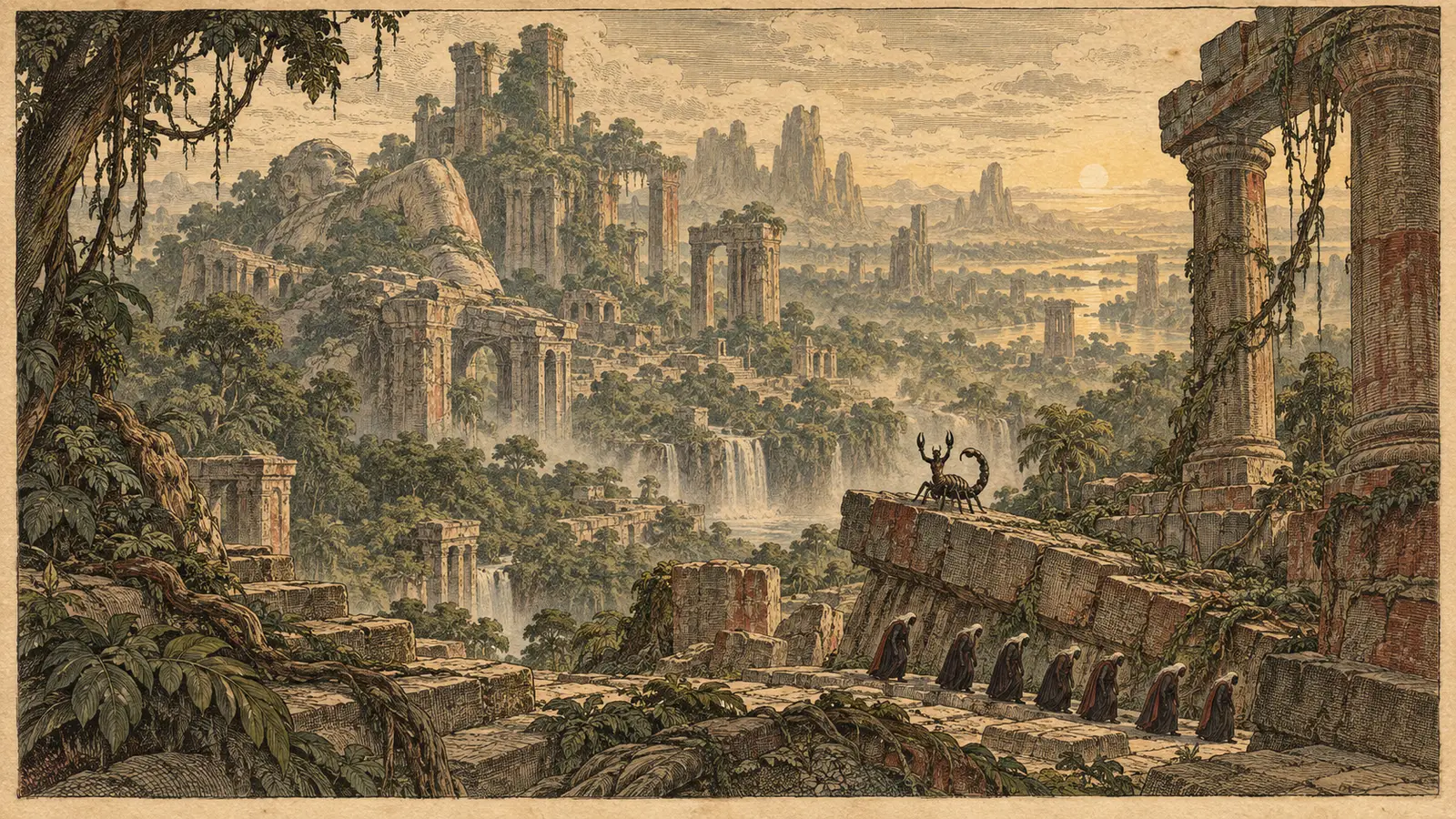
What is it like to meet a drider in a game? Let's imagine it, gently, as many tables have.
Your party has been travelling for some days through the Underdark. The tunnels are cold and damp, and the only light is what you carry. You come into a wide cavern where the ceiling rises out of sight, and the far walls are hung with grey sheets of web, old and new, some of them drifting slightly in an air current you can't feel. There's a smell of dust and something sweeter beneath it. The floor is uneven, and there's a narrow path through the webs.
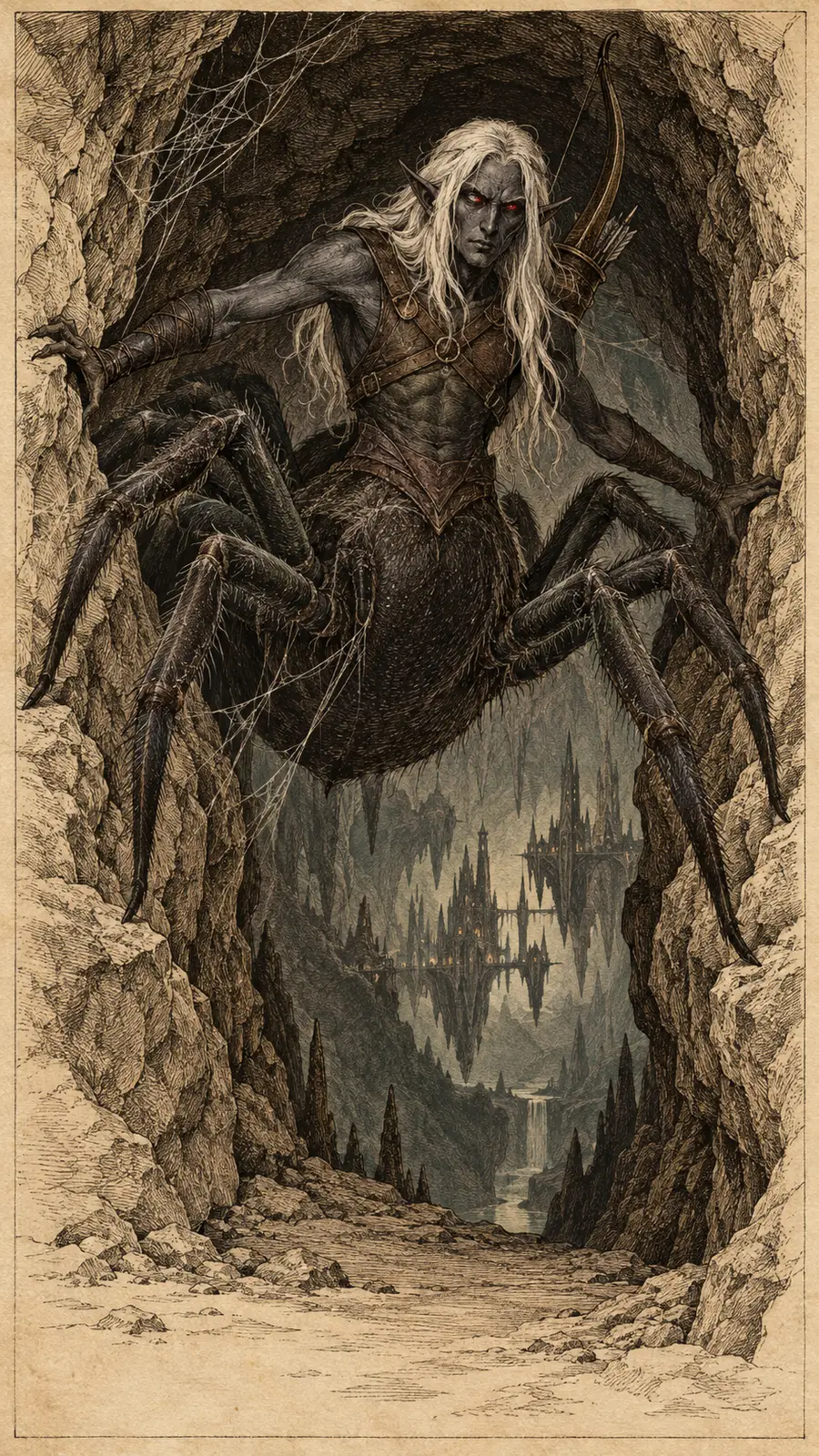
In the fifth edition, a drider in a place like this is one of the most natural ambushers in the game. It can walk on the walls, and upside down along the ceiling, without any trouble at all. Webs don't slow it in the slightest, while they snare and tangle anyone else. It sees in the dark much farther than most adventurers can, and it moves very quietly. So the first sign you might have of it is three arrows falling out of the dark above you, one after another, from somewhere you can't see. By the time you've lifted your light toward the ceiling it may already have moved.
That was the feel the fifth edition drider had at many tables: a strong, steady foe for heroes of middling experience, armoured, tough and quick, shooting three times a turn and fighting freely inside the webs that trapped everyone else. It could close and strike with its sword, and slip a venomous bite into its attacks. And its innate magic let it change the battlefield. It could drop a sphere of darkness over the party, or settle faerie fire over someone who was trying to hide, so that their outline glowed for its arrows.
Its weakness was the one every drow shares. Bring sunlight into its cavern, or meet it on the surface, and it's dazzled, its aim thrown off, its sharp eyes struggling. A party that knew this could carry light as a weapon.
The drider that kept its spellcasting played differently. A fallen priestess drider, still holding her prayers, might use her spells to shut down an enemy wizard or to pin a fighter in place, and leave the damage to her bow.
Keith , who writes about monster tactics in a long-running series called The Monsters Know What They're Doing, has thought about driders in a way that brings their story right into the fight. He calls them fighting machines. But he also points out what their making means for their will to live. A creature remade in failure, cast out and shunned, may have very little reason to survive, and some might even want to die. So most driders, he suggests, fight to the death. Only about one in three cares enough about its own life to flee when badly hurt.
The exception is the drider with something left to do. A drider with a vow to keep or a vendetta to finish will turn and run rather than die with its purpose unfulfilled. It will dodge as it goes, racing along the walls and across the ceiling, out of reach. And that makes it the kind of foe who comes back. Imagine your party, a few sessions later, hearing again the dry sound of many legs in a passage overhead, and knowing exactly who it is, and what it has not forgiven.
That's the heart of running a drider well. It isn't only a monster. It has a story built into its body. A lone exiled drider in its cave might be tragic, quiet, bitter, mad, or even willing to talk. It might bargain with a party, especially if they have a quarrel with the drow who cast it out. Because the drow hold driders in such contempt, a meeting between a drider and its former people carries an edge of old pain. A Dungeon Master can play the drider as a figure of fear, or of pity, or of both at once, as did when he looked at in the stone.
In earlier editions, the experience shifted with the rules. In the third edition every drider was its own kind of spellcaster, so you couldn't be sure what one might do: call on a cleric's prayers, a sorcerer's flashes, a wizard's careful spells. They were a source of magical bombardment as much as blades. In the fourth, the fanglord and shadowspinner came at you as part of a drow war party, the armoured brute and the shadow-folding skirmisher together, and you had to deal with the darkfire that stripped away your hiding places and the webs that held your feet.
In the Underdark of Out of the Abyss, driders were part of the dangerous world that escaped prisoners had to cross, while Mistress Ilvara and her drow followed their trail. A party fleeing with nothing but what they could steal would have little hope against a drider in its lair. Sometimes the best choice in an encounter like that is to go quietly past.
In Baldur's Gate 3, players met in whatever way their story demanded. Those who chose to fight him learned to keep their strongest fighters pressed close against him, so that he couldn't reach the more fragile members of the party, and when he fell they took his Moonlantern and carried its light onward. Those who travelled with his convoy instead learned what it was like to walk beside him through the shadow, listening to him talk to his absent goddess.
And then there's the other side of the table. For as long as there have been driders, players have wanted to play one. Ed 's book in 1991 offered the first ideas. Savage Species made it possible in 2003, letting a character grow into a drider over several levels. And through every edition players built their own drider characters, often by taking the rules for centaurs and reshaping them: a bite instead of hooves, the ability to climb, the old drow sensitivity to sunlight and the fey resistance to charms.
When players talk about their drider characters, they tend to talk about the transformation. They describe the feeling of a body torn apart and remade, pain enough to drive someone mad, and what it means to wake up as something your people despise. A drider character comes with a ready-made story: exile, self-loathing, a long struggle against the goddess who did this, or a search for someone or something that might undo it. That's a strong story to play. In a way, it's the story of and the Blaspheme, written small at a single table.
Chapter XIV
Figures, cards and borrowed shapes: the drider's legacy
The drider is one of Dungeons and Dragons' own creatures, born in its pages rather than borrowed from older myth, and it has never quite crossed into the wider world the way dragons or beholders have. It isn't in the animated series of the 1980s, nor in the 2023 film Honor Among Thieves, nor in The Legend of Vox Machina. Its legacy lives closer to the game, in the things people hold in their hands while they play, and in the other games and stories that borrowed its shape.
Perhaps the most tangible part of that legacy is the miniatures. For a creature that is, above all, a striking silhouette, the small sculpted figure on the table is a natural home. When Wizards of the Coast ran its collectible line of prepainted miniatures in the 2000s, it included driders among them, and the fourth edition's drider fanglord appeared as a figure in a set called Savage Encounters, a hulking armoured shape on eight legs.
Later, WizKids took up the making of official figures. In 2015, a set called Icons of the Realms: Rage of Demons, made to accompany Out of the Abyss, included a drider among its figures, so that players crossing that demon-haunted Underdark could set one down in a web-hung cavern. An unpainted line called Nolzur's Marvelous Miniatures offered driders for painters who liked to add their own colours, and a model kit series called Frameworks gave the drider to experienced hobbyists as a set of parts to assemble and paint, interchangeable with other kits so that you could build a drider of your own design. In May 2025 another set, Icons of the Realms: Underdark Expeditions, brought a new drider figure to the table. And beyond the official lines, independent sculptors have made driders of every kind, male and female, grim and graceful.
The drider has found its way onto cards too. In 2021 Magic: The Gathering visited the Forgotten Realms in a set called Adventures in the Forgotten Realms, and one of its cards was simply called Drider, painted by Jodie Muir. The card is a black creature, an elf spider that strikes from a distance with a long reach, and when it hurts an opponent it leaves a smaller spider behind. Its flavour text sums up nearly forty years of lore in one sentence: "Though their forms embody 's image, driders are those unfortunate drow who have failed the Spider Queen." That line holds the whole contradiction of the creature. Its body is shaped like the goddess, and the goddess has rejected it.
Other games carried the drider forward on their own terms. Pathfinder brought it into its bestiary, with its own alchemical origin and its black widow and tarantula forms. The NetHack variants gave it a place among their dungeon dwellers, and the webcomic Drowtales built its own driders out of mana and mercy. On fan worldbuilding sites and in homebrew collections, the drider has become one of the most common creatures turned into a playable people. People keep wanting to know what it would be like to live inside that shape.
And of course its greatest stage, outside the books, has been the video games: the long line of Realms titles in which driders lurked, Hordes of the Underdark, the Neverwinter modules where the Blaspheme fought for their freedom, and above all Baldur's Gate 3, where gave millions of players the experience of meeting a drider who was sad and strange and loyal, and very hard to forget.
What all of this shows is that the drider's power has always been in its image. A person rising from a spider. Something both elegant and wrong, a body that tells its own story at a glance. drew it for a century before the game, and artists and sculptors have drawn and carved it ever since. Every time someone paints a new drider miniature at a kitchen table, they're adding one more thread to a very old web.
Chapter XV
Forelegs and venom: the drider today
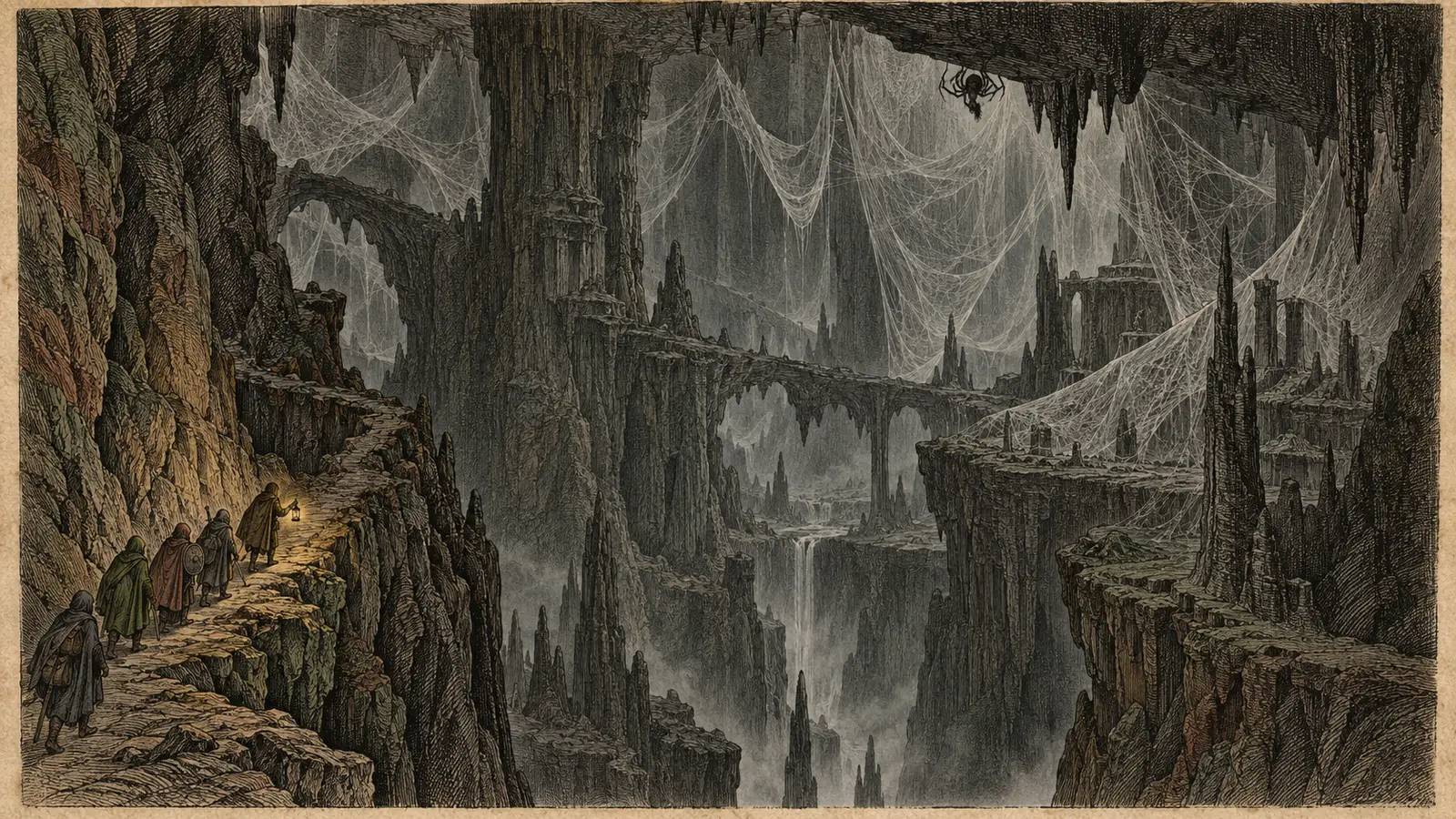
In the 2020s, Dungeons and Dragons revised its fifth edition rules, and a new Monster Manual came out in early 2025, the third of the revised core books. Many players call it the 2024 Monster Manual, after the year of the revision. It made monsters tougher across the board, to stand against stronger heroes, and it added notes about where each creature lives and what treasure it keeps.
The drider remained in it, and its story was told much as before. Driders bear the Spider Queen's curse, and they skulk through the caverns of the Underdark on eight legs. Each has the head and torso of a drow and the body of a giant spider. They are drow who failed in some way, and she remakes them so they never forget that she is their queen. They are driven toward madness and unwelcome among their former kin. They live in the Underdark apart from the drow, and sometimes they lead packs of giant spiders. Behind all of this stands the old story: the promising drow summoned to the Demonweb Pits, the test of faith and strength, and the failures turned into living reminders of the goddess's power.
I find that new phrase quietly haunting: she remakes them so they never forget she is their queen. It isn't exile, exactly, or only punishment. It's remembrance. The body itself becomes a lesson that can't be unlearned.
What changed most was how the drider fights. It no longer carries a sword and bow. It fights with its own spider body now. It stabs with a long foreleg, reaching farther than a sword ever could, and it spits a burst of venom that flies far across a cavern. It still climbs walls and ceilings, and it is very stealthy. And its old drow magic has been gathered into a single power, called Magic of the Spider Queen, which lets it now and then call down darkness, or settle faerie fire over its foes, or cast a web to bind them. The goddess's name is written into the spell itself.
Imagine meeting this drider, then, in a quiet cavern. No glint of steel. Only the long legs moving in the dark, a sudden reach from far off, the sting of venom, and grey web unfolding across the passage. It has become a little more spider and a little less elf, and that suits a creature that has spent so long being pulled from one nature toward the other.
The same book made a change around the drider that sets it in a new light. The drow themselves left the Monster Manual. Their old entries, the drow warrior and mage and the priestess of Lolth, were removed, and the drow were treated instead as a people, with the 2024 Player's Handbook offering them as one of the lineages of elves that a player can choose. So for the first time, in the core bestiary, the drider stands where the drow used to stand. The dark elves have moved into the players' book, and the one left behind among the monsters is the elf who failed, the lone cursed figure of the Spider Queen's power.
And now the story moves toward the player's side, too. In late August 2026, Wizards of the Coast released a playtest called Underdark Options, a set of new rules for players to try out, centred on Deep Imaskar, a hidden city of refugees from an ancient empire whose people wield a strange magic called Unlight. A few weeks later, on the tenth of September 2026, a second playtest followed, Underdark Options 2. It offered three new paths for characters, among them a sorcerer changed by the faerzress, that old magic of the Underdark's stone. And it offered five new species for players: the Deep Imaskari, the kuo-toa, the myconids, the illithidkin, and the drider.
This is the first time in the modern game that the drider has been offered as a standard species for players, and it's playtest material, meant for testing and feedback rather than the final rules.
The playtest drider bears the Spider Queen's curse, like all its kind. It has a drow's head and torso on a giant spider's body, and some driders carry extra spider features too, eight eyes or small fangs. They live about as long as elves do, around seven and a half centuries. To fit beside other heroes in a party, the playtest drider is a little smaller than the monster, standing somewhere between six and eight feet tall, though its spider build lets it carry loads like something larger. It sees far into darkness. It can climb walls as easily as it walks, and as it grows in experience it can move across ceilings with its hands free. Webs don't hinder it, and it can sense anything that touches the same web. Its mind has been sharpened by what it went through: it resists psychic harm and is hard to charm. It can speak silently, mind to mind, with those nearby. And it carries spells of the Spider Queen. It begins with dancing lights, gains faerie fire as it grows, and later the power to cast a web.
There's a quiet circle in that list. Dancing lights and faerie fire are among the oldest magics in the drider's long history, the ones the first-edition driders carried out of their drow lives in 1983. Here they are again, offered now to the player.
The design team, introducing their Underdark playtests, reminded readers that the Underdark was first explored nearly fifty years earlier, in the D series of adventures: Descent into the Depths of the Earth, Shrine of the Kuo-Toa and Vault of the Drow, the very road that led down to the Demonweb. And they noted that many players today know the Underdark from Baldur's Gate 3, or from the novels of . So the newest drider reaches back to its very first road and to its most famous modern face.
That is where the drider's story rests today, in the autumn of 2026: a cursed monster in the new bestiary, still haunting the caverns apart from its people, and alongside it, a playable drider being tried out at tables around the world, its form not yet final, waiting to see what shape the players will help give it.
Chapter XVI
The silent weavers beneath the world
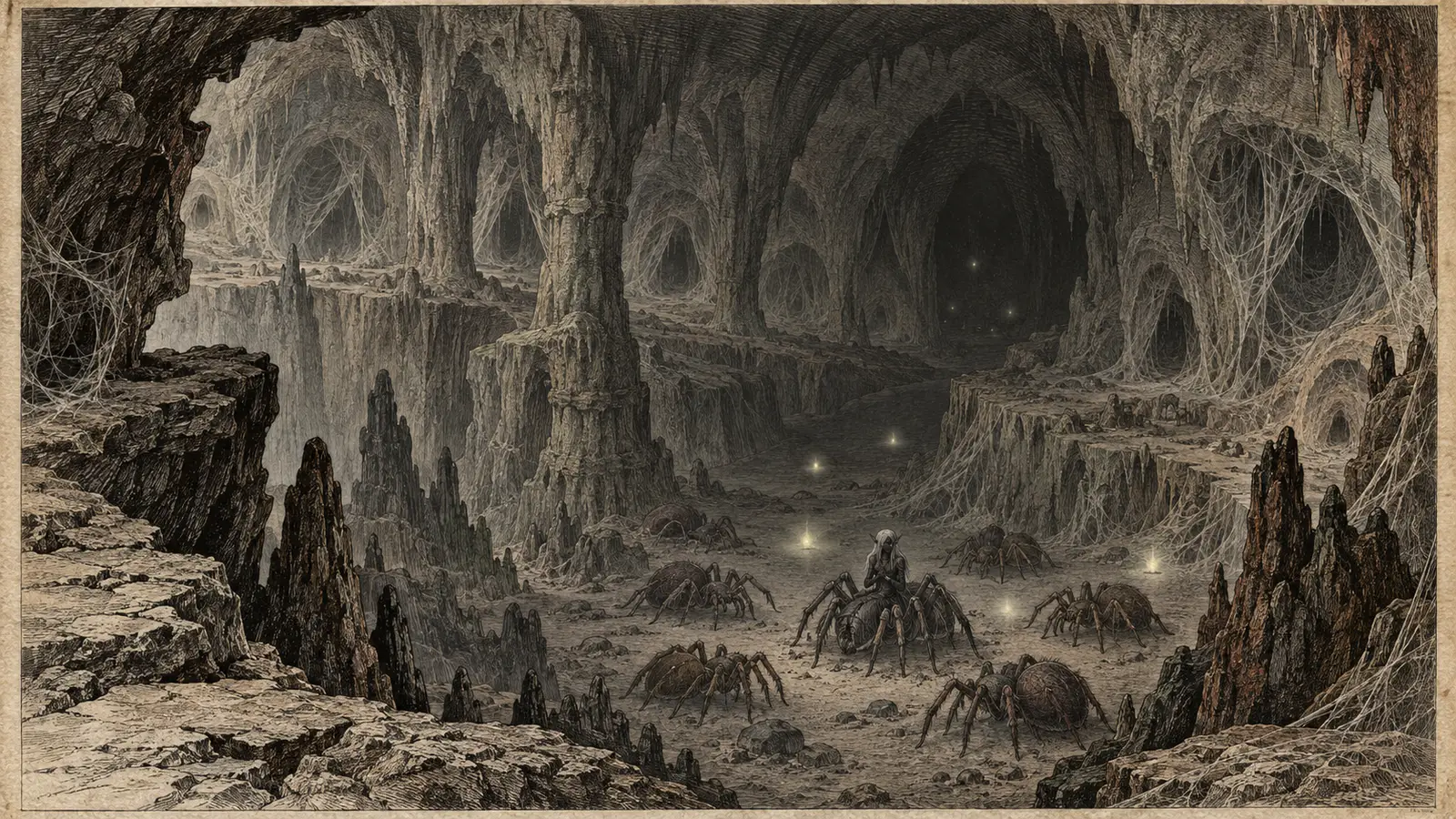
We've come a long way tonight, from and 's weaver to the playtests of the present day. Let's let the journey settle, and go back down into the dark one last time.
Picture a cavern far beneath the surface, very old and very quiet. No drow city glows nearby. The tunnels that lead here are seldom walked. Across the openings of those tunnels hang webs, layer upon layer of them, some new and some so old they have gathered dust, grey and soft as wool. Somewhere a little water drips. The air is cool, and it doesn't move.
In the middle of the cavern, a few small dancing lights drift, pale and slow, like fireflies that have forgotten where they were going. By their glow you can make out a shape: tall, upright at the front, with long legs folded beneath. A drider, resting. Around it, at the edges of the light, giant spiders keep their own stillness, the only companions it has ever had since the goddess sent them.
It was promising once. That's the strange heart of it all. Every drider began as someone the goddess thought worth testing, a priestess rising in a great house, a wizard of real skill, a warrior with a future. Each one carried that promise up into the Demonweb, onto the long fog-wrapped strands, and each one came back as this.
What does it remember? Perhaps the city, the glow of the great houses, the voices of its family. Perhaps the test itself, and the moment it knew it had failed. Perhaps nothing clearly anymore, only a feeling of having once been someone else. In some ages its people called that shape a blessing, and in most they called it a curse. In the novels, once, a great web of magic unmade the curse for eight hundred of them at a time, and they walked out as dark elves again and named themselves after the crime of being free. But this one, here in its cavern, is still waiting, if it's waiting for anything at all.
Far above, the drow live their crowded, dangerous lives, and they tell their children about creatures like this one, to keep them obedient. And somewhere beyond the world entirely, on a web strung across nothing, an iron palace shaped like a spider moves slowly along its strands, and the goddess inside it watches. She never quite lets go of what she has made. She remade them so they would remember.
Long ago, in an old Roman poem, a goddess looked at a proud young weaver and changed her into a spider, so that she would go on weaving forever, hanging from her thread. In a sense, the driders are her distant kin. They are gifted ones turned to weavers, bound to a goddess who both cast them out and keeps them close.
The dancing lights drift lower now and begin to fade, one by one. The drider shifts slightly, eight legs folding a little tighter. A single thread of web stirs in some current too faint to feel, catches the last of the light, and then the cavern is dark again and very still, and somewhere in that stillness the weaver goes on resting, deep beneath the sleeping world.