Chapter I
The Weaver's daughter and the arrow that turned
We begin in the time before there were drow at all, when the elven gods lived together in , the green and starlit home of the . The Seldarine are the gods of the elves, and at their head stood , the first of them, the maker and protector of the elven people. At his side, as his consort, was a goddess named .
In the Forgotten Realms telling, Araushnee was a lesser goddess of destiny and of artisans. They called her the Weaver. You can picture her as the gods' craftswoman, the one whose fingers shaped fine things and whose thoughts ran along threads of fate. She was also the goddess most closely tied to the dark-skinned elves of that ancient age, the people who would later become the drow. Her craft was real, and her place among the Seldarine was honoured, but under the honour there was envy. Araushnee wanted what Corellon had. She wanted to be First of the Seldarine and Coronal of Arvandor, the ruler of that whole bright realm.
Araushnee and Corellon had two children, twins. The elder, by a single minute, was a son named . The younger was a daughter named .
The two were very different. Vhaeraun grew close to his mother. He became her confidant, the one she trusted with her thoughts, and in time he became her partner in what she planned. Eilistraee was another kind of child entirely. The old descriptions call her free-spirited and kind-hearted, with a fiery streak running through the kindness. She loved music and movement, the hunt and the open night. She was her father's daughter in her warmth and her mother's daughter in her strength, and she had no idea what her mother was weaving.
What Araushnee wove was a war. Quietly, with Vhaeraun's help, she reached out to gods who hated the Seldarine. She went to , the one-eyed lord of the orc gods. She went to , the beastlord of the hunt that kills for joy. She went to , the Elder Eye, a shapeless and ancient thing of slime and hunger. She spoke to , the cold goddess of winter, and to the gods of goblins, giants and kobolds. To each she offered the same promise, an opening, a weakness, a way into Arvandor. She persuaded them to attack. All of this happened while Eilistraee was still young.
Araushnee's plan had layers, the way a good piece of weaving has a pattern on its face and another hidden in the back. On its face, as she arranged it with Gruumsh, the plan was simple enough. Corellon carried a sword in a scabbard that had been made for it, and Araushnee would curse that scabbard so the sword would fail him in the fight. The blade would stick, or shatter, and the leader of the Seldarine would stand empty-handed before his enemies.
The real plan was crueler. The curse she laid on the scabbard did something more than bind the blade. It would draw arrows toward whoever wore it. And Araushnee arranged that the scabbard would come to Corellon by way of his daughter. Eilistraee would give it to him. Eilistraee, who was a hunter and an archer, would be fighting at his side when the battle came. If all went as Araushnee intended, the arrows her daughter loosed in her father's defence would turn in the air and find his chest. Corellon would die. Eilistraee would take the blame. And Araushnee, the grieving consort, would be left standing in the ruin.
There was one witness. Araushnee did her first and darkest work, the cursing of the scabbard, at night. And at night, the moon watches. Moonbow, the elven goddess of the moon, of dreams and of the passage beyond death, could see whatever her moonlight touched. Through that pale light she saw the Weaver bent over a scabbard meant for Corellon, and she saw what the scabbard was meant to do, that it was cursed to bring its owner defeat. Sehanine was the only one of Arvandor's gods who acted before the plot unfolded. She went to the Seldarine and told them what Araushnee had done.
It's worth pausing on that image, because it rests quietly beneath everything that follows. The first truth about this betrayal was seen by moonlight. Long afterward, the young goddess caught in the middle of it would make the moon her own. The old stories don't draw that line for us, but it is there for anyone who wants to look at it, the way a silver thread catches the eye in a dark cloth.
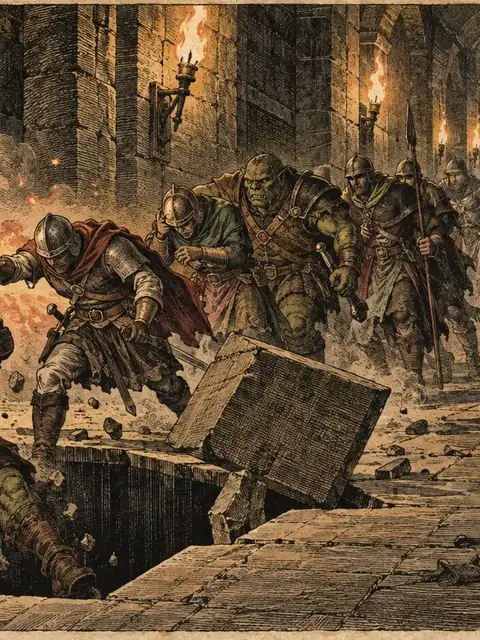
Warning or no warning, the attack came. The hosts of the evil gods poured into Arvandor, and the battle was terrible. At one point Ghaunadaur, the Elder Eye, held Corellon fast, pinning him where he stood. An ogre god came charging at him. Corellon reached for his sword, and the sword stuck in its cursed sheath.
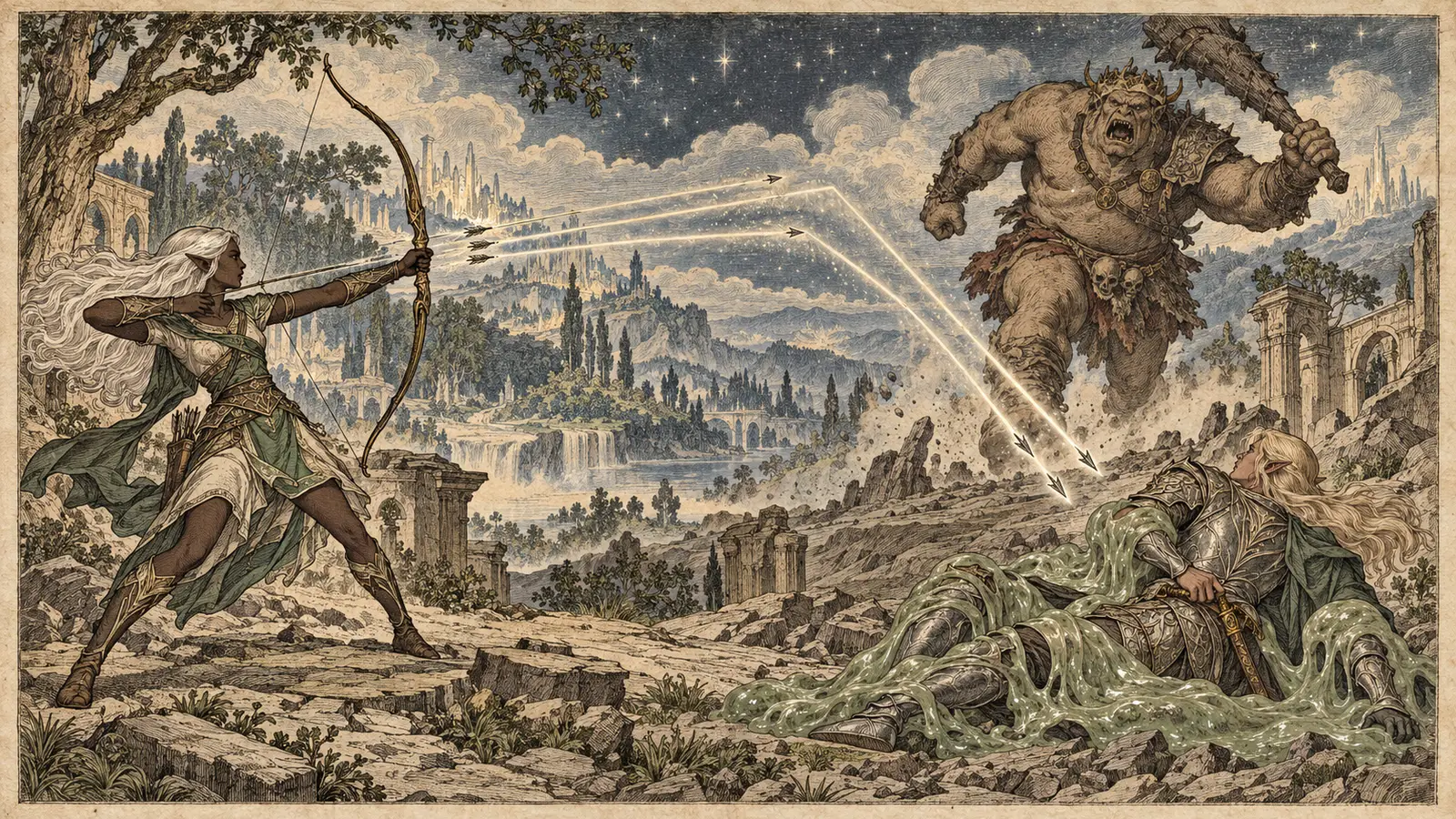
Eilistraee saw her father trapped and unarmed. She did what any brave and loving daughter would do. She drew her bow and loosed her arrows at the charging ogre god, quickly, one after another, to save him.
And the scabbard pulled them in. The arrows bent in their flight and drove into Corellon's chest. In the version told in Demihuman Deities, it was 's own magic, the magic of the goddess Araushnee was about to become, that turned the arrow in the air.
Corellon was badly wounded, but he did not die. Three goddesses of the Seldarine came to him then. Sehanine Moonbow, , the goddess of love and beauty, and , the goddess of air and sky, merged their powers into a single deity called Angharradh, a goddess of three faces, and she came to Corellon's aid. The tide of battle turned. The invaders were driven out.
Then came the judgments.
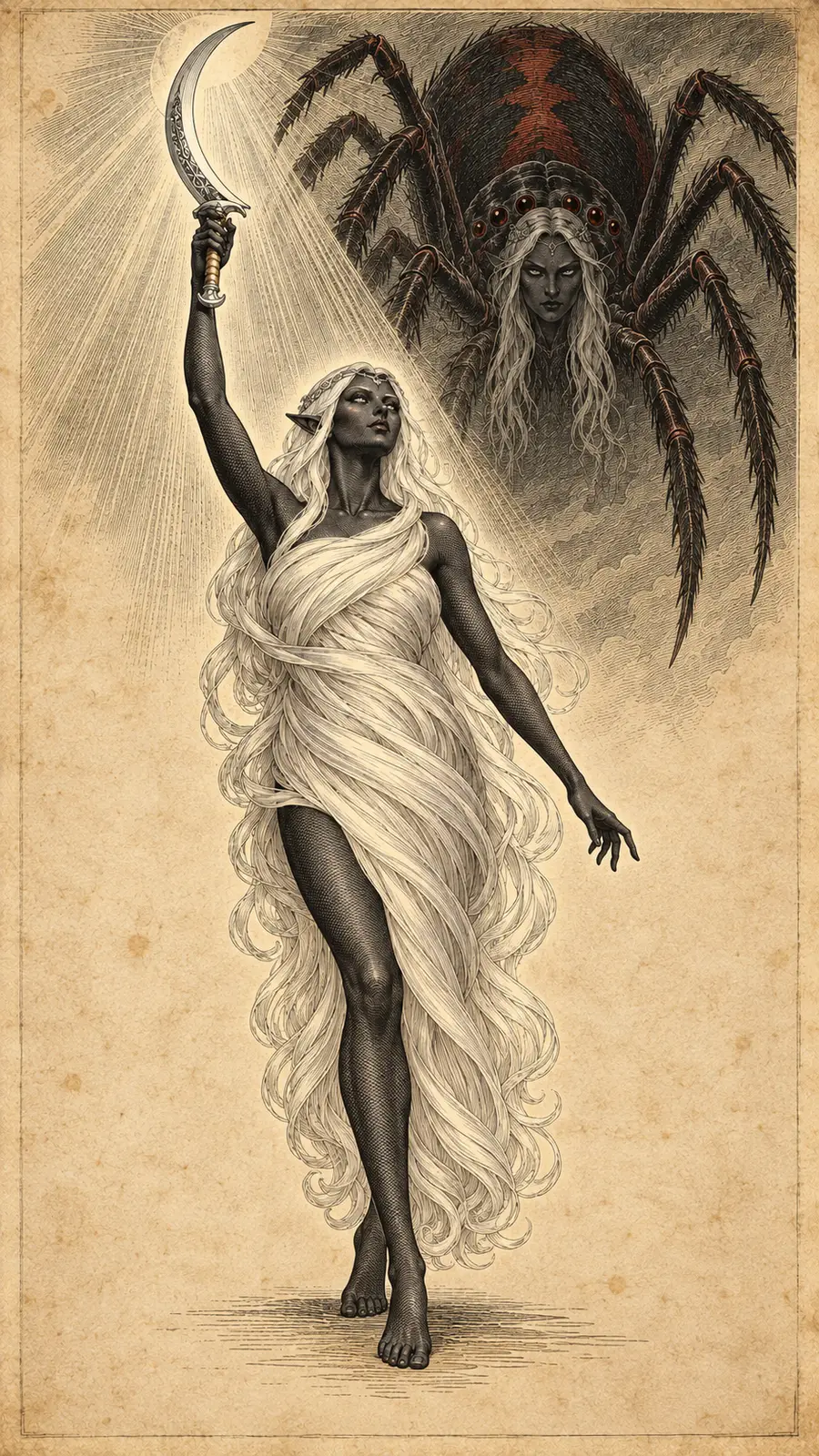
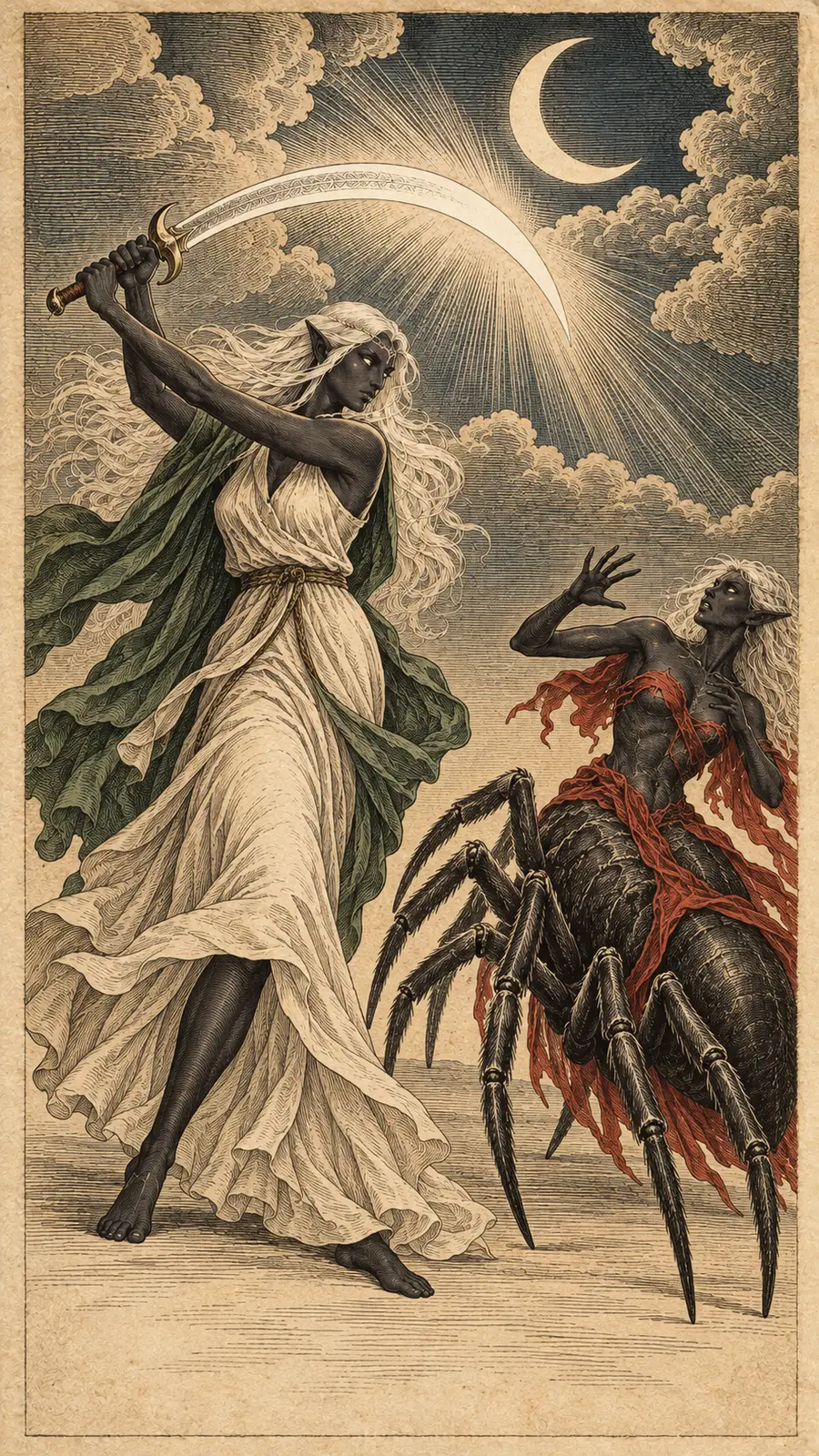
Araushnee's treachery could not be hidden any longer. Corellon cast her out of Arvandor and down into the Abyss, the endless plane of chaos and demons. There she was transformed into a tanar'ri, one of the demons of that plane, and she took a new name. She became Lolth, the Spider Queen. In time her realm in the Abyss would be the Demonweb Pits, a vast web strung across nothing, and from there she would reach up into the minds of the dark elves she had once watched over.
Vhaeraun was judged too. Corellon knew his son had been part of his mother's plots, and he banished him. In one telling, he was sent away to a mortal world.
And Eilistraee? Corellon knew the truth of what had happened. His daughter had been used. She had fired those arrows to protect him, and the curse had twisted her love into a weapon. She was found innocent, cleared of all guilt, an unwitting participant in her mother's scheme. She could have stayed in Arvandor, in the light, among the Seldarine, as the much-loved daughter of the First of the elven gods.
She asked to go into exile anyway.
This is the heart of Eilistraee, and nearly everything else about her grows from it. She looked ahead and saw what was coming. Her mother was going down into the dark, and her mother's people, the dark elves, would follow her. Lolth would set them on a path of hate and cruelty, and they would walk it for a very long time. Eilistraee foresaw that they would need something within reach, a beacon of good, a light they could find even after they had gone down into the deep places. Without her there, she believed, the drow would be lost to evil entirely. With her there, at least a few of them might be saved. And she wanted to save the few who could still be saved.
So she asked her father to let her share her mother's and her brother's punishment. Corellon agreed. In the words of Demihuman Deities, he did so "reluctant yet proud." You can imagine both of those feelings in him at once, the grief of a father sending his innocent daughter away, and the pride of a god who sees that his child has chosen the harder and kinder road.
At first she was banished close to her mother's new realm, alongside Lolth's domain in the Demonweb Pits. Later she was given a territory of her own in Arvandor, away from that first place of exile. So she came home, in a sense, but she never truly stopped being the goddess who had walked away from home for the sake of people who had not yet asked for her.
Her mission, from that day onward, was easy to say and very hard to do. She would draw the dark elves back toward the surface of the world. She would show them that a life without Lolth was possible. She would teach them to sing and dance and hunt beneath the moon, to live at peace with the other peoples of the world, and to set down the endless intrigue and murder that the Spider Queen demanded of them.
One more thing belongs to the end of this first story. Because Eilistraee lived between worlds, belonging fully neither to the bright Seldarine nor to the dark, the stories people told about her drifted far from the truth. On the surface, and in the Underdark too, she became the subject of wildly inaccurate legends. Some surface folk could not believe a good drow goddess existed at all. Some drow, taught by Lolth's priestesses, believed whatever dark rumour they were given. The real Eilistraee, the young archer who chose exile out of love, was often hidden behind the tales.
That old story, with the Weaver and the scabbard and the turning arrows, reached its full form in 1998, in Elaine Cunningham's novel Evermeet: Island of Elves, whose opening part tells of the elven gods and Araushnee's betrayal, and in the sourcebook Demihuman Deities that same year. But Eilistraee herself had arrived some years before that. To find her first steps into the game, we need to leave Arvandor behind and visit a home campaign, a set of players, and a goddess who first came to them in dreams.
Chapter II
A Dark Dancer steps out of a home campaign
Long before the Forgotten Realms was a published world, it was Ed Greenwood's world. He had been building it for years, writing about its towns and taverns, its wizards and its gods, and running games in it for his own players around his own table. In that private Realms, there was already a drow goddess who did not belong to the Spider Queen.
She came to Greenwood's players in several ways. Sometimes she appeared to them in dream visions. Sometimes she manifested, a presence felt or glimpsed. Sometimes she came in person. She was a goddess of dancing and moonlight, and he called her the Dark Dancer. Later she would be better known as the Dark Maiden, but the dancing never left her.
Then, at the start of the 1990s, Greenwood was writing a sourcebook for TSR about the dark elves of his world. During that work, TSR asked him for a deity for good drow. The request is credited to the editor Newton Ewell. It was exactly the opening Greenwood needed. He already had such a goddess. She had been living in his home games for years. He used the chance to make his Dark Dancer official.
The book was The Drow of the Underdark, and it was published by TSR in July 1991 for the second edition of Advanced Dungeons & Dragons. It was a Forgotten Realms book, devoted to drow culture, religion and society, and it carried new spells, magic items and monsters of the deep places. Jeff Easley painted its cover, and Tim Bradstreet and Rick Harris drew its interiors. It looked into the mysteries of and her worship, and it described the other powers the dark elves knew.
Its section on religion gave the drow a small family of gods. There was Lolth, of course, the Spider Queen, ruler of nearly all drow hearts. There was , the Realms' version of the Elder Elemental God, the old slime god of the depths. There was , a male god of stealth and thievery and of drow ambition on the surface world. And there was .
She entered the game as the Dark Maiden, the Dancer, goddess of good-aligned drow. Her portfolio was song, dance, swordwork, hunting, moonlight and beauty. She was set squarely against her mother, Lolth. And those who followed her were the good drow, the ones who wanted to escape the matriarchy of the Underdark where Lolth ruled, and who hoped to win back a place on the surface. They worshipped her in song and in dance. The ideal place for that worship was on the surface itself, beneath the moon, among the trees.
It's a striking thing to read even now. In a book otherwise full of poison, spiders and cruelty, here was a drow goddess who wanted her people to come up into the open air and dance. A modern reviewer remarked that she makes good drow make sense, and that's a fair way to see her. Before her, a good dark elf was an exception, a lonely figure walking against everything his people believed. With her, a good dark elf had somewhere to go, a faith to join and a goddess who wanted them.
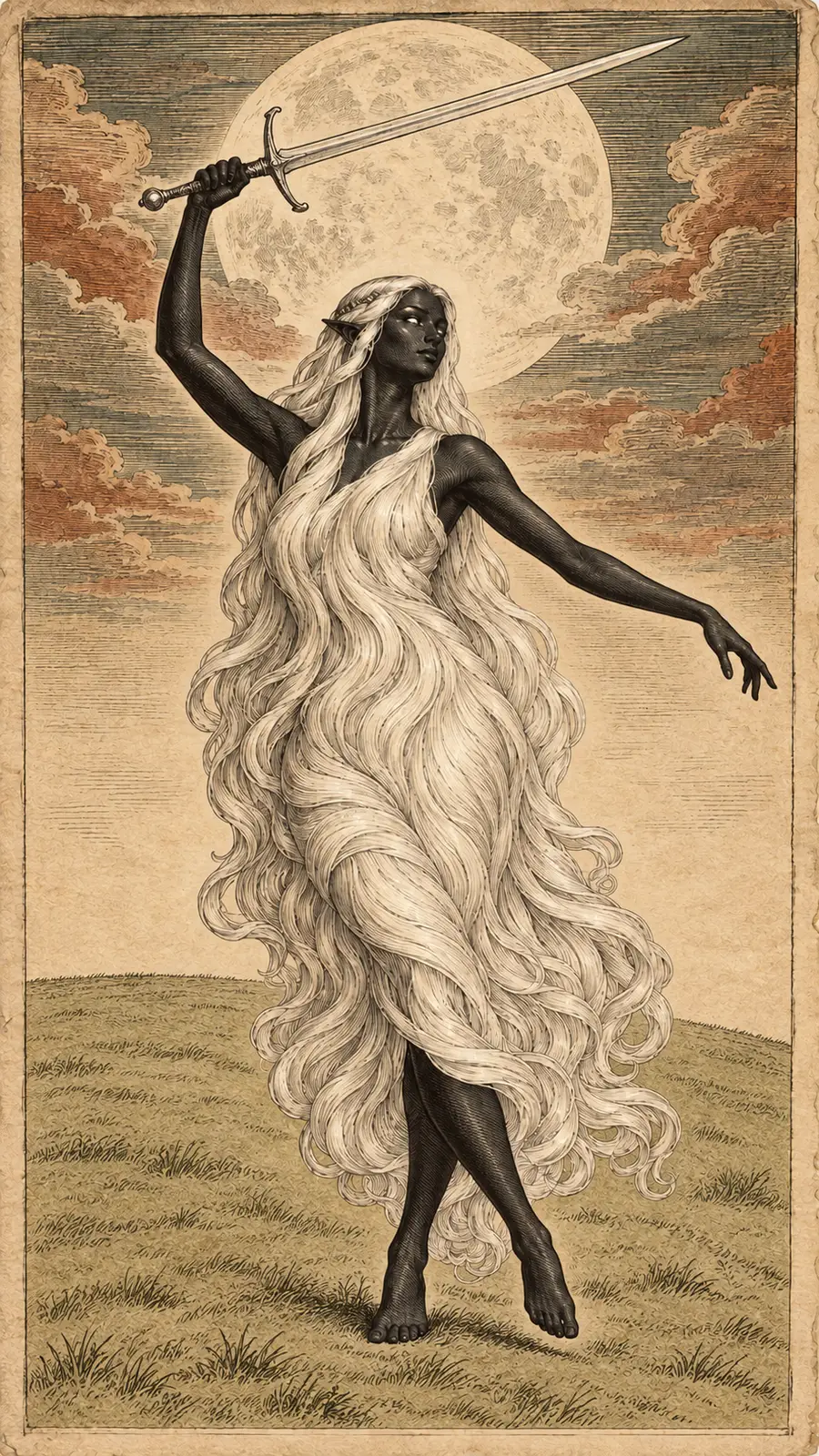
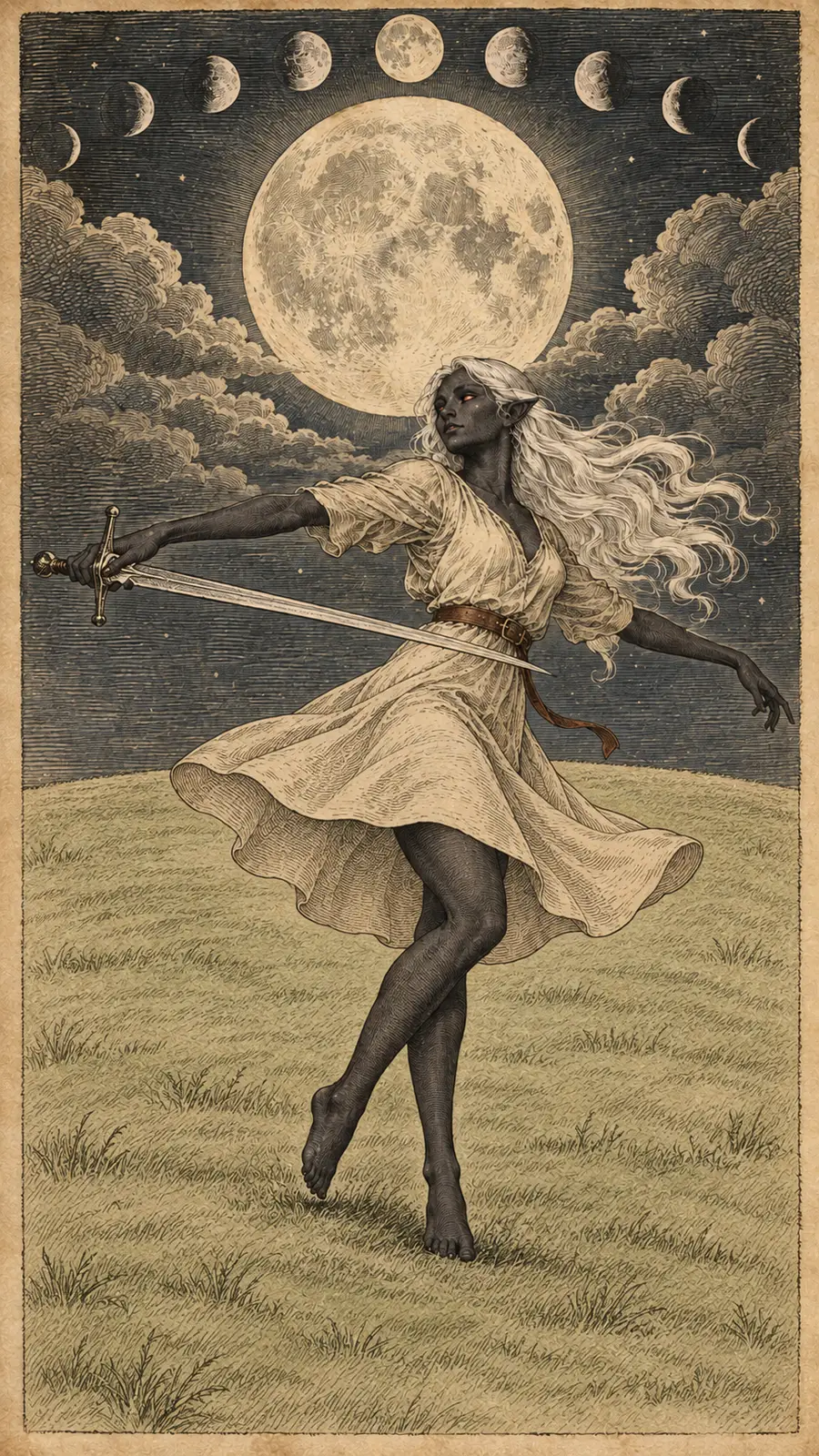
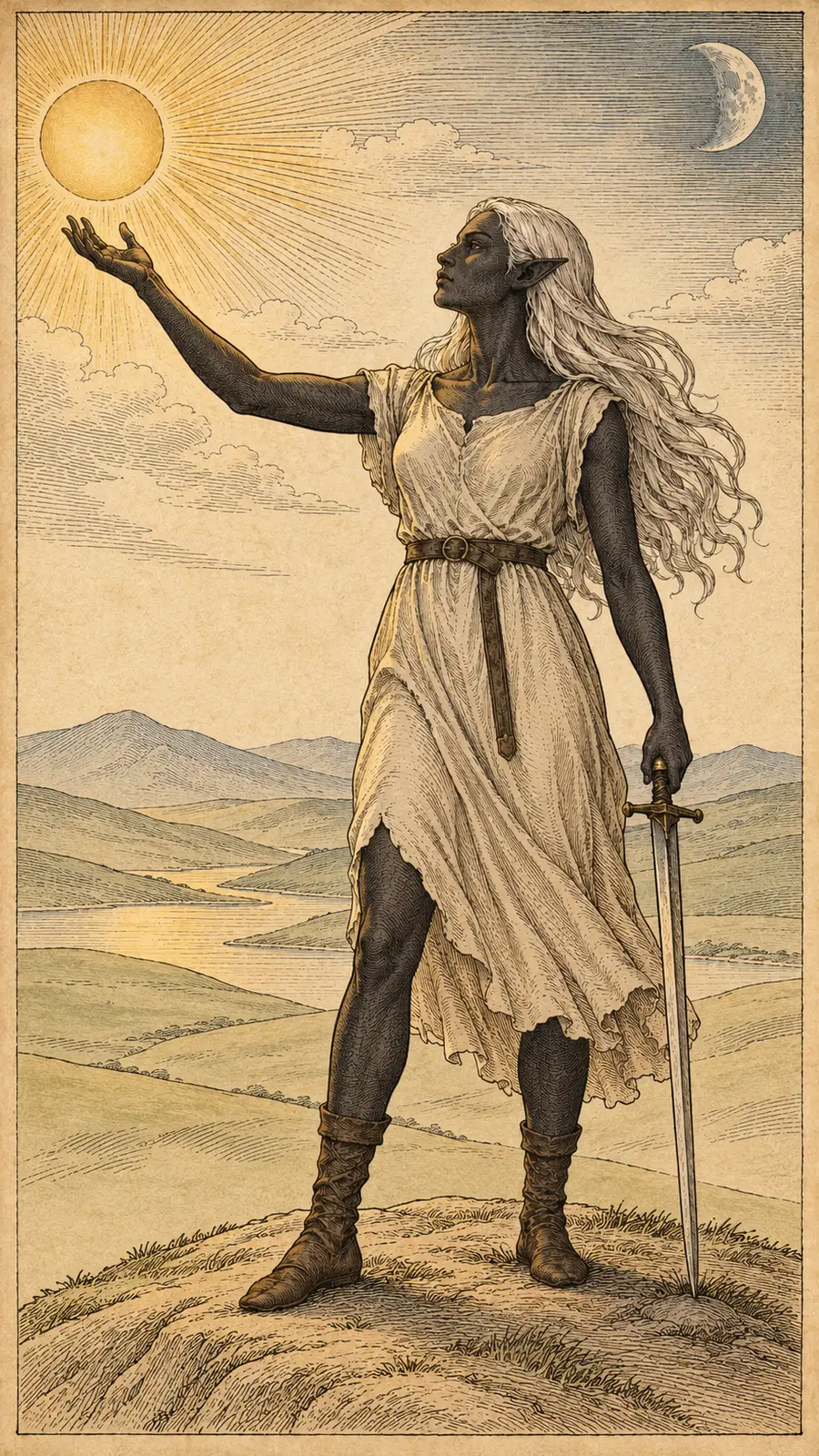
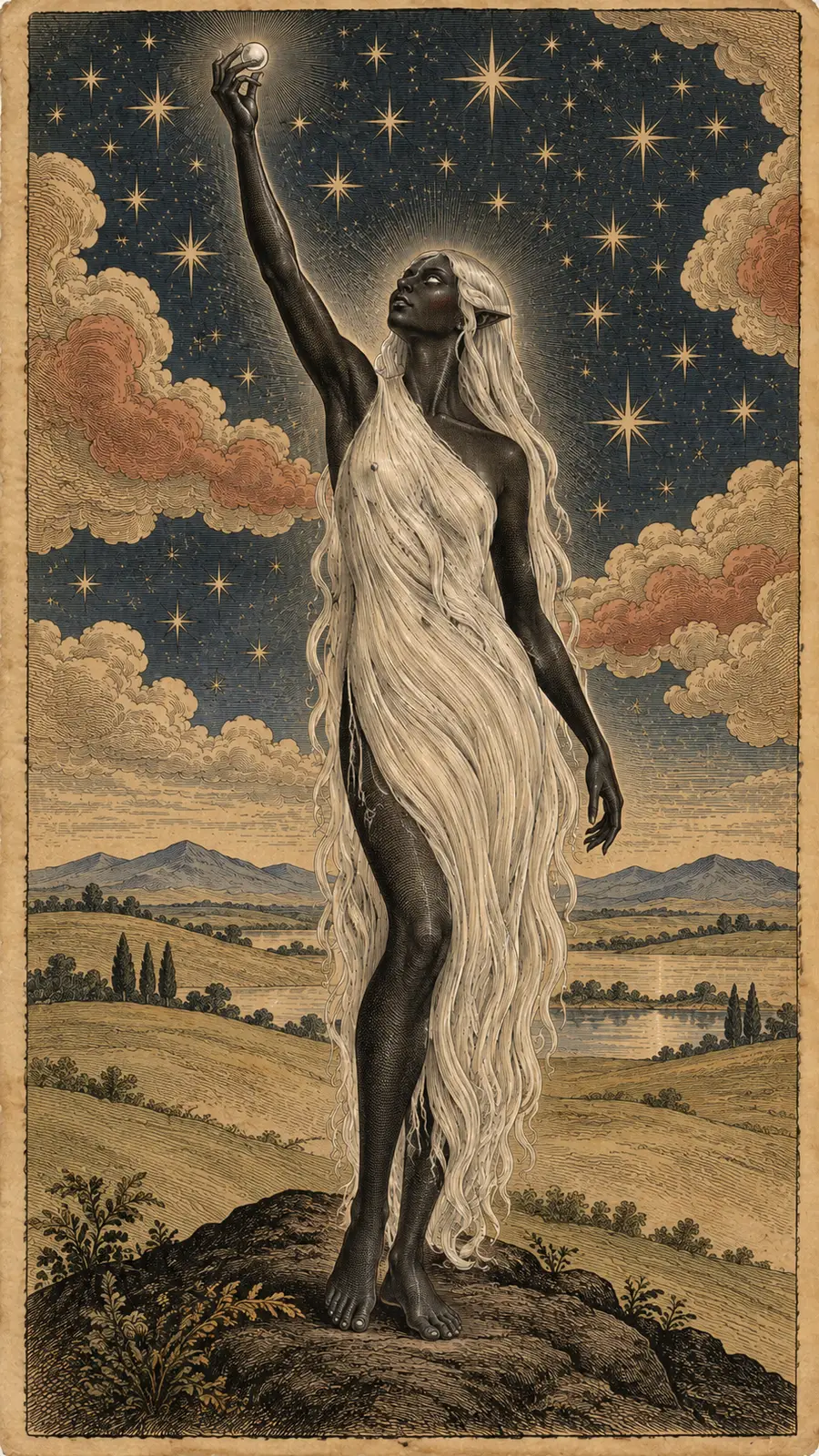
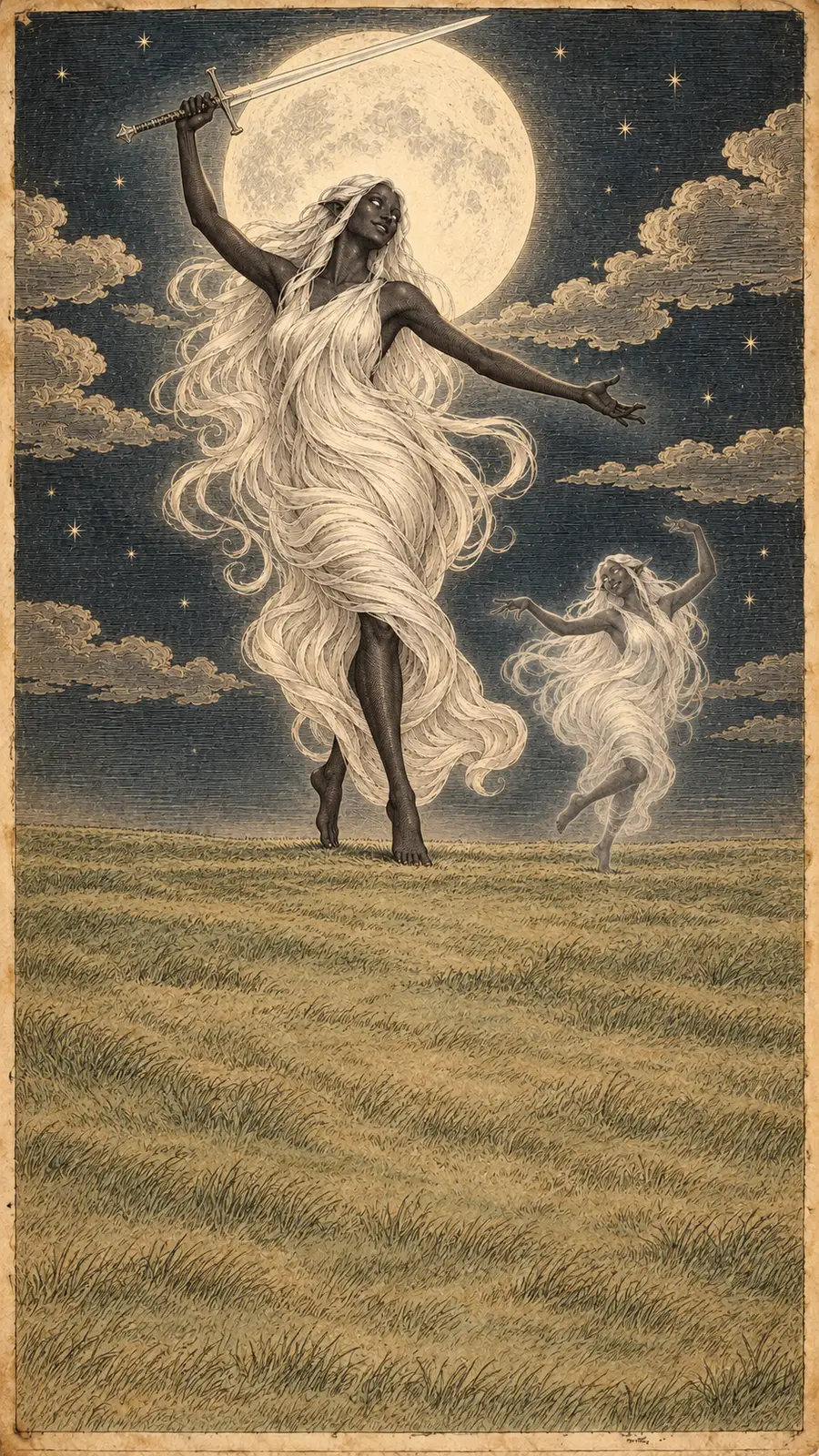
From the beginning, she had a look that would stay with her across every age to come. She was tall, about nine feet, lithe, with strong and graceful limbs and skin as dark as obsidian. She usually appeared unclothed, covered only by her hair, which fell all the way to her ankles and shone a bright silver. When she made her presence known, the most common sign was a silvery radiance. Sometimes it came with a snatch of song, or with a few echoing notes from a harp, as if someone just out of sight had touched the strings.
Her early holy symbol was a silver longsword standing upright, point to the sky, against a full moon. Around it hung a nimbus of fine silver threads. Those threads were her hair. It's a lovely piece of design. The sword is her swordwork and her hunt, the moon is her light, and her own hair wraps around both of them like moonbeams.
Her priestesses had a clear task. Their main duty was to encourage drow to return to the surface world and to show them that a life far from Lolth was possible. They were teachers, protectors and diplomats. When drow arrived on the surface, lost and hunted, unused to the open sky and feared by everyone they met, her priestesses sheltered them, fed them and healed them. And her priestesses did not wait for the lost to find them. They reached down into the Underdark too, to the drow still living there.
Her worship took place in moonlit forest glades and in stone circles. There was dancing. There were enchanted silver swords in the hands of her priestesses. There were sacred hunts held in her name. All of this would be filled in, deepened and named in the years to come, but the shape of it was there from the start, a faith of open sky and moving bodies, of blades and music together.
There is also a rite that belongs to the end of a priestess's life, called the Last Dance. When her time comes, a priestess of Eilistraee takes off her clothing and dances under the moonlit sky before she passes out of the world. It is one of the quietest and most beautiful images her faith has. The dance does not end at death so much as carry on past where we can follow it.
Years after that first book, Ed Greenwood spoke to fans about how Eilistraee works in his world, and his answers add something gentle to the picture of her early role. Every drow who sets out for the surface, he said, is "tempted by Eilistraee in their dreams." Those visions come in many ways. They come while a drow sleeps, or while they rest in Reverie, the elven trance that takes the place of sleep. They come while they lie wounded. They come while they sing, or while they let their minds drift into daydreams. And she sends them to drow who never go anywhere near the surface, too.
Think about what that means for a drow child growing up in a city of spiders. Somewhere in their dreaming, at some point, a tall silver-haired figure appears, dancing under a light they have never seen. Almost all drow, Greenwood said, learn that she exists, and they get a true picture of her. Lolth can't stop it. The Spider Queen relies on dream-visions herself to speak to her own people. If she shut that channel to keep her daughter out, it would cost her a great deal. Her lay worshippers would lose much of their sanity, her priestesses would lose much of their control over those worshippers, and Lolth would lose much of her control over her priestesses. So the door stays open, and through it, now and then, the moon comes in.
The Dark Dancer had stepped out of a home campaign and into the published Realms. In the years that followed, other books would take the outline drawn in 1991 and fill it with names, rites and ranks. We turn now to the second edition's long building of her church.
Chapter III
The Dark Ladies and the Sword Dancers
After The Drow of the Underdark, began to appear in more places. In May 1992, Carl Sargent's Monster Mythology gathered the gods of the non-human peoples of the game, the gods of orcs and giants, dwarves and elves, and the gods of the drow among them. It was the generic version of that cosmology, not tied to the Realms, and Eilistraee was counted among the drow powers there. In 1996, On Hallowed Ground placed her in the great cosmology of the Planescape setting, among the many gods of the planes. In 1999, Warriors of Heaven listed her among the good deities that celestials, the angels and other heavenly beings of the game, can choose to serve. Quietly, from book to book, she was becoming part of the furniture of the multiverse.
But the book that truly built her church was Demihuman Deities, published by TSR in 1998 and written by Eric L. Boyd. It was a Forgotten Realms book covering the gods of the elves, the drow, the dwarves, the gnomes and the halflings, and it gave every one of them a full portrait, their appearance and personality, their worshippers and church, their dogma, their holy days and ceremonies, the clothes their priests wore and the special priests who served them most closely. For Eilistraee, it was the fullest treatment second edition would ever give.
Here she is a lesser deity, chaotic good, with her home in . Her titles include the Dark Maiden, Lady Silverhair and the Moon Maiden. And it is in this book, alongside Elaine Cunningham's Evermeet, that the whole story of and the cursed scabbard is set down, the story we began with tonight.
Her holy symbol changed here too. Now it showed a nude, long-haired drow woman dancing with a silver bastard sword before a full moon. The sword standing alone had become a dancer holding a sword. You could say the symbol caught up with the goddess. She had always been the Dancer, and now her symbol was dancing too.
Her avatar, the form she takes when she walks among mortals, is described the way we have come to know her. She is an unclad drow woman, about nine feet tall, her skin glossy and dark, her hair sweeping down to her ankles and glowing with silver light. In battle she carries one of two kinds of weapon. Sometimes she fights with a pair of identical singing swords that dance through the air. Sometimes she wields a single blade called the Moonsword, a keen bastard sword, enchanted to the highest degree, which dances too.
She can call up moonfire whenever she wishes, a silvery light that she shapes as she likes, and she can conjure dancing lights. She can make music sound out of the air, the music of harps, of horns, of flutes. She can sing. Once in each short span of a battle, she can turn back every spell aimed at her in that moment, letting it rebound from her the way moonlight glances off still water. And once in each span, she can heal herself, even to the point of regrowing a lost limb. It's a picture of a goddess who is hard to wound and harder to keep wounded, a dancer who always rises again.
She shows herself in smaller ways too. She can turn a mortal's hair into a mane of silver flame, and keep it that way for as long as she chooses. And when she is watching one of her priestesses closely, the priestess's eyes begin to glow silver. Her faithful have a word for that. They say the priestess has been made moon-eyed.
Now, her church.
Her clergy as a whole are called the Dark Ladies. That is the name of the whole body of her priesthood, though each temple gives its own priestesses their own titles and names. There's no rigid hierarchy. Her church is free in the way its goddess is free, and each community of the faithful shapes itself.
Then there are her specialty priests, the ones most perfectly shaped to her purpose. They are called the Sword Dancers. Under the rules of the time, only female elves, drow, half-drow and half-elves could become one. A Sword Dancer must be quick and agile, skilled in dancing, in singing and in tumbling. And she must be a good diplomat, because her work is as much talking as fighting.
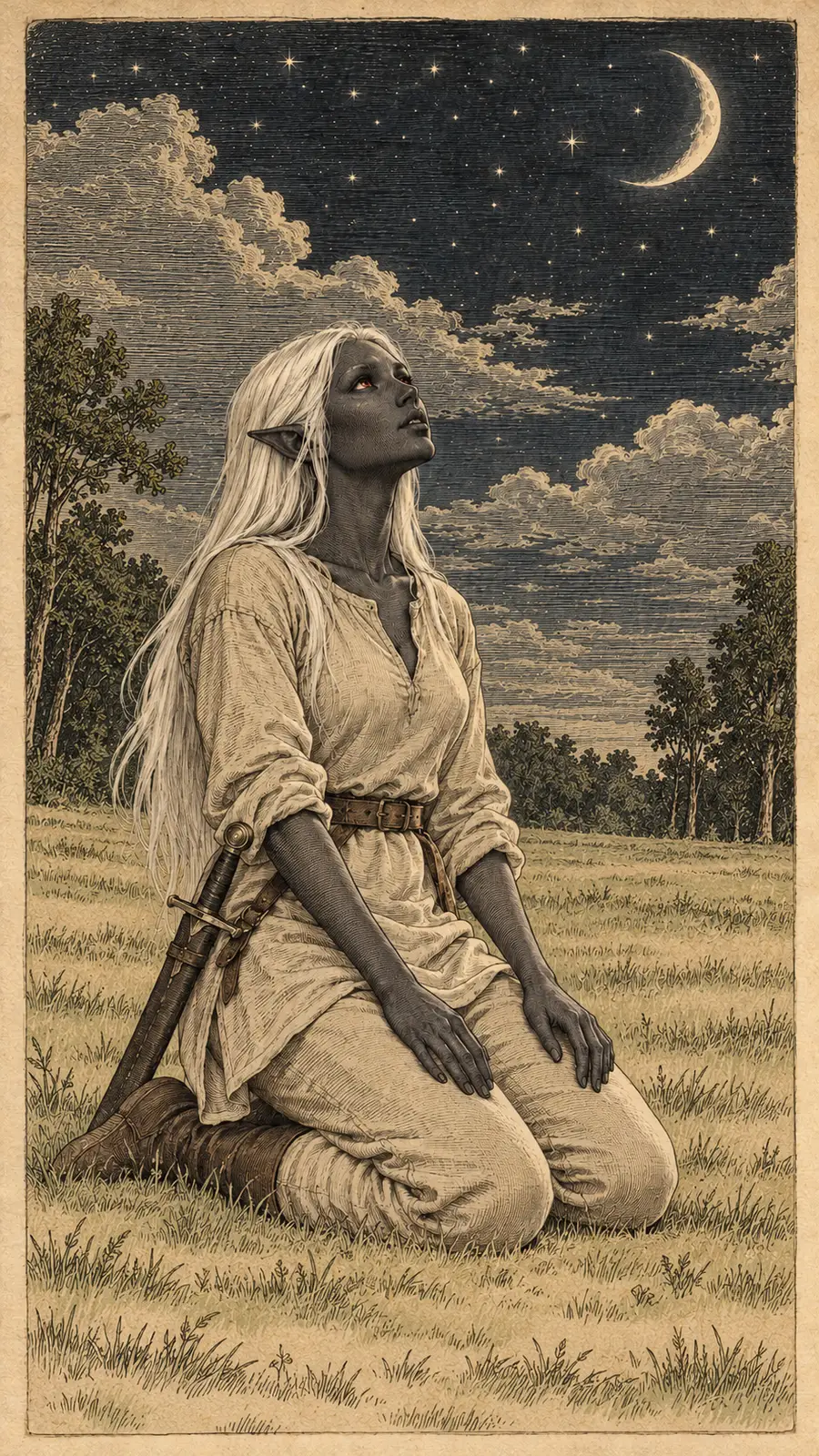
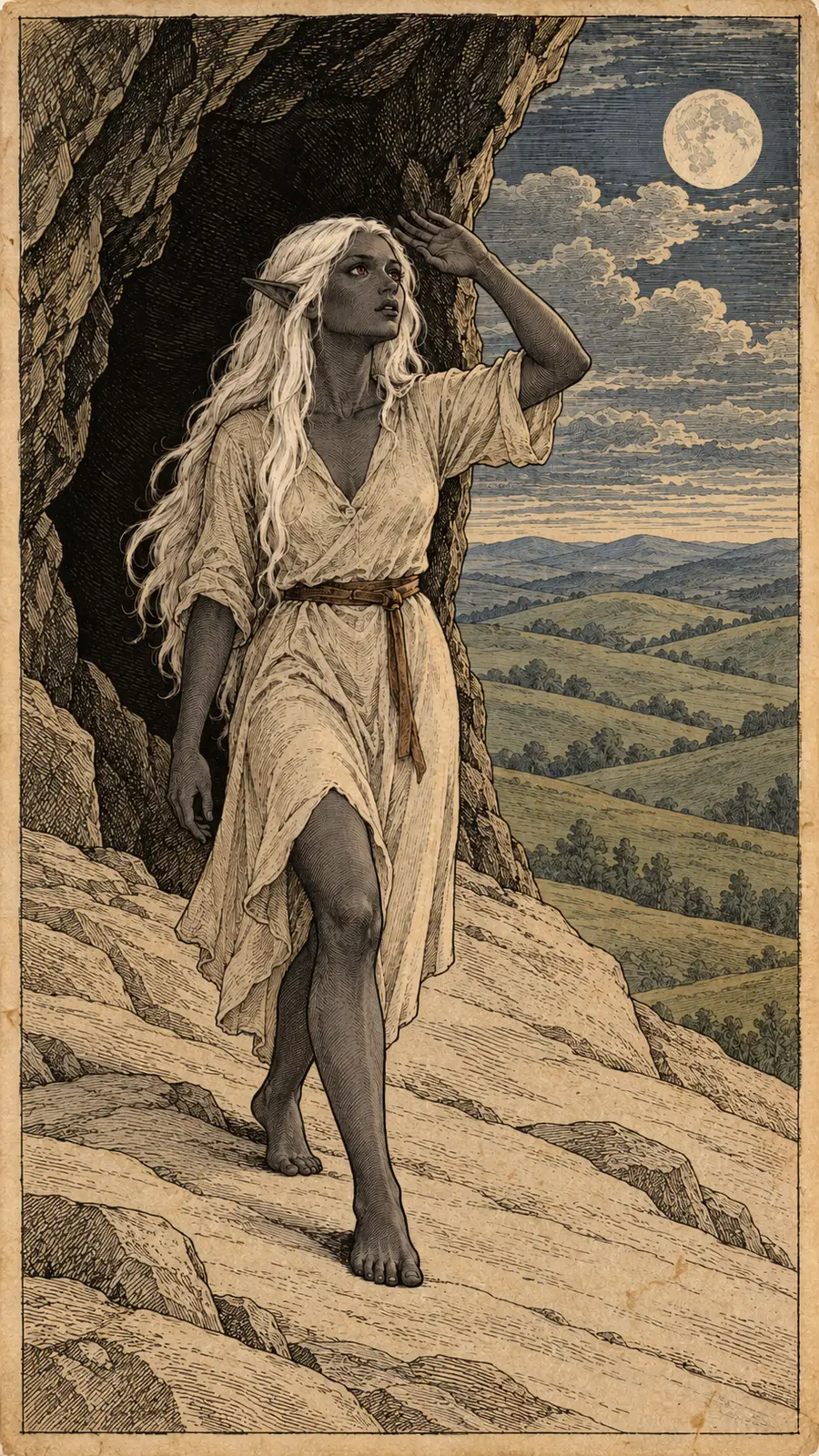
The way a candidate becomes a Sword Dancer is one of the loveliest pieces of Eilistraee's lore. She must spend at least a month on the surface world. Every night of that month that the moon shines, she must dance for Eilistraee. And at least once, she must witness the dawn.
Imagine what that asks of a drow. A creature of the dark, whose eyes are made for the deep places, who has been taught all her life that the surface is cruel and that the sun is a burning enemy, must go up into the open world and stay there, and dance under the moon night after night, and then, at least once, stand and watch the sun come up. That last condition is quietly profound. Dawn is the end of the moon's reign and the beginning of the day, the very light the drow fled from. A Sword Dancer has to see it, to let it touch her, before she can serve.
Once she is a Sword Dancer, her role is to be an extension of Eilistraee's motherhood of the drow. She becomes a teacher, a protector and a diplomat, helping drow make lives for themselves on the surface and find community there. A drow fresh from the Underdark has never known community in the way surface folk know it. Every neighbour in a drow city is a possible murderer, and every kindness is a trap. The Sword Dancers teach a new way to live together.
Her priestesses have no ceremonial garb at all. In their ceremonies they wear as little as possible. When they're at rest, somewhere safe, they like silvery gowns, light and diaphanous. Her clerics pray for their spells as the moon rises.
Who worships her? Mostly the rare dark elves who want to come back to the surface and live at peace with other peoples. But anyone of any race who wishes for all peoples to live in harmony is welcome among her faithful. Humans pray to her, and elves and half-elves, gnomes and half-orcs, and shapeshifters too, those her faithful call the children of the moon. Bards, musicians and dancers pray to her for their art. Hunters pray to her for their hunt. And the goddess herself takes great delight in one thing in particular. She loves it when bards learn new songs.
Now the rites, because Eilistraee's faith is a faith of things done more than things believed.
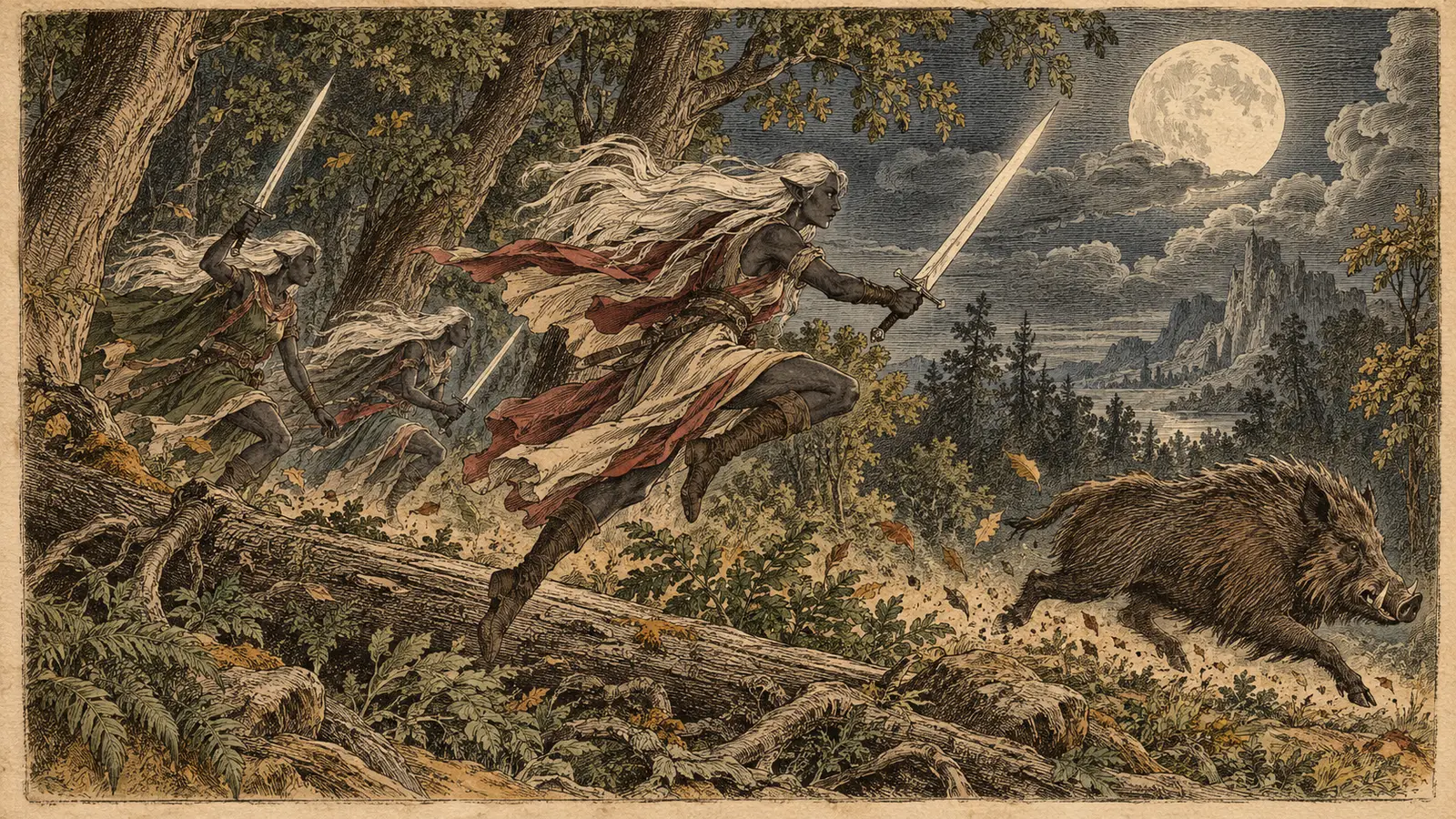
There is the High Hunt. A dangerous beast is hunted in darkness. The hunters go unarmoured, and often unclothed, carrying only a sword. When the beast falls, all of them pray aloud together, and then they form what is called a Circle Song, praising their goddess in music around the place where the hunt ended.
There is the Run. A group of the faithful travels through the surface world, and on their way they rely on three things, kindness, music and skill with the sword, rather than on force. They bring food and art and help to the surface communities they pass through, and then they return. The lesson the Run teaches is that music, dance and song can do more than the sword. For a faith whose priestesses all carry swords, that's a meaningful thing to teach. The blade is there. It's simply not the first answer.
There is the Grand Chorus, which is described as "an ever-changing song of celebration." A senior priestess leads it, guiding the singers with an overriding theme or melody, while everyone else weaves their voices in and out around her line.
There is Evensong, a personal and intimate dance of thanks.
And there is the Moonsong, which is high magic, given by the goddess to her followers for journeys to faraway places. Her priestesses sing a soft melody that sounds like wind. As they sing, a curtain of moonlight forms before them. They dance into it, and they travel along the moonbeams to wherever they need to go. If you like to picture these things as you drift, picture that one. A ring of dancers, a shimmering veil of pale light, and then nobody there at all, only the last note fading in the trees.
All of this takes place within a small and difficult family. In this era the drow gods are , Eilistraee, , and . Kiaransalee is a goddess of vengeance and the undead. Zinzerena is a goddess of chaos and of trickery. Every one of them except Eilistraee is evil, and all of them except Eilistraee want, in one way or another, to take Lolth's place. They want the throne. Eilistraee wants something else. She doesn't want to replace her mother as the ruler of the drow. She wants to free the drow from being ruled that way at all.
By the end of the 1990s, Eilistraee had begun to appear in fiction as well as in rulebooks. In 1999 Ed Greenwood wrote a novella called "Dark Dancer, Bright Dance" for the anthology Silverfall: Stories of the Seven Sisters. It is set in the years after the Time of Troubles, the season when the gods of the Realms were forced to walk the world as mortals. It opens in Forest, near the city of Waterdeep, at a place called the Ladystone. Priestesses of Eilistraee are dancing there in the night. And into their dance comes an outsider, a human woman named Dove Falconhand, who tries to join them.
Some of the priestesses are hostile. They don't trust outsiders, and you can understand why. Every drow on the surface has learned to expect a blade from strangers. But the priestess who leads them listens to Dove, and agrees to go and look into a troubling matter in the town of .
That priestess has a name we haven't spoken yet. She is the most important mortal in all of Eilistraee's story, and she deserves her own chapter. Her name is .
Chapter IV
Qilué Veladorn and the Promenade beneath Waterdeep
To understand , we have to meet her family, and her family is a strange one.
In the Forgotten Realms there are seven sisters who are each a Chosen of , the goddess of magic. Ed Greenwood created them, and TSR gave them a sourcebook of their own, The Seven Sisters, in 1995. Among them are some of the most famous women in the Realms. Silverhand is one. Dove Falconhand, who stepped into the moonlit dance at the Ladystone, is another. They are all daughters of the same mother, and that mother was carrying more than ordinary children.
Their mother was a half-elf sorceress named . Mystra came into her, inhabiting her, so that Elué would bear daughters who carried the goddess's power. That possession was a heavy thing to carry, and when Elué's husband, Dornal Silverhand, realised what had happened to his wife, he killed her.
But the seventh daughter had not yet been born. And Mystra went looking for somewhere for her to go.
She found a drow named Iliryztara . Iliryztara was an adventurer who led a band of 's followers, and she was carrying a child of her own, a child who had died before it could be born. Here two goddesses met. Mystra spoke with Eilistraee, and they made a bargain. The unborn children were exchanged. Mystra's seventh daughter was placed in Iliryztara's womb, and so she was born full-blooded drow, though her six sisters were human, and though by every ordinary reckoning her parents had been a human man and a half-elf woman. Some tellings call her the Dark Sister. Her birth is set in the year 767 of Dalereckoning, the calendar of the Realms, which makes her very old by the time our story finds her.
From that moment, Qilué belonged to both goddesses. She was a Chosen of Mystra, sharing in the goddess's silver fire, the raw divine power Mystra lends to a very few mortals. And she was a priestess of Eilistraee, and in time a Chosen of the Dark Maiden as well. The drow who followed her called her the Chosen of the Chosen. She was their leader and their inspiration, and she was recognised as the spiritual guide of all of Eilistraee's faithful. She was always careful with her power, because she served two goddesses, and both of them were free spirits. A servant of two free spirits has to walk carefully indeed.
She was about six feet tall, with a wild and dazzling beauty. Her silver hair fell to her ankles. Her eyes were silver too, and larger than most drow eyes, just like her goddess's. If you ever saw Qilué and Eilistraee side by side, you might wonder for a moment which one was the reflection.
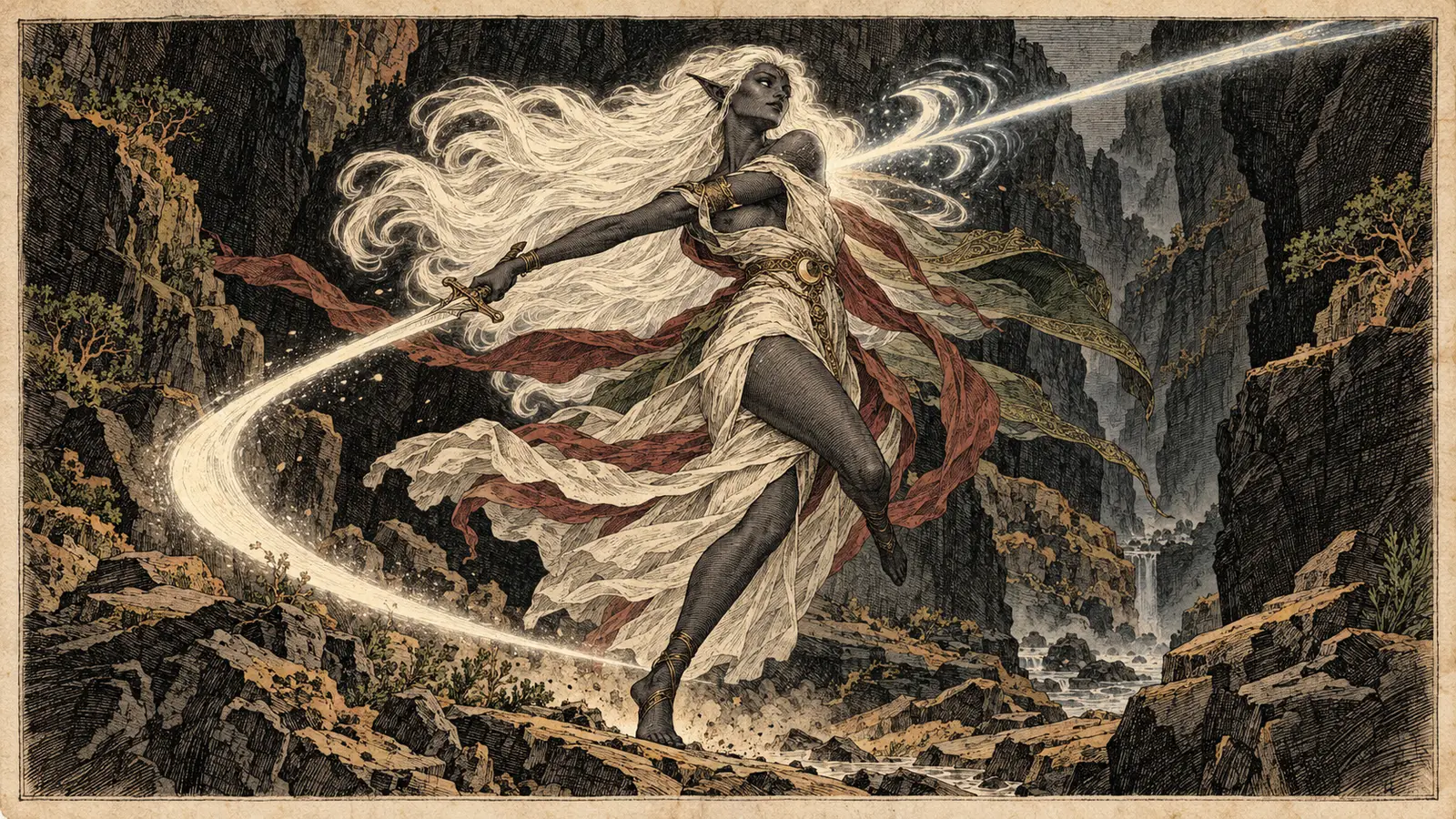
She carried a unique singing sword. She could store it in a hidden place within the Weave, the fabric of all magic, and draw it out whenever she wished, as if pulling it from the air. She called it Dancing Mistress. Eilistraee, though, called it by another name, Iluemeirarra, which was the name of one of the goddess's own servitors, a drow spirit whose soul and mind had been bound into the blade. So when Qilué fought, she fought alongside a friend of her goddess, and the sword sang with a voice that had once belonged to someone.
Qilué's great work was the Promenade of the Dark Maiden.
Most of Eilistraee's temples are on the surface. That's the whole point of her faith, after all. But her most sacred temple of all lies underground, beneath the city of Waterdeep, in the vast dungeon called , northeast of the hidden port of Skullport. Older descriptions place it on the Level, one of the deep layers of that maze. It is a strange place for a moon goddess's holiest shrine, and the reason it's there is a story of its own.
Before the Promenade, there was the Pit of . It was an ancient temple to the Elder Eye, the same shapeless god who had once held fast in 's great battle. At its heart was a shaft a mile deep, connected to the Sargauth Level of 's Undermountain, and through it, the god of oozes and abominations could have reached up and attacked the surface world. It was an open wound in the stone beneath one of the greatest cities in the Realms.
When Qilué was young, the story goes, Eilistraee appeared to her and to her playmates. The goddess gave them singing swords. And she told them to destroy the Pit.
They did. And on the ruins of that temple to the Elder Eye, Qilué built a home for the Dark Maiden's people, in the one place where they were most needed to stand guard. Some accounts place its founding in 1355 of Dalereckoning.
Let's walk through it, slowly, the way a visitor might.
The Promenade is a group of great caverns. In one of them stand the buildings where the faithful live, the homes of drow who have come out of 's cities and found their way here. In another are the quarters of the priestesses. Another holds mostly storehouses and armouries, for the temple guards.
Then there is the Cavern of Song. It's an open amphitheatre, about a hundred feet tall, where songs and celebrations to Eilistraee are held. And it has a strange and wonderful property. In the Cavern of Song, every echo dies, except the echoes of song. You could drop a sword on the stone and hear only a dull, lonely clatter that goes nowhere. You could speak, and your words would fall flat. But if you sang, your voice would come back to you, again and again, rising up into that hundred feet of dark. It's as if the cavern itself had decided to hear only one kind of sound.
From the Cavern of Song a large side cavern leads to a place called Eilistraee's Mound. There, dwarves carved a great block of stone into a towering statue of the Dark Maiden. There's a lovely small secret about it. The statue was actually modelled on Qilué. When the faithful look up at their goddess in stone, they are also looking at their high priestess.
Beside the main temple is the Hall of Healing. Once, long ago, it was a temple of , a dark god of rot and corruption, and worshippers of Tyr, the god of justice, destroyed it. Now it shelters and heals the temple's wounded, and anyone the Dark Ladies rescue from the depths.
A temple in Undermountain has to be defended, and the Promenade is. Its warriors train every day. The best of them become Protectors of the Song, the temple's guard, and many carry one of the twenty singing swords that belong to the temple. Their first duty, beyond guarding the Promenade itself, is to patrol the Pit, so that Ghaunadaur can never come back through it. Guards on the outer passages stay alert at all times against the dangers that wander Undermountain. Every priestess there can fight, at least a little. And the elven art of bladedancing is taught there, along with other ways of fighting.
Among the people of the Promenade were Qilué's own daughter, Veladorn, a priestess of Eilistraee who served there, and Iljrene Ahbruyn, a drow priestess and Qilué's friend.
The Promenade was not the only holy place of the faith. Up on the surface, in Forest, was the Dancing Dell, where the Ladystone stands, a stone that Eilistraee herself once touched. Qilué sometimes led worship there, and it was there that Dove Falconhand tried to join the dance. There was the Dancing Haven in Waterdeep. There was the Dancing Stone in Elventree. You can see a pattern in the names. Almost every place sacred to her is named for dancing.
Now, the Promenade did not reach most readers through sourcebooks. It reached them through a novel.
In 1995, the same year as The Seven Sisters, Elaine Cunningham published Daughter of the Drow. It was the first book of a trilogy called Starlight and Shadows, which went on with Tangled Webs in 1996 and finished, after a long pause, with Windwalker in 2003.
Its heroine is , a gifted young wizard and a princess of House Baenre, the first house of , the great drow city. Her father is Baenre, the city's archmage. When she was five, Gromph had her mother killed so that he could take his magically talented daughter for himself. That's the world Liriel comes from.
Liriel learns, from surface books, of an artifact called the Windwalker, an amulet that lets its wearer carry magic that normally works only near places of power. Drow magic is bound to the deep places, to the strange radiance of the Underdark. Liriel wants to store her drow magic in the Windwalker, so that she can keep it with her on the surface. Out beyond the city, she finds the amulet on the body of a drow killed by deep bats. The priestesses of Menzoberranzan learn of her plans and plot her death, and her rival, , allies with a drow named , the leader of a band called the Dragon's Hoard.
Liriel escapes to the surface, using a book her father once gave her, and there she joins a young man named , a berserker from the land of . And there, on the surface, she meets drow who worship Eilistraee. She meets Ysolde. She meets Qilué.
At the end of the first book, at the Promenade, Liriel and Fyodor join with the Chosen of Eilistraee, and with a deep dragon named Zz'Pzora, to attack the headquarters of the Dragon's Hoard and defeat them. For many readers, this was the first time they saw Eilistraee's people in action, a temple of good drow beneath a surface city, armed and singing and unafraid.
In Tangled Webs, Liriel is exiled for taking the Windwalker, and she and Fyodor sail for the island of aboard a pirate ship. The Dark Maiden's people stand mostly offstage in that book, and Liriel's quest takes her to Northmen, to a sacred tree, and to Lolth's plots below the earth.
Then Windwalker. It's set in 1361 of Dalereckoning. Liriel can now command her drow powers anywhere, and Fyodor has mastered his rages. They set out to return the Windwalker to the Witches of Rashemen, and on the way they come again to the Promenade, where Qilué tries to help them.
Trouble follows them. A drow named Gorlist leads what remains of the Dragon's Hoard against the Promenade, seeking revenge. In the fighting, Shakti Hunzrin kills Ysolde, Qilué's daughter. It is a quiet grief in the middle of a busy book, and it lingers.
At the story's end, Fyodor dies. Liriel, in her despair, comes very close to turning to Lolth, ready to offer the Spider Queen total submission in exchange for his life. And at that moment, Eilistraee answers instead. The goddess surrounds Liriel with light and magic. She does not need to be asked by name. She comes to the drow at the edge of the dark, as she always said she would.
And yet Liriel does not become her priestess. Her true calling is magic, and she chooses to follow Mystra. She feels that her presence brought only loss and suffering to Eilistraee's priestesses, above all the death of Ysolde, and she decides she would never have had a place among them. It is a gentle and honest ending. Eilistraee's light is offered freely. It does not demand to be kept.
By the time Windwalker came out, the Realms had moved into a new edition of the game, and Eilistraee's church was being written up in a new and much more detailed way. Let's go up out of Undermountain, and into the moonlit glades of third edition.
Chapter V
Moonlit glades and warrior orders in third edition
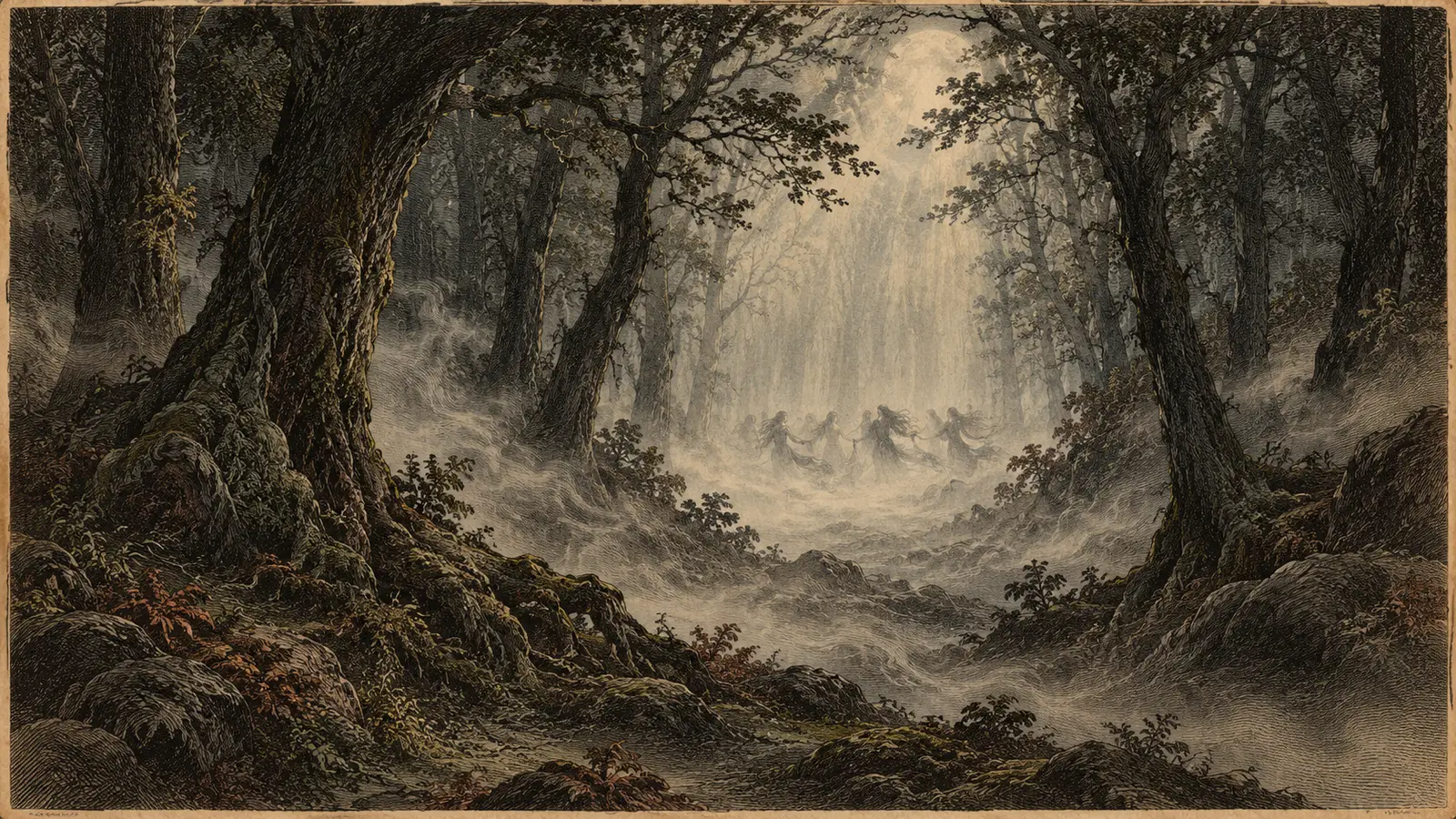
The third edition of Dungeons & Dragons arrived in 2000, and in 2001 the Forgotten Realms Campaign Setting brought the Realms into it. For the gods of the Realms, this meant something new. Each of them now had a full set of game statistics, the domains of magic their clerics could draw on, a favoured weapon, and a place in the rules alongside the old descriptions. The current year in the Realms, in those early third-edition books, was 1372 of Dalereckoning.
was in that book. She was still a lesser deity, chaotic good, a drow goddess of the Dark , the name now given to the drow gods as a pantheon of their own, with her home in . Her portfolio was still song, beauty, dance, swordwork, hunting and moonlight. Her titles were the Dark Maiden, the Lady of the Dance, Lady Silverhair, and sometimes still the Dark Dancer. Her favoured weapon was a bastard sword, and it had a name, the Moonsword.
A year later, in May 2002, came the book that would describe her faith most deeply in this era, Faiths and Pantheons, by Eric L. Boyd and Erik Mona. It took every major god named in the Realms setting and gave each a full account, their dogma, their clergy, their temples and their rituals. Eilistraee's entry gave her church more texture than it had ever had.
Her worshippers, it says, are mostly good drow who want to escape the evil, -worshipping matriarchy of the Underdark and win back a place in the surface world. They are called Eilistraeeans. They have three great aims. They encourage drow to come back up to the surface. They try to bring harmony between drow and the surface races. And they nurture beauty, music and song wherever they go.
One teaching deserves its own moment. Every follower of Eilistraee learns the true history of the dark elves. They learn of the Crown Wars, the ancient wars among the elven kingdoms, and they learn where the drow really came from, from elven kingdoms long since lost. Lolth's priestesses tell their people a different history, one that serves the Spider Queen. Eilistraee's faithful are taught the truth instead. There's a quiet power in that. Before a drow can choose another way, they have to know that another way was once there.
Her dogma is warm and simple. It stresses unity, merriment, self-improvement and kindness to all, without shying away from battle when battle is needed. One tenet tells the faithful to "Promote joy and happiness everywhere, was it with song, dance, jest or kind words." Her followers learn to make instruments and play them, to learn songs and to dance. Her clerics try to bring happiness wherever they go, lifting people's spirits with kindness and cheer, with songs and jokes, with dancing and revelry. If you met one on the road, you might well be offered a tune before you were offered a blade.
Her clergy were still called the Dark Ladies. New initiates and acolytes were called Maids. Beyond that, the titles varied from temple to temple, and they're worth hearing aloud, because they read almost like a song of their own. A priestess of Eilistraee might be called a Moon Dancer or a Moon Singer, a Dark Huntress or an Argent Maid, a Living Sword or an Unsheathed Blade, a Sword Smith, or a Protector. One title is the Bright Edge of Darkness. And one of them, the most haunting, is the Ghost of the Moonstruck Night.
Her clerics often trained in other paths as well, as fighters, bards or rangers, or as Sword Dancers. They prayed for their spells at night, after the moon rose, and they sang their prayers whenever they could. And worship itself had no hard rules at all. It was free expression through dance and song. All you needed was a moonlit glade. Where the moon couldn't reach, deep underground, some other light would serve.
The main act of worship, as third edition describes it, has a lovely shape. First, a hunt for food. Then a feast. Then the Circle of Song. The worshippers sit in a circle and take turns dancing, each one leading a song in turn, the others joining in, the lead passing round the circle like a cup.
Two of the great rites had a rhythm to them now. The Run was held at least once a year, a journey through the surface world on music, kindness and skill with the sword. The High Hunt was held at least once each season, a night pursuit of a dangerous beast or monster, led by her clerics.
Third edition also filled her church with orders, and three of them shape her story in this age.
The first are the Silverhair Knights. They are wholly devoted to redeeming the drow who follow Lolth, and the other dark gods, and then to protecting them once they've turned. And they practise mercy as a rule. They fight other dark elves only by non-lethal means. Think about what that asks of a knight. They go into a war against the cruellest people in the world, a war where their own lives are always at risk, and they carry the vow that they will not kill the very people trying to kill them, because those people might yet be saved.
The second are the Darksong Knights. They are fierce warrior-priestesses, crusaders trained in hunting demons. Their special quarry is the yochlol, the demonic handmaidens of Lolth, shapeshifting servants that carry the Spider Queen's will. The Darksong Knights were most active in and under the lands of ancient in the south of , a land deeply bound to the oldest history of the drow. They often went on missions into the Underdark alongside the Sword Dancers and the Silverhair Knights. And for all their fierceness, they swore to uphold Eilistraee's teachings with a particular focus on mercy and compassion. In 2005, Champions of Valor gave players a way to follow the Darksong Knight's path.
The third are the Sword Dancers, who had been her specialty priests in second edition and now became a prestige class, a special path that experienced characters could take. They remained what they had always been, a special order of drow priestesses who were artists, dancers and acrobats, who sang and played at least one instrument, usually a harp, a flute or a horn. They fought with an agile, acrobatic style of swordplay that looked like dancing. Their duty was to lead from the front, in missions to find drow trying to reach the surface, to encourage them, to help them and to protect them.
To take the Sword Dancer path, a character had to be skilled in diplomacy, singing and dancing, trained in quickness and swordplay, and able to cast divine spells. And the path held one ability that captures the whole spirit of the order. It was called Sword Song. A Sword Dancer could attune herself to one sword, magical or plain, by carrying or wearing it for at least eight hours a day over a tenday, the ten-day week of the Realms. One sword at a time. Slowly, through days of closeness, the blade and the dancer learned each other. There was even an epic version of the path, for Sword Dancers who rose to the very highest levels of power.
Away from the great temples, this era also described small and gentle places of worship. One of the loveliest is Shadowtop Glade. It lies in the north of , near Harrowdale in the Dalelands. It is two sets of caverns on either side of a steep gully, ringed by tall shadowtop trees. About fifty drow and other elves live there. They get along well with the humans of the area, and when local folk fall ill, the dwellers of the glade nurse them.
Under the full moon, something remarkable happens at Shadowtop Glade. Lycanthropes from the nearby Howling Hill, shapeshifters who worship the moon, come to join them. Together they hold sacred hunts, in honour of both Eilistraee and , the great moon goddess of humankind. And when the hunt is done, they dance the Evensong together, that intimate dance of thanks. Drow and werewolves, elves and moon-blessed beasts, all dancing in one clearing under one moon. If you were looking for a single picture of what Eilistraee hopes the world could be, you might find it there.
In 2003, the sourcebook Underdark described the deep places of Faerûn for third edition, the world the drow would have to climb out of. And in May 2007, a book appeared that carried Eilistraee beyond the Realms. It was a new Drow of the Underdark, sharing its title with the book where she was born, written for the 3.5 revision of the rules by Ari Marmell, Anthony Pryor, Robert J. Schwalb and Greg A. Vaughan. It was largely meant for drow in any world of the game, not just the Realms. Its drow pantheon held Lolth, Vhaeraun, and Eilistraee. Its options and prestige classes leaned heavily toward the Spider Queen's darkness, as you'd expect of a book about the drow. But it set Eilistraee among the drow gods as the good one, the goddess of dark elves who sought redemption and the surface. Wherever a table's drow lived, there could now be a Dark Maiden waiting for them.
Third edition gave Eilistraee's church more knights, more temples and more rites than ever before. But it was also the age when the novels of the Realms came to her doorstep with darker news. In 2002 a great series began, and through it, a priestess of Lolth would find her way to the Dark Maiden, and carry a blade made from the moon itself into the Spider Queen's home.
Chapter VI
The Crescent Blade and Halisstra's turning
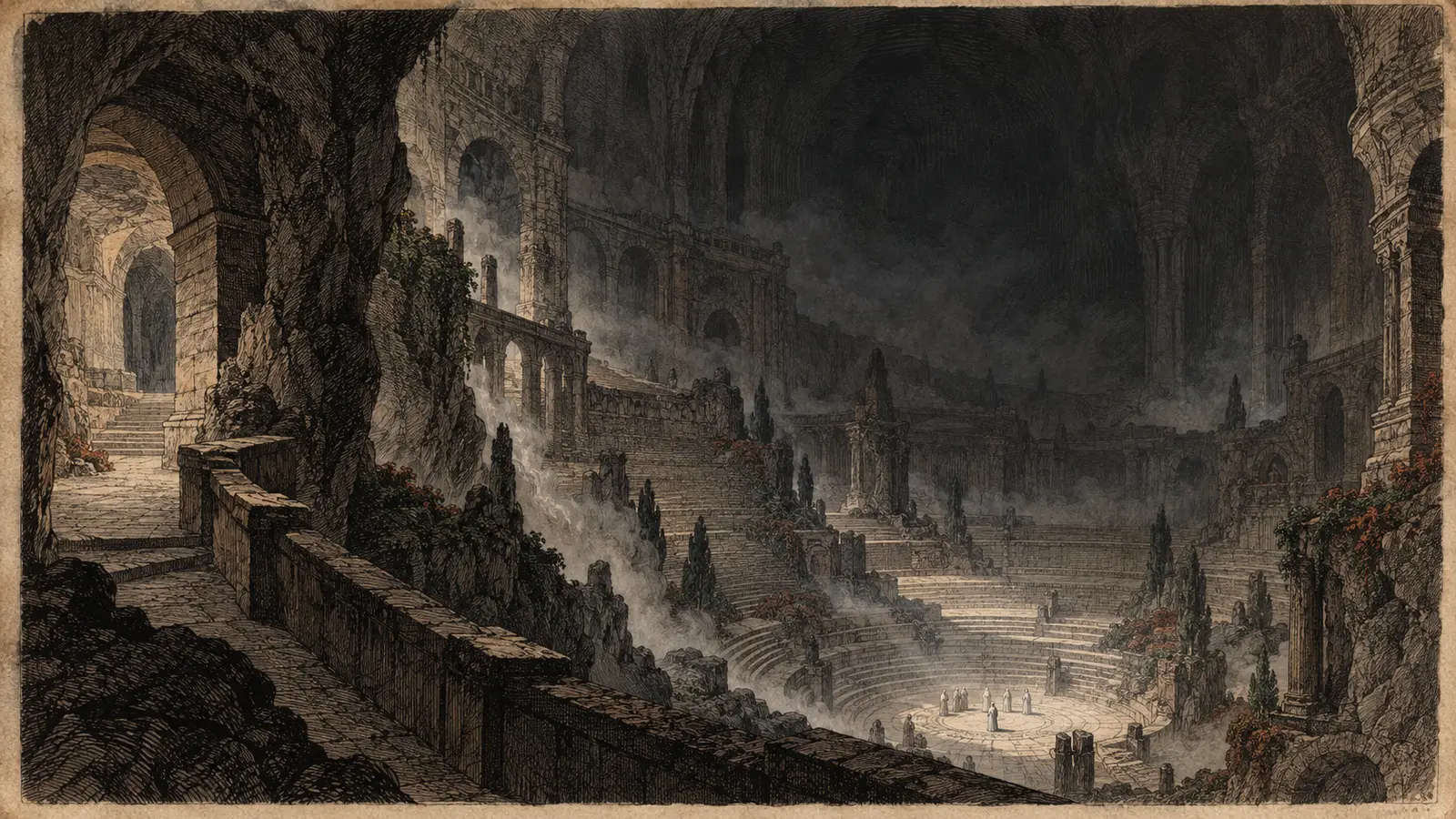
The series was called War of the Spider Queen. It ran to six novels between 2002 and 2005, overseen by R. A. and written by six authors in turn. The story belongs, above all, to . In the year 1372 of Dalereckoning, the Spider Queen fell silent. For about a year, her priestesses could reach her no longer. She had gone into a kind of hibernation, and her aim was to make herself a greater goddess, and to tear her realm of the Demonweb Pits free from the Abyss. While she lay vulnerable, her champion, , guarded her. And her son, , 's twin, came very close to killing her, before Selvetarm saved her.
Selvetarm is worth a moment's note, because he'll come back. He was once a drow who followed Eilistraee, before he became the Spider Queen's champion.
Eilistraee's thread through this great series begins in the third book, Condemnation, written by Richard Baker in 2003, and it runs to the end. It is the story of one drow woman, .
Halisstra was a priestess of Lolth, of House Melarn in the city of , a city of webs and calcified stone strung across a vast cavern. When Ched Nasad fell, she was left with no house. She had a servant, a battle-captive named , who would in time turn against her. And in the year of the Silence, the forces of Elventree, a town in the forest of , captured her.
There, Halisstra met a woman named . Seyll was a drow high priestess of Eilistraee who advised Lord Dessaer of Elventree. She had once been a priestess of Lolth herself. One hint at why she turned away is that her own daughter was killed for failing a senseless test set by the Spider Queen. Seyll knew exactly where Halisstra was standing, because she had once stood there too.
So Seyll tried to bring Halisstra to the Dark Maiden. She did it in two ways. She told her the goddess's message, the message of freedom, kindness and the open sky. And she trusted her. She trusted Halisstra far more than anyone would expect anyone to trust a priestess of Lolth, as if trust itself were part of the teaching.
That trust was partly misplaced. On the way to a gathering of Eilistraee's faithful, Halisstra killed Seyll.
But Seyll's kindness did not leave Halisstra. She kept remembering her. And she kept remembering something else too. In the Demonweb Pits, she had seen Vhaeraun attack, and she had seen Lolth, her own goddess, do nothing. Those two memories, a stranger's trust and a goddess's silence, worked on her quietly, the way water works on stone.
In the fourth book, Extinction, written by Lisa Smedman in 2004, Halisstra was attacked by a troll, and followers of Eilistraee saved her. Her lover, the weapons master , was in danger, and to save him she said that she wished to convert. She meant it as a trick. Then came the test of faith, and the test was simple. She had to kill a spider. A spider, the holy creature of Lolth, the creature every drow child is taught to revere. And as she passed that test, Halisstra realised that she truly meant it. She had changed. Ryld followed her into the faith.
After her conversion, Halisstra had a vision. Her destiny, it told her, was to find an ancient magical sword called the Crescent Blade. As a new priestess of Eilistraee, around 1373 of Dalereckoning, one of her first great tasks was to recover that blade and use it to kill Lolth.
Here we come to one of the most beautiful pieces of lore in Eilistraee's whole story.
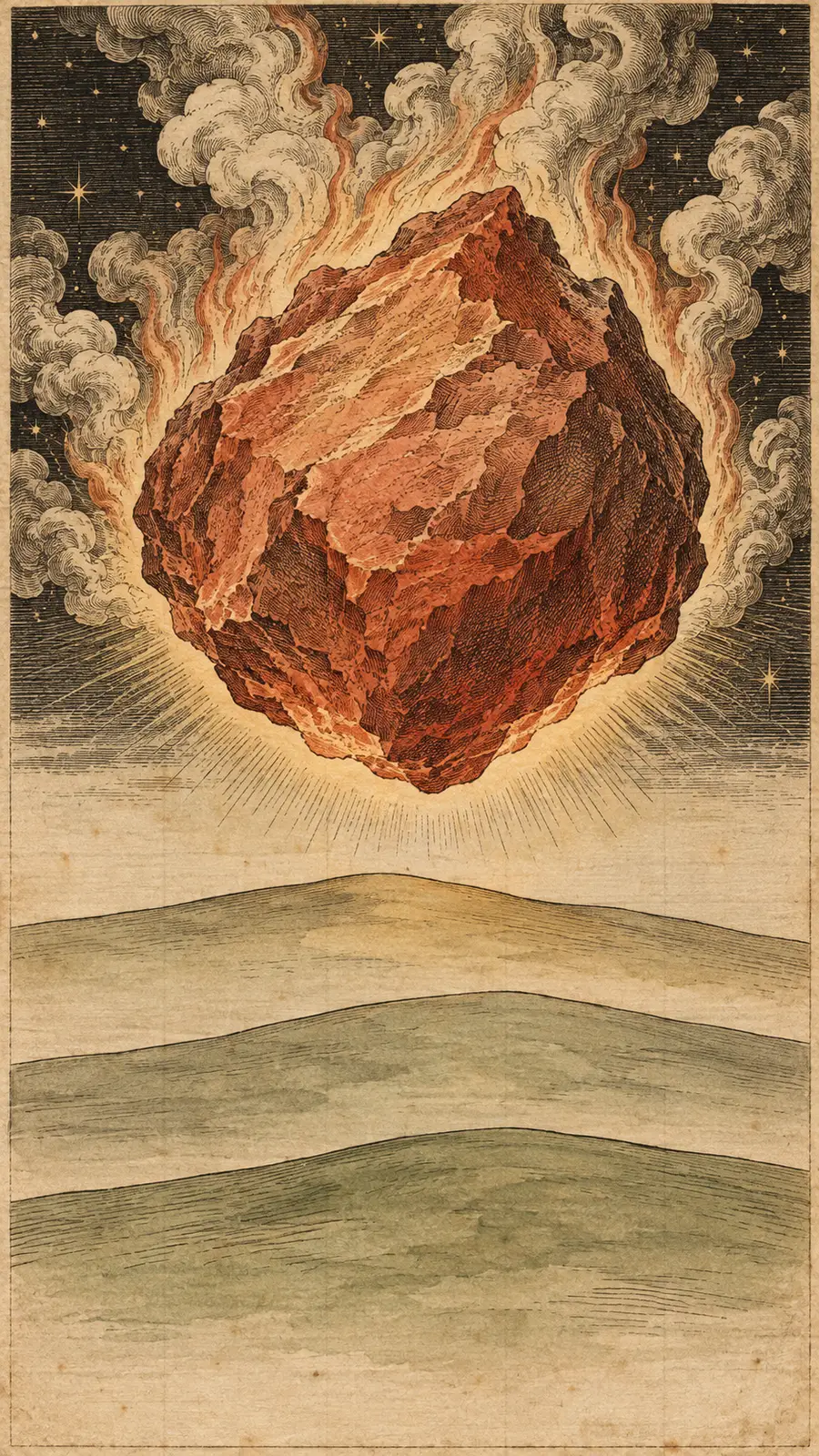
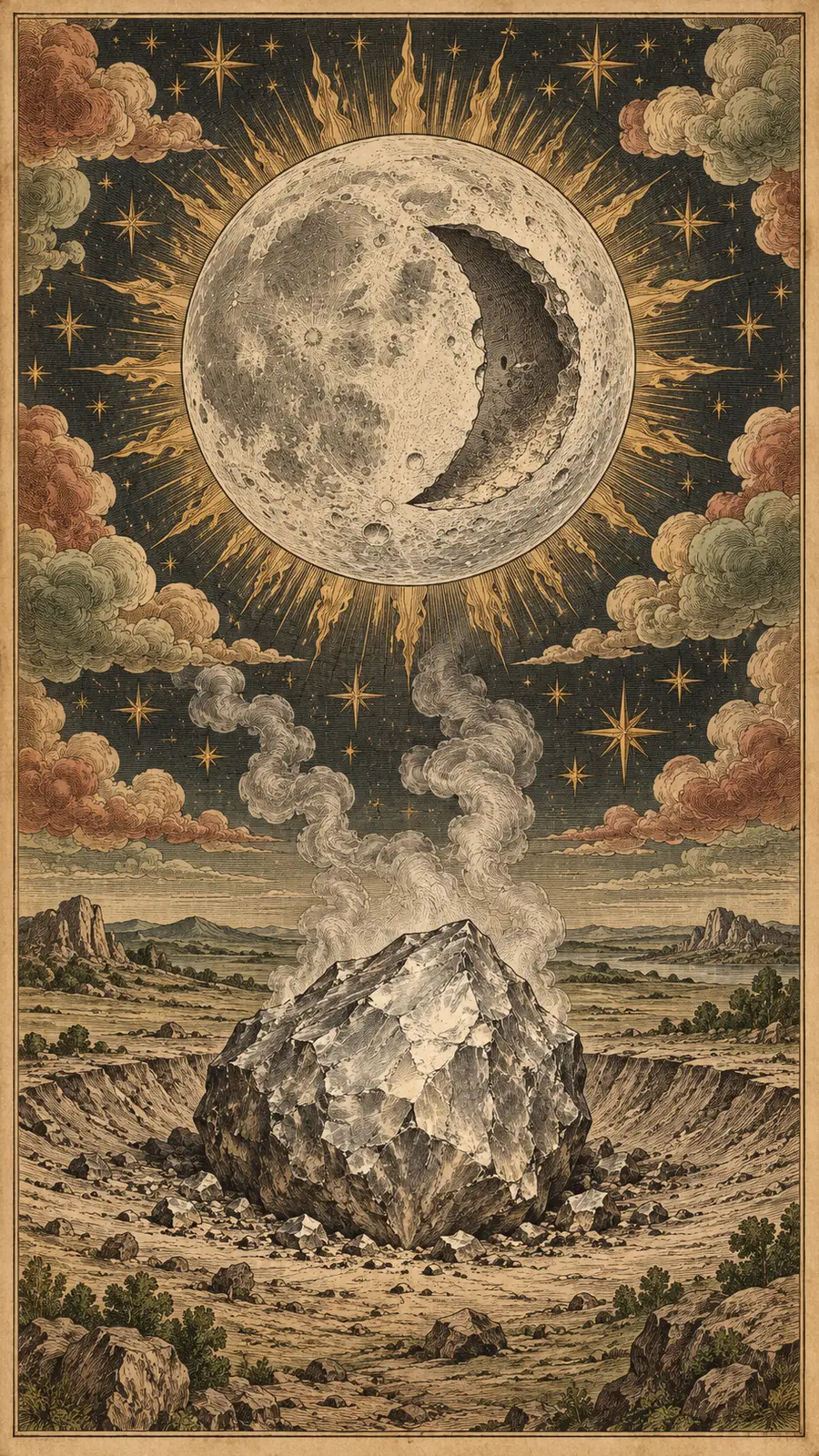
The legend says that the Dark Maiden once reached up into the heavens and plucked a pebble from them. She tossed it down to the earth. As it fell, it grew, and when it landed it was a boulder, huge and very hot. It was moonmetal. And if you look up at the moon, the legend says, you can still see the hole it came from, shaped like a crescent.
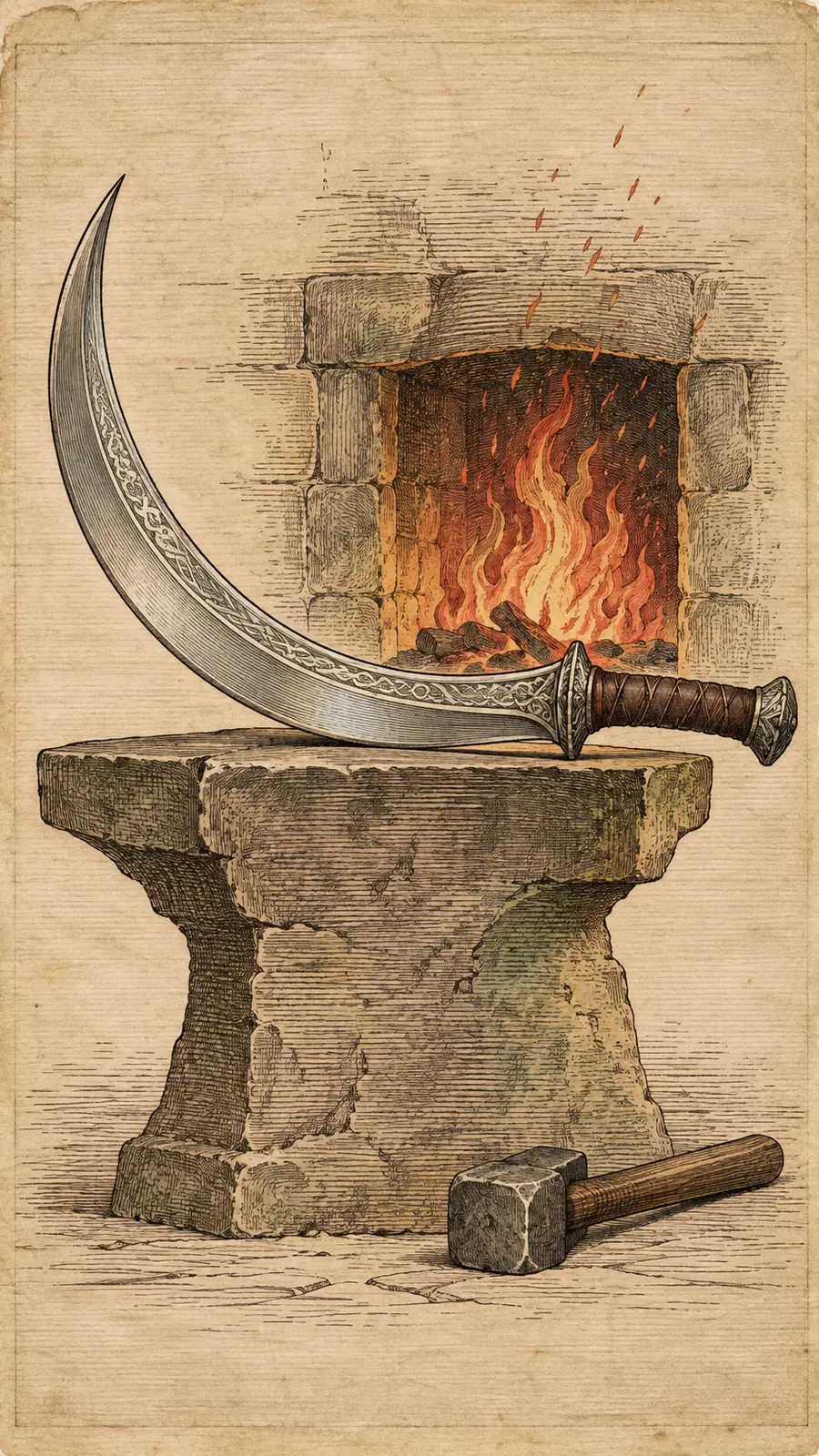
That boulder was forged into a sword. It was a curved blade, shaped like the crescent moon, inlaid with silver, on a leather hilt. And it was said that Eilistraee had it made for one purpose, the destruction of Lolth.
The Crescent Blade carried enchantments drawn from moonlight. It could cut through armour and stone. It guarded its wielder against evil and let her strike quickly. And if a true priestess of Eilistraee held it, it could cut through the neck of any creature at all, even the neck of a god.
Halisstra was not the first of her family to carry it. Long before, an ancestor of hers named Melarn had borne it. Mathira was a Sword Dancer of Eilistraee from Ched Nasad itself, proof that even in that city of Lolth, the Dark Maiden had once had her dancers. Mathira died on a place called the Cold Field, burned by the acid of a black dragon, and the blade was lost there.
In 1373 of Dalereckoning, as Halisstra searched for the blade, Mathira's ghost appeared to her. The sword lay on the Cold Field, guarded by a purple worm, one of the great burrowing monsters of the deep. The worm swallowed Halisstra whole. In its belly, in the dark, she found the Crescent Blade, and she cut her way out with it. Ryld had followed her in secret, and he helped her kill the worm. So a priestess of the moon came out of the dark carrying a piece of the moon.
The fifth book, Annihilation, written by Philip Athans in 2004, took Halisstra on a strange journey. With two priestesses of Eilistraee, and , who had helped her win back the blade, she travelled across the Astral Plane, the silver void between the worlds. They followed a long line of drow spirits drifting toward the new Demonweb Pits.
Along the way, they met spirits they knew. Ryld's spirit came to Halisstra, and told her that it was too late for him to join Eilistraee. And they met the spirit of Seyll, the priestess Halisstra had killed. Lolth was waking, and her power was rising, and Seyll made a choice. She chose oblivion over an afterlife with her goddess, so that she could shield Halisstra from Lolth's returning power. And she was destroyed.
Think about that for a while. A priestess of Eilistraee, murdered by the woman she tried to save, gave up her own eternity to protect that woman. It's the Dark Maiden's choice in , written small. Someone innocent stepping down into the dark for the sake of someone who might still be saved.
By now Halisstra had fully turned away from Lolth, and she was set on killing the Spider Queen with Eilistraee's sword.
The sixth book, Resurrection, written by Paul S. Kemp in 2005, brought the story to its end. In the new Demonweb Pits, a group of drow led by crossed the barren plane toward Lolth's temple. There, it would be decided who would become the , Lolth's chosen vessel. Halisstra decided she had to kill the Yor'thae first, before she could reach Lolth.
Before the Pass of the Soulreaver, Halisstra and her two companions attacked Quenthel's group. They were counting on help from Danifae, Halisstra's old servant. Danifae betrayed them. Danifae was herself competing to be the Yor'thae. Feliane and Uluyara were killed. Danifae struck Halisstra a fatal wound. And in the fighting, the Crescent Blade broke, and was left where it fell.
As she lay dying, Halisstra cursed Eilistraee for not stepping in to save her. She gave up her faith, and turned back to Lolth. And Lolth, who forgets nothing, punished her for her betrayal and her sacrilege. She remade Halisstra into a demonic servant. She called her the Lady Penitent.
It is a sad ending, and it's meant to be. Eilistraee's way is a way of choice, and choices can be unmade. But the story of the Crescent Blade and of Halisstra Melarn did not end on that barren plain. A broken moon-blade was lying in the Spider Queen's realm. A drow who had once worn Eilistraee's faith was bound to Lolth's will. And somewhere in the dark, Eilistraee's own brother was turning his eyes toward her.
Chapter VII
The Masked Lady and the fall at the Promenade
We come now to the darkest chapter of 's story, and we'll walk through it gently.
To understand it, we need to look at her twin. , the Masked Lord, was the drow god of thievery, of drow males, and of evil works on the surface world. He was also called the Masked God of Night. His holy symbol was a black mask, with blue glass lenses set over the eyes.
In one way, Vhaeraun and Eilistraee wanted the same thing. Both of them wanted the drow to return to the surface, and both wanted them free of . It was the way that divided them. Eilistraee wanted her people to come back in peace and make friends with the other races. Vhaeraun wanted them to win back their old standing through violence and conquest. In the older lore, he carried a murderous resentment toward his sister, and the twins fought often over the fate of their people. His church was centred on males, and its agents were called nightshadows. His clerics and hers clashed again and again, his seeking dominion, hers seeking peace with surface folk and redemption for the drow.
In January 2007, Lisa Smedman's novel Sacrifice of the Widow began a new trilogy called The Lady Penitent. It went on with Storm of the Dead and closed with Ascendancy of the Last in 2008. Its marketing promised that it would bring about "the Drow transformations that change the world of the Forgotten Realms forever," and it did. These books told the in-world story of why the drow gods would look so different in the next age of the Realms.
The trilogy is framed by a game. Lolth and Eilistraee, mother and daughter, are playing sava, the drow game that is something like chess. They are playing it for the worship of all the drow of . Each move they make on the board changes something in the world. You can picture it, if you like, two goddesses sitting across a board from each other in some silent place beyond the world, one with eight legs folded beneath her, one with silver hair spilling down to the floor, and the pieces moving slowly in the candlelight.
Among those pieces are a handful of mortals. There is , now the Lady Penitent, a creature half demon and half drow, bound to Lolth's vengeful will. There is Melarn, a wizard and the only other surviving Melarn after the fall of . He finds a portal to the surface, accidentally kills one of Eilistraee's priestesses, and then, strangely, makes contact with her faithful. There is , a Darksong Knight and priestess of the Dark Maiden, a demon-hunter of the order we met in third edition. And there is , still at the Promenade, still the Chosen of the Chosen.
In 1375 of Dalereckoning, Halisstra told Qilué and Cavatina where the Crescent Blade lay. Qilué sent Cavatina to the Demonweb Pits to recover it. Cavatina found the sword there, and it was whole again. But it had changed. Now it held a demon within it, a balor named .
Meanwhile, Vhaeraun was making his move.
He planned to kill his sister. His followers prepared a ritual of elven High Magic, the oldest and greatest kind of elven magic, the first time drow had worked High Magic since the Descent of the Drow long ago. The ritual would open a gateway into Eilistraee's own divine realm in , so that Vhaeraun could step through and murder her in her home.
To fuel it, his followers murdered priestesses of Eilistraee. They caught the souls of those priestesses inside their masks, using a spell called soultheft. It's a grim image, and we won't linger on it. Masks full of stolen song.
The ritual worked. The way into Arvandor opened, and on the twentieth day of , the last month of the year 1375 of Dalereckoning, Vhaeraun stepped through.
But Eilistraee had been warned. She was ready for him.
What happened between the twins in that place has never been told. No one has described the fight. We know only how it ended. Vhaeraun failed. And Eilistraee, in her own realm, killed her brother.
Then she did something unexpected. She took his divine portfolio into herself. She absorbed what he had been, his place among the gods, and with it came responsibility for the souls of his worshippers, and many of his priests. For a time, she was called the Masked Lady. She wore her brother's mask, as a sign of their union.
It's a strange and moving shape for the story to take. The twins who had been split apart since Arvandor's war, one his mother's confidant and the other his father's defender, ended up joined in a single goddess. Some of Vhaeraun's males, nightshadows among them, came to serve the Masked Lady. In this time, her faith accepted male clerics, or at least tolerated them, something it had never really done before. Her followers and his began, a little, to work together.
But the long war between the twins had weakened both their faiths. And there were others watching the board. Lolth was watching. So was , the Elder Eye, the god whose pit lay buried beneath the Promenade.
In Storm of the Dead, Cavatina took up the Crescent Blade and, with the help of the Lady Penitent, killed , Lolth's champion, the demigod who had once followed Eilistraee. Lolth then gave Halisstra to the balor Wendonai, and in 1377 of Dalereckoning he sent her back to Faerûn to find Cavatina and bring her to him.
In Ascendancy of the Last, the story came home to the Promenade.
Qilué was beset by a demon. Ghaunadaur's oozes rose, and through the temple's own network of portals they poured in, assaulting the place that had been built on the ruins of their god's pit. Halisstra and Ghaunadaur's followers slaughtered Eilistraee's faithful in great numbers.
In 1379 of Dalereckoning, Eilistraee came to the Promenade herself. She entered the body of her Chosen, Qilué, so that she could try to free Halisstra from Lolth's grip. Even now, after everything Halisstra had done, the Dark Maiden was reaching for her. Even now, she wanted to save the one who might still be saved.
And Wendonai deceived her. The Lady Penitent, wielding the Crescent Blade, the sword made from the moon to slay Lolth, struck down Qilué, and the goddess within her seemed to die with her.
Qilué's soul was not destroyed. She was a Chosen of , and so the blade could not unmake her. Instead her soul was drawn into the Weave, the fabric of all magic, the place where Mystra's dead Chosen often linger as voices. And because the goddess had been inside her body at that moment, much of Eilistraee's own power was drawn into the Weave along with her. Cavatina died. The Lady Penitent died.
There's one more piece, and it softens the ending a little. Some accounts frame Eilistraee's death as part of her own plan for the redemption of the dark elves. And something did happen, carried out through Q'arlynd and drow wizards of the city of . They worked another ritual of elven High Magic, and through it, drow who were untainted by Wendonai's blood were turned back into dark elves of the original kind, the people they had been before the Descent. Their skin became brown. Not all of Eilistraee's people changed, but some did. The redemption she had promised since Arvandor came true, for a few, and its price was her own fall.
Lolth learned too late what her daughter had done. And then , Eilistraee's father, took over his dead daughter's realm, and her place at the sava board. Her mission to save the drow passed to him. Lolth, who had played against her daughter for so long, found herself facing a stronger opponent.
That ending was never carried forward in any later book. It sits there at the close of the trilogy like a held note. But the Realms itself was about to move on, a whole century on, into a world where Eilistraee's name was spoken only as a memory.
Chapter VIII
A century of silence
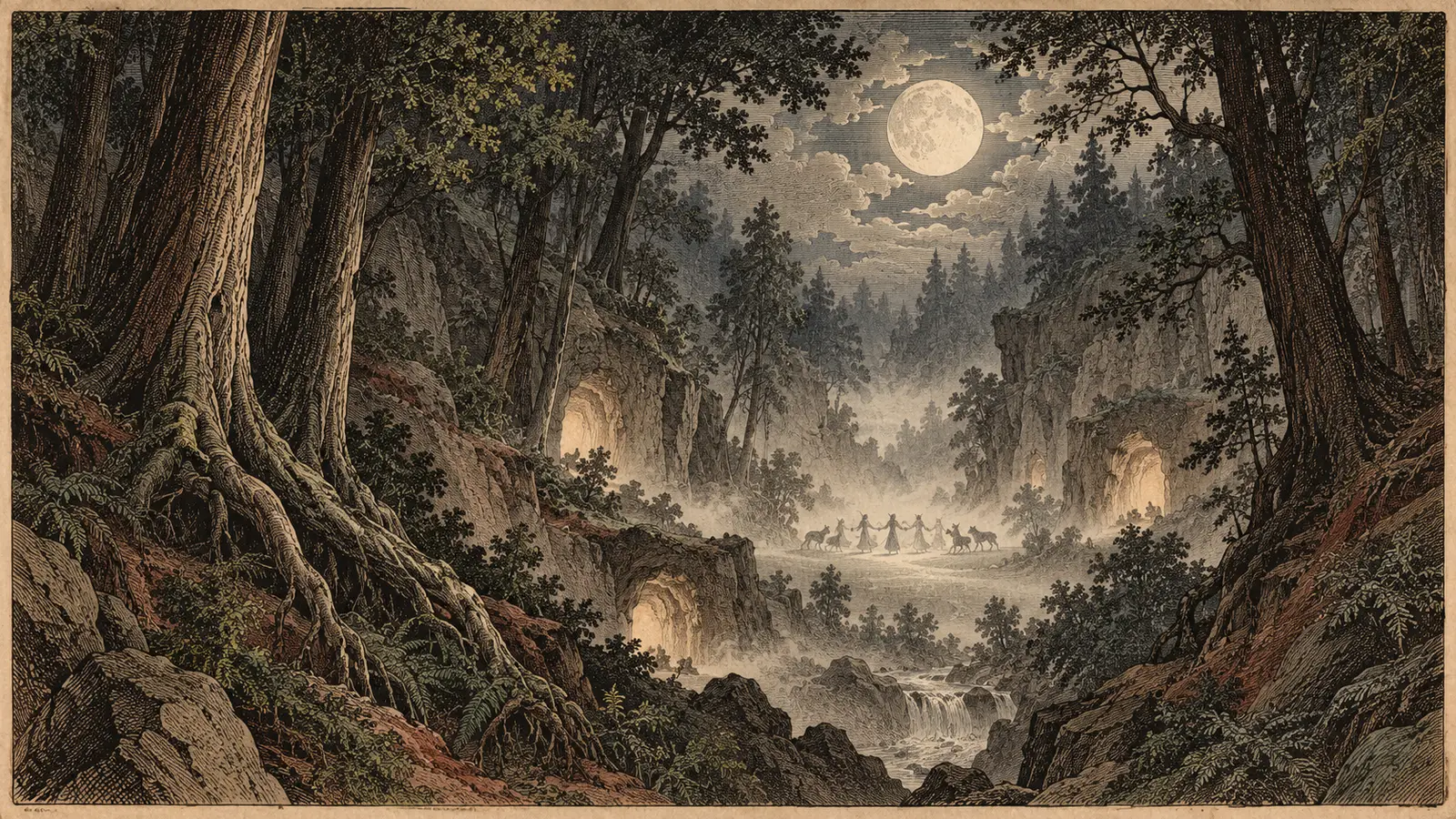
In 2008, the fourth edition of Dungeons & Dragons arrived, and with it, the Forgotten Realms Campaign Guide. It described a Realms transformed. A great catastrophe called the Spellplague had struck in 1385 of Dalereckoning, after the death of , and the setting had moved forward by about a century, to around 1479.
In that world, the drow pantheon had shrunk to a single goddess. alone remained. Between 1375 and 1379, had left the Demonweb Pits, and the other drow gods had died. was gone. was gone. was gone. And was gone.
Even before the Spellplague, her temples had been few, and growing fewer. In the books of fourth edition, her followers do not appear at all. The silver dancers, the singing swords, the Promenade with its echoing cavern, all of it passed out of the setting's present and into its history.
There's not much more lore to tell about this era, because the lore of this era is mostly absence. In the online game Neverwinter, launched in 2013 and set in the Realms of this time, the world's people knew Eilistraee as a dead goddess, and players could not take her as their deity. If you walked those streets as an adventurer, you might find no shrine to her, no glade where anyone danced. For about a hundred years of the Realms' history, from the 1370s into the 1480s, the Dark Maiden was considered dead, or missing.
Still, if you have been listening to her story closely tonight, you may notice something. Every time Eilistraee has gone away, she has gone away into the dark for the sake of someone else. She left for the drow. She entered 's body for . And the dream-visions, those silver figures dancing at the edge of a drow's sleep, were never something Lolth could close. A silence, for her, has never quite been the same thing as an ending.
Later, the Realms would tell this century differently. The story would say she had never truly died. But that is a later retelling, and it belongs to the next turning of the world.
Chapter IX
Held in the Weave: the Dark Maiden returns
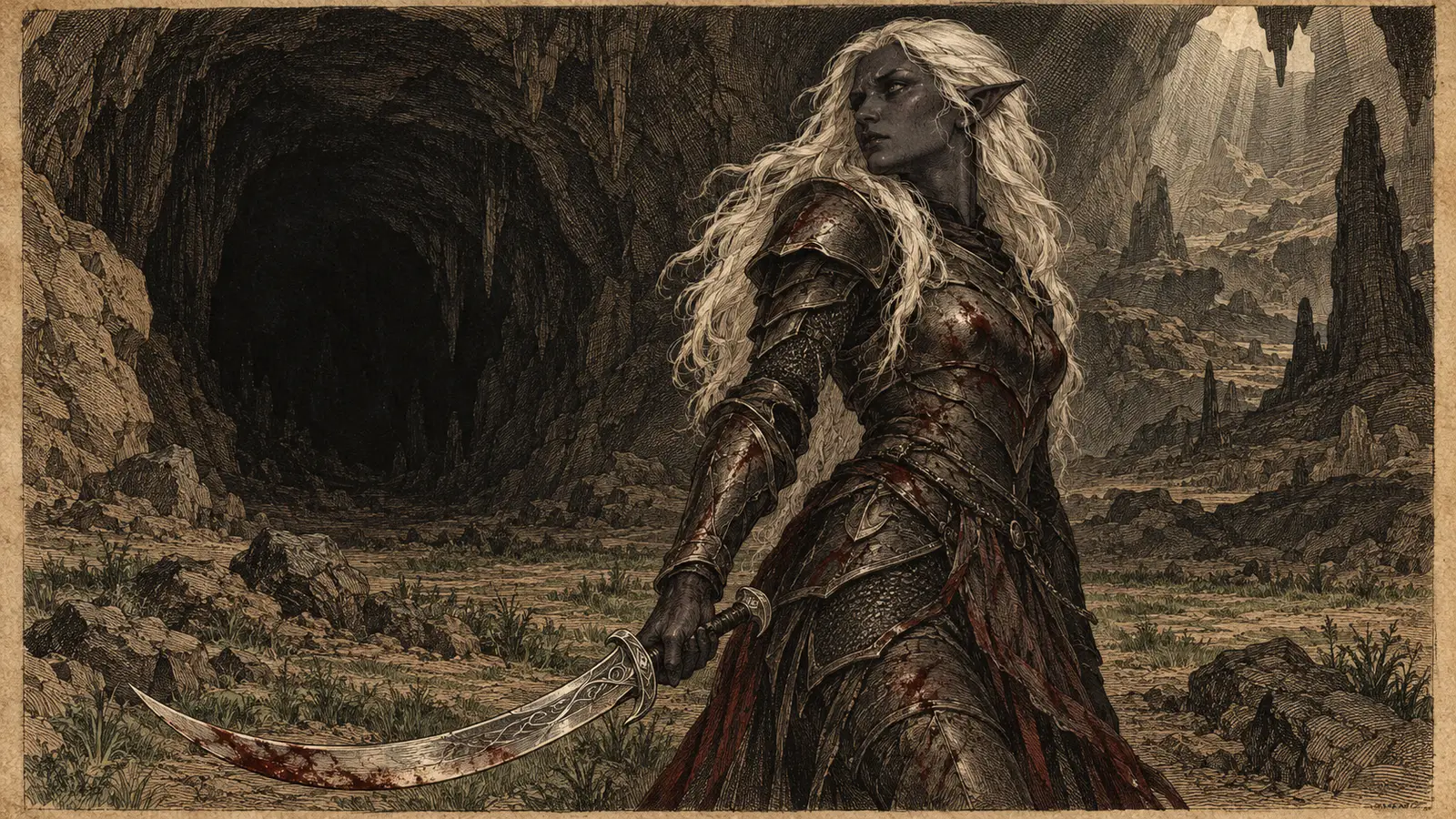
In the Forgotten Realms of the 1480s, something enormous happened. It was called the Second Sundering, a great reshaping that ran across several years and ended in 1487 of Dalereckoning, when the Tablets of Fate were rewritten, and and the Weave were fully restored. In our own world, it was the bridge into the fifth edition of the game, told through a series of novels in 2013 and 2014, as fifth edition itself arrived in 2014.
Among the many things the Sundering brought back, it brought back the Dark Maiden.
Ed Greenwood, the creator of the Realms and of herself, answered fans' questions around 2014 and 2015, and in those answers he told a new and gentler story about the silent century. Eilistraee and , he said, had never truly died. They had been held in stasis within the Weave, absent but not destroyed. Both of them had now returned. And both were allied, though they did not always agree on how to do things.
It's a later retelling, a retcon in the old word, and it changes how the story of the fall reads. Remember that when the Crescent Blade struck , much of the goddess's power was drawn into the Weave along with Qilué's soul. In the new telling, that is where Eilistraee was, all along. Not gone. Resting inside the fabric of magic, held there through the long dark.
Greenwood also said that mortals in the Realms know only of a "reappearance, post-Sundering." The full details, he said, might be revealed "in the fullness of time." So the exact way she came back is left soft and veiled, the way a moonrise is soft and veiled through thin cloud.
Other accounts of the Realms add a little more to the picture. Shortly before the Spellplague, they say, Mystra secretly placed Eilistraee in a hidden sanctuary, to shelter her from the disaster that was coming. If that is so, then the goddess of magic repaid an old debt. Long ago, Eilistraee had helped Mystra by giving a home to the seventh sister in a drow mother's womb. Now Mystra, in turn, gave the Dark Maiden somewhere safe to wait.
While she was away, looked after her faithful. He kept them from being swallowed by 's malice, guarding his daughter's people as if he were keeping a lamp lit in her window. And when she came back, he was overjoyed. Now he is helping his daughter regain her strength, after more than a hundred years away.
The twins announced their own return. They manifested through avatars to their followers, appearing among the faithful to let them know that their gods were alive. Each of them once again holds their own portfolio. Eilistraee is the Dark Maiden again, and Vhaeraun the Masked Lord.
And the twins have changed. They understand each other better now. They have grown more open to each other's ways and goals. They have reached a truce, and even a friendship, and they support each other against their mother, Lolth. They may not always agree on methods. Some of their followers still skirmish, as followers do, carrying old quarrels long after their gods have set them down. But the brother who once came to his sister's realm to murder her is now, in his own masked fashion, her ally.
There's one more gift that came with her return. After she came back, Mystra entrusted Eilistraee with a share of the responsibility for keeping the Weave intact. When a fan asked whether this was true of the present day, Greenwood answered, "Yes, that refers to the present time." So the Dark Maiden, who was sheltered in the Weave, now helps keep it whole. There's something fitting in that. A goddess who weaves dances now helps tend the great weave of magic, a far gentler weaving than her mother's.
Greenwood carried her return into his novels. In Spellstorm, in 2015, an story set in a mansion called Oldspires that is sealed inside a storm of magic, she is present in the world again. In Death Masks, in October 2016, a Waterdeep murder mystery about someone killing the Lords of Waterdeep, readers were given an update on Eilistraee and her followers. Her people were back in the city's story, back in the world above .
And then fifth edition's own sourcebooks began to speak of her.
Chapter X
The Dark Maiden in fifth edition
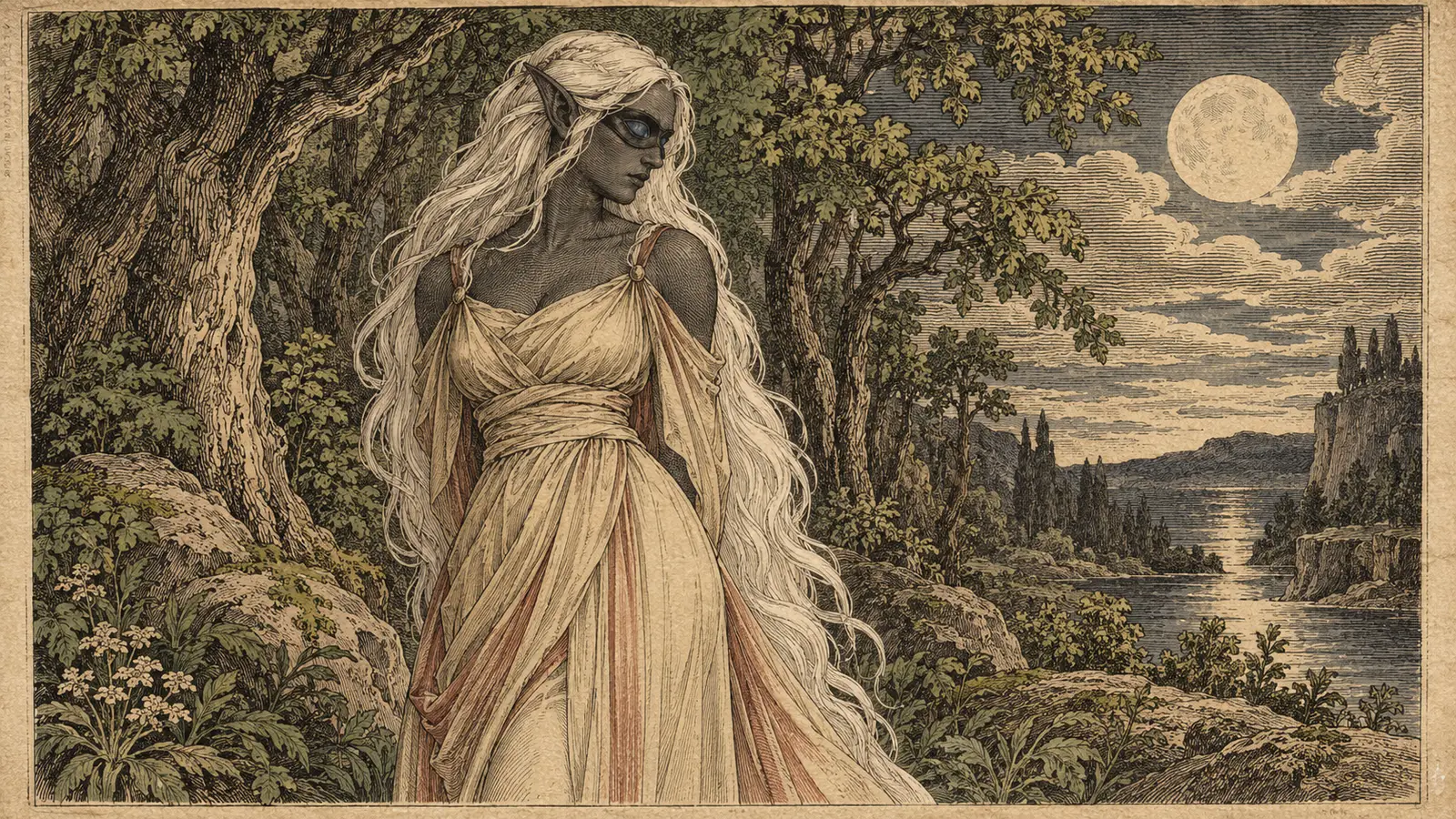
The first fifth-edition book to name her again was the Sword Coast Adventurer's Guide, published by Wizards of the Coast in 2015. It gave her only a short entry, among the many gods active in the Realms after the Sundering, but those few lines carried the essence of her. , it said, lures drow to the surface on moonlit nights. She urges them to throw off the yoke has placed on them, and to take their place among the surface races. Her portfolio was the one we know, song, dance, swordwork, hunting, moonlight and beauty. She was the patron, still, of drow who long to come up into the world and live in peace.
Fifth edition's fullest portrait of her came three years later, in Mordenkainen's Tome of Foes, in 2018. That book holds a long chapter on elves and drow, retelling the and and Lolth's betrayal for a new generation of players. Within it, Eilistraee has an entry of her own.
In its table of drow gods, she is chaotic good. Her province is given in three words, "freedom, moonlight, song." Freedom stands first in that list. Over the years, it had become as much a part of her as the moon. The book suggests the Life, Light and Nature domains for her clerics, the domains of healing, of radiance and of the living world. And her symbol is described as "a sword-wielding, dancing female drow silhouetted against the full moon." Through all the editions, that symbol has moved like a dancer moves. First a sword standing alone against the moon, wrapped in her silver hair. Then a dancing woman with a sword before the moon. And now a silhouette, a dancer seen from far off, a shadow against the light.
The book describes her as the deity often chosen by drow who wish to return to the surface and live in peace with other elves. She is worshipped through song and dance, ideally on the surface, under the stars, on a moonlit night.
Mordenkainen's Tome of Foes also tells the drow pantheon a new way. It speaks of the Dark Seldarine as the gods who sided with Lolth when she betrayed Corellon, gods who chose her side for the sake of power in the world. It names nine of them. Almost all are chaotic evil. Eilistraee stands among them as the one clear benevolent exception, the goddess who sits at that dark table without ever being of it.
The book also gave players ways to bring drow to the table as heroes. It offered story hooks for elf and drow characters, a secret love, a trail of clues, an escape from an assassination attempt, the slow work of overcoming hatred of the drow. All of them frame a character who has turned away from Lolth. And every one of those characters, standing at the edge of the Underdark with a decision to make, has a goddess waiting for them. Eilistraee is the faith such a character would take.
Fifth-edition accounts carry forward what has always been true of her. She is Lolth's daughter, and the only benevolent drow goddess. She tries to be a mother goddess to her people, leading them back to the lands of light where they can live in harmony with other races, free of the Spider Queen. But Lolth's grip on the drow is so tight that most dark elves know very little of any other god. Wildly wrong legends about Eilistraee still pass from mouth to mouth, both on the surface and in the Underdark. Many people who are not elves simply can't believe a good drow goddess exists. And Lolth's followers suspect Eilistraee's faithful of being spies for the surface elves. Some things change across a century, and some things do not.
Her enemies remain her enemies. Lolth above all. , the goddess of vengeance and undeath. , the Elder Eye beneath the Promenade. And , the champion who once followed her, and who returned to the world in the Sundering after his century of death.
D&D Beyond, the game's official online home, published an article called "A Light in the Darkness: Playing a Drow Character," and it uses Eilistraee in just this way. A drow hero, it suggests, might carry the Dark Maiden's hope back down into the Underdark, so that "the light of the Dark Maiden can shine even amidst the darkness of the Underdark." Or a drow might be one of her clerics, risking their lives in those deep places to bring others out. Her faithful, the article says, are mostly drow who escaped Lolth. They welcome every race, and they hope for harmony without discrimination or war.
And the old path to her priesthood is still told in this age. A woman who would become a priestess must spend at least a month on the surface, dance every moonlit night for Eilistraee, and see at least one dawn. Her clerics, the Sword Dancers, are still teachers, protectors and diplomats, the hands of a goddess who wants to be a mother to her people.
That's the main line of Eilistraee's story, from to the present age of the Realms. But a goddess like her leaves echoes, and some of those echoes have stories of their own. Let's spend some time with them now.
Chapter XI
Sisters, blades and shadows: the echoes of the Dark Maiden
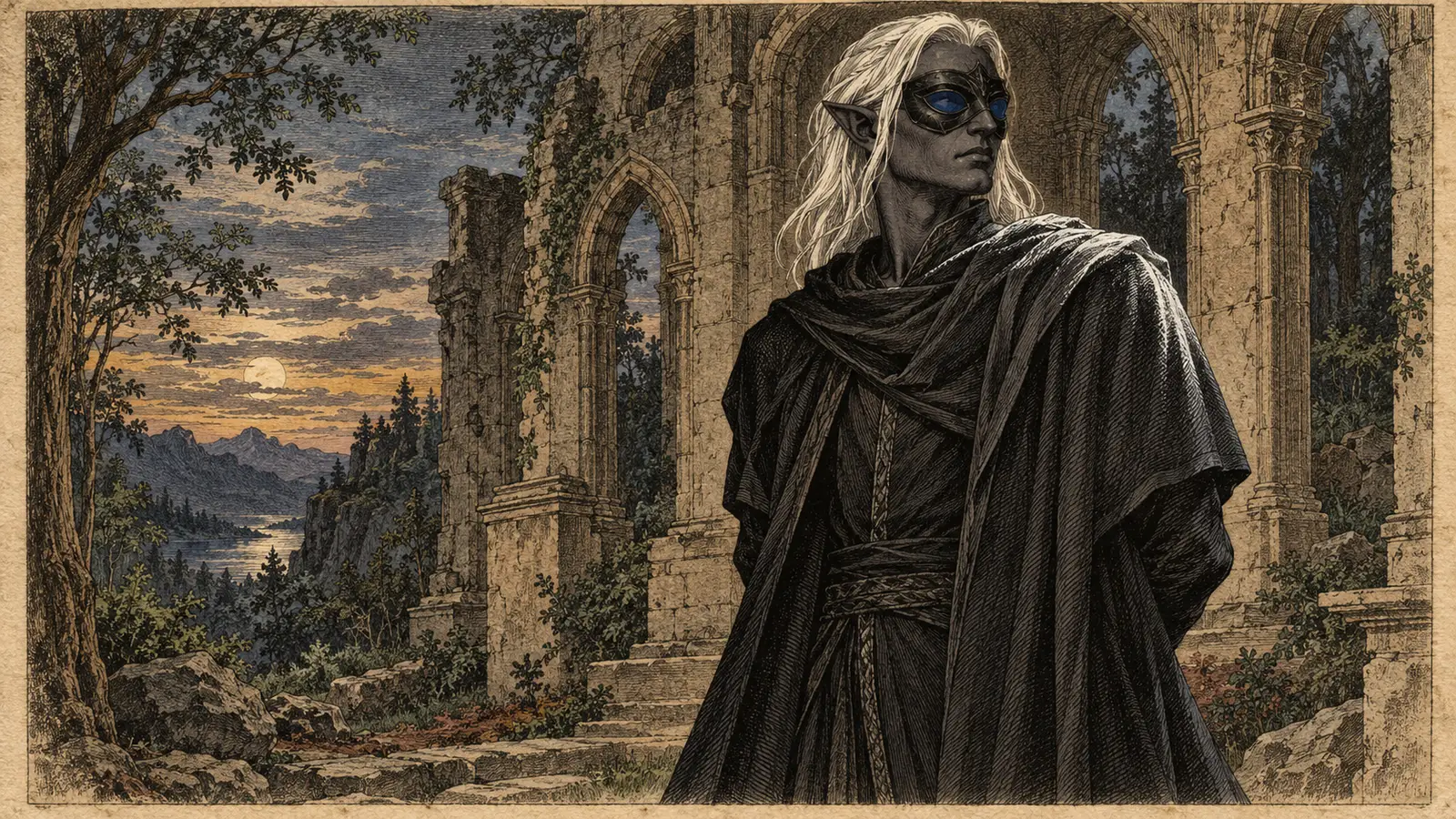
Some of the echoes of are people. The first and brightest of them is .
Qilué is the living link between two goddesses, and also between two great families of the Realms. Through her birth, the Dark Maiden's story is woven into the story of the Seven Sisters. Silverhand, the famous archmage, is her sister. Dove Falconhand, the ranger and knight, is her sister. When Dove stepped into the dance at the Ladystone in Forest, in Greenwood's novella, it was a human sister trying to join a drow sister's moon-dance in a surface wood, and some of the priestesses looked on her with suspicion. In a way, that small scene holds the whole of Eilistraee's hope and the whole of its difficulty. The surface and the deep reaching for each other, uncertain, wary, and still reaching.
Qilué, too, was willing to carry darkness into herself to destroy it. Once, she planned to take a demon into her own body and burn it out there with 's silver fire. It's a quieter echo of her goddess's choice, the choice to go down into the dark on purpose, because that is where the darkness can be ended.
Then there are the blades.
The singing swords are blessed weapons, carried by the best and most graceful of Eilistraee's warriors. They are the swords of the Sword Dancers, who fight in a style like dancing. In a singing sword, three of Eilistraee's gifts meet at once, swordwork and song and the silver light of the moon. The Promenade held twenty of them, for its Protectors of the Song. Qilué's own sword, Dancing Mistress, carried the soul of the goddess's servitor Iluemeirarra. And the goddess's avatar fights with a pair of them, or with the single dancing Moonsword. Wherever her faithful go to war, the swords go singing.
Video games carried the singing sword forward too. In Baldur's Gate 3, released in full by Larian Studios in 2023, there is a longsword called , set in a stone pedestal deep in the Underdark. Whoever wields it can make it sing, lifting the courage of nearby friends, or make it shriek, shaking the nerve of nearby foes. We'll come back to it, because it has a small story of its own.
The darkest echo of the singing swords is the Crescent Blade. It was a moon-blade, forged from a pebble the goddess plucked from the sky, made to destroy . It was carried by a Sword Dancer of , lost on the Cold Field, found in the belly of a worm, broken in the Demonweb Pits, made whole again with a demon inside it. And in the end, it was the blade that struck down Qilué, and the goddess within her. A weapon of Eilistraee turned against Eilistraee. It's a hard echo, but a real one, a reminder that her gifts can be twisted, just as her own arrows once were twisted in .
And then there are the shadow-images, the people and forms who mirror her in darker glass.
The Lady Penitent is the first of them. was once a priestess of Eilistraee, carrying the goddess's own sword toward her mother. When she fell, Lolth made her into the opposite of everything she'd been trying to become. Where a Sword Dancer is free, the Lady Penitent was bound. Where a priestess of the Dark Maiden dances in the open, the Lady Penitent served in torment. She is what one of Eilistraee's daughters might look like if the Spider Queen got hold of her.
is another kind of echo, a gentle one. A former priestess of Lolth who turned to the Dark Maiden after her own daughter died for nothing, she gave up her afterlife to shield the woman who killed her. She is an echo of Eilistraee's first sacrifice, repeated in a mortal life.
The Masked Lady is an echo in Eilistraee herself, a different version of the goddess. For a time, after 's fall, she wore his mask and carried his portfolio, and male drow and nightshadows served at her side. It was a strange, short-lived form of her, the moon wearing a mask, a goddess who had become two. When the Sundering brought her brother back, the mask went back to him, and she became the Dark Maiden again.
, in his way, became an echo of her mission. In the closing pages of the Lady Penitent trilogy, he took her place at the sava board and carried her purpose forward against Lolth. And in the later retelling, he watched over her faithful through the silent century until she returned. The father who sent her into exile "reluctant yet proud" took up her work while she was gone.
And there is an echo that is a whole people. Through the High Magic ritual worked at the end of the Lady Penitent story, some of her followers were turned back into dark elves of the ancient kind, brown-skinned, untainted by the demon's blood that had crept into the drow. They are, quite literally, descendants of her hope.
Her church's orders are echoes too, each one taking a single part of her and making a life of it. The Silverhair Knights carry her mercy, fighting only to save. The Darksong Knights carry her fire, hunting the demons of the Spider Queen. The Protectors of the Song carry her watchfulness, standing guard over the Pit beneath the Promenade. The Sword Dancers carry her dance.
Players, too, have carried her into their own worlds. On D&D Beyond, people have made their own versions of her priestesses for fifth edition, cleric paths and bardic colleges built around the sword dance, and backgrounds for drow who answered her call in secret. Some have built mods for Baldur's Gate 3 that bring the Sword Dancers into that game. None of these are part of the official story, but they're a sign of something. When people love a goddess, they keep making new places for her to dance.
Which brings us, naturally, to the table itself. What does it feel like to bring the Dark Maiden into a game?
Chapter XII
Dancing beneath the moon at the table
Imagine you're sitting down to make a character, and you've decided she will be a priestess of . What does that mean, once the dice come out?
In second edition, she might be a Sword Dancer, one of the goddess's specialty priests. Before the game even begins, she has already done something remarkable. She has spent a month on the surface. She has danced every moonlit night of that month. She has stood and watched the sun come up. Your character's story starts with that dawn.
Her signature gift is Eilistraee's moonfire. A Sword Dancer can call it up by an act of will, and there is a priest spell of the same name, "Eilistraee's Moonfire," for those who want to cast it. It is a beacon of light, and she controls it completely, its brightness from a faint glow to clear bright light, and its colour, white or silver, blue-white or a soft green. As she grows in power, she can send that moonfire drifting away from her body, floating through the dark like dancing lights. Picture a priestess walking down a tunnel in the Underdark with a little silver moon bobbing ahead of her. To a drow hiding in the shadows, it would look like the goddess herself coming to find them.
A Sword Dancer can also cast magic missile, those darting bolts of force. Or she can pour that energy into her next sword stroke instead, so that her blade is wrapped in blue-white flame. Sword and magic, dance and fire.
Then there is spellsong. Sword Dancers channel their goddess's power by singing and dancing. A single spellsinger can reproduce many lesser spells, heal someone who's hurt, or grant protection from magic. And when many of them sing together, as a choir, they can do greater things, even restore limbs that have been lost. As they grow more powerful still, they can turn spells back on those who cast them, commune with their goddess, see things as they truly are, speak with stone, and step between the planes.
All of that is the rules. But the heart of playing her priestess is the work. Many Sword Dancers go out looking for drow who need help, or who could be brought to a different life. That might mean slipping into a drow settlement in disguise, or crossing hostile ground in the deep places, to reach one dark elf who has shown a flicker of doubt. Once a drow is free, the Sword Dancer becomes a teacher, a protector and a diplomat, helping the newcomer learn what community is, and how to make friends among the surface races. You can run a whole campaign on that alone. Not slaying a dragon, but teaching a frightened drow how to trust a village baker.
In third edition, the paths multiply. A priestess might become a Sword Dancer through the prestige class, slowly attuning herself to a single sword over a tenday of carrying it. She might join the Darksong Knights and hunt yochlol in the ruins of ancient . She might become a Silverhair Knight, sworn to fight dark elves only by means that will not kill them, so that they live to be redeemed. Picture that at your table. Your party is ambushed by drow, and one of your friends is fighting with the flat of her blade, pulling every blow, because the woman trying to kill her might one day be her sister in the faith.
And she would carry one of those wonderful titles. You could be an Argent Maid. A Moon Singer. A Living Sword. The Ghost of the Moonstruck Night.
Her rites give a game master lovely scenes to stage. A High Hunt, beneath a full moon, the hunters unarmoured and carrying only swords, after some dangerous beast in the dark, and then the prayers and the Circle Song where it fell. A Run, where the party travels through surface lands as drow, armed only with kindness and music and swordskill, bringing food and art to villages that expect them to burn the houses down. A Circle of Song after a feast, each character in turn leading a song while the others dance. A Grand Chorus, an ever-changing song led by a senior priestess. An Evensong, a quiet dance of thanks after a hard night. And, at the very end of some long campaign, perhaps, a Last Dance, an old priestess setting down her clothes and dancing under the moonlit sky before she passes from the world.
There are places to visit, too. The Promenade, beneath Waterdeep, with its Cavern of Song where only song echoes. A party might come there wounded and be taken into the Hall of Healing, or be sent by down to the edge of the Pit with the Protectors of the Song. There's the Dancing Dell in Forest, where the Ladystone stands, the stone the goddess touched. There's the Dancing Haven in Waterdeep itself. And there's Shadowtop Glade, in the Dalelands, where you might be invited, if you are trusted, to hunt under the full moon alongside drow and werewolves both, and dance the Evensong when the hunt is done.
And there are foes to face. and her yochlol are always there, behind everything. In the older lore, 's nightshadows stalk Eilistraee's people. 's oozes boil beneath the Promenade. Somewhere in the dark lies the Crescent Blade, a relic any party might go looking for, with all the sorrow it has gathered.
In fifth edition, the most common way to bring her into a game is simpler, and maybe more personal. A drow player character, raised under Lolth, who has turned away. Often, that character is a cleric of Eilistraee, sent up to the surface by the goddess to prove to the world that good drow deserve trust. Their domains might be Life, Light or Nature. The very first scene can be your character standing in a tavern doorway, dark-skinned and silver-haired, as every head turns toward them, and every hand moves toward a blade. Everything that follows is your character slowly changing what those people expect.
That's what playing Eilistraee feels like, in the end. Her faith isn't about winning. It's about turning people. A Sword Dancer's victories are drow who come up out of the dark and stay, villagers who stop reaching for their knives, enemies who live to see another night. If you've ever wanted to play a hero whose greatest weapon is a song, the Dark Maiden has been waiting for you since 1991.
From the table, her story spread outward, into novels and games and conversations far beyond any one group of players. We turn now to her legacy.
Chapter XIII
The good drow's goddess in stories and games
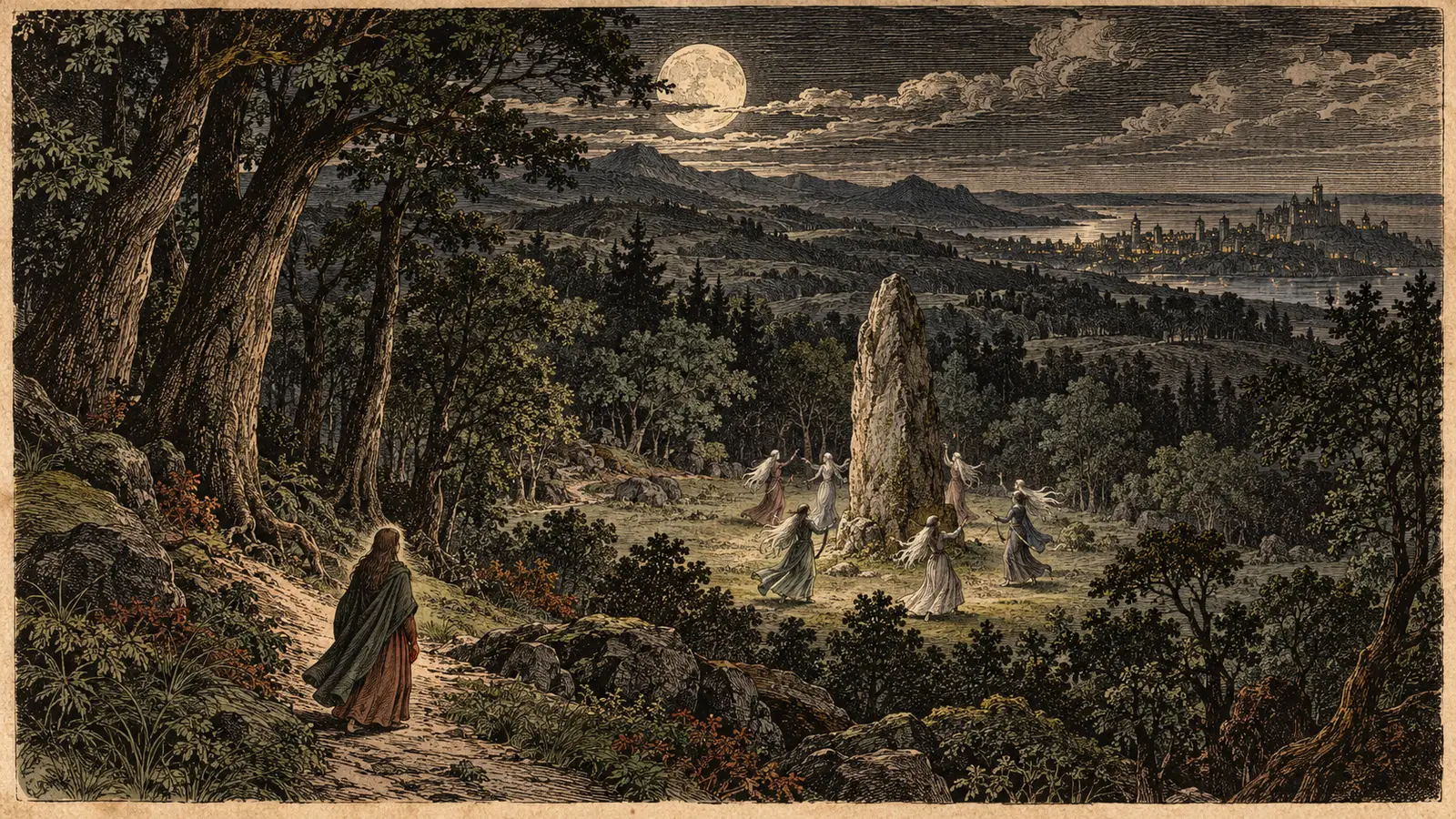
For a long time, the most famous good drow in all of fantasy did not worship .
, created by R. A. , was the first drow in the Realms to throw off the evil forced on his people and try to make himself a better person. He fled , found his way to the surface, and became one of the best-loved heroes of the game. His goddess, though, is , the goddess of forests and rangers. Through decades of Drizzt's stories, Salvatore largely left Eilistraee out.
That changed in 2023. Salvatore's trilogy The Way of the Drow began with Starlight Enclave in 2021, went on with Glacier's Edge in 2022, and ended with Lolth's Warrior in 2023. In that last book, Menzoberranzan breaks into civil war, between 's faithful and the drow who have begun to question the Spider Queen and the story of how their city was founded. Some of that questioning was stirred by the growing legend of Drizzt, the one who escaped. Even the most powerful house in the city begins to doubt. And clerics and paladins of Eilistraee play a significant part in the struggle. After all those years, the Dark Maiden walked into the heart of the Drizzt saga, and her faith fed into its own long story of redemption.
The video games had found her long before that.
In 2000, BioWare's Baldur's Gate II: Shadows of Amn took players down into the Underdark, to the drow city of . There they met a male drow fighter named , their contact in the city. A drow priestess named orders the party to kill him. They can choose to spare him instead. If they do, he gives them his cloak as false proof of his death, and later helps them trick Phaere with false dragon eggs. And, if spared, he speaks of Eilistraee. The game never tells his whole story. He remains a drow at the edge of a choice, a quiet hint of the Dark Maiden in the deep. Players loved that hint so much that a long-running fan modification, called "Eilistraee's Song," was made to follow his story further.
In 2003, BioWare's Neverwinter Nights: Hordes of the Underdark gave her faithful a much larger part. Among the hero's companions is , a drow who was once one of the Red Sisters, an order of assassins, and who is now a devout follower of Eilistraee. She guides the hero toward , who has been imprisoned by the drow. The hero comes to , an Underdark port city held by good drow, where a priestess of Eilistraee called the Seer leads a small band of the faithful out of an abandoned temple of Lolth. They have taken the Spider Queen's own house and turned it to the Dark Maiden's purpose. And it is Eilistraee's followers who lead the ragtag rebel army against the evil ruler known as the . In 2006, Obsidian's Neverwinter Nights 2 listed her among the gods a character could choose to follow.
Then came Baldur's Gate 3, released in full by Larian Studios in 2023, and for many new players, it was their first meeting with her.
In that game, Eilistraee is one of the gods a cleric can serve. She is chaotic good, the goddess of beauty, song and freedom, with the Life, Light and Nature domains. She is worshipped by drow who have abandoned Lolth, and she wants balance between all races, opposing her mother's corrupt aims. Her friendship with , the moon goddess, lends a few lines of dialogue in the middle of the story. The game offers two kinds of drow. There are the Lolth-sworn drow, and there are the drow, those who reject Lolth's cruelty, whose outlook matches that of the Dark Maiden's followers.
And then there is the sword. In the Underdark, northwest of an outpost of Selûne's faithful, a longsword stands in an altar pedestal. It is . A drow, or a cleric of Eilistraee, can draw it easily. Others may come to understand the ritual of drawing it through their knowledge of religion. A cleric of Eilistraee who pulls it free receives her blessing. A cleric of Lolth can draw it too, but the Spider Queen warns them against honouring anything of her daughter's. On the stone, freshly carved in the drow tongue, is an inscription. It reads, "Though I have to leave you, I will dance forever in Eilistraee's Light."
You could listen to that line many times over and it would never lose its weight. Someone left that sword there. Someone who had to go. And whoever they were, they believed that wherever they went, they would still be dancing.
Beyond the games, her presence has shaped how people think about the drow themselves. The German religious studies scholar argued that adding Eilistraee as a kind counterpart to her evil mother gave the fantasy drow a new depth. With her, he suggested, the drow move beyond the racist and anti-feminist stereotypes critics have seen in the dark elves of Tolkien's and Gygax's writing. A people with a good goddess among their gods is a people capable of choosing good.
That's why players who love playing drow heroes so often point to her. She is the in-world foundation for the good drow character, the reason such a character makes sense in the world, and not just as a lone exception. And her shrines, with their good drow living openly on the surface, give the Realms a living counter-image to the cities of the Underdark. Where Menzoberranzan has the web, Shadowtop Glade has the dance.
Not everyone saw her as an obvious fit for the game, of course. The writer Rob Bricken included her in a list called "The 13 Strangest Deities in Dungeons & Dragons," for io9. A nine-foot unclothed drow goddess who dances with swords under the moon is, it's fair to say, a little unusual. But strangeness and beauty often keep company, and her strangeness is part of why she lingers in people's minds.
From the tables of the early 1990s to some of the best-selling games of our time, the Dark Maiden has travelled a long way. So where does she stand now?
Chapter XIV
Where the Dark Maiden stands today
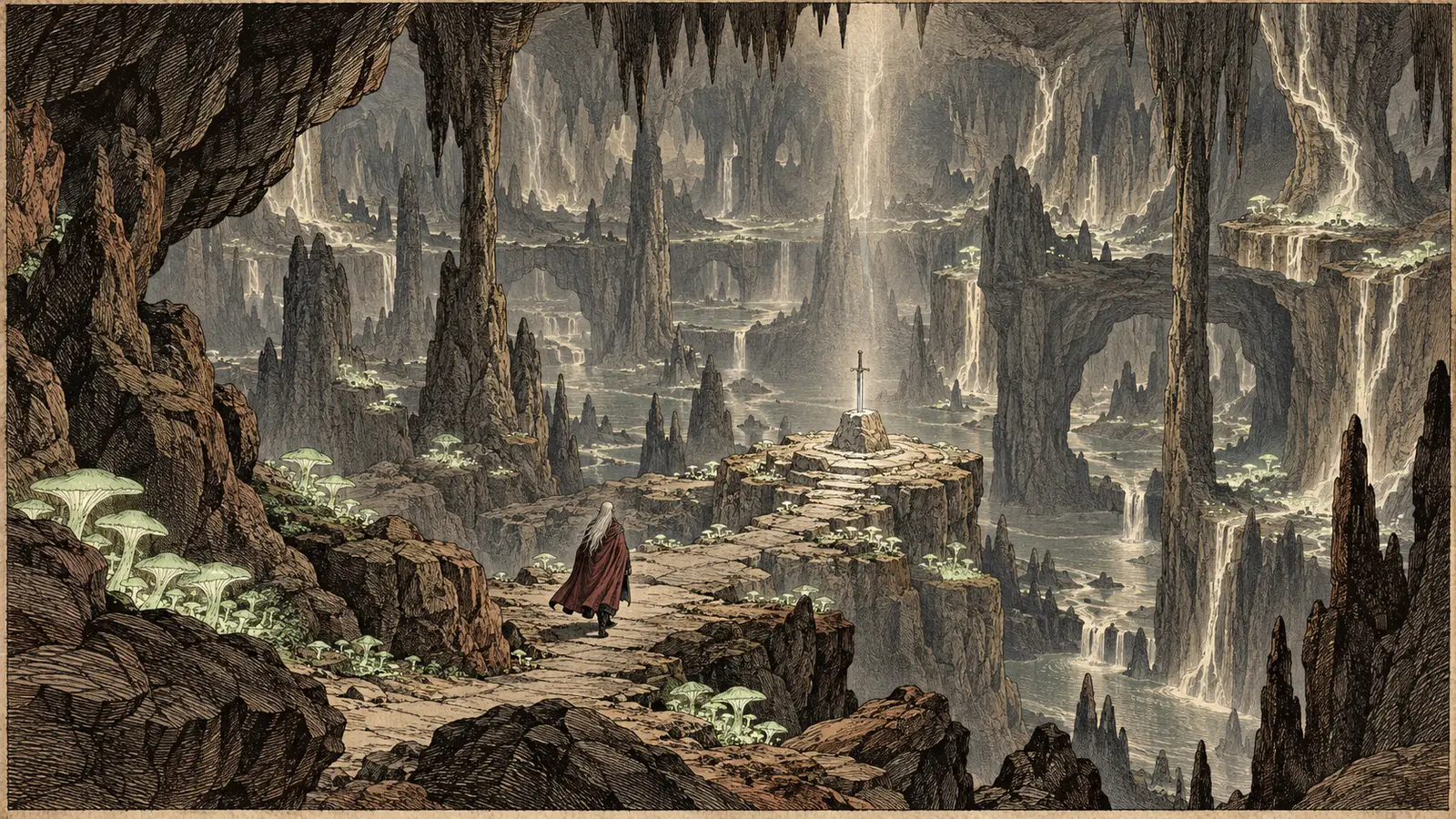
In the Forgotten Realms of the present day, is an active goddess once more. She is the chaotic good drow goddess of beauty, song, dance, freedom, moonlight, swordwork and hunting. She is the patron of drow who want to return to the surface and live in peace with other peoples. She is called the Dark Maiden, the Lady of the Dance, Lady Silverhair, and still, now and then, the Dark Dancer. Her twin brother stands beside her in an uneasy, honest truce. Her father helps her regain her strength. And she shares in the keeping of the Weave. Her origin is still told the same way. She is the daughter of and of , who became , and when her mother's betrayal came to light, she went into exile beside her family, though she had done nothing wrong.
The game itself has moved in a direction that suits her very well. The revised rules of 2024 describe elves as shaped by the places where they live, which give them magic and change how they look. Drow, in that telling, are "marked by the Underdark," without necessarily being bound to Lolth. The old idea that drow are evil by their very nature has been set aside. That's a quiet change in the rules, but it's the change Eilistraee has been working for since her first book. A drow is not their mother's goddess. A drow can choose. The 2024 Monster Manual also dropped its generic drow, and Jeremy Crawford, one of the game's lead designers, explained that humanoid stat blocks built for particular peoples would appear in setting books instead.
The newest book to give her a full place in the Realms is Forgotten Realms: Heroes of Faerûn, released by Wizards of the Coast on the eleventh of November, 2025, alongside its companion, Adventures in Faerûn. It's the player's book for the Realms under the 2024 rules, and it holds a primer on forty-two gods, along with rules for renown among the factions of the world.
Most of the gods in that primer belong to the Realms specifically. The heads of the great racial pantheons, such as Corellon and , were left out. But Eilistraee and Lolth were given entries of their own, because they are so deeply tied to the lore of the Realms. Fans noticed something gentle in that. The daughter has an entry, and the father does not. For a goddess who once chose exile over her place in her father's realm, there's a soft irony in it.
Her entry calls her the Dark Maiden, the Lady of the Dance and Lady Silverhair, the drow god of dance, song, beauty, moonlight, swordplay and hunting. Her home is given as , in . Her followers are bladesingers, elves and performing artists. And where the worship of Lolth is strong, as in the Underdark, drow and others who oppose the Spider Queen turn to Eilistraee as a beacon of hope and freedom. A beacon. That's the very word her old origin story uses, the thing she chose to become when she walked out of Arvandor. The book also lists her among the gods that aasimar, the people touched by celestial light, often follow.
Her creator, too, has kept returning to her. In April 2024, Ed Greenwood shared word that he had released long-requested lore about what he called "THE COURT OF EILISTRAEE," describing her as "the chaotic good drow goddess that so many Realms fans love." More than three decades after her first book, the man who first dreamed her up was still adding rooms to her house.
Her newest appearance in the rules is a playtest, not a finished book. In August 2026, Wizards of the Coast released a set of playtest options called Unearthed Arcana: Underdark Options, and on the tenth of September, 2026, a second set, Underdark Options 2. In that second set is a new path for clerics, the Freedom Domain. It is built around free will, escape and resistance to tyranny. Its text says that in the Underdark, Eilistraee and Moonbow both stand for freedom. Sehanine, you'll remember, was the moon goddess who first saw Araushnee's betrayal by moonlight. Now the two of them stand side by side again, as patrons of escape.
A Freedom cleric relies on quickness more than heavy armour, and her spells are about moving and getting away, slipping through walls, stepping through space, shaking off bonds. Her most striking power is called Invoke Liberty. She lifts her holy symbol, and the allies around her throw off whatever holds them, fear and grappling hands, paralysis and restraint, and later even charm and petrification, and they move freely again. You can imagine a priestess of the Dark Maiden in some Underdark prison, raising her silver symbol, and every chain in the room falling slack at once. This is playtest material, offered for players to try, and Wizards of the Coast has not announced any Underdark book to carry it.
And in homes all over the world, people are still choosing her in Baldur's Gate 3, drawing from its stone, and reading those carved words again. Though I have to leave you, I will dance forever in Eilistraee's Light.
We've followed the Dark Maiden a long way tonight. There's only one place left to go, and it's not a book, or a game, or an edition. It's a clearing in a wood, at night.
Chapter XV
A dance under the open moon
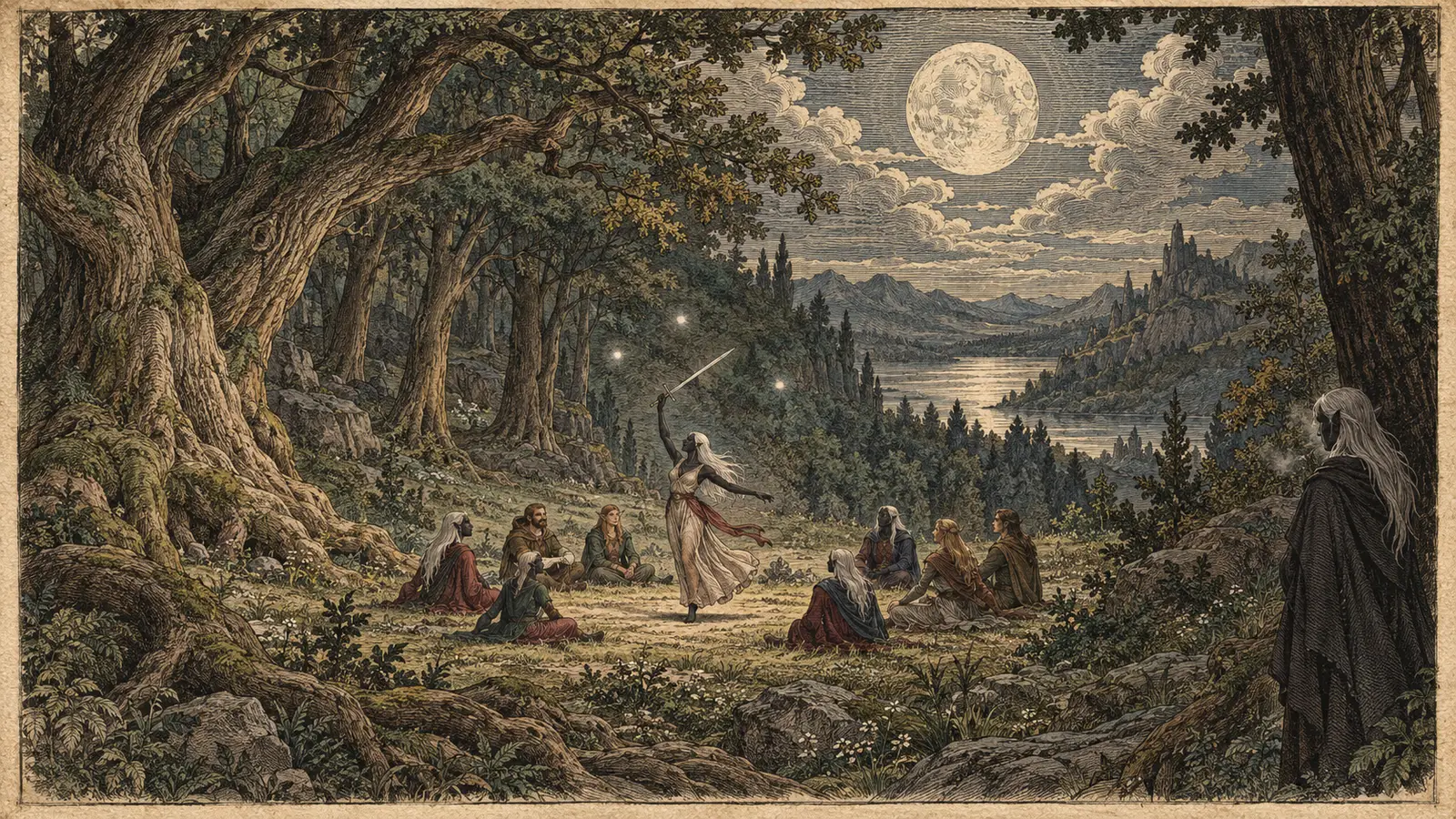
Somewhere beneath the world, in the deep stone, a young drow is climbing.
She has been climbing for a long time. She has left behind a city of webs and whispers, where every kindness was a trick, and where the only goddess anyone spoke of was the one with eight legs. For months now, maybe years, something has been calling her upward. It came first in Reverie, in the half-sleep of the elves. A tall figure, dark-skinned, wrapped in silver hair that fell all the way to her feet, dancing under a light the young drow had never seen. Then it came when she was hurt and alone, and once while she was humming to herself without knowing what song it was. She could not have told you the dancer's name. But she knew, the way you know a thing in dreams, that the dancer wanted her to come.
The tunnel grows colder, and the air tastes different. There is a smell she does not recognise, green and damp and alive. And then the stone opens, and she steps out into a night with no ceiling.
There is something hanging in the sky. It is round and pale and silver, and it is so bright that she has to shade her eyes, though it does not burn. Its light falls on everything, on the leaves, on the grass, on her own dark hands. If she looks closely, if she has heard the old legend, she might think she can see a small curved hollow in its face, a crescent where once, long ago, a goddess reached up and took a pebble.
She stands there for a long while. And then, through the trees, she hears singing.
She follows it. It leads her to a clearing, a ring of open ground among old trees, and in the clearing there are people. Some are drow, like her, with silver hair loose down their backs. Some are elves of the surface, and some are humans, and one or two might be something wilder, children of the moon who run on four legs when the moon is full. They are sitting in a circle. One of them is standing in the middle, dancing, a slender sword lifted in her hand, and the blade is humming along with her voice. When her song ends, she sits, and another rises and begins a new one. The song goes round the circle like a cup passed hand to hand.
Little lights drift above them, white and silver and soft green, floating like dancing lights. The eyes of one of the dancers are glowing silver. The goddess is watching her tonight.
Someone sees the young drow standing at the edge of the trees. She waits for the hands to go to the swords. They don't. Instead the dancer in the middle of the circle turns toward her, and smiles, and holds out a hand.
This is what has always been. A long time ago, in a bright realm, a young goddess was given every reason to stay in the light, and she chose to go down into the dark instead, because someone would need to be there. Her arrows were twisted. Her mother became the Spider Queen. Her brother came to kill her. Her blade was turned against her, and for a hundred years the world believed she was gone. And through all of it she kept doing the same small, patient thing. She kept sending dreams down into the deep places, dreams of a dance beneath the moon, so that anyone who wanted to could follow them up.
Her priestesses teach that music, dance and song can do more than the sword. They carry swords anyway, because the world is what it is. But the sword is never the first thing they offer. The first thing is a hand, and a place in the circle, and a turn to lead the song.
The young drow steps out of the trees and into the moonlight. Above the clearing the moon goes on shining, as it shines over every open place in the world, over every glade and stone circle and quiet hilltop where someone, tonight, might be dancing.
And under it, somewhere, the Dark Maiden is dancing too.