Chapter I
Dark elves under the hills, and the founding of a city
Tonight we follow a city that has never seen the sun. We'll trace from the dark elves of old northern stories to the first drow cities of the game, then walk its streets as each era of Dungeons & Dragons added new houses, new wars and new gods. We'll end beside its great stone clock, as the glow slowly climbs the pillar and fades again.
Every city begins with a place, and this one begins far below the ground. Before we reach the cavern, though, we should spend a little time with the people who would come to live in it. The dark elves are older than the game. Their name and their shadow came from the folklore of northern Europe, and the game made them into something new.
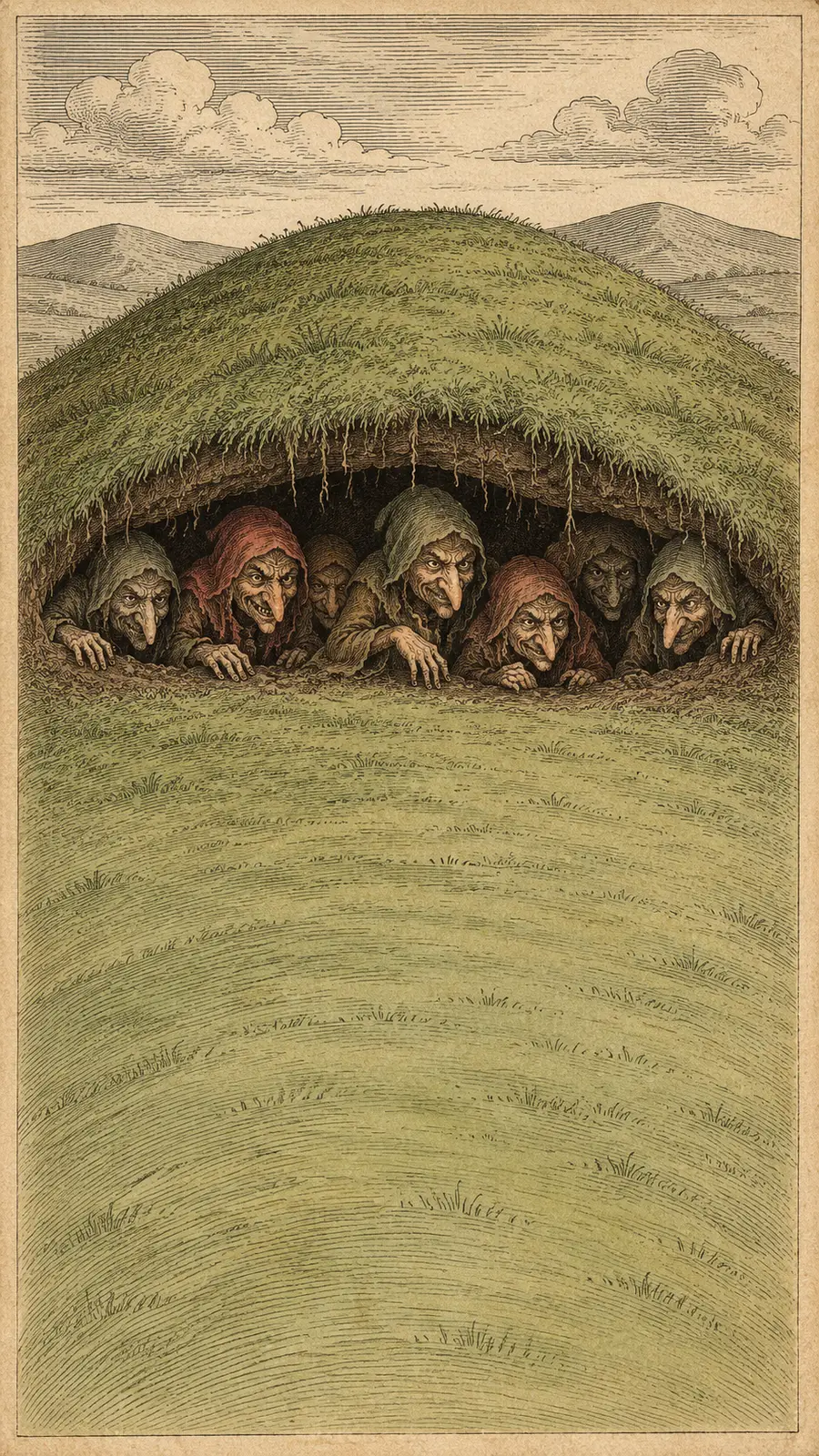
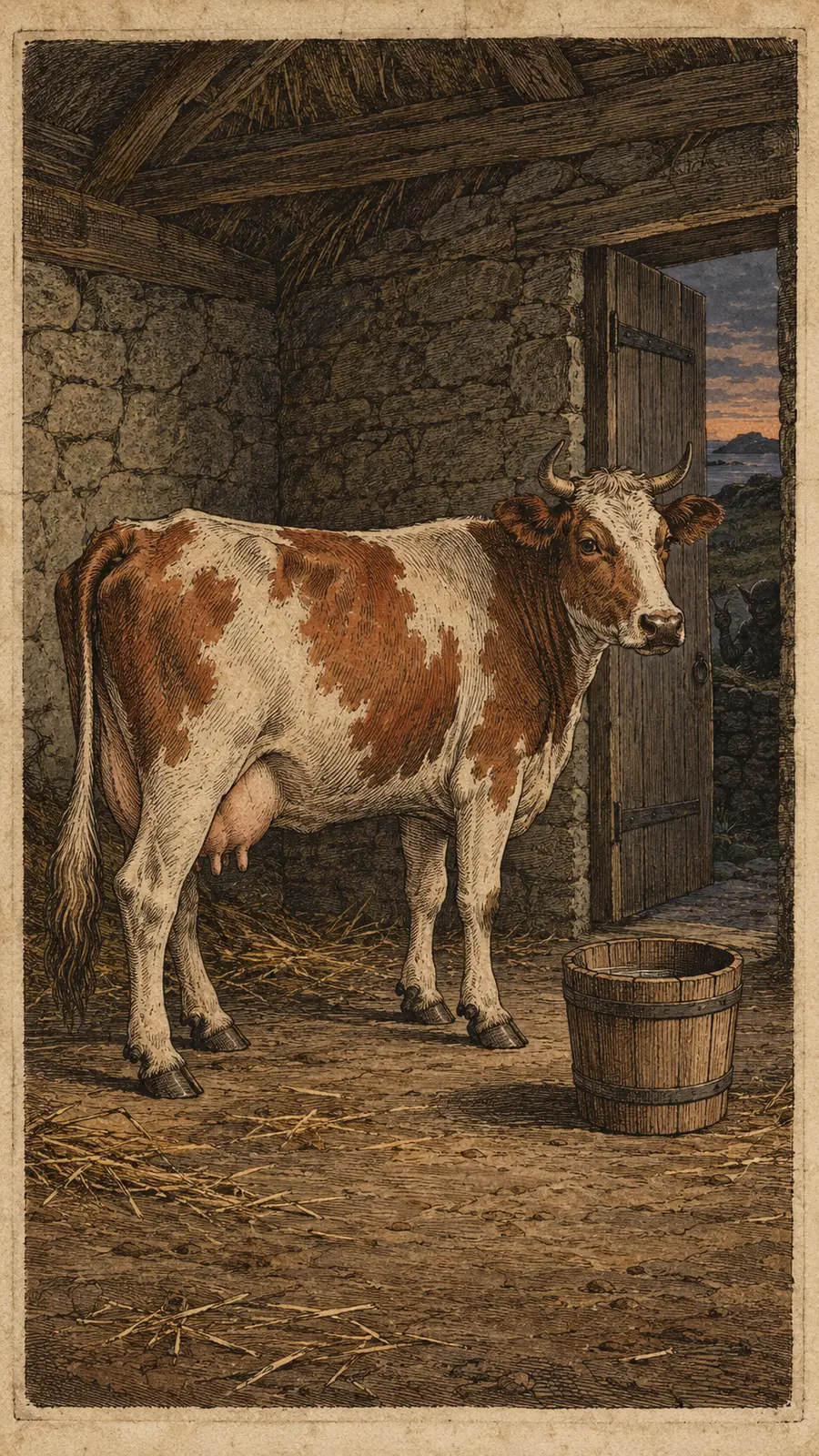
The word itself came from the islands. In the dialects of Scots spoken on and Shetland, a "drow" was another form of "trow," a word related to "troll." Islanders used it for a whole crowd of sly and spiteful little people who lived in the hills and the grassy mounds. Those drow were not elves in any grand sense. They were the folk you heard but never saw, the reason a cow went dry or a door would not stay shut. The word carried the feeling of something living just under the turf, close by and unfriendly.
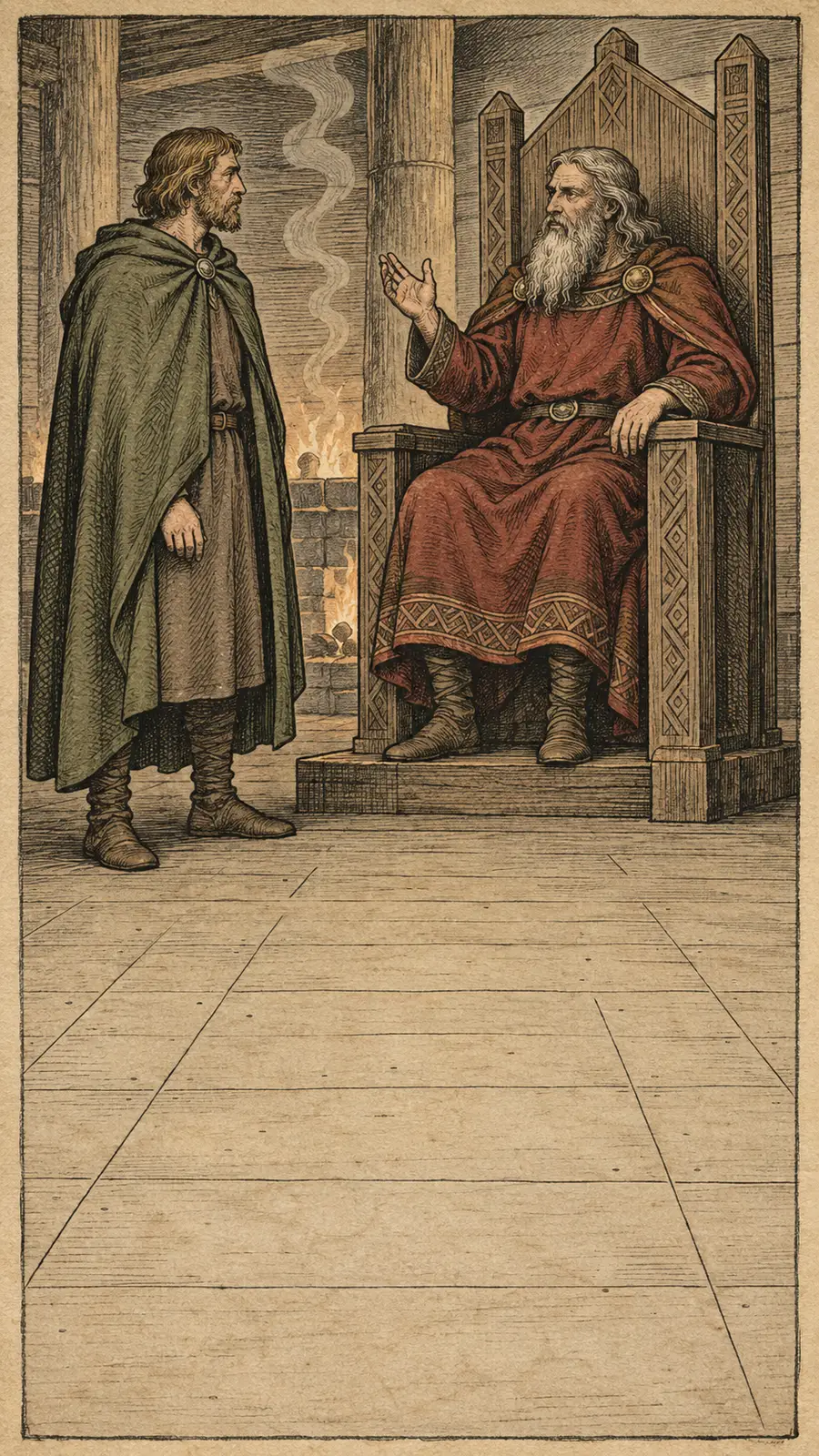
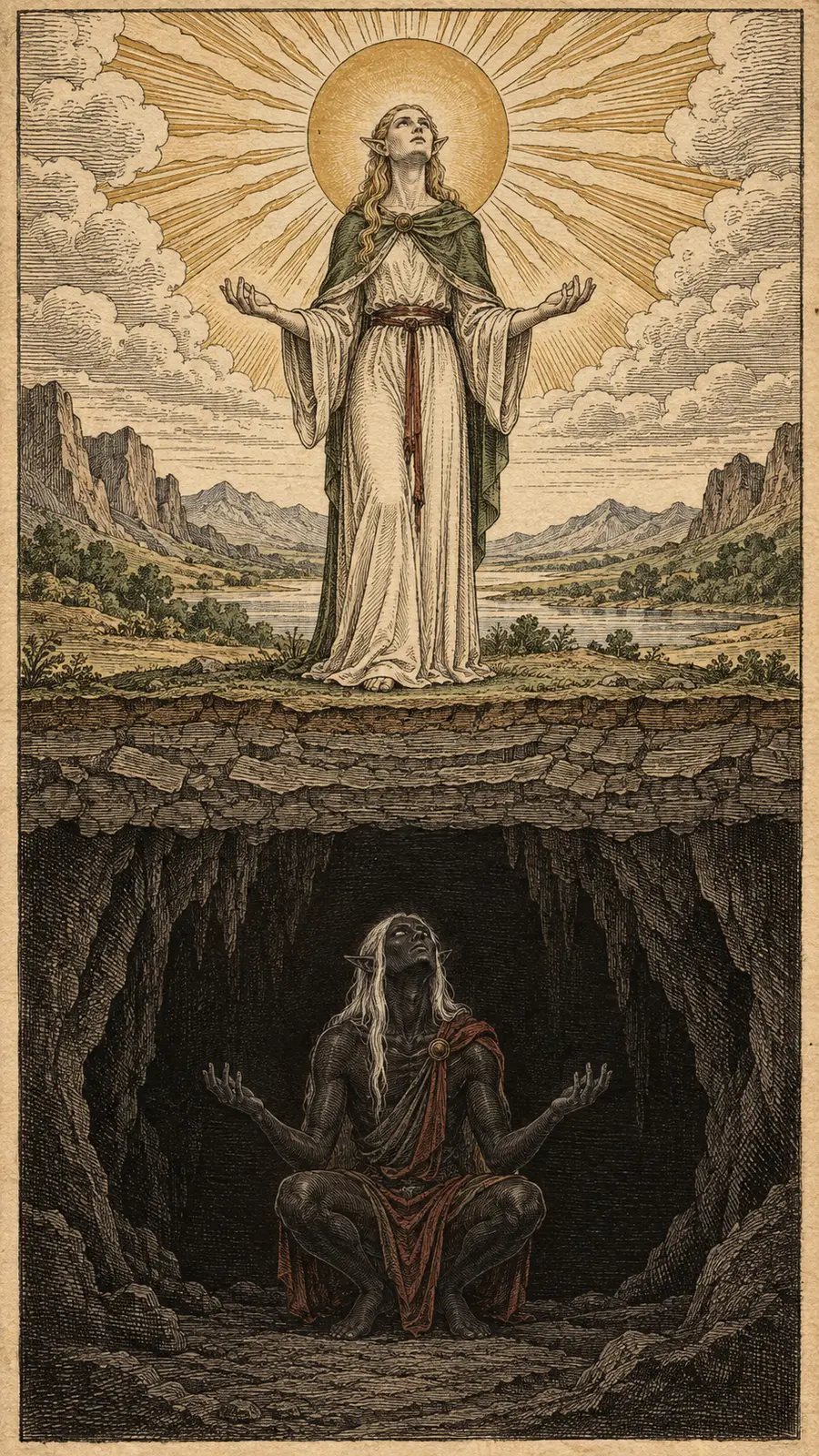
The idea of dark elves came from Norse myth. In the thirteenth century the Icelandic scholar wrote the Prose Edda, and in the part called Gylfaginning, a disguised king named questions an enthroned figure called High about the order of the world. High tells him there are elves of light, the ljósálfar, who live in and are "fairer than the sun to look at." Then there are the dark elves, the dökkálfar, who live down in the earth. They are "blacker than pitch," and they look and behave quite unlike their bright cousins. Elsewhere the Edda speaks of svartálfar, the black elves, who live in a realm called Svartálfaheimr. Scholars often treat them as the same beings as the dwarfs. They're bound up with deep places, fine craft and cunning. In one story, the sons of , called svartálfar, forge new golden hair for Sif, the wife of Thor, after has cut off her own.
We spent an evening with these roots when we went down into the Underdark together, so tonight we'll pass them gently. What matters for our city is how little of them the game kept. When Gary brought dark elves into Dungeons & Dragons, he took the bare idea of elves who dwell below and invented nearly everything else. He pointed to Thomas 's old book The Fairy Mythology as a good basis for building a new mythology suited to the game. The drow that came out of his notebooks owed the Norse a name and a mood, and owed the rest to his own imagination.
They arrived quietly. The Monster Manual of 1977 mentions them only in passing, inside the entry for ordinary elves, with one cool sentence: "The 'Black Elves,' or drow, are only legend." There were no statistics and no description. The drow were a rumour on the page.
Then the rumour turned out to be true. In the late 1970s Gygax wrote a run of adventures in which giants of the hills, the frost and the fire raid the lands of men. As the heroes cut their way through each giant hall, they find that someone else has been stirring the giants up. The hidden hand belongs to the drow, and in Hall of the Fire Giant King they finally step into the light of the game, with a full write-up of their own. From there the trail leads downward. In 1978 came the three adventures of the Descent: Descent into the Depths of the Earth, Shrine of the Kuo-Toa and Vault of the Drow, set in the World of Greyhawk.
At the bottom of that trail lay the first great drow city of the game, Erelhei-Cinlu. It filled an immense cavern called the Vault, and in it stood the Fane of . We walked those streets in our Underdark evening, under the strange plum-coloured light, so here we'll only notice what Erelhei-Cinlu handed down. It was a city of noble houses, eight of them, ranked and jealous, with a priesthood above them and rival factions threading through. The module left it open, so a Dungeon Master could spend long sessions on plots inside the city rather than simply fighting through it. A drow metropolis in a giant cave, ruled by feuding noble families under the clergy of a spider goddess: twelve years before Menzoberranzan appeared, that pattern was already set.
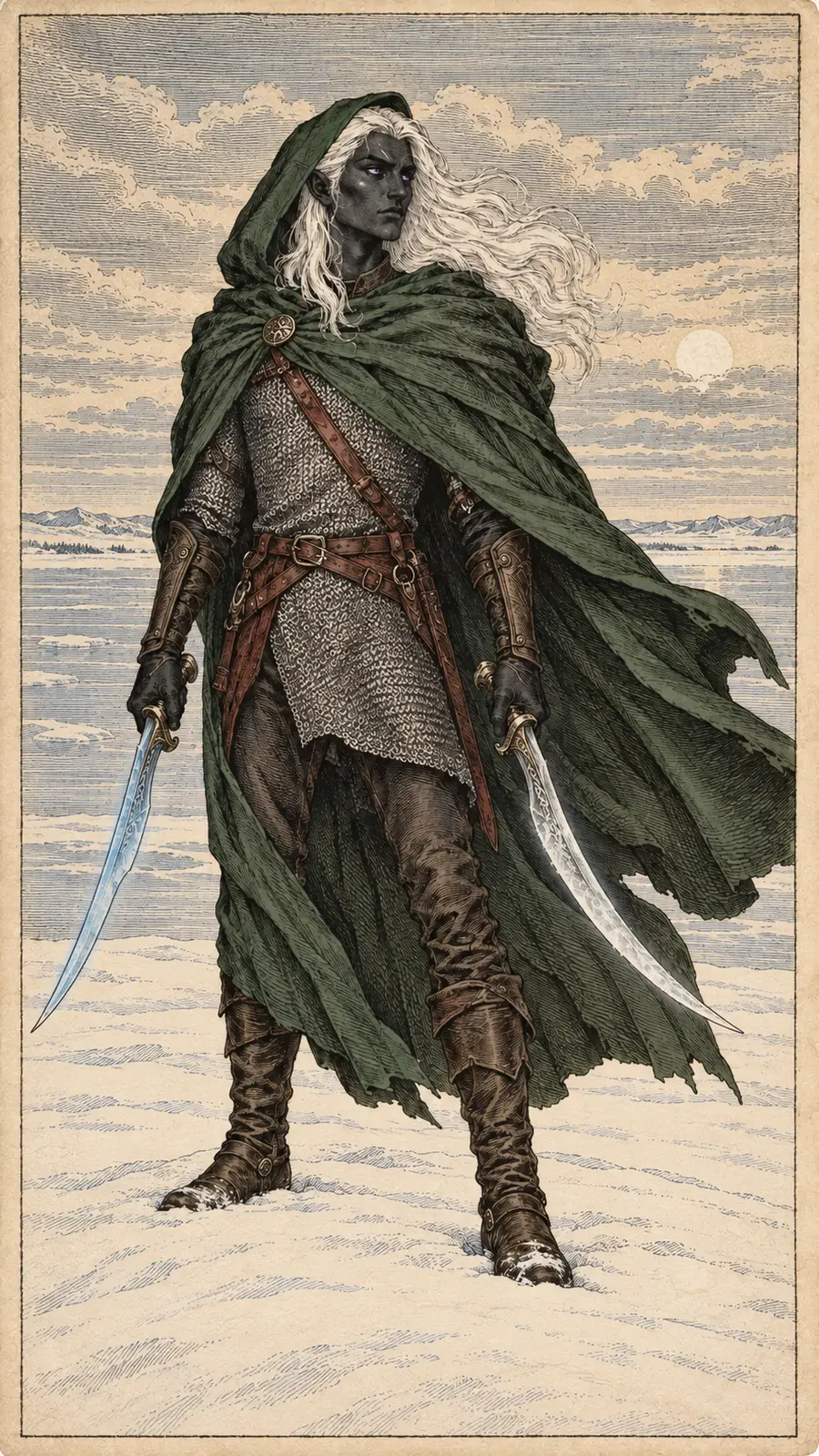
The look of the drow was fixed in those years too. Erol Otus painted the cover of Vault of the Drow, his first colour cover, and Jeff Dee drew the back. Between them and Bill Willingham, the early drow took on the appearance they would keep for a long time: black skin, white hair, sharp features and a sinister grace.
Lolth arrived in stages. She is named in the giant and descent adventures and described in full, with her own statistics, in Vault of the Drow. Gygax said she was "strictly a creation of [his] own imagination," and not drawn from Tolkien's great spider, Shelob. In 1980 David C. Sutherland the Third wrote the finale, Queen of the Demonweb Pits, with Gygax editing. In it, heroes cross into Lolth's own realm in the Abyss, a place of webs and passages. Sutherland is said to have found the pattern for the Demonweb printed on a hand towel, which is a homely beginning for so dark a place. That same adventure introduced the drider, a creature with the upper body of a drow and the lower body of a great spider. Gygax credited Sutherland with inventing it, and we'll meet driders often before the night is through.
The rest of the decade filled in the edges. Deities & Demigods, in 1980, treated Lolth as a goddess. The Fiend Folio, in 1981, was the first hardcover rulebook to give the drow full statistics. In 1982 Roger E. Moore wrote about the elven gods in Dragon magazine, and in 1985 Gygax's Unearthed Arcana allowed players to choose the drow as their own characters for the first time. In 1986 Douglas Niles gave the great underworld the name it still carries. Before then it had been called the Deepearth, and in the Dungeoneer's Survival Guide it became the Underdark. Keep Niles in mind. He'll come back to help build the city itself.
By the end of the 1980s, a set of traits had settled around the drow. They lived underground. Their society was a matriarchy, ruled by priestesses of Lolth. Lolth herself was a demon goddess who had fallen from the elven pantheon. The Monstrous Compendium of 1989 expanded their society, and in 1991 Ed Greenwood's The Drow of the Underdark gave the Forgotten Realms a thorough account of drow religion, history, magic, crafts and language.
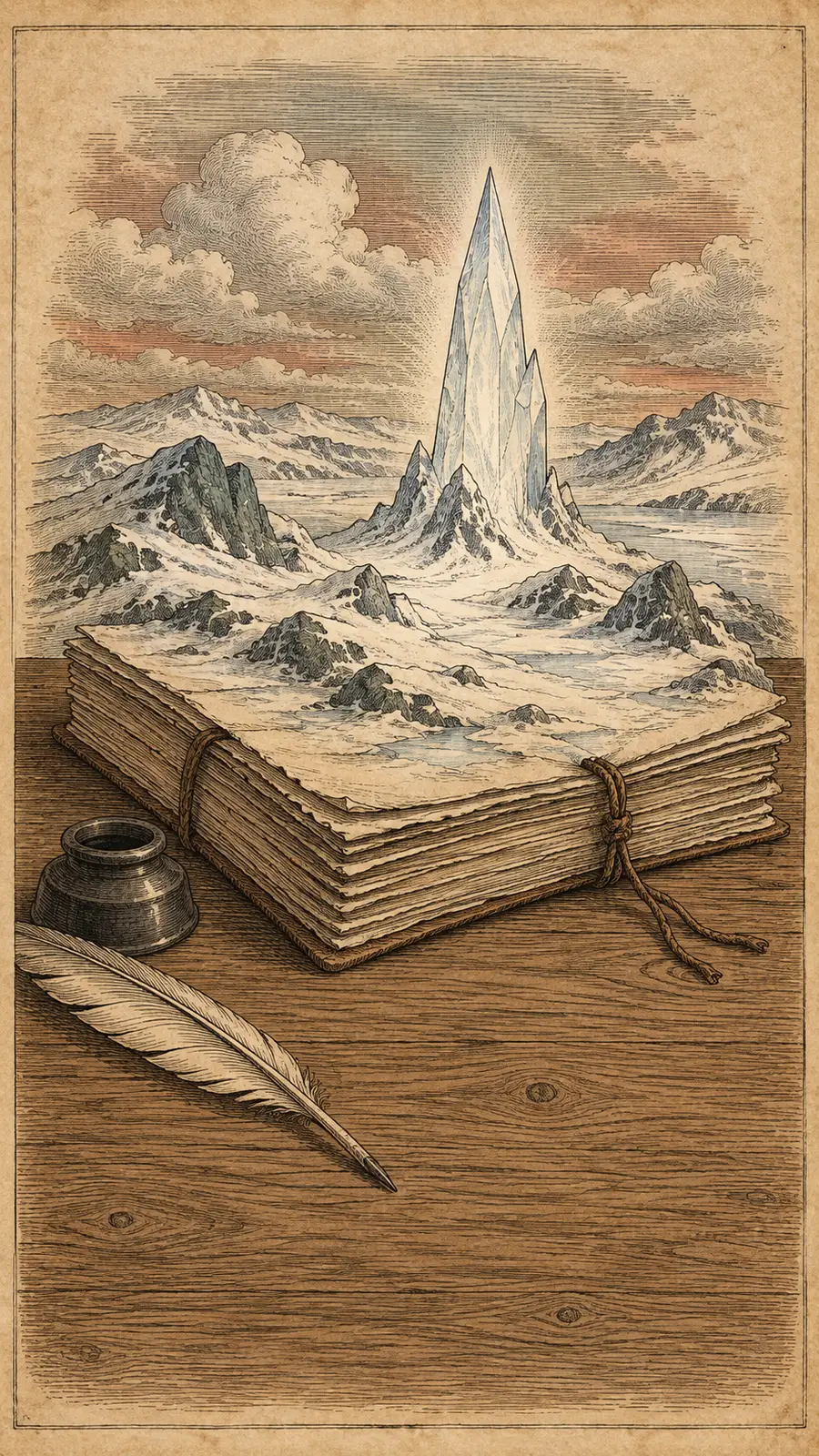
By then, though, the name we are following tonight had already been spoken. In 1988, R. A. published The Crystal Shard, a novel of Icewind Dale in the far north of the Realms. In it a dark elf named walks beside a barbarian and a dwarf, and the book mentions, almost in passing, his "years in Menzoberranzan." So the city had a name two years before anyone saw it. For a while it was a word in a ranger's past, the place a drow had walked away from.
Before we follow Salvatore down into that place, let's hear the story the city tells about its own beginnings. Most of this legend was written in the years after the city first appeared, as sourcebooks and novels looked back and asked where the drow of the Realms had come from. It belongs here, though, at the start of things, because in the world itself it comes first.
The story begins among the gods. Long ago, the legend says, Lolth was not Lolth. She was Araushnee, a lesser goddess of the elves, linked with destiny and artisans, and she was the consort of Corellon Larethian, the great father of the elven gods. She bore him twin children, Vhaeraun, the elder, and Eilistraee. Araushnee was ambitious, and her ambition turned against her husband. First she helped the orc god in an attempt to kill Corellon, enchanting the scabbard of Corellon's sword so that the blade would shatter when he needed it. The goddess Sehanine Moonbow saw through the plan and foiled it. Then Araushnee raised a host of gods hostile to the elves and sent it to storm Arvandor, the elven heaven. In the chaos she tricked her own daughter, Eilistraee, into wounding Corellon with an arrow.
The rebellion failed. Corellon cast Araushnee out, and her children were caught up in the exile. To be sure her beauty could never sway him to take her back, he changed her into a demon in the shape of a bloated spider. In the Abyss she took a new name, Lolth. She conquered one of its layers, the sixty-sixth by the old count, and made it the .
There is a darker telling, too. In one myth, Corellon cursed the elves who followed Lolth, turning their skin black and their hair white and banishing them from the sunlit world. Later lore stepped away from that idea of a curse written on the skin, and we'll come to that change in its proper place. For now it's enough to know that this was one of the stories the drow were given, and that it was never the only one.
Mortal history tells the fall more slowly. Long before the drow were drow, there were the Ilythiiri, the Elves of the South, called dark elves for the colour of their skin. They were proud and warlike, and their culture was highly advanced. Urged on by their nobles and by the clergy of two hungry powers, Lolth and the ooze god Ghaunadaur, they raided everyone around them, other elves included. These were the ages of the Crown Wars, when elven realms fought each other across the forests of the world. In one of those wars came the Dark Disaster, when the dark-elf realm of Miyeritar was turned into a wasteland in three months. The victors spread the blame, but the High Mages of Aryvandaar had done it, and most of Eilistraee's worshippers died in that ruin.
In the end elves, humans, dwarves and others joined against the southern dark elves. A series of vast magical battles broke them, and they fled into tunnels they had found long before. The elves remember this as the Descent. It ended the drow as a people of the surface, and the long night began.
Below the land called the lay Bhaerynden, the first great kingdom of the dwarves. Long before the dark elves came down, a dwarf named Taark Shanat had led many of its people west, and they became the shield dwarves of Shanatar. After the Crown Wars, the drow came into the deep places and took Bhaerynden for their own, making the dwarven city into a drow city. Then the cavern collapsed. Its fall left the Great Rift, a wound in the land that can still be seen. The legends disagree about why it fell. Some say the drow tore it apart with their own warring sorceries. Others say the dwarven gods struck it with their hammers and buried the dark elves under the stone. Exiled dwarves later settled in the Rift, and they became the gold dwarves.
Among the drow holdings of Great Bhaerynden was a place called Golothaer. Its people were caught in an endless war between the followers of Lolth and the followers of Ghaunadaur. Out of that war came a priestess of Lolth named , called the Kinless. Following the will of her goddess, she led seven drow families north, away from the fighting, into the region of the Underdark called the Northdark.
The journey was long and cruel. Lolth guided them through dreams, but the dreams came only when all hope seemed gone. It's a fitting kind of help from that goddess, enough to keep them going and never enough to let them rest. They fought the creatures of the deep along the way, and a war with a clan of dwarves cost them half their number. At last they came to a vast natural cavern where a beholder made its lair. The drow killed it, and the survivors settled in the cave. They named their new home after the priestess who had led them there, and it became Menzoberranzan. This happened nearly four thousand years before the reckoning that the surface folk of would one day use to count their years.
The peace of the new city did not last long, and nobody in it had expected it to. About fifty years after the founding, two houses called Nasadra and Thaeyalla fought a great battle inside the cavern. The fighting brought down a cavern wall. Four houses were destroyed in the fall, and Menzoberra herself was killed. In the confusion that followed, House S'sril turned on House Nasadra, and a family named Baenre joined S'sril's side. From that alliance House Baenre began to rise, and in time it became the First House of the city. It would hold that place for the rest of the city's long history.
Lolth then ordered House Nasadra to leave the city and found a second one in her name somewhere else, and she commanded that the two cities remain friends. So Menzoberranzan had a daughter almost from the start. We'll visit that daughter, the City of Shimmering Webs, much later this evening.
That is the legend, and the people of the city are taught it as truth. Many generations later some of them would begin to wonder whether it was true, but that is a story for near the end of our journey. For now we leave the founders in their cavern, under a ceiling they've only just won, and step forward to the year when readers first walked into the city.
Chapter II
Homeland, and the city first seen
In 1987, R. A. sent a manuscript to Mary Kirchoff, then managing editor of TSR's book department. She liked his writing and asked him to rework it for the Forgotten Realms. Out of that request came The Crystal Shard. While it was being drafted, Kirchoff called him on her way into a marketing meeting to say that one of his characters couldn't be used. With no time to think, he offered a dark elf as a sidekick for the barbarian , and named him on the spot. Salvatore later said the drow "wasn't even in the original synopsis of the book," and that he "kinda came up with him off the top of my head under pressure." Then Kirchoff read the manuscript and said, "give me more Drizzt."
Readers agreed with her. By the end of the Icewind Dale books, the brooding drow ranger had quietly become the heart of the story, and everyone wanted to know the same thing: how had the one good-hearted dark elf in all the Realms come to be that way? The answer would have to come from the place he had left. So in 1990, TSR published Homeland, the first book of The Dark Elf Trilogy, and readers went down into .
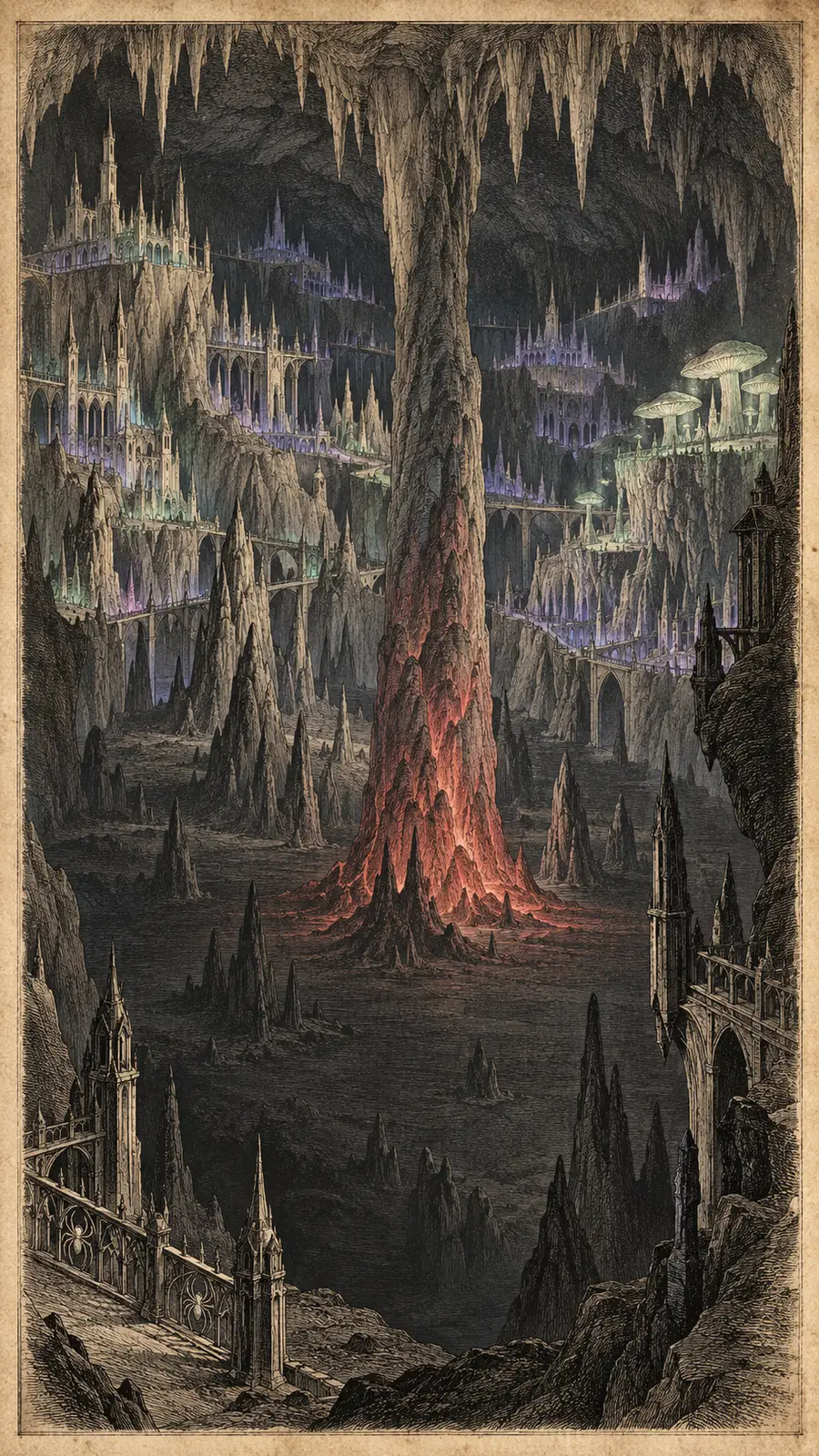
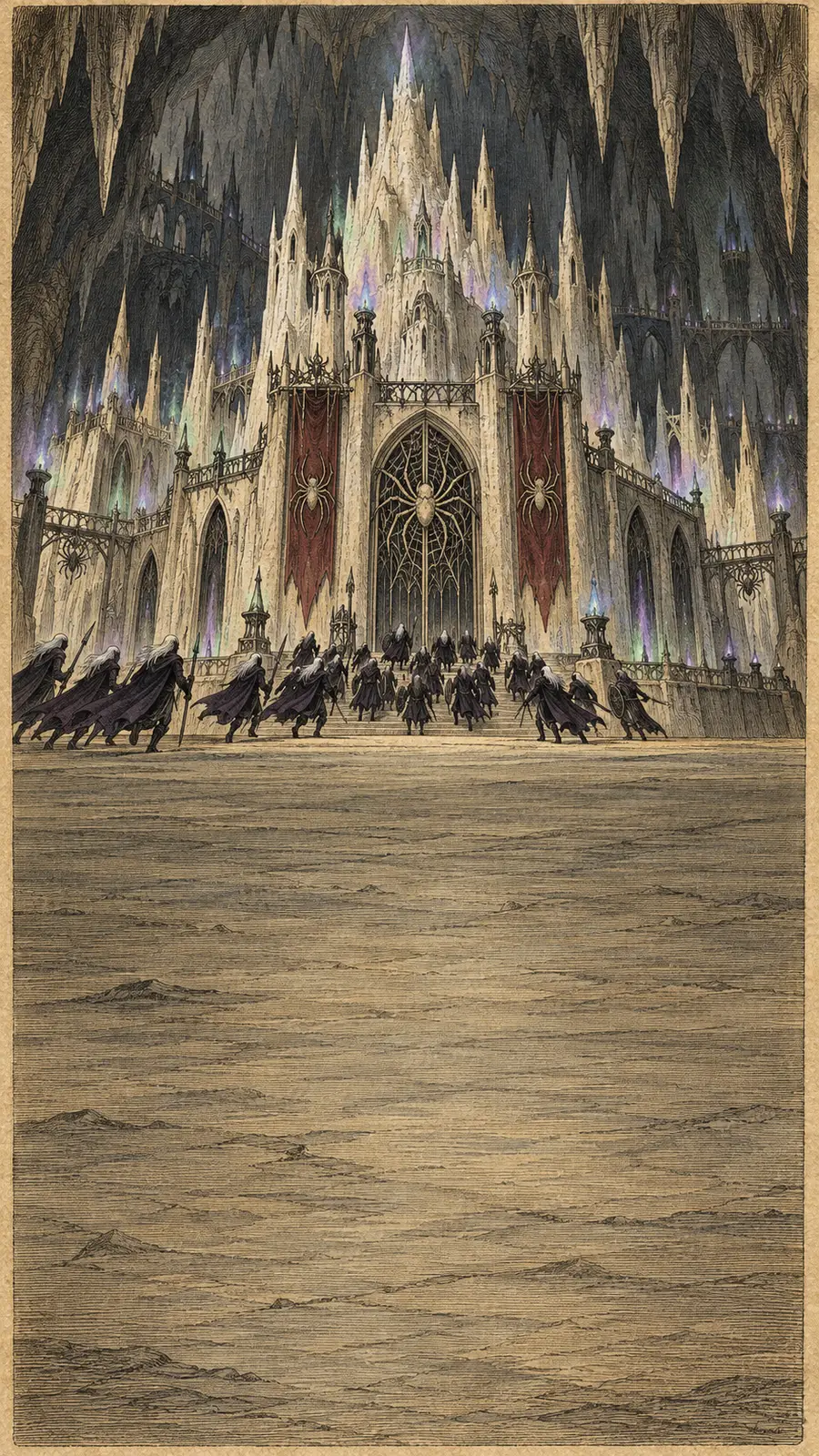
Here's what they found. The book names it plainly, "Menzoberranzan, the city of drow." Twenty thousand dark elves live there, which Salvatore's narration darkly calls "twenty thousand soldiers in the army of evil." They live in a cavern about two miles across. The noble houses aren't built so much as carved. Their walls and chambers are cut into the great stalagmites rising from the cavern floor and the stalactites hanging from the roof, and they glow with faerie fire, the soft magical light the drow use to edge their homes in colour. Picture a forest of stone spires in a dark you can't see the end of, each one lit along its carved edges with quiet shades of violet, blue and green. Seen from above it would look almost like a field of strange lanterns.
At the northern end of the cavern the floor rises to its highest point, and there stands Tier Breche, with a view across the whole city. Tier Breche holds the Academy, where the young drow of good families are trained, and the Academy has three schools. Arach-Tinilith is built in the shape of a spider, and there the priestesses of are made. Sorcere is a tower of wizardry, graceful and curving, with many spires. Melee-Magthere is a plain pyramid, where the male fighters learn their trade. In those three buildings you can read the whole order of the city: the priestesses first and grandest, the wizards second, and the warriors in a plain building at the bottom.
In the middle of the cavern rises , a great pillar of stone. It's the city's clock, and in a world without sunrise or seasons it is the only way the drow mark the passing of a day. Later books would describe the ritual that keeps it, and we'll watch it closely when we come to them. Even in Homeland the image is there: a whole city watching one slowly glowing column of rock to know how much of the day is left.
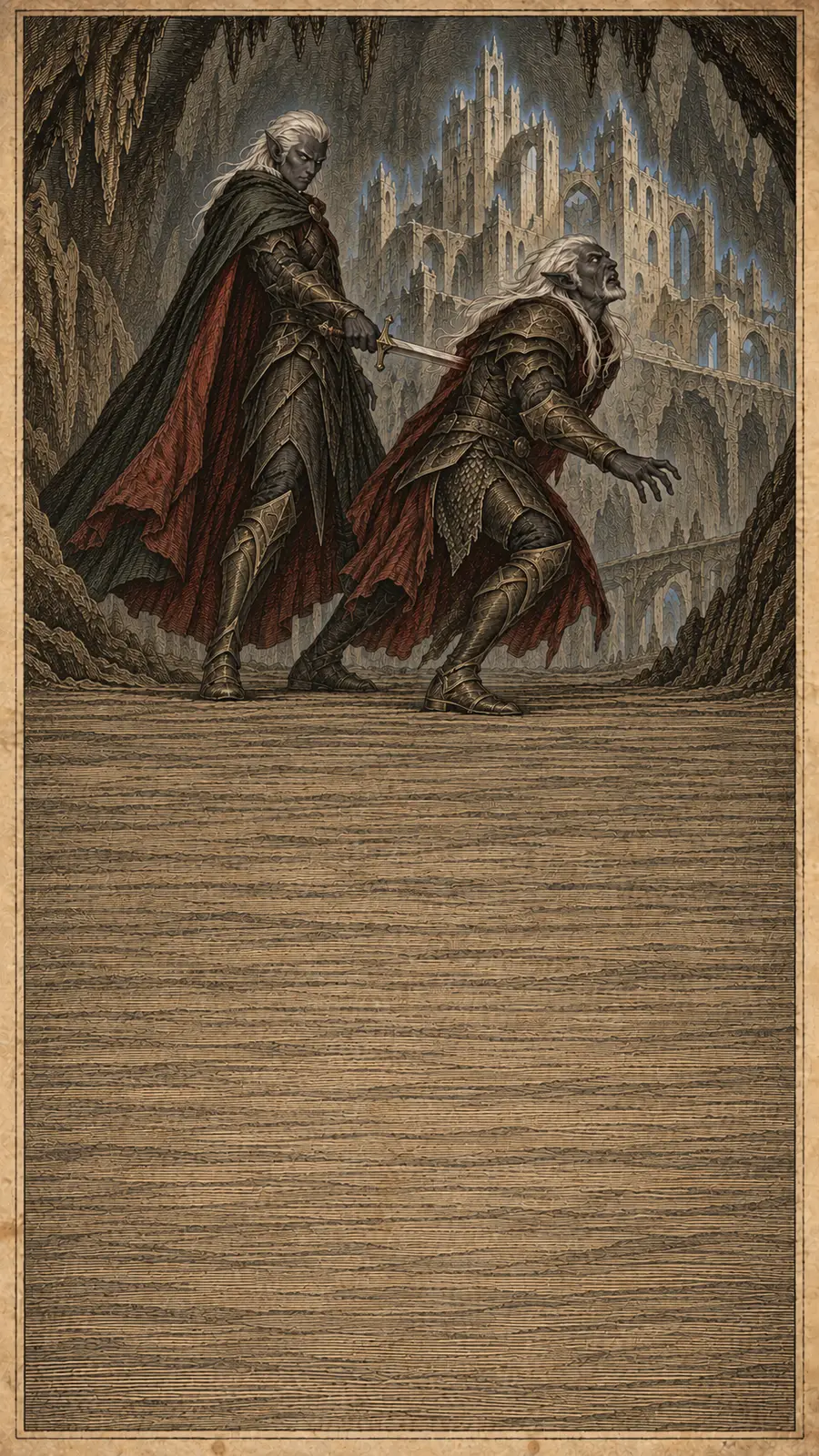
The book opens with murder, carried out in the cool, ordered way the city prefers. House Do'Urden, whose formal and ancient name is Daermon N'a'shezbaernon, is the Tenth House of Menzoberranzan. On the night we meet it, it attacks House DeVir, the Fourth House, whose matron mother has lost the favour of Lolth. The soldiers are led by Dinin, a son of the house. The house's weapons master, , goes in alone and kills every one of the DeVir clerics. Above it all, Matron Do'Urden is in labour, and she takes the pain of childbirth and turns it into a devastating spell. House DeVir is wiped out. Do'Urden rises to Ninth House.
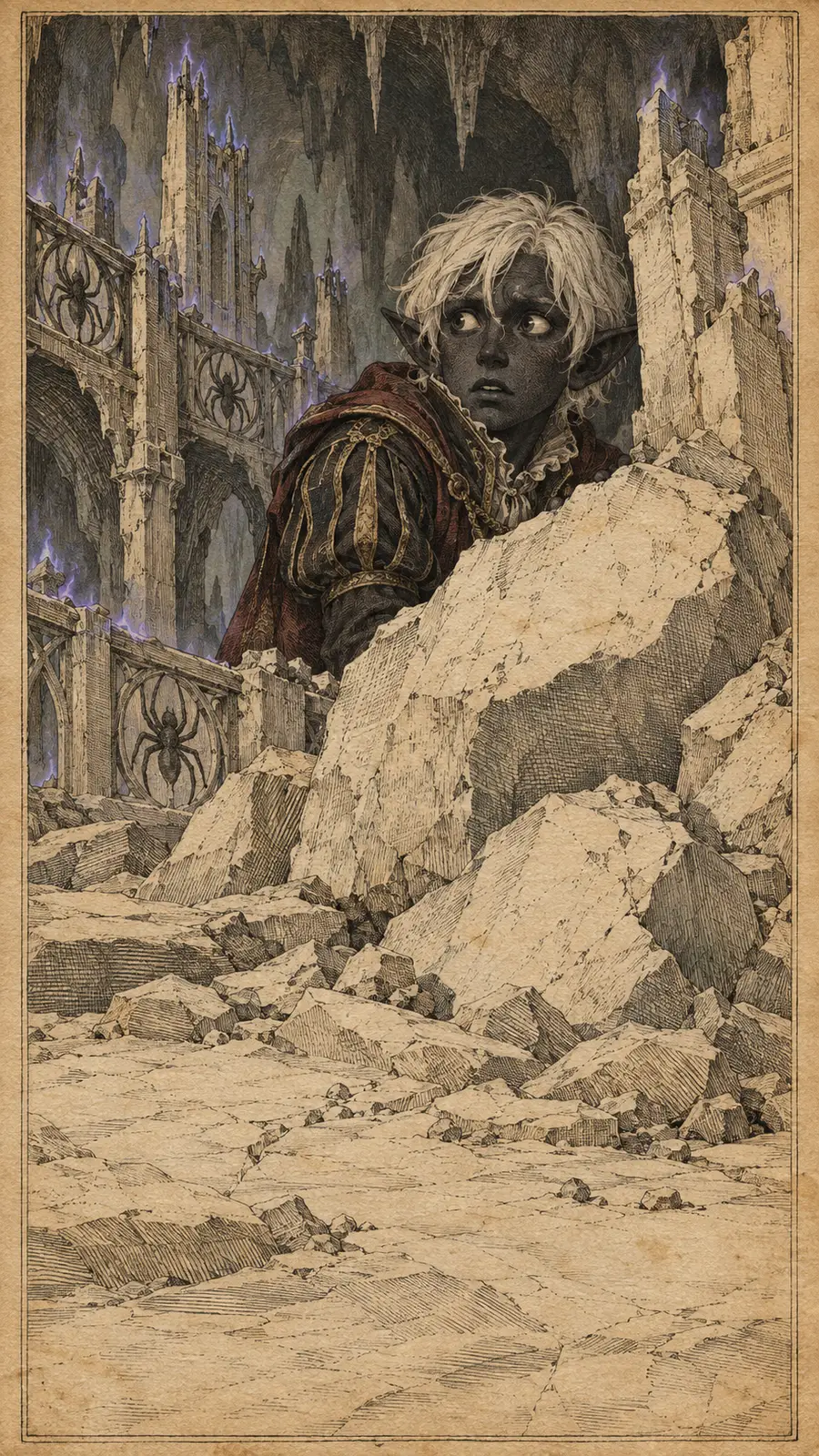
The book shows the city's first rule here, and it's an odd sort of rule. A house may destroy a rival house, and the city will allow it, but there must be no witnesses. Everyone may know. No one may be able to prove it. The houses wage secret wars that are only half secret, and the law cares only about evidence. One witness does survive that night, a young DeVir named , and he'll matter later.
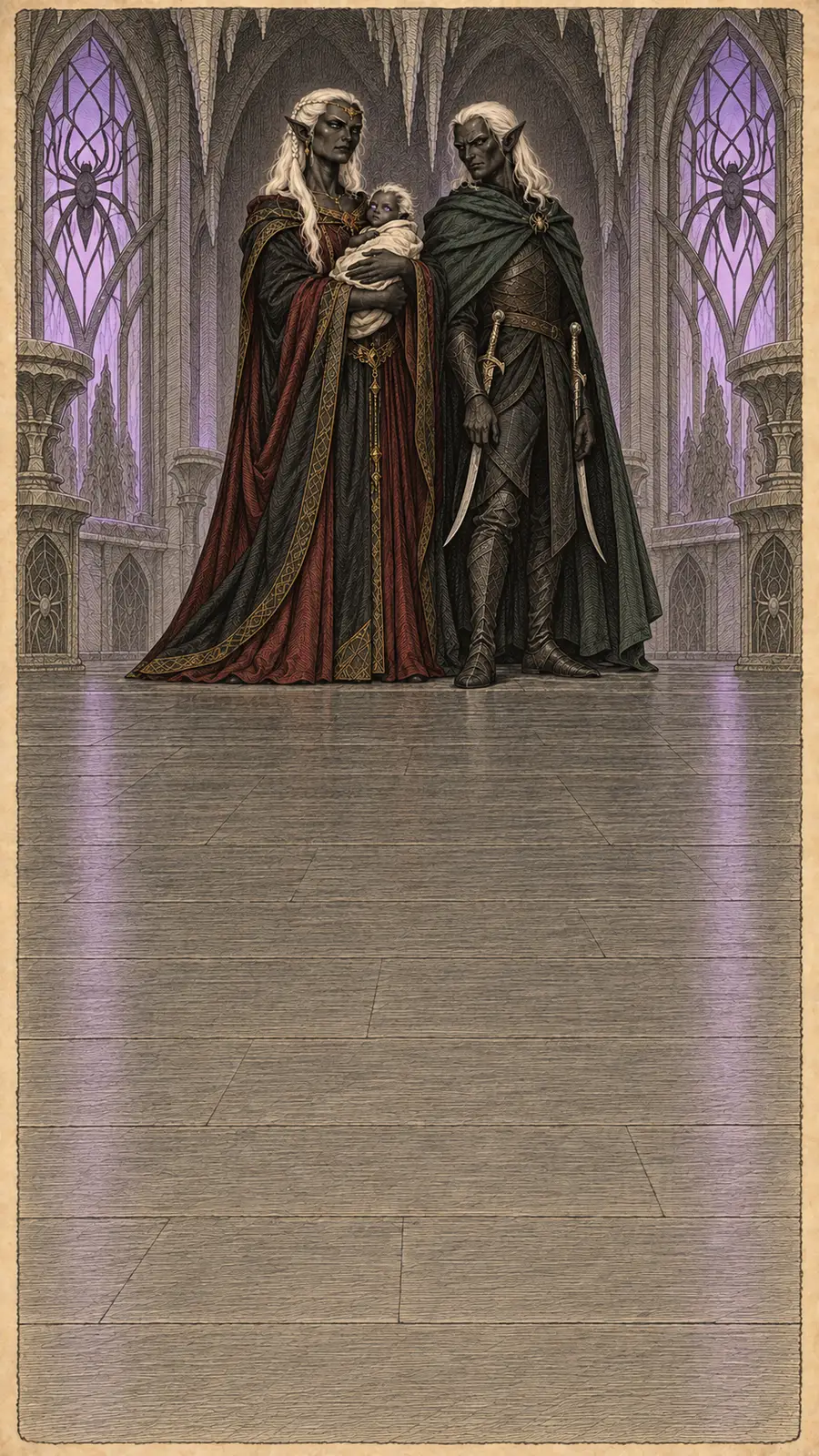
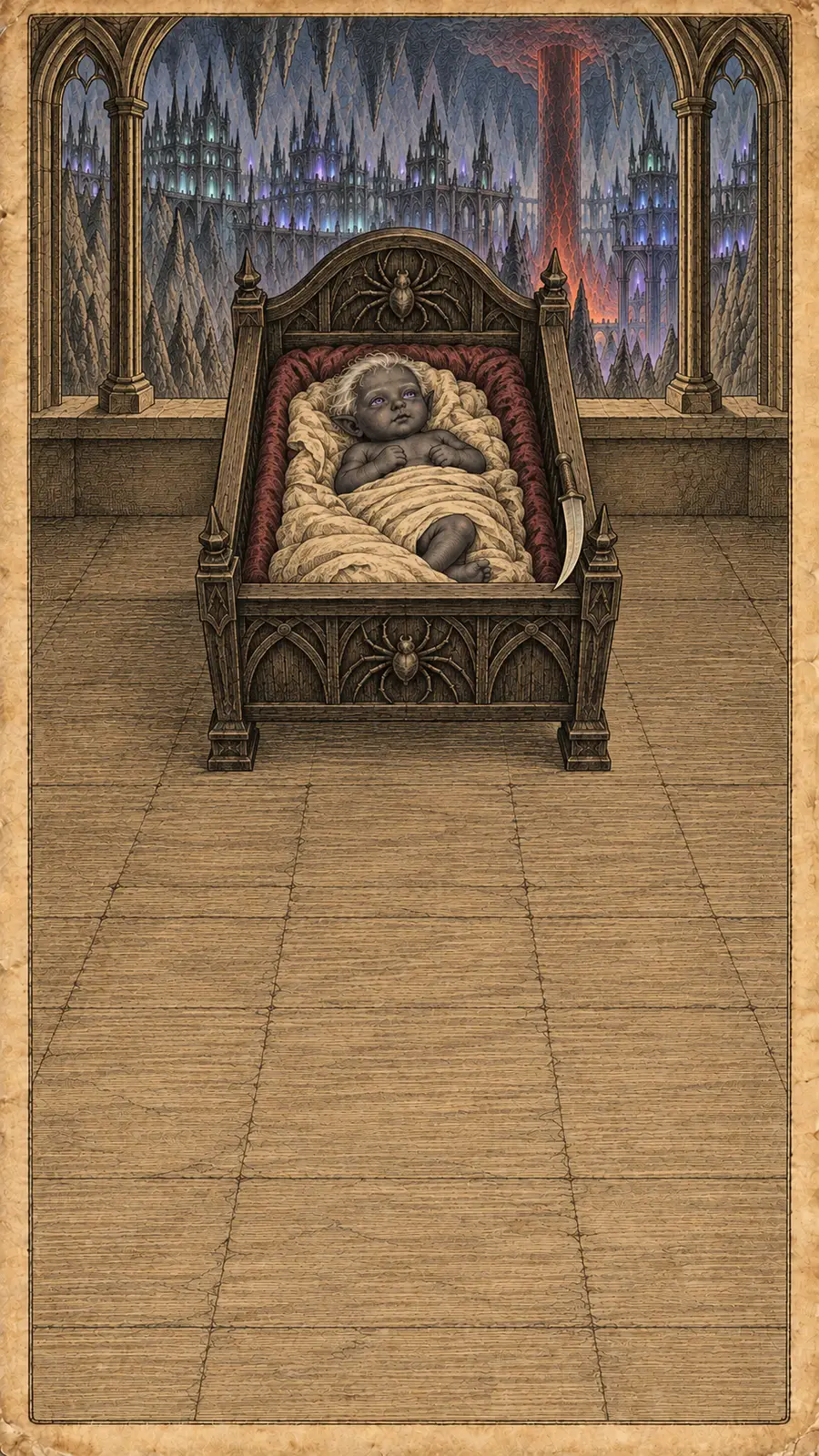
In the middle of the slaughter a child is born to Malice. He's Drizzt, her third son, and his father is Zaknafein, though that is kept within the family. By the custom of the city, a third son is owed to Lolth as a sacrifice. His eldest sister, Briza, is already preparing the rite when word comes from the battle. During the raid, Dinin has murdered their older brother, Nalfein, to make himself elderboy, the eldest son of the house. Nalfein's death counts as the sacrifice, and the infant Drizzt is spared. So the hero of the story owes his life to his brother's ambition, and from his first night the city teaches the lesson it will keep repeating: in Menzoberranzan, even mercy turns up by way of a knife.
Drizzt grows up among his sisters, Briza, Vierna and Maya. Vierna raises him in his early years. Then he is handed to Zaknafein to learn the blade, and something passes between them that has little to do with swordplay. Zaknafein is the finest warrior of his house and perhaps of the city, and he quietly despises everything around him: the cruelty, the scheming, the worship of a goddess who loves nothing. He has found no way to escape it, so he kills the city's priestesses when he's ordered to and hates himself for it. In the son he trains, he finds the same unease, and he teaches Drizzt to fight well and to watch his surroundings carefully.
Then Drizzt goes to Melee-Magthere, the plain pyramid on Tier Breche. He excels there, winning the yearly grand melee where the students test themselves against one another. He also learns what the Academy is really for. In one training exercise he discovers that his masters have used a child as bait. In his final year he learns the truth about the night of his birth: that his family destroyed House DeVir, and that Dinin murdered Nalfein. All through his years at school the city has been telling him what it is, and now he understands it.
Meanwhile Alton DeVir has kept himself alive. On the night of the raid he was close to graduating from Sorcere, and a wizard of House Hun'ett named Gelroos attacked him. Before Gelroos could finish, his own brother, Masoj Hun'ett, killed him, which is a perfectly ordinary family matter in Menzoberranzan. Alton then burned his own face with acid and took the dead man's place as a master of Sorcere, a figure known as the Faceless One. Hidden behind that ruined face, he plots revenge on House Do'Urden, and he finds a willing partner in House Hun'ett, the Sixth House, ruled by Matron SiNafay.
Masoj owns a small onyx figurine of a panther. When he calls on it, a great black cat comes out of the Astral Plane to serve him. Her name is , and readers first meet her here. Masoj treats her as a tool, and she bears it with patient dignity. Drizzt treats her as a friend. When the long plot of Alton and the Hun'etts finally comes to a head, an explosion kills Alton, Drizzt kills Masoj, and the figurine passes into Drizzt's hands. From then on, wherever the dark elf goes, the panther goes with him.
The turning point comes on the surface. After his schooling, Drizzt joins a raiding party sent up to slaughter a band of surface elves. In the chaos he finds a small elf child, and he can't kill her. Instead he smears her with blood and hides her beneath the body of her murdered mother, so that the raiders will take her for dead. Zaknafein believes his son has killed the child and mourns what the city has made of him. Lolth isn't fooled. The goddess knows exactly what Drizzt has done, and House Do'Urden loses her favour.
In Menzoberranzan, lost favour must be bought back, and Malice decides the price will be Drizzt. Zaknafein offers himself in his son's place, and Malice accepts, because one sacrifice will serve her as well as another. Zaknafein is given to Lolth. After seeing his father die, Drizzt renounces his house and his people and walks out into the Underdark, alone except for a figurine in his pocket and a panther who will come when he calls.
That's the city as it first appeared. It's beautiful and luminous and quietly lethal. Every element that the game would later put into tables and maps is already here, seen through the eyes of a young drow who doesn't belong. There are the ranked noble houses, the matron mothers, the priestesses at the top and the men below, the three schools on their high ground and the stone clock in the middle. One later reader called the city "as beautiful as a poisonous snake," and that sums up how Homeland made it feel.
Chapter III
Exile and Sojourn: the hunt for a renegade son
Homeland had two companions. Exile followed in 1990, and Sojourn in the spring of 1991, and the last of them made the New York Times best-seller list. Together they carry from the city's edge, across the wild Underdark and up into the sunlight. Even after he has left, keeps reaching after him.
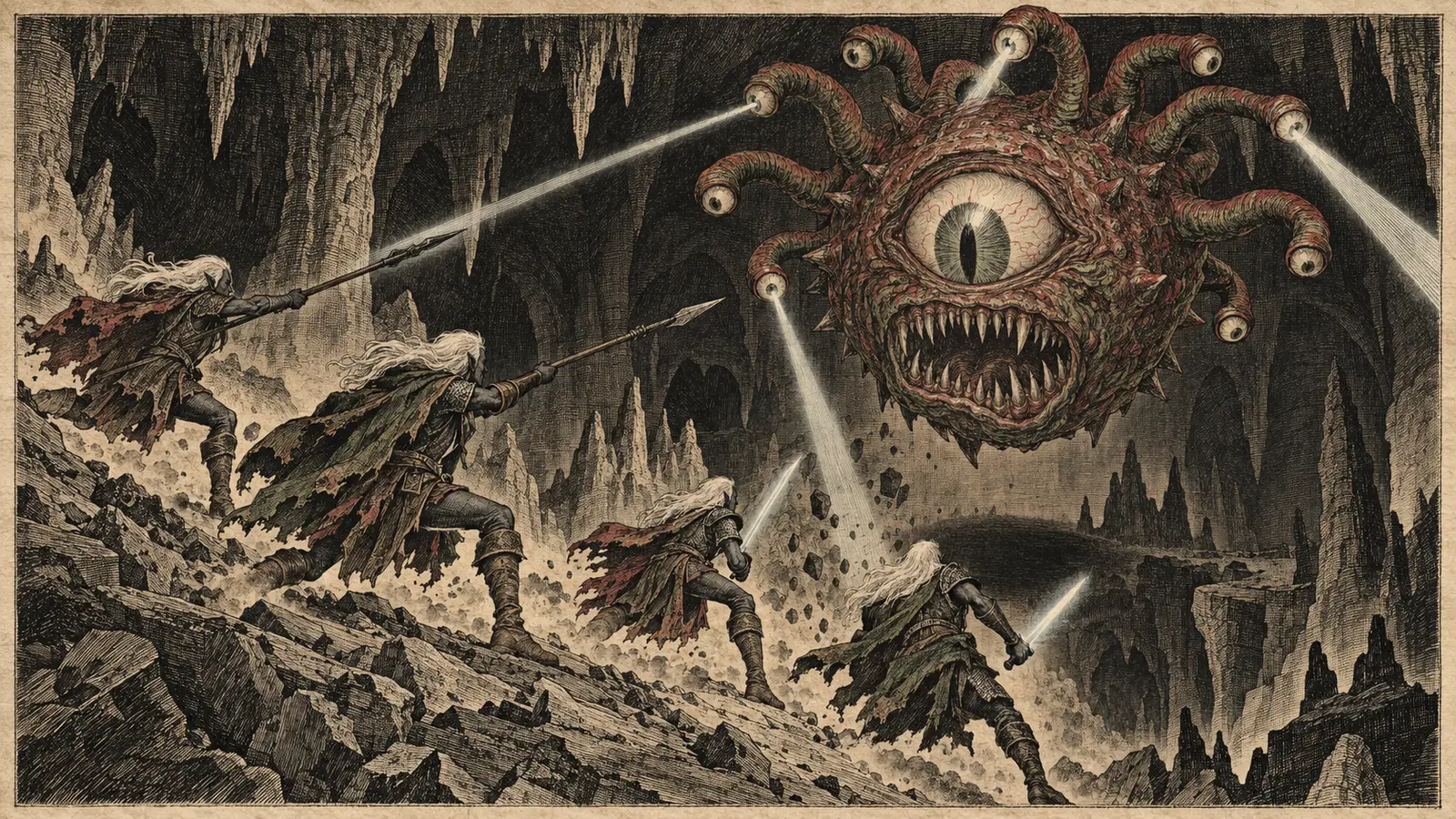
At the opening of Exile, Drizzt has spent about ten years in the wilds of the Underdark with only for company. He has hardened into something primal and watchful, and he's half lost himself in a cold persona he calls the hunter. The Underdark beyond the city is a country of its own, with twisting tunnels, mushroom forests, dark lakes, and creatures that eat whatever they can catch. He survives it the way the deep creatures do, by never quite letting his guard down.
Back in the city, Matron has not forgotten him. Her house is still out of 's favour, and the surest way to win it back is to bring the runaway home and give him to the goddess. She sends Briza and Dinin into the wilds after him, and they fail. She also hires outside help, and here the trilogy brings forward a character who'll outlast nearly everyone else in it. He is , leader of a mercenary company called Bregan D'aerthe.
Bregan D'aerthe is made up of houseless drow: outlaws, survivors of fallen families and rogues of every kind. It is based in and around Menzoberranzan and works mostly for the noble houses, doing jobs no matron wants to be seen doing herself. Jarlaxle is a male in a city of matrons, a houseless drow in a city of houses, and yet he is one of the most quietly powerful people in it. He wears outlandish clothes and has a lazy smile, and he always seems to know more than he says. Even this early he's playing his own game, and he will turn up at every age of the city, still smiling.
When ordinary hunters fail, Malice asks for more. She calls on a yochlol, one of Lolth's handmaidens, and requests Zin-carla, the Spider Queen's greatest gift. It's an old and terrible blessing. A dead body is raised with its own spirit and its old fighting skill, bound to the will of the matron who asked for it. To pay for it, Malice offers the goddess a sacrifice, and the sacrifice is Matron SiNafay of House Hun'ett, her old rival. The body Lolth returns to Malice is 's. The father is raised as an undead spirit-wraith and sent into the dark to kill his son.
While that shadow follows him, Drizzt finds something like a home. He comes to , the city of the svirfneblin, the deep gnomes. They're a cautious, stony, practical people, and they have every reason to fear a dark elf. They might have killed him. But one of their leaders, Belwar Dissengulp, a burrow-warden whose life Drizzt once spared, takes him in. Belwar lost his hands in a long-ago drow raid, and he wears magical mattock and hammer heads in their place. He becomes the first true friend Drizzt makes outside his own people.
Drizzt and Belwar travel for a time with a third companion, Clacker. Clacker was once a pech, one of the small, gentle people of the deep rock, until cruel magic turned him into a hook horror, a great armoured beast with a beak and hooked claws. As the journey goes on, the beast's mind slowly overtakes his own, and he loses himself a little more each day. He's a sad figure, and the book handles him gently.
At last the spirit-wraith finds its son. Drizzt sees his father's face looking at him without recognition and is undone by it, and the two fight. Then, for one moment, Zaknafein breaks through the spell that binds him. In that moment he takes back control of his own body and throws himself into a pool of acid. The Zin-carla fails, and Lolth's great gift comes to nothing.
The price of that failure falls on House . Briza kills her mother. Lolth decrees the destruction of the house, and House Baenre, the First House, the city's oldest and most favoured, carries the decree out. Daermon N'a'shezbaernon ends the same way House DeVir did. Only two of the family survive: Vierna and Dinin, who find shelter among Jarlaxle's mercenaries in Bregan D'aerthe. Their stories end in the books that come later. Vierna will die at her brother's own hands, and Dinin, by then made into a drider, will fall to when the drow come against the dwarves of . Drizzt is left as the last known Do'Urden.
In Sojourn, the third book, the city is behind him and the sky above him. It opens on a mountainside where Drizzt watches the sun come up, the hundredth sunrise he's seen. The light is wonderful and painful to him, and it's slowly destroying his gear. Drow magic is bound to the Underdark, and sunlight unravels it. His piwafwi, the dark cloak that hides its wearer, is fading. His boots are failing, and so are his scimitars. Everything the city gave him is wearing away in the sun, and the book quietly suggests that this is no great loss.
The surface people do not know what to do with him. He comes near a farm and its family, hoping to watch and learn, and the eldest son, a boy named Connor, charges him with a sword. Drizzt disarms him without harming him, and the children run. Then a monster takes advantage. Ulgulu, a shapeshifting barghest, takes the form of a drow and murders the Thistledown family, leaving behind a scimitar it has stolen from Drizzt. The surface world sees what it expected to see. A bounty hunter named Roddy McGristle takes up the chase, and Drizzt, unwilling to kill, drops a tree on him, which costs Roddy an ear and leaves his face scarred and his grudge sharpened.
Then Drizzt meets Montolio DeBrouchee, an old human ranger called Mooshie by his friends. Mooshie lost his sight fighting a dragon, and now he lives by his other senses and by his bond with the forest and its creatures. He sees what no one else on the surface has seen: that the young drow is a ranger at heart. He teaches Drizzt the ways of the woods, and of the goddess of the wild, and of a life lived by choice rather than birth. When orcs come against Mooshie's Grove, Drizzt fights beside him. Later, a band of rangers led by Dove Falconhand crosses his path, and a wood elf in it named Kellindil attacks him on sight. That's the shadow Menzoberranzan casts over every drow who leaves it.
In the end Drizzt reaches Icewind Dale, in the far cold north, and finds the people who'll become his family: the dwarf Bruenor Battlehammer, the girl , the halfling and the young barbarian . With that the trilogy loops back to The Crystal Shard, where his story had begun two years earlier.
When the last page is turned, the city has lost its son, but it hasn't changed. House Do'Urden is gone, and other houses have moved up to fill its rank. glows and fades. The game was about to build the whole city for players to explore, so that people could walk where Drizzt had walked.
Chapter IV
The famed city of the drow: the 1992 boxed set
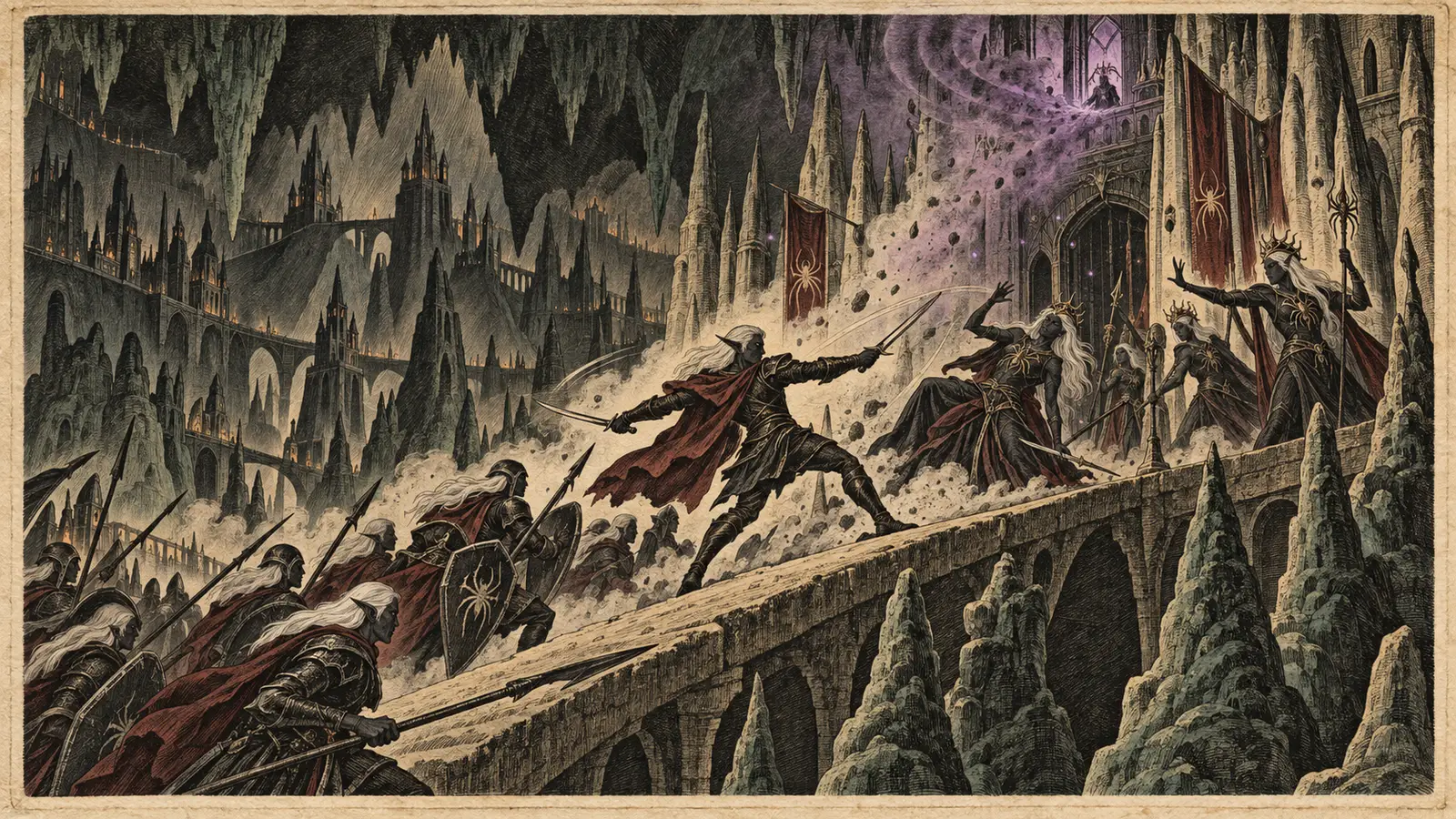
In December 1992, TSR published Menzoberranzan, a boxed set for the second edition of Advanced Dungeons & Dragons. Its fuller title was Menzoberranzan: The Famed City of the Drow. It was written by Ed Greenwood, who had created the Forgotten Realms, R. A. , who had created the city, and Douglas Niles, who had named the Underdark. Jeff Easley painted the cover. Until then the city had lived only in novels. Now the game laid it out in maps and pages so that Dungeon Masters could set adventures there.
The box was full. It held three books. The first, The City, toured the streets and districts and described the customs and daily life of every class of citizen and non-citizen. The second, The Houses, set out the noble families with maps of their compounds, their key people and what drove them. The third, The Adventure, was a ready-made adventure that could begin either with players as visitors from the surface or with players as drow. Alongside the books came poster maps that joined into one great map of the city, a map of the House Baenre compound, and a poster tracing the rivalries and alliances of all eighteen major and minor houses. There was also a small booklet called The House Retrospective, presented as 's own writings. In it the lost son, writing from far away, looks back at the city and at the house that is no more.
One small thing in that box may catch your ear. In this era the goddess's name was often spelled with a doubled letter, , as the city's own dialect had it, and the back of the box speaks of the priestesses of Lloth, the Spider Queen, who demand complete respect. It's the same goddess, written a little differently.
Now we can describe the city in proper detail. lies in the Upper Northdark, about two miles beneath the surface of the Surbrin Vale, between the Moonwood and the Frost Hills. On a warm night in the North, people walking under the trees there have no idea that a city of twenty thousand drow is spread out in the dark below them. The great cavern has an old dwarven name, Araurilcaurak, meaning the Great Pillar Cavern. It's shaped like an arrowhead, about two miles across, with a ceiling about a thousand feet above the floor.
The light is everywhere and never bright. Blue and green faerie fire lines the carved stone, with violet among it. Much of the city is cut from calcite, and luminous fungi grow in its gardens and along its walls. Spider shapes are worked into everything: railings, gateways, windows and the ornament of the great houses. Warmth drifts through the cavern from fissures in the floor and from hot springs, so the air of the city is never quite cold. Some of the noble houses don't stand on the floor at all. They're carved into stalactites and hang from the ceiling, held there by magic, with their lights high overhead like constellations someone has hung by hand.
In the middle stands . It is a vast natural pillar that joins the floor to the ceiling, rising from a low area called the Deep Shadows to the highest point of the cavern roof, and it can be seen from anywhere in the city. Every day, the Archmage of Menzoberranzan casts fire magic into its base. The drow see heat as well as light, and over the course of the day they watch that heat climb the stone, so that someone looking at the pillar can tell the hour from how high the warmth has risen. Near the end of the cycle the stone glows red. Then it cools. When it's completely dark again, the drow call it Narbondel's Black Death, and that is their midnight. Then the Archmage renews the spell, and another day begins. It is one of the loveliest ideas the city has. A people who have never seen the sun made their own sunrise and sunset out of fire, rock and patience.
Tier Breche is a side cavern at the high end of the city, and it holds the Academy. Its three schools have a set order. Arach-Tinilith, the spider-shaped school of the priestesses, is the most prestigious. Sorcere, the many-spired tower of the wizards, mostly male, comes second. Melee-Magthere, the plain pyramid of the fighters, is the least honoured of the three. Every drow of great promise passes through one of them.
Arach-Tinilith keeps a ceremony that tells you a good deal about the city. At each year's graduation, the priestesses summon a glabrezu, one of the great clawed demons of the Abyss, in an attempt to bring a draegloth into the world, a creature half demon and half drow. Most years the attempt fails. About once a decade it succeeds, and the city counts that as a blessing.
The districts spread outward from there. Qu'ellarz'orl is the noble plateau, where the greatest houses stand: Baenre, Barrison Del'Armgo, Mizzrym and Agrach Dyrr. A forest of giant mushrooms divides it from the lower city, like a park left between the powerful and everyone else. Narbondellyn, near the great pillar, is a rising district, where younger and ambitious families build. The Braeryn, called the Stenchstreets, is the slum, where the poor and the outcast crowd together. Donigarten is the city's farmland. At its heart lies a lake with a small island in the middle, and around it are fungus farms, fields of moss, fish and eels in the water, and herds of deep rothé, the shaggy cattle of the underworld. The Bazaar is said to be the finest market in all the Underdark, where nearly anyone or anything can be bought. The Clawrift is a great chasm splitting the cavern floor. The box names other districts too, Duthcloim, Eastmyr, Manyfolk and Westrift, whose streets later books would fill in.
The city's government comes down to a single council table. The matron mothers of the eight highest-ranked houses sit together as the Ruling Council, and that is as close as Menzoberranzan comes to a government. The set describes the city in what the Realms calls the early Sable Years, the time after Drizzt's flight. In that order, Baenre is First House. Barrison Del'Armgo is second, a house of warriors with plenty of strength. House Oblodra is third, and its members wield the strange powers of the mind, psionics, which the priestesses can't fully understand or control. The city would later destroy that house, and only its ruins and a few survivors would remain. Faen Tlabbar and Xorlarrin hold fourth and fifth place, allies who don't trust each other. Hun'ett, Agrach Dyrr, Fey-Branche and Mizzrym also rank. House Do'Urden is no longer on the list, which is why it appears only as a retrospective.
The compound of House Baenre is a kind of city of its own. It sits on Qu'ellarz'orl and is made from twenty stalagmites and thirty stalactites, all carved and joined, about three-eighths of a mile long. The largest of them is called the Great Mound, and it holds the nobles of the house and the house chapel. Around the whole compound runs a magical fence twenty feet tall, shaped like a silvery spider's web. Nobody may pass it without a Spider Mask, and anyone who touches it without one sticks fast, like a fly, until the Matron Mother decides to let them go.
The people inside that fence would carry the city's stories for decades. At their head is Matron Mother Yvonnel Baenre, called the Eternal, about two thousand years old and one of the most important priestesses has ever had. She is ancient, patient and very hard to surprise. Her son, Baenre, is the Archmage of Menzoberranzan, master of Sorcere, and it's his hand that lights Narbondel each morning. He's a male with real power in a city that rarely allows it, which makes him both very valuable and constantly in danger. Her daughter Triel leads Arach-Tinilith, and in time she'll sit where her mother sits.
If you laid out that eighteen-house poster on a table and studied its lines of alliance and enmity, you'd see the set's real gift. It didn't give the city a single villain. It gave it a web, with every house tied to every other by jealousy and need. Pull on one thread anywhere and the others move.
Chapter V
The Spider Queen and the matriarchy of the city
Before we go on to the next great age, let's stay a while with the power who stands behind every house in the city. Through the 1990s, novels and sourcebooks kept adding to the picture of and her church. The Lolth we know took shape gradually in those years, and much of what follows grew up around the city in the second edition era and was kept in the ones that followed.
She has many titles: the Demon Queen of Spiders, the Spider Queen, the Queen of the . In the Realms she rules over darkness, the drow, evil, spiders, assassins and chaos. She's both a demon lord and a goddess, and the stories can't quite agree which she was first.
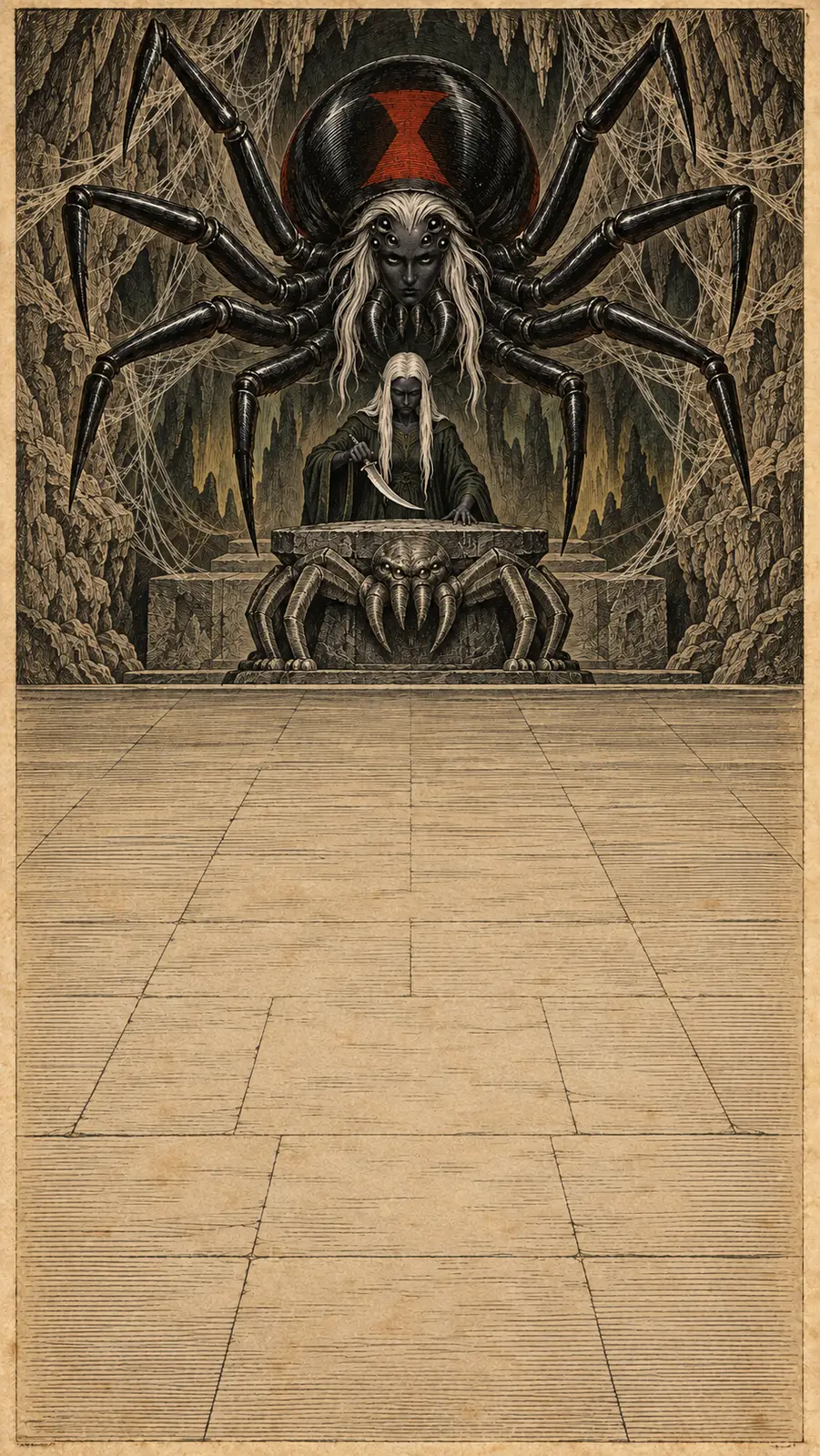
She shows herself in two forms. In one she is a drow woman of exquisite beauty, sometimes covered in clinging spiders. In the other she is a giant black widow, and from among the eight eyes of the spider a woman's face looks out. Sometimes her two front legs are arms. Her holy symbol is a black spider with the head of a drow woman, and in the Realms it hangs from a web. Her home in the Demonweb Pits is a fortress of iron shaped like a great spider, and it walks.
Her teaching is simple, and the whole city is built on it. Only the strong deserve to survive. Constant rivalry weeds out the weak, so she encourages it. She wants no rival faiths and no ideas she can't control, and she can't abide complacency, so she keeps her people restless. Beneath all that she simply delights in disorder. In , worshipping any other god is strictly forbidden, and no other force in drow life reaches as far as her church.
So the city's shape follows her will. The matron mothers who rule the houses are also high priestesses. Their authority comes from the goddess, through the spells she grants them, and every matron knows that the favour can be withdrawn. Houses rise and fall through covert war, and the rule about witnesses is how the goddess's love of conflict is kept just short of collapse. The men of the city are soldiers, wizards and servants. A few of them hold real power, chief among them Baenre and , but they hold it in the shadows, and they know how quickly it could be taken away.
The Temple of Lolth stands beside the Council Hall where the eight matrons meet. Ordinary people reach it in one of two ways: by a single bridge, or by a winding stair through a shaft that rises from the Mid-Caverns. It's a little like a mountain chapel. You come to it only by deliberate effort.
Lolth's servants are as much a part of the city as its stone. Yochlols are her handmaidens, lesser demons that her priestesses often call. When a yochlol answers, it forms a link with the mind of the priestess who called it and searches her thoughts and memories for proof of her loyalty. So for a high priestess, every summoning is also a test, and she can't hide anything from the thing she called.
At the edges of the drow settlements live the driders. They're drow who were tested by Lolth and found wanting, transformed through agony into creatures with the upper bodies of dark elves and the lower bodies of giant spiders. The goddess made them sexless, so that no new race could ever rise from them to threaten her people. They're hated and pitied in equal measure, kept outside the life of the city, a reminder to every drow who passes them of the price of failure.
The priestesses carry a famous weapon, the snake whip, which later books call the scourge of fangs. It has a handle of adamantine and three lashes that are living snakes. The heads writhe and hiss with the mood of the woman who holds the whip, and she can name each one and command it by will alone. Only a priestess of Lolth can truly master one. A whip that hisses when its owner is angry is a useful thing to carry in a city where nobody says what they feel.
Then there are the gifts. We've already seen Zin-carla, the raising of a dead warrior bound to a matron's will, and how it failed for . Most of Lolth's gifts are tests in disguise. The goddess helps her people the way she helped 's band in the tunnels, only when hope is nearly gone and only as much as it suits her.
In the years after the Dark Elf Trilogy, brought the city back to the surface world in a run of novels gathered as Legacy of the Drow. In one of them, Siege of Darkness, the gods themselves walk the world. This is the Time of Troubles, when the deities of the Realms were cast down into mortal forms and magic failed or went wild. It reached the city too. In that year was bathed in searing flames, so bright that any drow who looked at it with heat-seeing eyes was blinded. The clock of the city, which had always measured the day so quietly, became for a time something nobody could look at.
With magic failing, the priestesses' spells fell silent along with everything else, and only one ancient house kept its strange power. Lolth, walking the world in a mortal body, handed control of her plans for a time to the demon Errtu, while Matron Mother Baenre gathered the city's strength for a great assault on , the dwarven home of 's friends. The city's armies were going up out of the dark to take back the son who had left and to break the dwarves who had sheltered him. The war did not go the way the old matron hoped, and in the course of it Dinin, the drider, fell to Bruenor's axe.
So by the middle of the 1990s the city had a fully drawn goddess and a church whose habits ran through every house. That church depended entirely on Lolth answering her priestesses. The next era of the game would ask what happens to a city like that if she stops.
Chapter VI
The Silence of Lolth: the War of the Spider Queen
The third edition of Dungeons & Dragons arrived at the turn of the millennium, and in 2001 Wizards of the Coast's Forgotten Realms Campaign Setting carried the city into the new rules, with its cavern, its pillar, its council of eight and its First House all intact. In 2002, Wizards held what it called the Year of the Drow, and at the centre of it was a series of six novels called R. A. 's War of the Spider Queen.
The series was unusual. Each book had a different author, while Salvatore oversaw the whole and Philip Athans helped shape it as editor. Dissolution, by Richard Lee Byers, came out in 2002. Insurrection, by Thomas M. Reid, followed that same year. Condemnation, by Richard Baker, came in 2003, and Extinction, by Lisa Smedman, and Annihilation, by Athans himself, in 2004. The last, Resurrection, by Paul S. Kemp, came in 2005. A tabletop adventure joined them, City of the Spider Queen, by James Wyatt, which took characters from the middle levels up to great power along paths loosely shadowing the novels. One of its strangest places was an Undying Temple adrift on the Ethereal Plane, which players compared to the walking spider-fortress in the old Queen of the Demonweb Pits.
In the world, it began with silence.
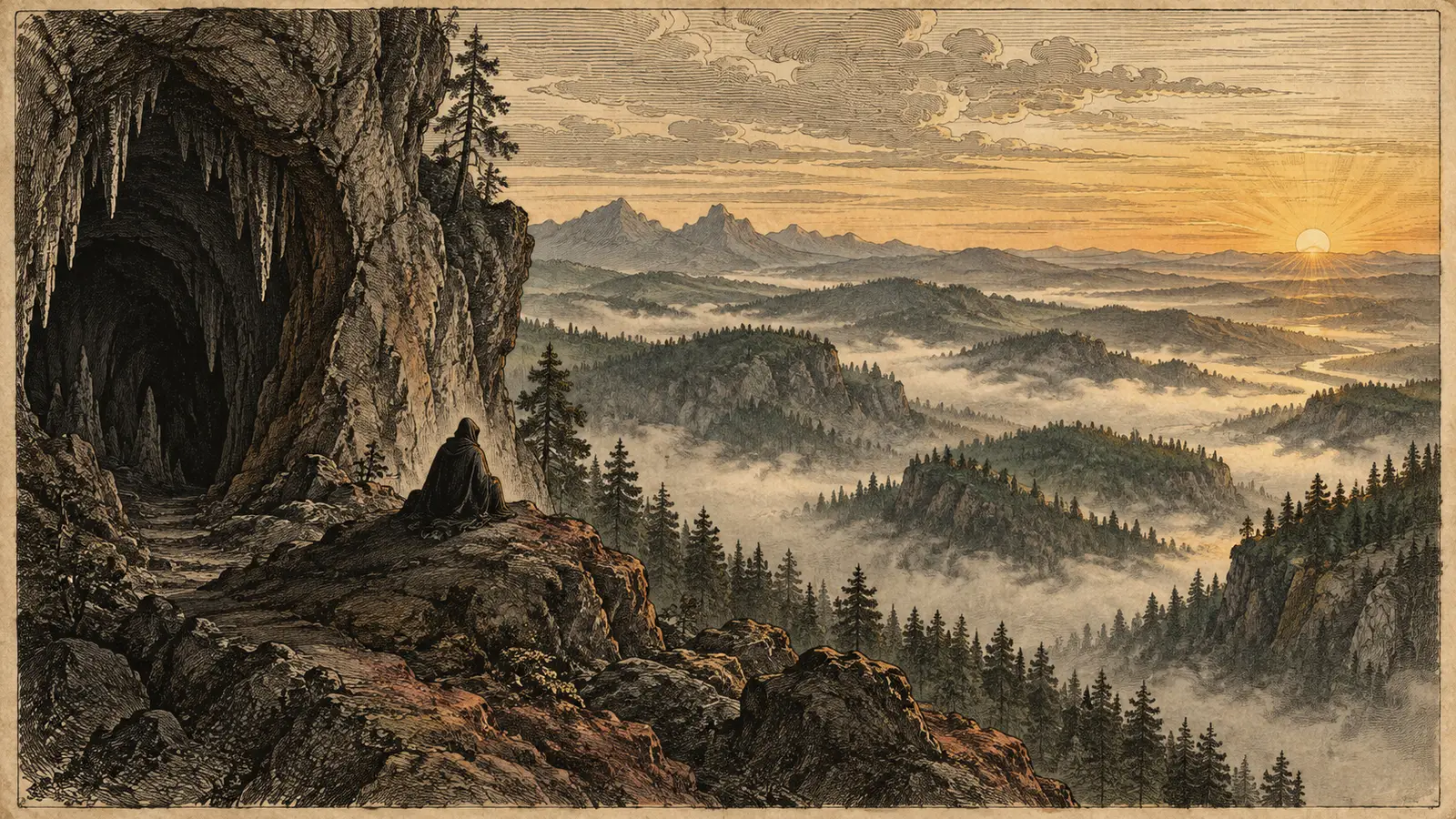
In the year 1372 by the Dale Reckoning, late in the summer, stopped answering. Her priestesses prayed and received no spells. They tried communion and found nothing there. The ways to the were closed to all travel. For about half a year, the Spider Queen was simply absent, and her church in every drow city was left without its power.
In , the matrons' authority had always rested on the spells they could call down, the sense that the goddess stood behind every word they spoke. Now there was nothing behind them. They had to hide it, and fear spread through the city underneath.
The first book, Dissolution, opens in Menzoberranzan. Yvonnel the Eternal is gone by now, and her daughter Triel Baenre rules House Baenre and through it the city. Something strange is happening. Males are vanishing from the noble houses in large numbers, slipping away in the night. Triel orders her brother, , the Archmage, to find out why. Gromph, who has his own concerns, hands the task down to a younger wizard, Pharaun Mizzrym, clever, vain and very capable. Pharaun recruits a warrior friend, Ryld Argith, a master of Melee-Magthere with a great sword. Meanwhile Gromph keeps one eye on his other sister, Quenthel Baenre, Mistress of Arach-Tinilith, because in House Baenre siblings are always watching one another.
When it's clear the silence reaches further than one city, Quenthel leads a band out of Menzoberranzan to seek answers. Her company is a strange one. It includes Pharaun and Ryld, and Jeggred, Quenthel's nephew, a draegloth, half demon and fiercely loyal to her. It includes Valas Hune, a scout of Bregan D'aerthe who knows the tunnels as well as anyone alive, and Faeryl Zauvirr, the envoy from Ched Nasad, the daughter city. They go first to Ched Nasad itself.
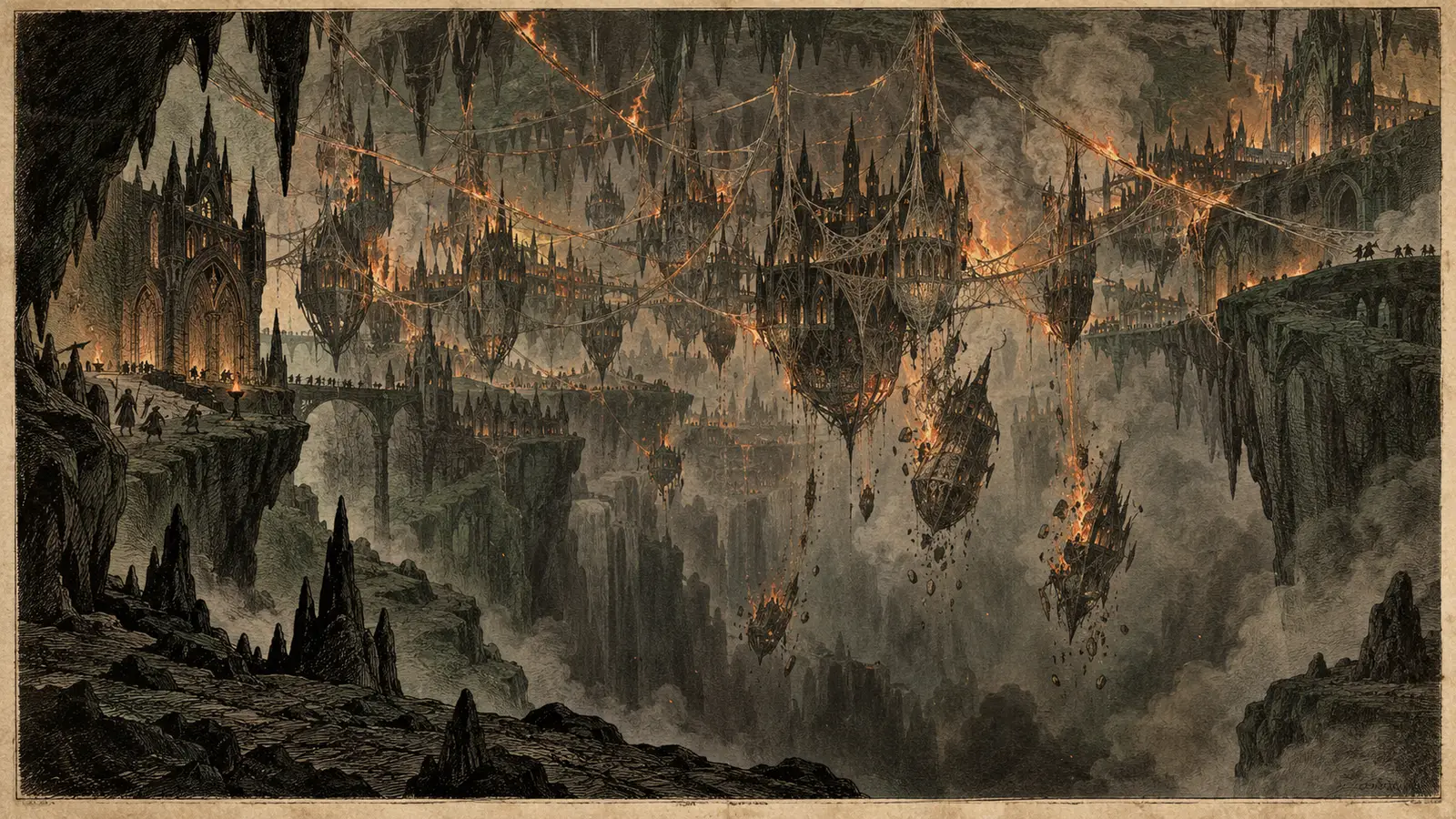
The second book, Insurrection, tells what happened there, and it's one of the saddest stories in drow lore. Ched Nasad, the City of Shimmering Webs, fills a great cavern hung with layer upon layer of calcified web, its buildings suspended from the filaments like cocoons. During the Silence, a matron named Ssipriina Zauvirr moved against the great House Melarn, and to do it she hired a band of duergar mercenaries, the gray dwarves, called Clan Xornbane. The duergar carried alchemical bombs called stonefire. The fire caught in the calcified webs that held the city up, and the webs burned.
Ched Nasad fell into its own chasm. Of roughly thirty thousand drow who lived there, only about three thousand survived, mostly those whose homes stood on the cavern walls and in side caverns, away from the burning strands. Among the survivors was Halisstra Melarn, daughter of the matron of the house that fell first. She joined Quenthel's band. With her came her battle-captive, a clever young woman named Danifae Yauntyrr, who will matter a great deal by the end.
In Condemnation, the band continues its search, and Halisstra, stripped of her home and her goddess, begins to turn toward another. Eilistraee, the daughter Araushnee once tricked into wounding Corellon, is the goddess of song, moonlight and the dance, and of drow who want to come back up into the world. Halisstra feels her pull.
Meanwhile Menzoberranzan was besieged. With the priestesses powerless, enemies who had waited for centuries saw their chance. King Horgar Steelshadow of Gracklstugh, the great duergar city, marched on Menzoberranzan with thousands of gray dwarves, with orc and ogre slaves among them. With him came Kaanyr Vhok and his Scoured Legion, an army of tanarukks, the brutish children of demons and orcs. Behind them both, unseen, was the Jaezred Chaulssin, a secret brotherhood of drow assassins who wanted to end the rule of Lolth's priestesses altogether.
The noble houses raised a host of their own and called it the Army of the Black Spider, and they sent it out into the tunnels to meet the invaders. A drow captain calling himself Zhayemd, of House Agrach Dyrr, had come to warn them of the danger. Zhayemd was really Nimor Imphraezl of the Jaezred Chaulssin, and the warning was part of the plan.
The betrayal came from inside the city. House Agrach Dyrr was ruled in name by Matron Yasraena Dyrr, but the real power in the house was a figure called the Lichdrow Dyrr, a drow wizard who had made himself undead and had lived more than two thousand years. The Lichdrow and his matron had struck a bargain with the Jaezred Chaulssin, and their reward was to be the murder of Ghenni Tlabbar, matron mother of House Faen Tlabbar. In the field, the Agrach Dyrr contingent turned on the Army of the Black Spider and delivered it to the duergar and the Scoured Legion. The fighting reached a place called the Pillars of Woe, and the city came close to falling.
Gromph lost his sight in this war. He and Andzrel Baenre, the house's weapons master, disguised themselves as tanarukks to get near Nimor, and they fixed a gem of light upon him to stop him walking through shadows. The plan worked, but it cost the Archmage his eyes.
The climax is told in Annihilation. Gromph and the Lichdrow meet in the Bazaar, the market that had been called the finest in the Underdark, and fight a long duel of spells that wrecks it. Nimor joins the fight, and he is revealed for what he truly is: half shadow dragon, a child of the ancient wyrms who long ago conquered the city of Chaulssin. The Lichdrow turns Gromph to stone, and for a moment the Archmage of Menzoberranzan stands among the ruins as a statue.
At that moment Lolth's power comes back. All over the city, priestesses who had prayed into silence for half a year feel their spells return all at once. Triel Baenre carries herself by magic to the Bazaar and turns her brother back to flesh. Gromph, restored, breaks his staff of power and lets its stored magic explode, and the blast destroys the Lichdrow's body. Kaanyr Vhok's legion withdraws. The duergar are beaten. Nimor flees into the Plane of Shadow and is stranded there. Menzoberranzan survives, battered, its market in ruins and its archmage blind, but standing.
The goddess's return was the end of another story, and that story is told in Resurrection. Lolth hadn't been gone. She had been changing. She meant to raise herself from a demon to a greater goddess, and to do it she had drawn the Demonweb Pits out of the Abyss altogether, making them a realm of their own. To finish the change she needed a Yor'thae, a Chosen, a mortal priestess who would come to her at the end. Three candidates had been set on the road without knowing it: Quenthel Baenre, Halisstra Melarn and Danifae Yauntyrr.
Quenthel's band crossed the new Demonweb Pits toward Lolth's temple, and Quenthel believed she was the Chosen. Halisstra, now a servant of Eilistraee, came with two priestesses of that faith, Uluyara and Feliane. They meant to kill the Yor'thae, and then Lolth herself. They met at a place called the Pass of the . The followers of Eilistraee attacked, counting on Danifae, who had been Halisstra's captive and companion, to help them. Danifae turned on them. Feliane and Uluyara died, and Danifae gave Halisstra a mortal wound. Pharaun Mizzrym, the clever wizard who had been sent from Menzoberranzan at the start, was given to the spider horde.
Then they came before the goddess. Lolth appeared as eight giant black widows. The largest of them seized Danifae and drained her, for Danifae, the captive who had served everyone, was the true Yor'thae all along. Absorbing her, Lolth took her as her eighth aspect and completed her change. What rose from it was a giant black widow with Danifae's body rising from it, and Lolth stood as a greater goddess.
Halisstra did not die as she should have. Lolth remade her into the Lady Penitent, a being whose purpose is to hunt forever the worshippers of Eilistraee, of Vhaeraun and of Selvetarm, Lolth's former champion. Quenthel Baenre went home to Menzoberranzan.
So the Third Edition years ended with the goddess greater than before and her favoured city scarred but whole. The daughter city lay in its chasm. The streets of the Bazaar would need rebuilding. And in House Baenre, the sisters went on watching each other, as they always had.
Chapter VII
The layers of the deep, and a lonely goddess
While the novels told of war, the game's sourcebooks were drawing new maps of the underworld around the city. In 2003, Wizards published Underdark, a Forgotten Realms book by Bruce R. Cordell, Gwendolyn F. M. Kestrel and Jeff Quick. A reviewer at the time called it one of the most readable and entertaining game supplements he'd seen in years, and it still has that easy, wandering quality, like a traveller's journal from the deep.
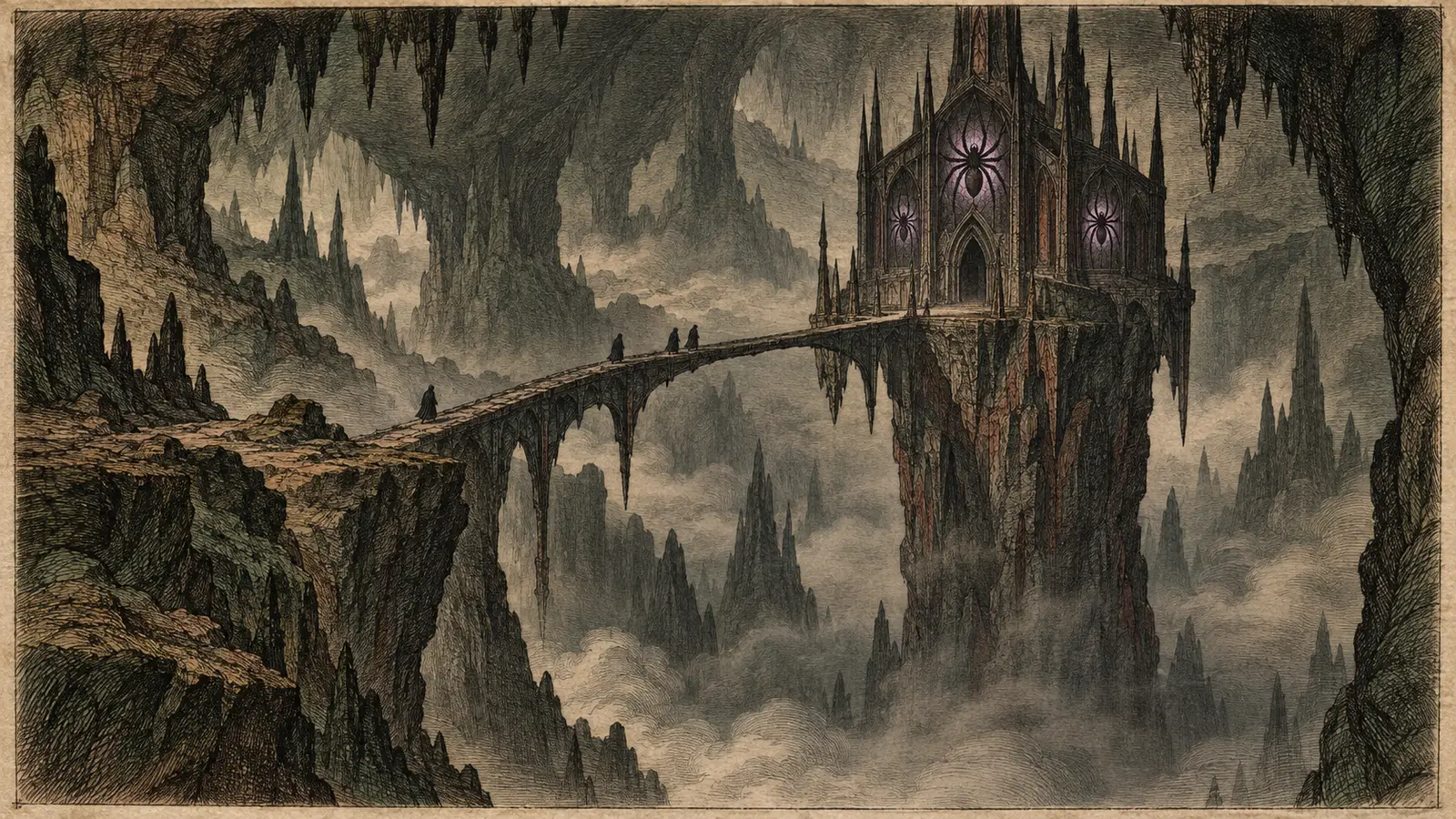
Underdark divided the world below by depth. Closest to the surface lies the Upperdark, then the Middledark, and deepest of all the Lowerdark. In that scheme, sits in the Upper Northdark, high and northern, not far, as the deep reckons distance, from the forests and hills overhead. The book described around sixty cities and places of interest. It covered the drow and sixteen other peoples of the deep: the gray duergar, the eyeless grimlocks, the fish-like kuo-toa, the svirfneblin we met in , the spidery chitines, the shadowy gloamings, the deep imaskari and more. It named the great regions, the Northdark, Great Bhaerynden and the ruins of Ched Nasad, and it revealed Deep Imaskar, a hidden realm of people who had gone down into the stone long ago. For drow characters it offered the judicator, a holy executioner of 's church.
Around the city, the wider lore was filling in its quarrels with its neighbours. Far down in the Middledark, beneath a region called the Deep Wastes, lies Sschindylryn, a drow city famous for its magical portals. Once, in a war remembered as the Great Conflict, Sschindylryn tried to conquer Menzoberranzan. It failed, and the defeat left it almost completely disarmed. It's the kind of story the matrons of Menzoberranzan like to tell, quietly, when visitors from other cities are present.
In 2007 came Drow of the Underdark, a third edition book that shared its name with Ed Greenwood's older one but stood apart from any single setting. It was written by Ari Marmell, Anthony Pryor, Robert J. Schwalb and Greg A. Vaughan, and its publisher called it "the definitive treatise on the drow." It covered their nature, society, history and faith, their crafts, magic, language and runes, and four of their gods: Lolth, Vhaeraun, Eilistraee and Ghaunadaur, whom the game had long also called the Elder Elemental God. Its model for drow society was the one Menzoberranzan had made famous. There were noble houses and matron mothers, and above them the Spider Queen, who keeps her people obedient because she can come into the mortal world and punish disobedience herself.
In the novels, the gods of the drow were dying. Lisa Smedman's trilogy The Lady Penitent, published in 2007 and 2008, follows the years just after the Silence. The Lady Penitent, the remade Halisstra, carries out the purpose Lolth gave her. By the end of those years, the drow pantheon had been cut down to Lolth alone. Vhaeraun, the masked lord, the elder of the twins, died. Ghaunadaur left the . Finally Eilistraee herself fell. She had been dwelling in the body of her high priestess, Qilué Veladorn, and the Lady Penitent killed her with a weapon called the Crescent Blade.
The ending has a quiet turn. When it was over, Lolth discovered, too late to undo it, that Eilistraee had already redeemed around a fifth of the drow, turning them back into dark elves whose hearts were their own. The daughter had lost her life but saved a great many of her people.
From then on the Spider Queen stood alone among the drow gods. Her realm, no longer a layer of the Abyss, had become its own plane, one vast web whose pattern repeats endlessly, where spiders fight and destroy one another every day so that only the strongest go on. She had what she had always wanted and no one left to compete with. She also had no one left to blame.
The world above was about to be broken and remade, and the game itself was about to jump forward a century.
Chapter VIII
The Spellplague years: a city that barely changed
The fourth edition of Dungeons & Dragons brought a great change to the Forgotten Realms. In 2008, the Forgotten Realms Campaign Guide, by Bruce R. Cordell, Ed Greenwood and Chris Sims, moved the setting forward about a hundred years, to near the year 1479 by the Dale Reckoning. It showed a world reshaped by a catastrophe called the Spellplague, with new maps, new kingdoms and old ones vanished. appeared as one of the key settlements of the Underdark, with a new map of its own. In 2010, a general fourth edition book also called Underdark, by Rob Heinsoo and Andy Collins, sketched the underworld in a new way, with regions named the Shallows, the Deeps, the Feydark and the Shadowdark, the last two touched by the realms of faerie and of shadow. It set the mood for the edition, though our city lay elsewhere in its pages.
The novels bridged the century. 's The Ghost King, in 2009, told of the Spellplague year itself. Then came his Neverwinter Saga: Gauntlgrym in 2010, Neverwinter in 2011, Charon's Claw in 2012 and The Last Threshold in 2013. These books moved through the decades in long strides, so that and those around him crossed the hundred years.
Here is what happened. In the year 1385, the goddess of magic, , was murdered by two gods, Cyric and . The Weave, the fabric through which all spellcraft flows, tore. Wild blue fire swept the world. Land was hurled into the sky. Whole countries changed shape. Far to the south and east, kingdoms like Chessenta and Mulhorand were swept away or remade. In the Underdark beneath the western , the stone collapsed into a pit miles deep and as wide as a country.
Menzoberranzan was hardly touched. The North, above and below, was spared the worst of it. The cavern held, stood, the houses kept their spires, and the city went on with its business. That quiet endurance is the chief thing the Spellplague era tells us about the city. While the maps above were redrawn, it hardly changed.
It wasn't wholly untouched. Under the city of Neverwinter, the catastrophe left a small plagued region in the Underdark, and over the decades the aboleths of the Abolethic Sovereignty, ancient creatures of the deep waters, took an interest in it. By the end of the century, scholars studying the great chasm that had opened in Neverwinter wondered whether the aboleths had somehow caused the Spellplague itself, though nothing was ever proved. All the while, the faerzress around the city, the strange magic in the stone that we'll come to know better soon, kept teleporting there difficult and dangerous, just as it always had.
Within the city, the century was ruled by Baenres. In 1383, two years before the Spellplague, Quenthel Baenre killed her elder sister Triel and took her place as Matron Mother of House Baenre, and with it the first seat of the city. She would rule for the whole century that followed. remained Archmage through it all, blind since the siege, still lighting Narbondel each day. Andzrel Baenre, his old companion of the siege, remained weapons master of the house for many years.
A younger Baenre rose in those decades too. Tiago Baenre was a grandson of the house's famous weapons master Dantrag, proud, gifted and hungry for glory. He came to see the renegade Drizzt as the one prize that would make his name, and he set out to be the drow who finally ended the legend. It's a very Menzoberranzan sort of ambition, to be remembered as the one who killed the person everyone else is talking about.
The city was also beginning to look outward. One of the great stories of this era concerns , the ancient capital of the dwarven realm of Delzoun, lost for ages under the earth. In Gauntlgrym, and a dwarf named Athrogate find the old city, and their treasure-hunting sets loose a catastrophe that falls on Neverwinter above. Inside Gauntlgrym, chained beneath its great forge, lies Maegera, a primordial of fire, a being as old as the world, and the forge draws on its power.
Decades later, in 1463, Menzoberranzan came for that forge. On the orders of Matron Zeerith Q'Xorlarrin, an expedition of House Xorlarrin seized it. The plan was the work of Ravel Xorlarrin, the house's second son, a spellspinner, which is what his house called its wizards. He wanted a sister city, one where his family could work the great forge and grow rich, and above all one that would stand outside the direct control of House Baenre.
The Xorlarrin expedition was quite a family. Brack'thal, a mage, was Ravel's older brother and also, as can happen in that house, his father. Jaerth was the house weapons master. Berellip and Saribel were Ravel's sisters, both priestesses. With them came Tiago Baenre, escorting a weaponsmith named Gol'fanin, and acting as House Baenre's emissary. Tiago's real job was to remind the Xorlarrins, often and politely, that he reported to Quenthel. By 1484, House Xorlarrin had won permission to leave Menzoberranzan for the new settlement, which they called Q'Xorlarrin. It was the first new drow city on the old dwarves' ground.
While the houses reached for Gauntlgrym, Bregan D'aerthe went to sea, or at least to the coast. By 1377, the mercenary band had a strong hidden presence in , the rough port city of the northern Sword Coast, working through one of its great merchant houses, Ship Kurth. Beneath Luskan, in the ruins of ancient Illusk, it kept a secret headquarters, with a passage leading to Closeguard Isle and to Ship Kurth's holdings. By 1483, a drow agent named Beniago, magically disguised as a human, had become High Captain Kurth himself, the strongest of Luskan's five High Captains, with a fleet twice the size of any other.
So the band changed. Jarlaxle's mercenaries became merchants as well, carrying surface goods down into Menzoberranzan and the Underdark, including relics of ancient Netheril brought through Luskan's docks. Jarlaxle himself had handed command to his long-time lieutenant Kimmuriel Oblodra, a psionicist and one of the last of the house the city had destroyed. Jarlaxle went off to wander and scheme and enjoy himself, as he usually did.
By the end of the century the city looked much as it always had from inside. Quenthel ruled. Gromph lit the pillar. The houses schemed. But its people had gone out into the wider world, to the forge of Gauntlgrym and the docks of Luskan, and the next books would bring that wider world back into the city.
Chapter IX
City of Intrigue: the city in the late fourteen-seventies
In August 2012, near the end of the fourth edition, Wizards of the Coast published Menzoberranzan: City of Intrigue, by Brian R. James and Eric Menge. It was a hardcover with an unusual quality: it contained no game rules at all. There were no statistics and no numbers for combat, only the city, its people and advice for running stories there. That made it usable in any edition, then and later.
It drew together the geography of Greenwood's 1991 The Drow of the Underdark and the 1992 boxed set, and it moved the city's clock forward to around 1479 by the Dale Reckoning, after the War of the Spider Queen and through the Spellplague. Its chapters walked through the art of a campaign of intrigue, the way of , the factions of the drow, the city itself, the wider Northdark around it, and how to play a drow.
Reviewers admired how it looked, with its clear layout and new art that ran from very good to breathtaking. The only common complaint was that there wasn't more of it.
The book was part of a larger story Wizards told that year called Rise of the Underdark. In the world, the framing was ominous: the goddess of magic was failing, the Weave was weakening, and Lolth was reaching to take control of what remained. A drow invasion was beginning, and adventurers would have to stop the Spider Queen. That spring came Into the Unknown: The Dungeon Survival Handbook, and a season of in-store play called "Web of the Spider Queen." In June, the online game Dungeons & Dragons Online added an expansion, "Menace of the Underdark." In August, the city returned in City of Intrigue, followed by a season called "Council of Spiders" and a last one, "War of Everlasting Darkness."
In the pages of City of Intrigue, House Baenre is the oldest surviving house in the city, and in one form or another it has led the Ruling Council almost since the founding. The line of its matrons runs from the legendary Yvonnel to Triel, then to Quenthel. The book paints Quenthel vividly. She is the model of a noble drow priestess: arrogant, confident and fearless, tall and athletic and very beautiful. What she lacks is her mother's patience and subtlety. Yvonnel ruled for two thousand years by waiting. Quenthel rules by pushing.
Her brother is the counterweight. He is head of Sorcere, wizard of House Baenre and Archmage of , one of the few males anywhere in the city with real power. For decades he has kept to the shadows, steering the city where he wants it to go while quietly undermining his sister's authority. Picture him in a high room of the spired tower, blind, with his spells his only sight, listening to the city and judging which of its threads to pull.
The book gave the wizards of the city a plot of their own. The Council of Spiders is a secret cabal of wizards seeking something the city has never allowed: a seat for the arcane on the Ruling Council, a voice beside the eight matrons. That would challenge the matriarchy itself, and Lolth's church means to prevent it. Quenthel is sure her brother must be part of it. No one has ever proved it.
The book also filled in the districts that earlier maps had only named. The Braeryn, the slum, is home to the sick and the outlaw among the drow and to many of the city's non-drow. Eastmyr is where most commoners live: mercenaries, lesser merchants and working people. It's better than the Braeryn, but plenty of poor and outlaw folk still live there. Duthcloim is home to the well-off among the commoners and to wealthy non-drow, and most of the tradesfolk and their shops are there. Along West Wall, House Teken'duis once stood as a noble house. And there were the familiar places: the Bazaar, rebuilt after the great duel; Donigarten with its lake and island; and Qu'ellarz'orl, high above everything, where the noble houses stand. The book also introduced new faces, like Xeva Hunzrin of House Hunzrin. Even a family outside the top eight has its own ambitions here.
The organised play season that ran alongside the book, "Council of Spiders," put players right into this. In it, Lolth tries to seize arcane magic for herself by creating what was called a Demon Weave, a twisted replacement for the failing Weave of the dying goddess. That threatened the whole balance of drow society, because whoever held the arcane would hold power, and in Menzoberranzan the wizards were mostly men. The wizards of the Council of Spiders demanded their seats, and players found themselves caught in what amounted to a drow battle of the sexes. In one scene, agents of House Xorlarrin, House Melarn and Bregan D'aerthe all turn up looking for the same prisoner and end up fighting the Council of Spiders together. In another, the characters reach an ancient drow outpost and complete a ritual that lets Lolth draw arcane power into her Demon Weave. Whether that was the right thing to do was left for them to argue over afterward.
By 2012, then, the city had been described in detail, district by district and faction by faction, ready for whoever came next. The fifth edition would come in by way of an archmage's spell.
Chapter X
Out of the Abyss: the demon lords in the deep
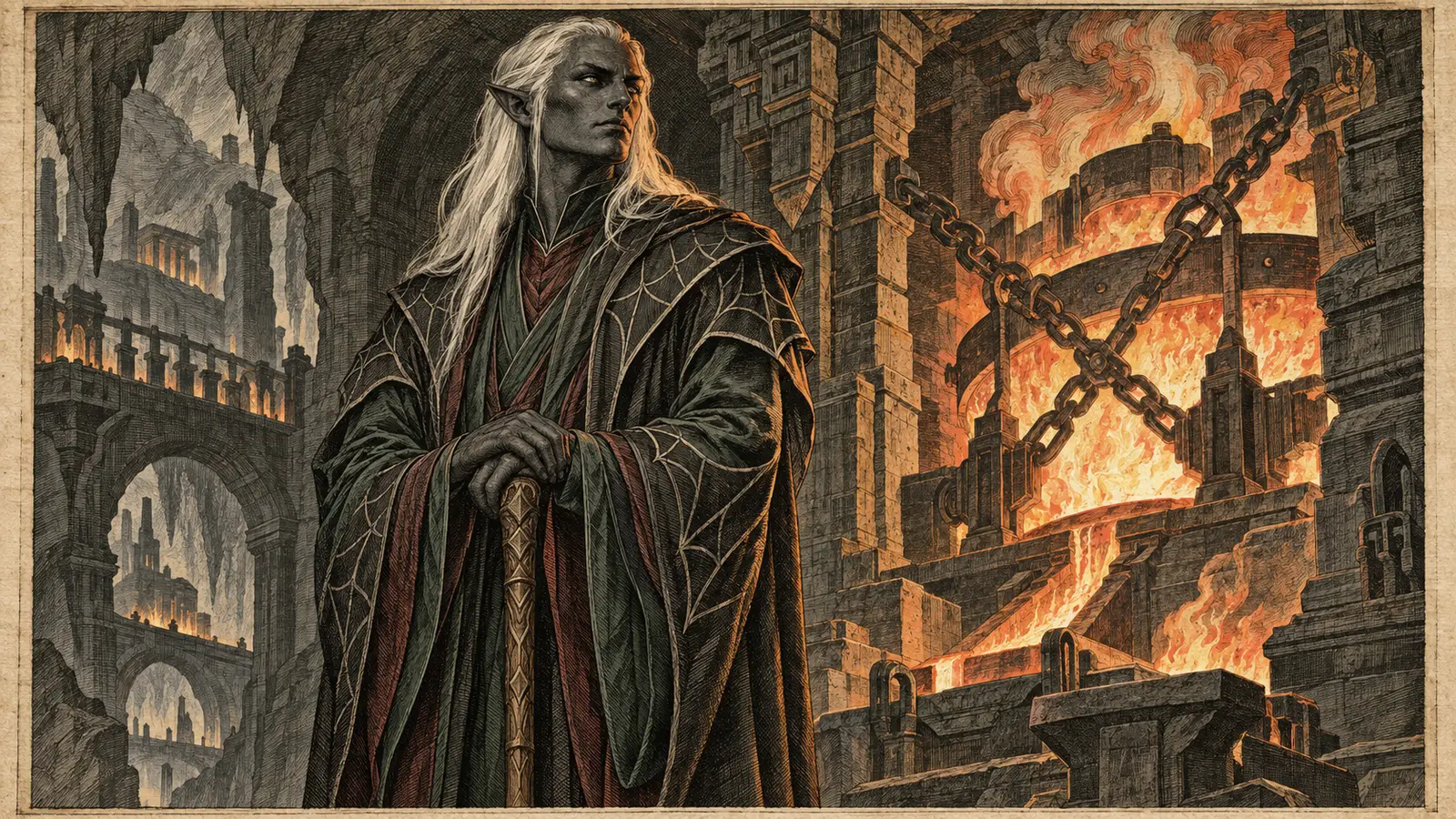
The demons came in 2015, but the trouble began a little earlier, in 's Companions Codex, three novels published in 2014 and 2015. In them, and his old companions go back to and then through the Underdark to rescue Thibbledorf Pwent, a dwarf who has become a vampire, at a time when drow politics are in turmoil. House Baenre, never content, races to build a sister city of its own inside Gauntlgrym, and a Baenre noble sets out to bring Drizzt down for good.
In the same years, did something even he must have hesitated over. The old Matron Mother Yvonnel's head had been kept since her death, and her memories were still in it. Gromph brought in a mind flayer advisor named Methil El-Viddenvelp, who read the memories in that severed head and then, around the year 1484, forced them into Quenthel. Quenthel woke with two thousand years of her mother's knowledge layered over her own impatient mind. In effect, Gromph had made his sister into a version of their mother. It's hard to say whether he meant it as a gift, a weapon or an experiment.
Then came the fall of 2015 and a storyline Wizards called Rage of Demons. Its centrepiece was a fifth edition campaign, Out of the Abyss, published in September with Green Ronin Publishing, the studio led by Chris Pramas. Christopher Perkins shaped its story, and its designers included Cam Banks, Walter Ciechanowski, Alex Melchor, Pramas, Robert J. Schwalb, Matt Sernett, Rodney Thompson and Ray Winninger. It takes characters from the very beginning of an adventuring life up to great power. Salvatore's Archmage, opening a trilogy called Homecoming, came out the same month and told the same events from inside the city. The online game Neverwinter followed with an Underdark of its own.
The story begins with a spell. Gromph Baenre, the Archmage, casts what the adventure calls "a foul spell meant to ignite a magical energy that suffuses the Underdark." That energy is the faerzress. The spell "tears open portals to the demonic Abyss," and "what steps through surprises even him."
This is a good moment to stop and get to know faerzress properly, since it has been under the city all along. Faerzress is a magical energy found only in the Underdark of the Forgotten Realms. It soaks into the stone like a kind of radiation. Plants of the deep draw on it for life, and the peoples of the Underdark have learned to draw on it for sorcery. Long exposure to it has warped some of the creatures that live there. It disrupts scrying, so the deep places are hard to spy on from afar, and it makes teleporting dangerous. Legend says faerzress goes back to the creation of every underworld on every mortal world. Some scholars in the Realms have a darker theory: that Corellon and the elven gods set its strange effects in place after 's fall, to keep the dark elves imprisoned below.
The drow and the other thinking peoples of the deep map the places where it's strongest, and they build their cities in or near them, because a city where nobody can teleport in and nobody can scry is very hard to attack. sits wrapped in it.
Out of the Abyss gave the faerzress a feel at the table. In places where it runs strong, the stone always glows with a dim light and gives off a comfortable warmth. Creatures inside it are hard to find with divination magic, and anyone who tries to teleport into it, through it or out of it risks being hurt by the attempt and failing to arrive. So the deep has its own quiet weather, patches of warm, faintly glowing rock that keep secrets.
Now back to the spell. Gromph had learned it from Kimmuriel Oblodra of Bregan D'aerthe, who taught it to him through psionics. Gromph felt held down and betrayed by Lolth and her priestesses, and his sister had pushed him too far. In his anger he reached for the faerzress and opened a door he didn't fully understand.
Behind his anger, though, was the goddess. Lolth had arranged the whole thing. She had manipulated the Archmage into tearing the Weave, and she had her own reasons: a scheme to take control of the Abyss itself. She drove the demon lords out of it, and they came into the Underdark through the doors Gromph had opened. The first of them to arrive came straight into the city. , Prince of Demons, was summoned into Sorcere, the wizards' tower on Tier Breche, and he rampaged through Menzoberranzan.
Quenthel, now carrying her mother's memories, was not much troubled by this. She saw the invasion as a chance to purge the dregs, to clear away the weak inside drow society and outside it, exactly as Lolth would want. Other matrons saw other chances. Mez'Barris Armgo, matron mother of House Barrison Del'Armgo, the Second House, used the chaos to move against a new rival. House had been revived in name, and its matron now was , a woman from the surface with a complicated past. The old name of Drizzt's family had come back to the council's attention.
Out in the wider Underdark the demon lords spread out, and each pursued its own madness. Demogorgon rose from the lake at Sloobludop, a town of the kuo-toa, the fish-folk who worship strange gods of their own invention, and who took him for one, calling him Leemooggoogoon. Zuggtmoy, the Demon Queen of Fungi, made plans to marry Araumycos, a fungus so vast it spreads through miles of the deep. She held the rehearsal dinner among the myconids, the gentle mushroom-folk, at Neverlight Grove, in a chapter of the adventure called "The Fetid Wedding." , the Demon Prince of Undeath, found the dead elder brain of a mind flayer colony, raised it, and used it to drive the mind flayers into undeath. Graz'zt came too, and Juiblex, the faceless lord of oozes, and , and Fraz-Urb'luu, and Yeenoghu. Rumours of them drifted up to the Sword Coast like smoke through a crack in the floor, and madness spread through the deep.
One person in the Underdark worked out what had really happened. Vizeran DeVir was an exiled drow archmage and a survivor of House DeVir, the house that Do'Urden destroyed on the night Drizzt was born. So the story of the city comes back around to that first night after all these centuries. Vizeran understood that Lolth had used Gromph as a pawn to let the demon lords loose. He was also a sponsor of the Council of Spiders, the cabal of lesser wizards, many of them of Xorlarrin and Barrison Del'Armgo, who wanted a seat on the Ruling Council.
Vizeran had a plan, and it centred on a talisman called the Dark Heart. It would be the focus of a demonic ritual that would call every one of the demon lords to a single place, playing on their hunger for power. There they would fight one another until only one was left, and the heroes could deal with that one. A demon lord slain on the material world doesn't truly die. It is cast back into the Abyss, which was where everyone wanted them.
He needed strange things for his ritual. He needed an intact, unhatched egg of a purple worm, and the central eye of a beholder. He needed six feathers from six different angels and the heart of a goristro, a towering demon. He needed thirteen timmasks, which are devil's mushrooms, and a few drops of the blood of a demon lord. Gathering them takes a party across much of the Underdark. Vizeran also needed something from the city itself: Gromph's grimoire and his notes on the summoning ritual, so that he could understand the power that had opened the doors. They were kept in Sorcere, which was the main reason adventurers had to slip into Menzoberranzan.
Vizeran had one more wish, and it gave the adventure a hard moral question. He wanted the Dark Heart planted where the summoning began, in Menzoberranzan. If the heroes did it, the demon lords would come to the City of Spiders and fight there, and much of the city would be ruined. Vizeran hoped that ruin would show the drow, once and for all, that Lolth couldn't be trusted. The players had to decide whether they would doom a city in order to break a goddess's hold over it. The adventure leaves the choice to them.
The adventure's chapter on the city is called "The City of Spiders," and it's a fine walk through the place we've come to know. There's a secret tunnel through the Westrift, a rift choked with spiderwebs that Vizeran knows about. There's Qu'ellarz'orl, where the noble estates stand, and where the eight matrons of the Ruling Council meet around a table shaped like a spider, in a cavern lit by candles. There's , still heated by the archmage, still marking the hours. There's Sorcere, where the grimoire lies. In Duthcloim, among the tradesfolk, a spy of Bregan D'aerthe waits. In the noble manors and the halls of Sorcere, intruders meet yochlols, giant spiders and drow wizards, and a little luck is needed to get out again.
In the end, the demon lords meet wherever the Dark Heart was placed and tear at one another, and the heroes face what's left. The doors close one by one, and the deep grows quiet again, more or less, though the city doesn't forget it.
Chapter XI
Homecoming and the long questioning: the later novels
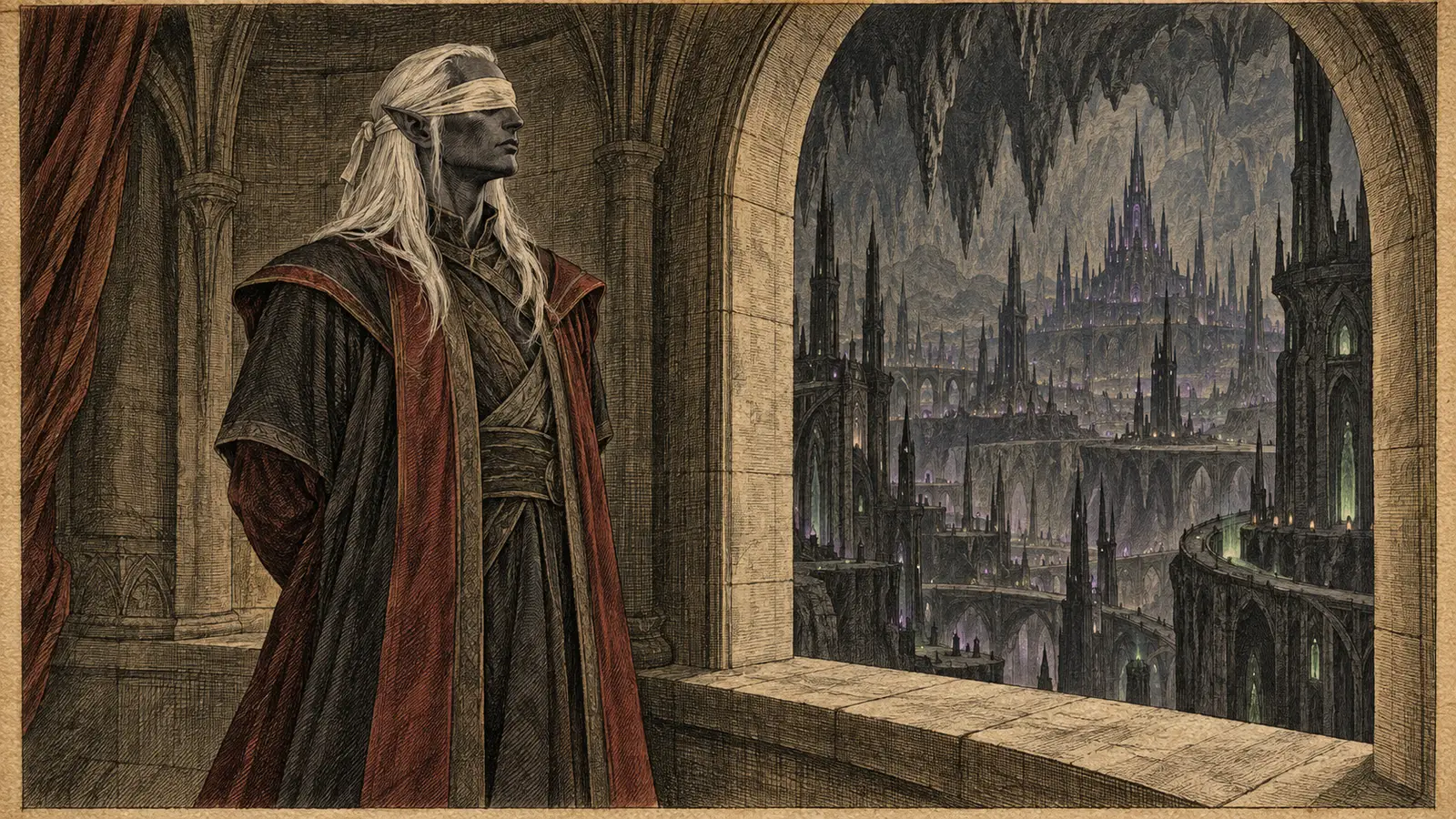
's novels went on, and in them the city began, slowly and painfully, to question itself. The Homecoming trilogy, Archmage, Maestro and Hero, told the demon years from within. In Maestro, published in 2016, thousands of demons fill . In the midst of the chaos a new power rises. has a daughter, born to Minolin Fey of House Fey-Branche, and her name is Yvonnel. She is a reincarnation of her grandmother, Yvonnel the Eternal, and she becomes the true power behind House Baenre, while Quenthel remains matron in name, and remains the obvious target for anyone with a grudge. Elsewhere, beneath , the primordial of fire is stirring, and and Gromph go together to the ruins of the Host Tower of the Arcane in , seeking the one power that can keep it bound.
In Hero, the demon hordes pull back at last. The matron mothers turn to the old question of , the renegade who keeps coming back, and they argue over what to do with him. One by one they come to the same understanding: the renegade can come and go, but the City of Spiders will crawl forever on. Drizzt is free to leave, and he goes looking for peace, family and home on the surface.
The Generations trilogy, Timeless, Boundless and Relentless, came out between 2018 and 2020, and from here the novels came from Harper Voyager. Timeless moves between two times. One is the year 1488. The other is Menzoberranzan centuries earlier, when a young weapons master named was making a name for himself far above his station. Matron decided she would take him for her own, but someone else reached him first: a young, sly mercenary named . Out of those days came two great threads of the city's history. One was the match of Malice and Zaknafein that would bring Drizzt into the world. The other was the friendship of Zaknafein and Jarlaxle, which lasted through everything that came after. It's a gentle discovery to make, that the smiling mercenary and the grieving weapons master were friends long before the story we knew began.
In 1488, Zaknafein comes back to life. Jarlaxle has to introduce him again to his son, and Drizzt isn't ready to accept that the father he lost twice has returned. It takes time. In Relentless, demons fight in the upper reaches of Gauntlgrym, 's agents plan to rename the old dwarven city in honour of the Spider Queen, and the forces of Menzoberranzan surround it. Zaknafein, who has slowly let go of the prejudices the city taught him, fights beside Drizzt and Jarlaxle against Lolth's ambitions. The book turns on a question the drow had rarely been allowed to ask. One house might gain enough power to unite all the drow into a single army. Or the drow might turn away from the infighting their goddess encourages and look after their own needs instead.
The Way of the Drow trilogy followed: Starlight Enclave in 2021, Glacier's Edge in 2022 and Lolth's Warrior in 2023. In Starlight Enclave, two years after Relentless, civil war still hangs over Menzoberranzan, and Jarlaxle, who has spent his long life slipping around the edges of Lolth's church, now wants to see her cult overthrown for good. That book also widened the world of the drow. Far from the city, it revealed other dark elves who had never bowed to the Spider Queen: the Aevendrow of the arctic and the Lorendrow of the jungle. The drow of Menzoberranzan, the people of the old cities, came to be called the Udadrow. Suddenly the City of Spiders was no longer the whole story of the drow. It was one tradition among several, and its own people learned it.
In one thread of the trilogy, Jarlaxle, Artemis Entreri, Zaknafein and Catti-brie go on a long quest, and in Glacier's Edge Jarlaxle has to bring a great deal more strength to save them, gathering warriors and mages, with Gromph beside Catti-brie. In another, Drizzt takes his young child to the monk Grandmaster Kane, with Kimmuriel and a small band of Bregan D'aerthe alongside.
Then comes Lolth's Warrior, and the city itself shakes. Drizzt's legend has seeped down into the dark and spread discontent. Many drow begin to question the Spider Queen's influence, and even the official history of how the city was founded, the old story we heard at the start of our evening, of the Kinless and the seven families and the dreams. House Baenre and its matron mother are among the doubters. Fighting breaks out between Lolth's loyalists and drow who "demand more, demand better."
Yvonnel, the reborn granddaughter, is at the centre of it. She has spent time with Drizzt and studied the city's history, and what she found left her disillusioned with Lolth. She sets out on a path of redemption and revolution. Meanwhile, two yochlols, Yiccardaria and Eskavidne, are enjoying the chaos enormously, and they place a wager on whether House Baenre or House Melarn will win the war. Lolth herself appears, delighted by the destruction, and she dismisses Yvonnel and Drizzt alike as having outlived their usefulness. A captured agent of Bregan D'aerthe named Braelin is offered up for execution before a champion called Lolth's Warrior. Yvonnel's desperate attempt at peace ends in betrayal, and Lolth banishes her through a cruel game of chance.
The war ends, as wars in the city do, with a new arrangement. In the year 1490, after the civil war that grew from the heresy of Quenthel and the younger Yvonnel, Sos'Umptu Baenre becomes matron mother. The line of Baenre matrons goes on: Yvonnel, Triel, Quenthel, and now Sos'Umptu. The Spider Queen still has her city, though many of its people have started asking questions she doesn't like.
Chapter XII
The city on glowing screens
While the novels and sourcebooks built the city, video games kept trying to put players inside it. The first try came early, in 1994, from Strategic Simulations, the studio known as SSI, working with DreamForge Intertainment, a team in Greensburg, Pennsylvania. The game was simply called Menzoberranzan, and it used the first-person engine SSI had built that same year for Ravenloft: 's Possession.
Its story began in Icewind Dale. You made two heroes, newly famous in a small village for slaying a monster. The villagers held a celebration, and after a long night of drinking the heroes woke to find drow raiders setting the village on fire and carrying its people away. The drow were hunting their renegade kinsman, . The heroes followed them down, through woods and along an underground river, into the Underdark, and eventually into the city itself, meeting allies along the way, Drizzt among them. He told them the raid had been ordered by his mother, Matron , to draw him out so he could be brought home and punished. The game's manual introduced players to a vast underground city of dark elves in the world it called the Underdark. Players remembered the animated introduction fondly, and the dark corridors of the game itself rather less so. In time it was gathered into Forgotten Realms: The Archives.
Four years later, Baldur's Gate brought two people from the city to the Sword Coast. In a wilderness area by Fisherman's Lake, players could come across Drizzt himself, fighting gnolls, carrying his scimitars Icingdeath and Twinkle. The other was a companion: DeVir, a drow cleric who had fled the city. Her name tells you where she came from. She was born into House DeVir, the house destroyed on the night of Drizzt's birth, and she served as a priestess for many years. Then, to prove her faith, she was ordered to sacrifice an infant to the Spider Queen, and she refused. Her house lost Lolth's favour. Her mother, the matron, tried to sacrifice Viconia instead, and Viconia's brother, a wizard, killed their mother to save her. For that killing Lolth turned him into a drider, and she took Viconia's clerical powers away. Viconia fled to the surface and in time took the goddess as her own. Her story, too, begins with one small refusal.
Baldur's Gate II, in 2000, took players deep into the Underdark to a drow city, though not this one. Its city was Ust Natha, ruled by Matron Mother Ardulace, with her ambitious daughter Phaere and a troubled male warrior named Solaufein. Players went there in disguise as drow, and they had to trick the city out of dragon eggs it meant to use in a war on the surface elves. It felt like a smaller sibling of , built on the same ideas.
The online game Neverwinter reached the city in two stages. In November 2015, its Underdark expansion joined the Rage of Demons story. A spell had turned against the Archmage of Menzoberranzan, and demons were spilling through the deep. It was the first time Drizzt appeared in that game, and wrote a questline called "The Dwarven King," in which players fought alongside Drizzt, Bruenor and . Players could challenge himself, and they could rest at Mantol-Derith, a hidden trading post deep below where the peoples of the Underdark meet to bargain.
Then, in 2023, came two modules called Northdark Reaches and Menzoberranzan, written with R. A. Salvatore and his son Geno Salvatore. They were set between Glacier's Edge and Lolth's Warrior, in the troubled years of the novels. A missing drow scout, Braelin Janquay, has been found, and conflict looms between the Lolth loyalists and those the loyalists call the Blaspheme. , now bearing the name Baenre, asks the heroes of Neverwinter to help him keep the peace, and there are rumours of a long-forgotten artifact that could tip everything toward the Spider Queen. For the first time in that game, players could explore the city itself. They waited with Jarlaxle on the Cliffs of the Starless Sky, caverns on the city's edge, walked the Midnight Market, and met Drizzt among the ruins of House Oblodra, the house the city destroyed long ago. They also faced a trial called Gzemnid's Reliquary, under the gaze of a god of the beholders. That summer, a last module, Demonweb Pits, carried them into Lolth's own realm for a battle against the goddess herself.
In 2021, Dark Alliance, a cooperative action game, put Drizzt and his companions on the field in Icewind Dale against armies seeking the crystal shard. There Menzoberranzan was only a memory, the City of Spiders where Drizzt was born.
In 2023, Baldur's Gate 3, by Larian Studios, brought the city a new daughter, in a manner of speaking. Minthara Baenre is a drow paladin and one of the great foes of the game's first act, though players may also come to recruit her, and even love her. She was born into House Baenre, the First House, and grew up among the nobles on Qu'ellarz'orl. She was raised in Lolth's ways. As a child she survived one attempt to assassinate her. When she came of age she survived another, made by her own mother.
Her turn came the way so many turns in the city do, through a heresy. A few months before the game begins, a True Soul and two novices came to Menzoberranzan preaching about a new power called the Absolute. Minthara hanged them and displayed their bodies as a warning. Then her curiosity got the better of her. She used necromancy to question the corpses, learned where their masters were, and led a band of warriors to strike at Moonrise Towers. There she was converted herself. She speaks of the city's customs with cool frankness, and from her you learn that in Menzoberranzan romance is "commonly a luxury enjoyed between women," and that men are "mostly present for propagation." Viconia DeVir returns in that same game, a century older, now Mother Superior of a Sharran enclave in the city of Baldur's Gate. And among the drow of the game's Underdark you'll meet one named Araj Oblodra, still carrying the name of the lost psionic house.
Chapter XIII
Daughters, sisters and distant cousins: the other drow cities
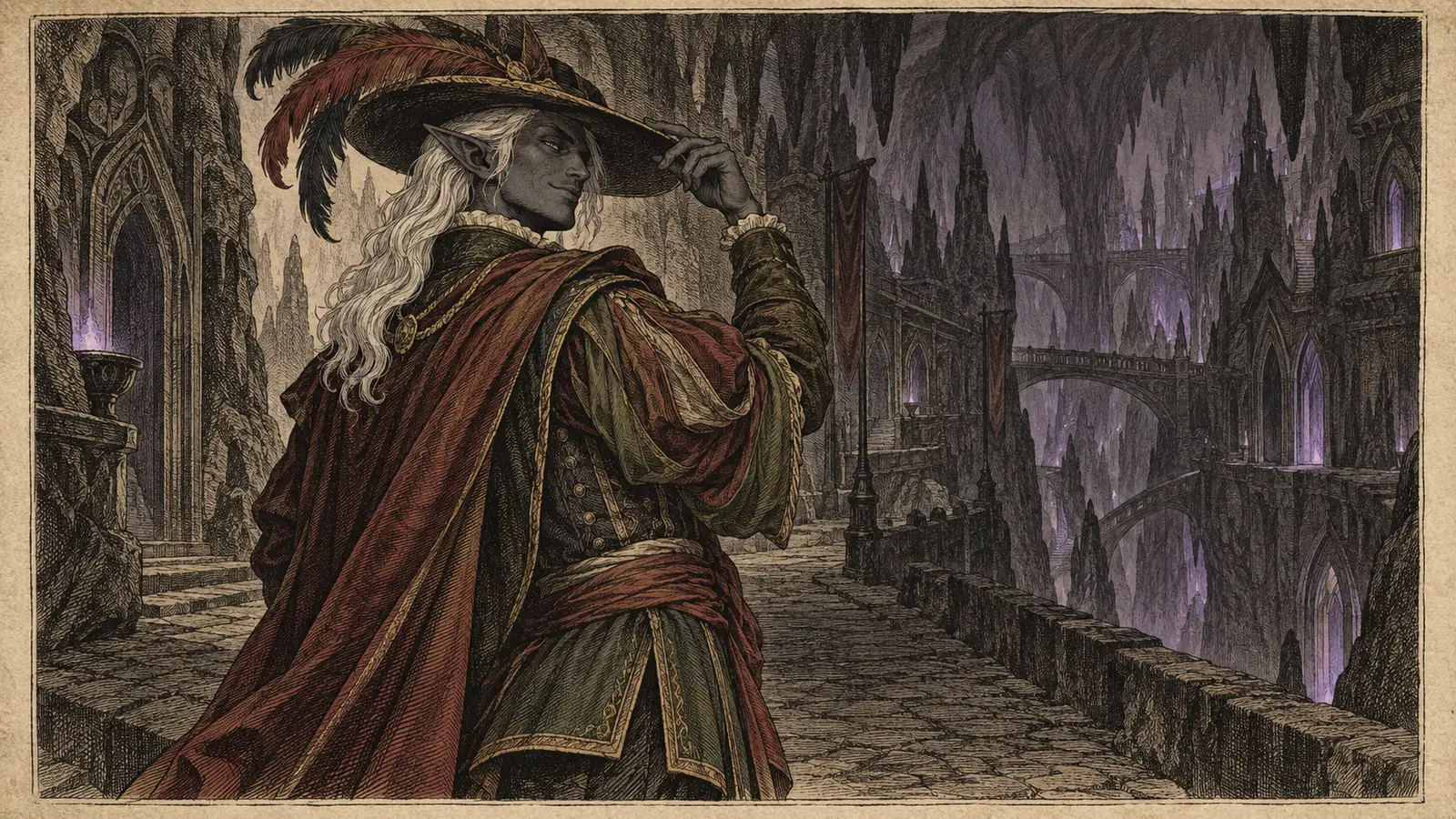
was never the only city in the dark. Over the years the Forgotten Realms built others around it, and each one shows a different way a drow city could have turned out, a little like reflections in a set of dark mirrors.
The closest is Ched Nasad, the daughter city. It was founded by the drow of House Nasadra, who left Menzoberranzan soon after its founding, when commanded them to build a second city in her name and keep friendly ties with the first. Ched Nasad grew in a great V-shaped cavern, filled from wall to wall with layer upon layer of iridescent webbing, calcified into stone. Its buildings hung from those strands like cocoons. If Menzoberranzan is a forest of carved spires, Ched Nasad was a hanging garden, a city that floated in its own glittering web.
At its height it held about thirty thousand drow, more than its mother city. Twelve noble houses sat on its Ruling Council, among them Melarn, Zauvirr, Auvryndar and Claddath. House Nasadra held even more authority there than House Baenre ever held at home. Trade between the two cities flowed through the Black Claw Mercantile Company, run jointly by Zauvirr, Melarn and Baenre itself. We've already watched it burn. In the Spellplague years much of it still lay in ruin, though a new council, led by House Teh'Kinrellz, brought a measure of order back to the lower city.
Eryndlyn is a different kind of mirror. It lies in the Upperdark, in caves beneath the High Moor, and holds more than sixty thousand drow. Its cavern is a limestone dome more than two miles across. A shallow lake lies at its centre, fed by two rivers and drained by a third, and around the water the drow live on great plateaus. Its founders hoped one day to reclaim the lost elven realm of Miyeritar, the one turned to wasteland in the Dark Disaster. They weren't especially devout, so Eryndlyn never belonged to a single god. As merchant clans came to rule, three faiths grew there, and each claimed its own ground. Lolth's faithful hold the largest plateau, to the west. Vhaeraun's followers live on the plateau to the northeast. Ghaunadaur's followers live on the southeastern one, which is often flooded, which suits a god of oozes. Eryndlyn is also where the worship of Selvetarm, Lolth's champion, is most common. During the Silence, the Jaezred Chaulssin united the followers of Vhaeraun and Ghaunadaur against Lolth's church and broke it quickly. They ruled over the ruins. In Eryndlyn, Lolth had to share power from the start, and in the end she lost it.
Sshamath turns Menzoberranzan upside down. It lies beneath the Far Hills, and there the wizards rule, most of them men. The priestesses of Lolth play only a small part. A Conclave governs the city, with one member from each college of arcane specialisation and one more for wizards who refuse to specialise. In the years of the Silence, one of its members was Antatlab of the Shaking Stones, head of the College of Elemental Magic. Sshamath is the leading market for magic items in the entire Underdark. Long ago its faerzress began to flicker and fail, and within five years it was gone, which left the city weaker than it had been. So the city of wizards had lost the very magic of the stone around it.
Chaulssin, the City of Wyrmshadows, is the coldest of these cities. It lies beneath the northern Rauvin Mountains and hangs over a deep abyss, and cold winds howl through it without end. Long ago, in a year remembered as the Year of Shambling Shadows, the shadow dragons of Clan Jaezred conquered it and enslaved its drow. Over the centuries the drow there were nearly wiped out, or changed into creatures of shadow, and from the joining of dragon and drow came beings called zekylyn, half drow and half dragon. In 1136 by the Dale Reckoning, House Jaezred returned to the ruined city and founded the House of Hidden Masters, the Jaezred Chaulssin, a brotherhood of male assassins devoted to ending the rule of Lolth's priestesses. It kept secret fosterages in seven drow cities ruled by Lolth's church, Sschindylryn and Sshamath among them. Its hand was behind the siege of Menzoberranzan, and Nimor, the half shadow dragon who fought in the ruined Bazaar, was one of its own.
There are others, and some of them are only glimpses. Maerimydra was destroyed during the Silence, and its last faithful of Lolth fled to an outpost called Szith Morcane. Sschindylryn, the portal city that lost the Great Conflict, kept its gates, and a house wizard of Eryndlyn named Zinnirit Yauntyrr fled there and kept a three-portal gatehouse until his death. Guallidurth is a drow city whose slaving routes run through the tunnels of the deep. And in the region of Great Bhaerynden, where the drow conquered the first dwarven kingdom, lies Llurth Dreier, called the Accursed City and the City of Ooze, and that name suggests which god rules there.
Outside the Realms, there's the ancestor. In Greyhawk, Erelhei-Cinlu came twelve years before Menzoberranzan, with eight competing noble houses and Lolth's fane in its great Vault. As we heard when we walked the Underdark together, its houses didn't all keep faith with her. House Eilservs, which ranked seventh among the eight, controlled a district called the Ghetto of the Dead, with estates across a dark river called the Pitchy Flow. Its priestess Eclavdra gave up Lolth for the Elder Elemental God, and her house joined with House Tormtor against the rest. Erelhei-Cinlu, too, was a city divided by faith.
Then there's , the world Keith Baker made, where the idea is taken apart altogether. The drow of Eberron live on the shattered continent of , in jungles and beneath them. Their culture is tribal, and most of their tribes worship Vulkoor, a male scorpion god, rather than any queen of spiders. They mastered the binding of elementals before the gnomes did. A branch of them, the umbragen, the shadow elves, revere , the dragon below, the Umbra, the Consuming Shadow. Eberron has no Spider Queen, no matriarchy of priestesses and no city like Menzoberranzan. It shows that the dark elves of the game never had to be what the City of Spiders made them.
Taken together, these places tell us something about Menzoberranzan. The daughter city was more delicate and it burned. The divided city shared its faith and lost it. The city of wizards gave its men the power that Menzoberranzan withholds, and the cold city was ruled by assassins who wanted the priestesses gone. Each of them differs from Menzoberranzan in one important way, and Menzoberranzan, the original, has outlasted them all.
Chapter XIV
Menzoberranzan at the table
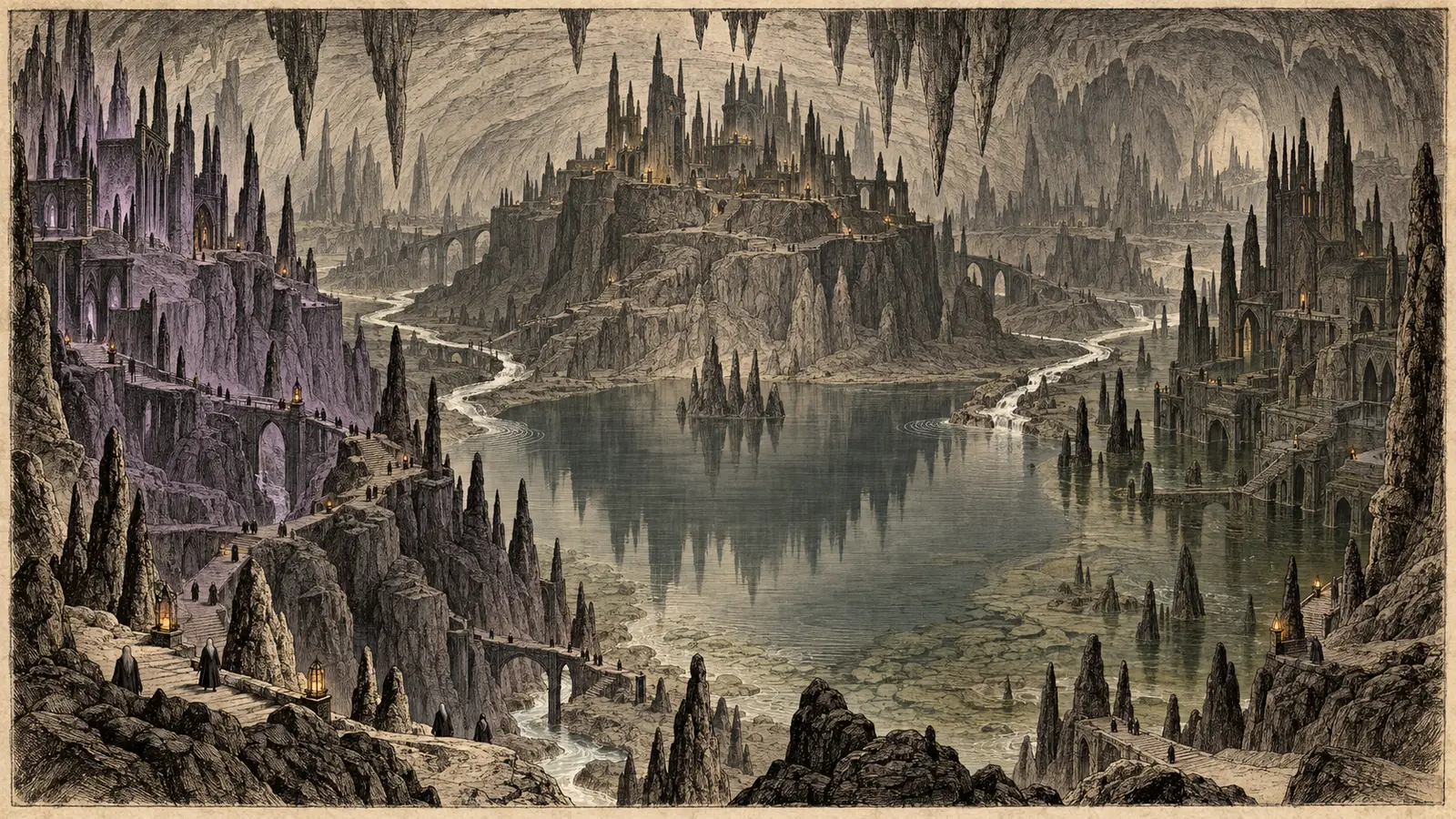
What does it feel like to bring this city to a game? Every era has offered a different way in, and every way in feels a little different.
The 1992 boxed set offered two doors. Through the first, the players are visitors from the surface, slipping into a city where every face is hostile and every glow of faerie fire might be watching them. Through the second, they are drow, born to the city, members of its houses, players in its games. The set gave everything needed for that second road: ready-made drow characters with histories, guidance for creating more, and the whole web of eighteen houses on a poster for the Dungeon Master to study. It was built with powerful parties in mind, and one reviewer described it as the perfect mix of maps, information and open-ended plots to keep a group busy for months.
Playing drow in is less about the sword than the whisper. Imagine your character standing on a balcony carved from a stalagmite, watching the heat climb , while a messenger from a lesser house waits behind her with a gift that is plainly a trap. She can't refuse it, because that would insult the house. She can't accept it either, because nothing in the city is free. She needs to find a third way, and the table goes quiet while the players think. That pause is what the city is like to play.
City of Intrigue, in 2012, made that choice the heart of a character. A player picks a house or an organisation, and the choice brings real advantages and rivalries that come along whether you want them or not. If you're of Baenre, every lesser house resents you. If you're of Xorlarrin, House Baenre has someone watching you. If you belong to Bregan D'aerthe, you have no house at all, only a smiling master and a contract. The "Council of Spiders" season that same summer asked players to make drow, and if they didn't, their characters were assumed to be slaves of drow. Each character was bound to House Xorlarrin, House Melarn or Bregan D'aerthe, and the season pitted those loyalties against one another as everyone went after the same prisoner.
Because the city's men so seldom hold power, male characters, wizards and mercenaries are natural places for a party to stand. and show how much a man can do in the city if he's clever and patient. A party of drow men, wizards from Sorcere or swords from Bregan D'aerthe, has every reason to want change and every reason to hide it.
Out of the Abyss, in 2015, came at the city from the other direction. It begins with the characters as prisoners at a drow outpost, waiting to be carried off to Menzoberranzan as slaves. Much later, after escape and a long road through the mad Underdark, they come back to the city by choice, sneaking in through the web-choked Westrift to steal a blind archmage's book out of his own tower. Doing that well needs disguise and timing, a good deal of nerve, and perhaps some help from the Bregan D'aerthe spy in Duthcloim. Then comes the hard choice of where to plant the Dark Heart, and whether a city is worth saving if it might be freed by its ruin.
The rules for playing a drow have changed with the editions. In the fifth edition's first Player's Handbook, in 2014, the drow were a kind of elf, with keen sight in the dark that reaches far beyond what other elves can see, and with a sensitivity to sunlight that made it hard for them to strike true or notice things when the sun was overhead. They carried a little of the city's own magic. A drow could call up dancing lights from the start, later outline foes in faerie fire, and later still summon a sphere of darkness. They were trained with the rapier, the shortsword and the hand crossbow, the classic weapons of a house soldier. Players liked the magic and often looked for ways around the sunlight. In the rules that came in 2024, the drow became one of the lineages of the elf, with the same deep sight and the same light, fire and darkness, cast with whatever gift of mind the player chooses. The old weakness to the sun was gone.
For a long time, one kind of character was almost a legend of its own at the table. He was the good-hearted drow ranger, wielding two scimitars, sometimes with a panther at his heel, brooding at the edge of the campfire about the decadent society he'd fled. He was so common in the 1990s and early 2000s that many Dungeon Masters began to ban him outright, and players gave him a name, the clone. Others said, gently, that he was rarer at real tables than in jokes about them. Either way, his popularity shows how strongly one runaway son of Menzoberranzan had taken hold of people's imaginations. Plenty of players met the city first by meeting the one who left it, and then wanted to see it for themselves.
Chapter XV
A city beyond its cavern: the legacy of Menzoberranzan
has become one of the best-known places in fantasy gaming, more than a footnote in the Realms. Pyramid magazine once called it one of "the most famous pieces of the Realms." Readers who came to it through the novels still speak of the same things: the luminous stone, the ranked houses, the schools on their high ground, and the constant paranoia. One reader remembered Homeland as a stunning metropolis of "svelte architecture, omnipresent magic and an atmosphere of choking paranoia." Another said that what hooked him as a child was how thoroughly the book laid out the city's society, its cult and its schooling, its class structure and its art. It's sometimes called an unusually high-fantasy city, where every resident can work a little magic and the whole place glows with it.
Much of its fame travels with . The series of novels around him now runs past thirty-five volumes, and 's books have sold more than ten million copies and regularly reached the best-seller lists. Each of those books carries a little of the city with it, in a memory, a villain or a mercenary arriving with a smile.
The city went into other forms too. Starting in 2005, Devil's Due Publishing adapted the Dark Elf Trilogy as comics, with Andrew Dabb writing and Tim Seeley drawing, beginning with Homeland, and the comics were later collected and reprinted. In 2011 came a cooperative board game, The Legend of Drizzt, in which players take the roles of Drizzt and his companions on tiles of dungeon stone. In 2021, the card game Magic: The Gathering included Drizzt among its legends in Adventures in the Forgotten Realms. His card strikes twice, and when it enters play it brings along. has a card of her own there too.
That same year, Wizards of the Coast held what it called the Summer of Drizzt, and it began with something you might like to picture now, wherever you're lying. It was a short animated film called Sleep Sound. Over it, Benedict reads a rhyming poem written by Salvatore, and the poem follows Drizzt from his birth in the Spider Queen's city, through his flight to the surface and his years in Icewind Dale, to the forming of the Companions of the Hall. So the city has already been the subject of one bedtime poem.
The most important change to the city's legacy, though, has been in how its people are understood. In June 2020, Wizards of the Coast acknowledged that the drow, along with the orcs, had been described as monstrous and evil in ways "painfully reminiscent of how real-world ethnic groups have been and continue to be denigrated," and said simply, "That's just not right." The old picture of dark-skinned elves, ruled by a religious matriarchy and evil by nature, had troubled many readers for a long time.
Salvatore spoke about it openly. He said he wanted to "broaden the identity of the drow," and that he did it "because it's the right thing to do... for things that I didn't even know were a problem when I first wrote the books." He admitted, "I was oblivious." The new peoples of Starlight Enclave, the Aevendrow and the Lorendrow, who never served Lolth, were part of that answer. In the world itself the change was a natural one. Menzoberranzan stopped being the measure of every drow. It became what the Spider Queen made of one people, in one city, over a very long time, and the novels began to show that its own people could unmake it.
In a way the city had been heading here from the beginning. Its first great story was about a child who saw his people clearly and still loved what they might become. Readers spent thirty years following him, and then turned to look at the city he came from.
Chapter XVI
Menzoberranzan in the present day
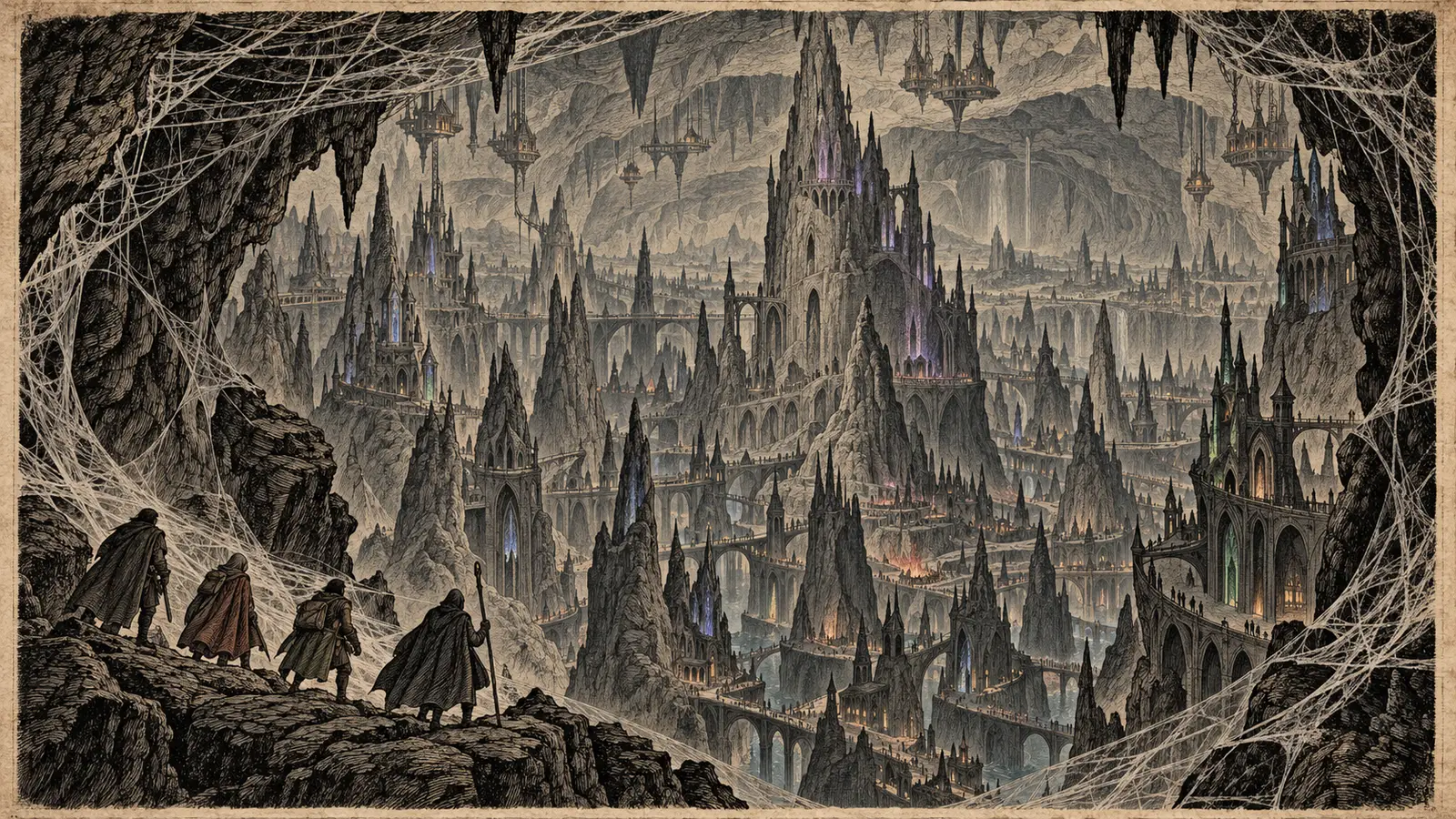
Where does the city stand now?
In the rules of 2024, the drow have been gently redrawn. The Player's Handbook of that September makes them one of three lineages of the elf, alongside the high elf and the wood elf. It says they were shaped by the Underdark in the earliest days of the multiverse, the way other elves were shaped by forests, oceans, ancient magic and the realms of faerie and shadow. A drow is "infused with the magic of the Underdark," at home in shadow, able to call up both light and darkness. Most have stark white hair and grey skin in many shades.
On , the book is careful. It says her cult has corrupted some of the oldest drow cities, especially on the world of Greyhawk and on , the world of the Forgotten Realms. Other worlds, and among them, have escaped her. Wherever her cult lurks, drow heroes stand on the front lines against it. What binds the drow together is their ancient tie to the Underdark, not the worship of any goddess, and some drow have never even heard her name. In that light, is one of the old cities her cult corrupted, and still the most famous of them.
The Monster Manual of February 2025 set aside the drow stat blocks that the earlier one had carried, offering in their place general figures, an acolyte, a gladiator, a deceiver and a cultist, so that no people would appear in the book simply as foes. Those drow came back in November 2025, in two books for the Forgotten Realms: Heroes of Faerûn, for players, and Adventures in Faerûn, for Dungeon Masters. There they appear plainly as followers of Lolth. The Spider Queen stands among forty-two gods of the Realms. The books note that the drow who worship her enslave people from the surface. The Drow Priestess of Lolth returns, with her scourge and her chance, once a day, to call a yochlol to her side. Those books didn't give the Underdark or the city a chapter of its own, and many players noticed and hoped one would come.
The novels have moved to the next generation. Lolth's Warrior closed the Way of the Drow in 2023. In October 2024, an audio story called Betwixt Two Worlds introduced , the daughter of and . In October 2025, The Finest Edge of Twilight began a new series with her at its heart. Breezy studies combat, magic and the Way of Shadow, and she hopes to become a Master of Dragons at the Monastery of the Yellow Rose. Her fate is tangled up with Sin'felle, the woman who was once matron of the revived House Do'Urden, who has come back as a vampire spawn. So the name of Drizzt's old house goes on, now carried by a girl who was born under the sun.
And the city itself seems to be stirring at the game table again. On the twentieth of August, 2026, Wizards of the Coast released a playtest called "Underdark Options" through Unearthed Arcana, described as material for a future product. One of its new paths is the House Agent, a rogue who spies for one of the great drow houses that rule Menzoberranzan, in a city where deceit and intrigue are simply expected. The House Agent works by charm and patience, winning people over, drawing secrets from the careless and putting a blade in the back on the way out. A House Agent might instead serve a duergar clan, a religious order, Bregan D'aerthe or the . The same playtest drew on , a radiant magic from the deepest Underdark among the people of Deep Imaskar, for a barbarian path and a wizard's tradition, and it offered a chain of feats called the Path of Ceremorphosis, through which a character slowly becomes a mind flayer.
A second playtest followed soon after, and in it was the Faerzress Sorcerer, a spellcaster changed by the magic in the stone, able to raise a space of faerzress around them for a day, where scrying fails and teleportation falters. Its text gives a new idea of where that strange energy came from: "the uncanny radiation Lolth used to shape the Underdark eons ago." If that idea holds, the warm glowing stone under the city is the Spider Queen's work too. For now, all of this is playtest material, offered for players to try and comment on. No book has been announced to carry it. Still, after years with little new about the city, a rogue spying for its great houses suggests the game is coming back to Menzoberranzan.
That is where things stand this autumn. The city is old and wounded and full of new doubts. Sos'Umptu holds the Baenre seat, and the matrons still meet around their spider-shaped table. still marks the hours.
Chapter XVII
The slow light on Narbondel
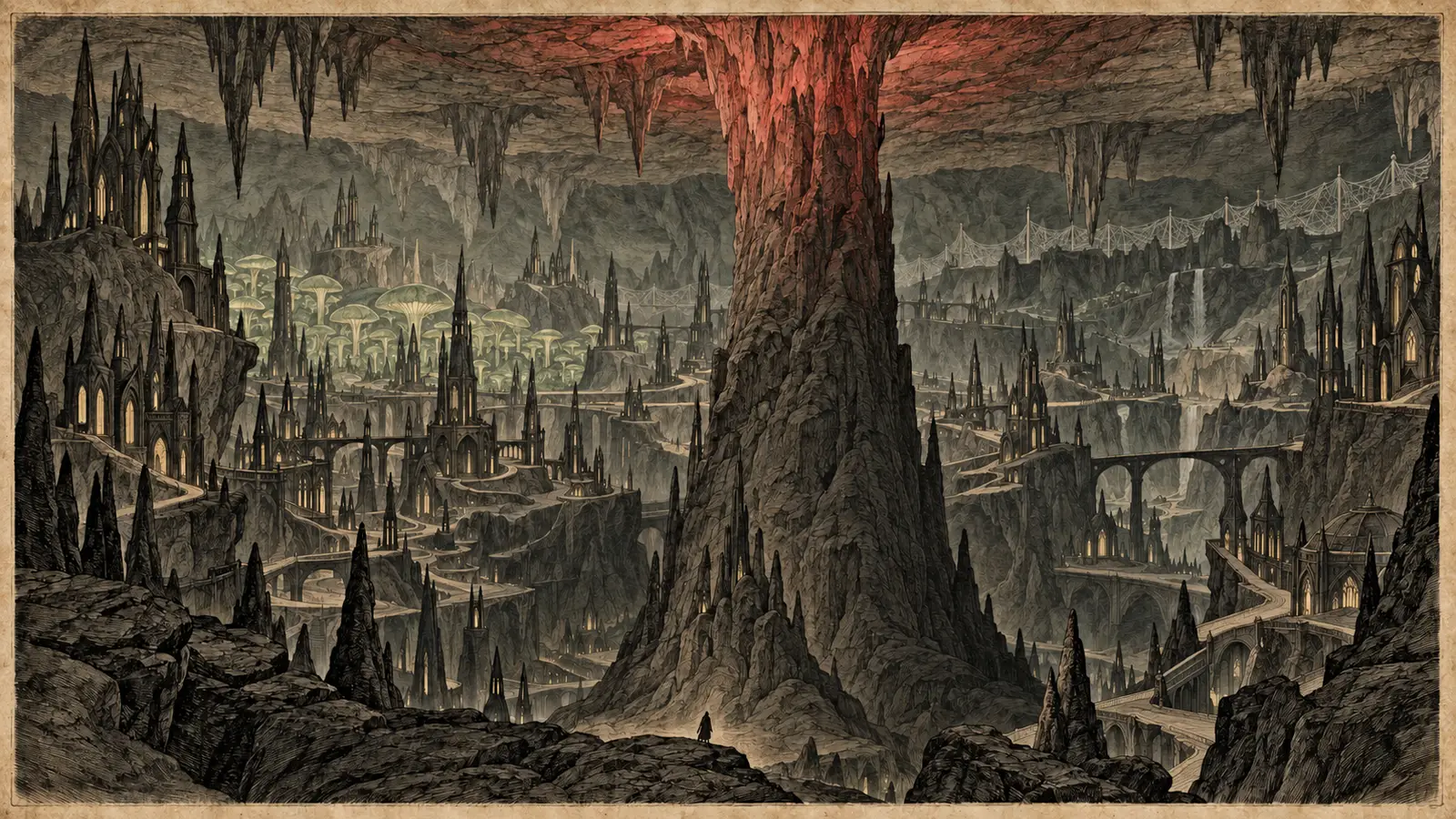
Let's finish where so much of the city's life is measured, at the foot of the great pillar.
Imagine standing on the cavern floor in the low place called the Deep Shadows, with the column of stone rising above you into the dark. It joins the floor of the world to its ceiling a thousand feet overhead, and from here you can't see the top. Around you the city is quiet the way is ever quiet. The blue and violet edges of the great houses glow on their stalagmites. Lights hang from the far roof where the ceiling houses cling. Over on the plateau of the nobles the mushroom forest stands in its own soft luminescence, and beyond it, the silver web of the Baenre fence.
Somewhere above, the Archmage lays his hand against the stone and speaks, and fire goes into the rock. You can't see it the way you'd see a candle. But if you had the eyes of the drow, you'd see warmth begin to rise in the pillar, slowly, a little higher with every hour. All across the city, in the houses and the schools and the slums of the Braeryn, people glance up at it, and they know where they are in the day.
The warmth climbs. In Donigarten, the rothé shift in their herds by the lake, and the water lies still around its small island. Students on Tier Breche bend over their lessons. Merchants in the Bazaar call out their wares. Matrons make their plans. The faerzress lies in the stone of the deep all around the city, dim and faintly glowing, and comfortably warm, as it has for longer than anyone has kept count.
Near the end, the top of the pillar glows red. Then, slowly, it cools. The red fades. The heat drains out of the stone until it's dark from base to crown, and the drow have a name for that moment, 's Black Death, though it's really only midnight. For a little while the city's clock shows nothing at all, and Menzoberranzan rests, as much as it ever does.
Then the hand returns to the stone, and the fire goes in again, and the warmth begins its slow climb. Far above, beyond two miles of rock, the night is passing over the Moonwood and the Frost Hills, and somewhere in the North the real sun is getting ready to rise. Under the ground the city has no sun of its own, so it heats a pillar of stone each day and lets it cool again in the dark.