Chapter I
A lich, a lieutenant and a few lines of legend
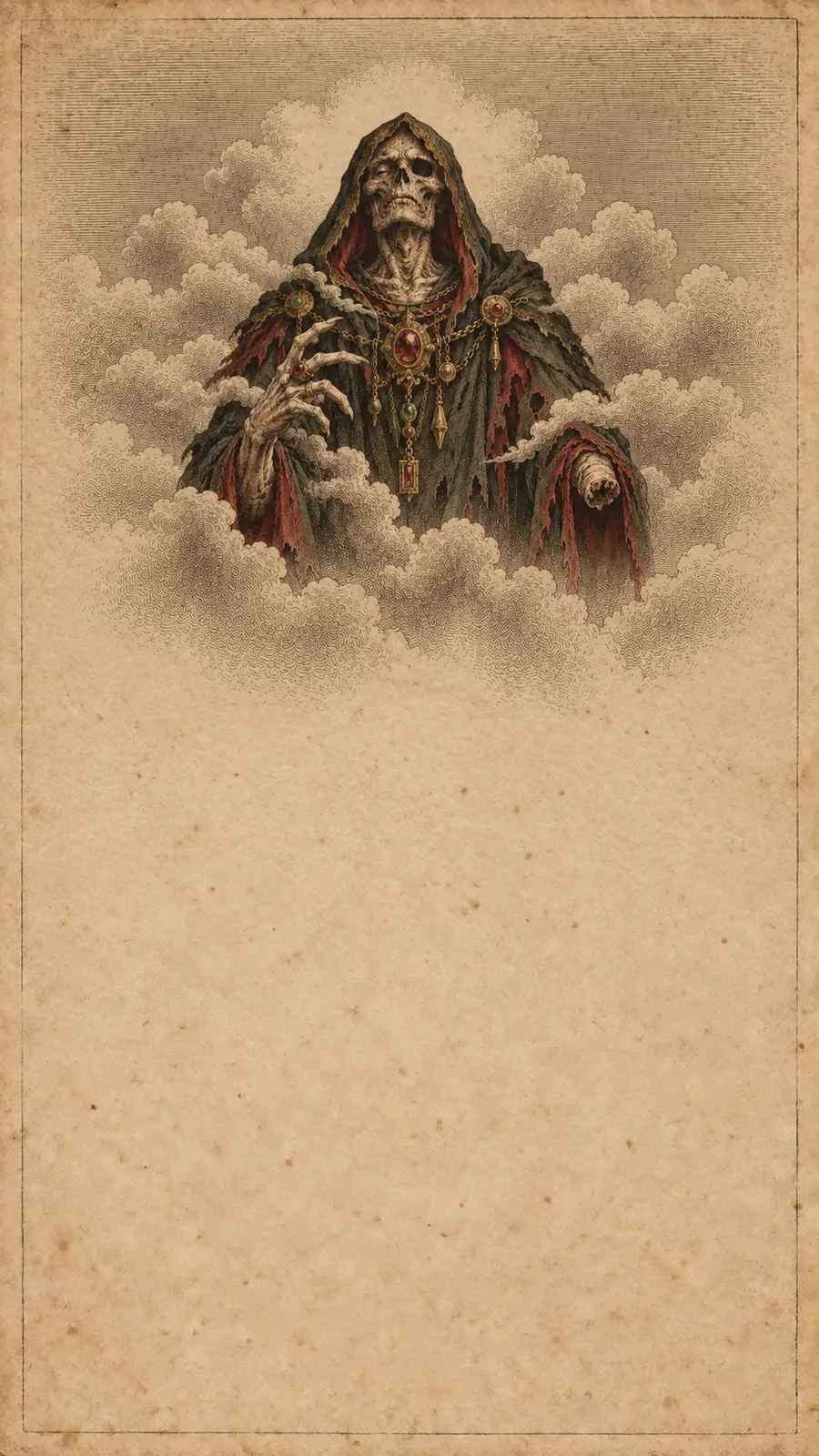
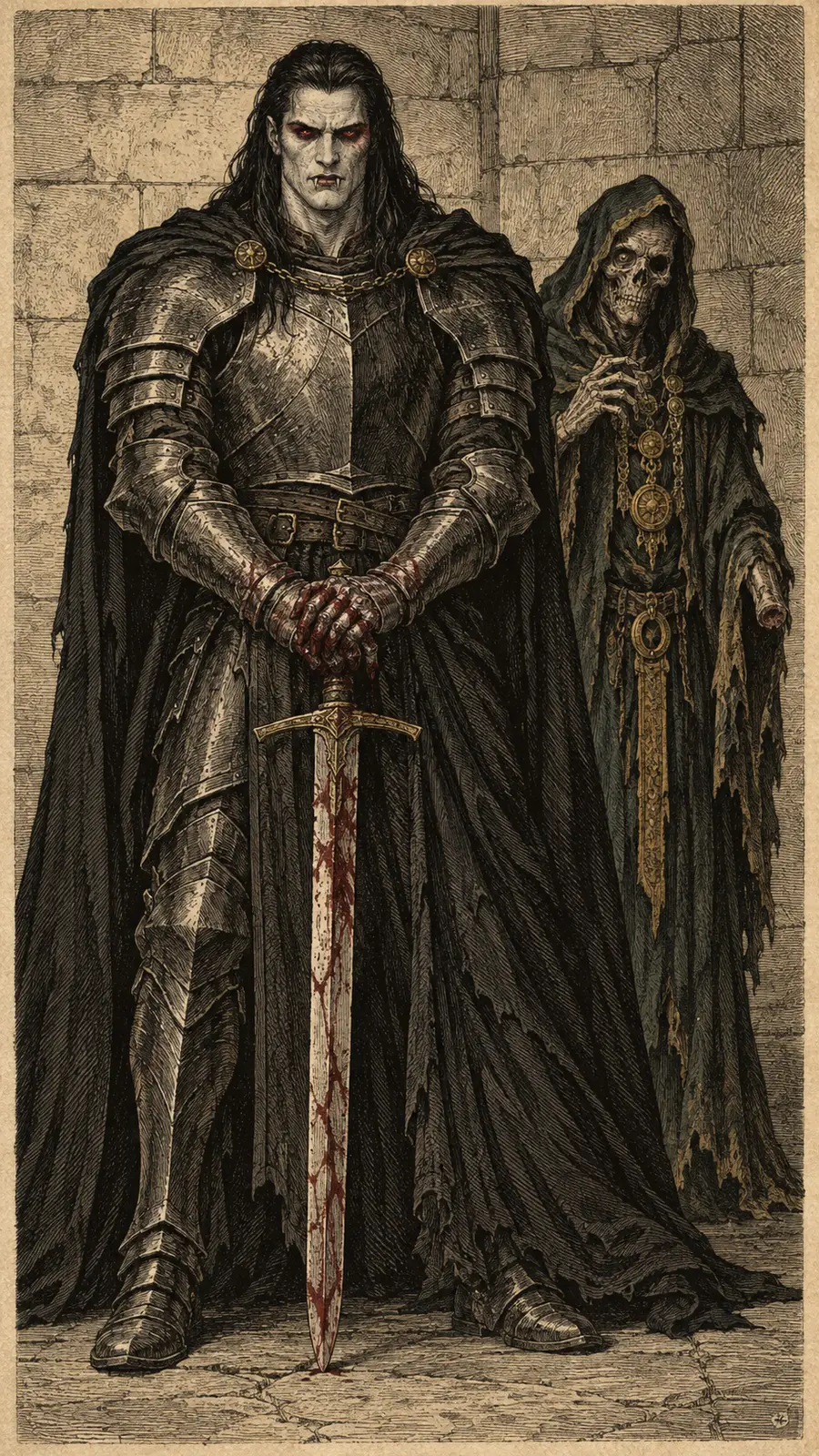
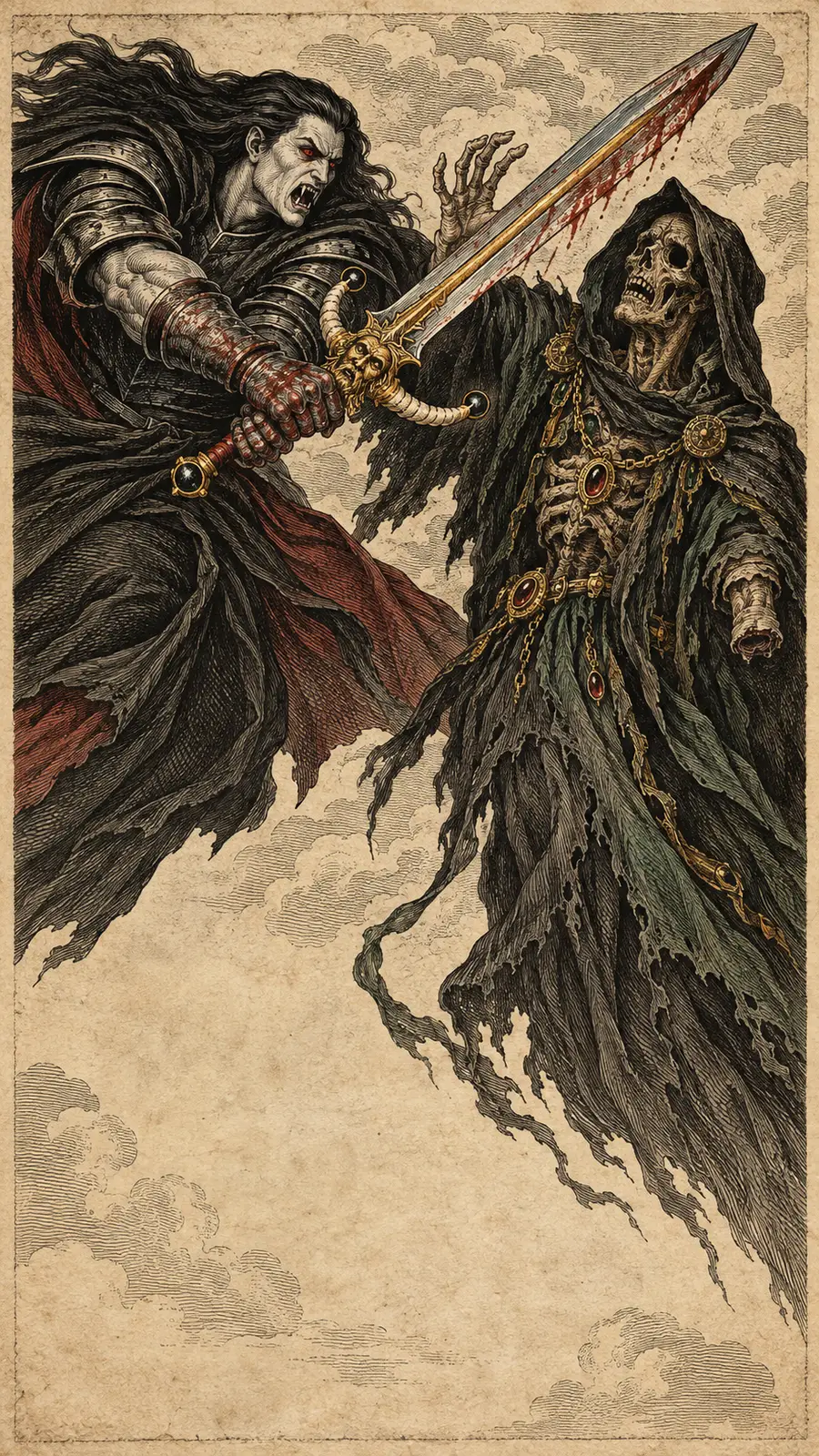
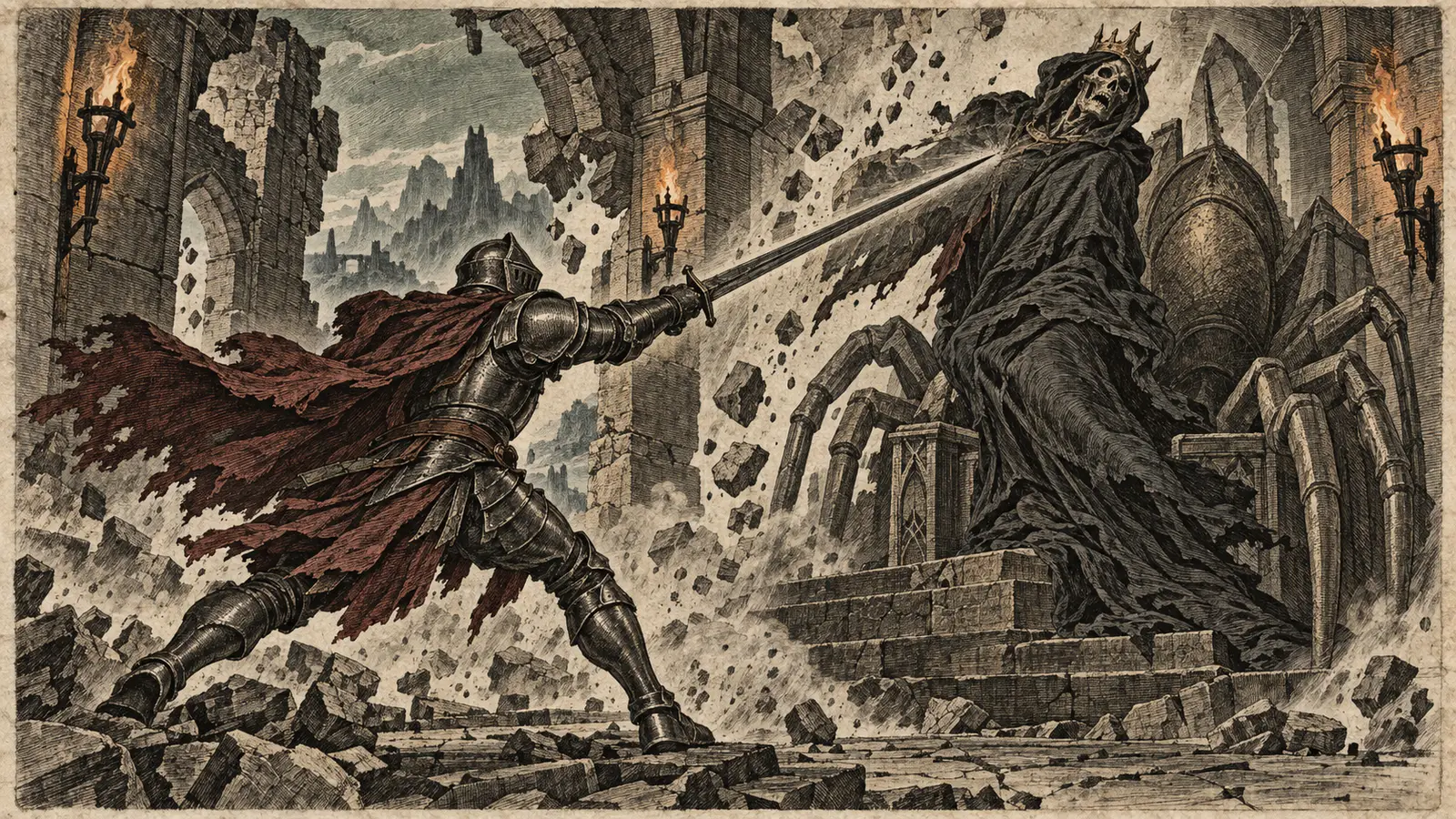
Every long story about the Sword of Kas starts with the night the sword was last held by the man it was named for. In that story there is a tower, a throne shaped like a spider and an undead king who has ruled for longer than most kingdoms last. There is also a man who stands closest to that throne, closer than any adviser or general and closer than any friend, if a lich can be said to have friends. Then a moment comes when the man draws his sword against his master. When the dust settles there is no tower and no king, and there is no lieutenant either. Three things lie in the rubble: a severed left hand, a single left eye and a sword.
Each of those three objects became one of the best-known artifacts in Dungeons & Dragons. The hand and the eye have had their own evening on this channel, and we followed them from the first rulebook that mentioned them to the edge of 's return as a god. Tonight we pick up the third object, the one that did the cutting.
Begin with how small this legend was at the start. In 1976, Gary and Brian put together Eldritch Wizardry, the third supplement to the original Dungeons & Dragons rules. Blume came up with two strange relics for it: a mummified hand and a single eye, said to be all that survived of an evil lich called Vecna who had been destroyed long ago. The name Vecna rearranges the letters of Jack Vance, the fantasy author whose fiction gave the game its old style of magic, where a wizard memorises spells and forgets each one as soon as it is cast. Blume never set down much more about the lich. Gygax himself, so the story goes, never got further detail about the relics from his co-author. The supplement adds only one more fact about Vecna: he had a bodyguard, and the bodyguard's name was Kas.
That was the seed. The supplement included a sword bearing the bodyguard's name, and a short phrase that would echo for half a century: by this blade, some say, Vecna lost his Hand and Eye. Those two words, "some say," are a rumour, the sort of thing an old soldier might mutter by a campfire. Nobody in 1976 explained why a bodyguard would turn on the master he was supposed to guard, or what kind of sword could cut a lich down. The early designers left a gap in the story, and players and later writers would spend decades filling it.
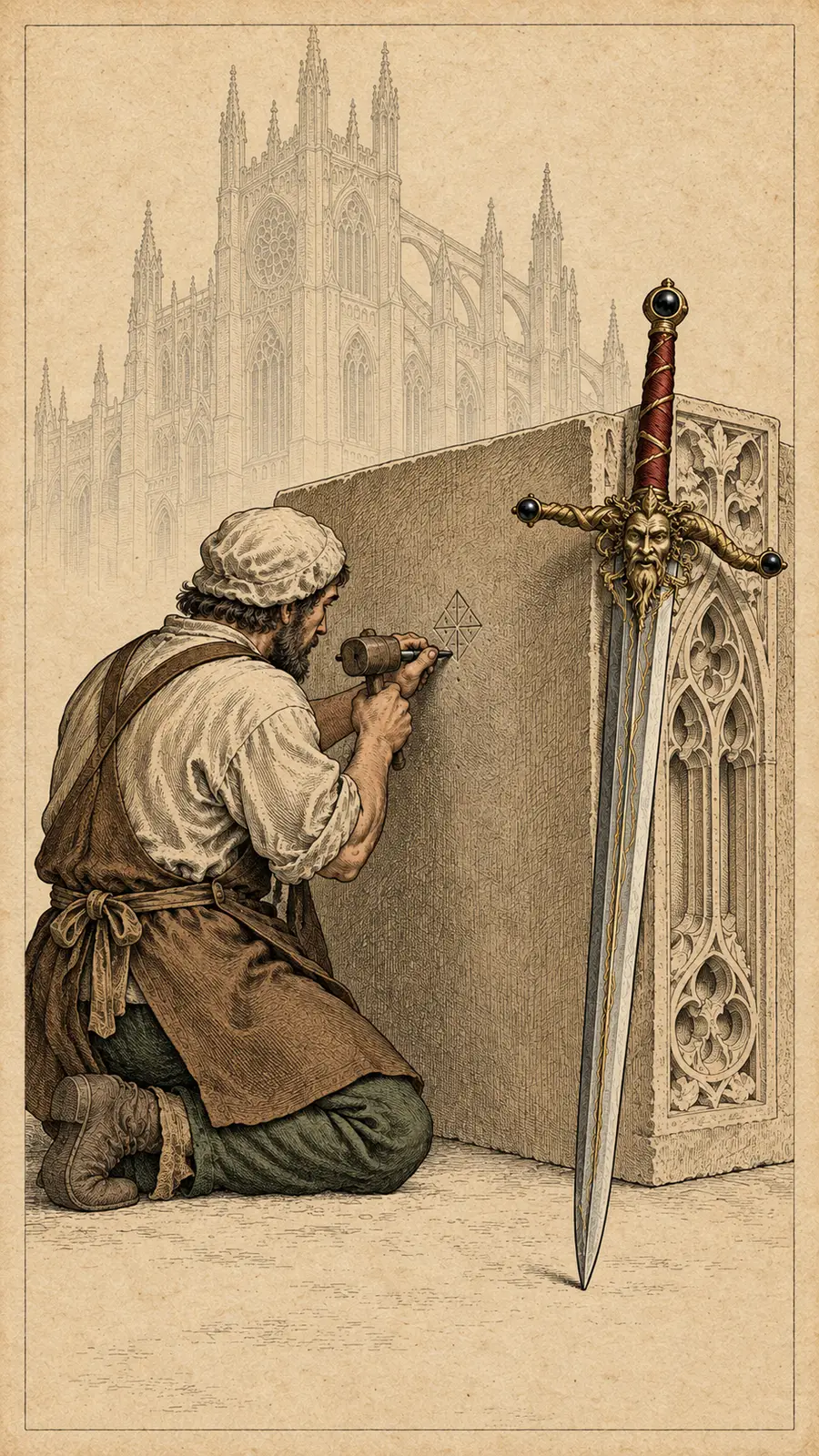
The name Kas carries a small private joke. Tim edited Eldritch Wizardry and was the first editor of Dragon magazine, and the name of Vecna's bodyguard is a quiet nod to him. The early designers liked tucking each other's names into their rulebooks, the way a stonemason might carve initials on the back of a cathedral stone where only other masons would find them. So the sword began with an anagram for its enemy and a borrowed name for its bearer.
It's worth picturing what an artifact meant to players in those days. Treasure in early Dungeons & Dragons was mostly useful and modest: a sword that hit a little harder, a ring that turned aside a blow, a potion against fire. Artifacts were a different kind of thing. They were rare, dangerous, mysterious and nearly impossible to destroy, and their powers weren't fixed. A Dungeon Master rolled them up from tables, so the Sword of Kas in one campaign might do quite different things from the Sword of Kas in another. Players weren't supposed to know what an artifact could do. They learned it from rumours in taverns, old songs and painful experiment. In a sense the legend of the sword was built for half-knowledge from the very beginning.
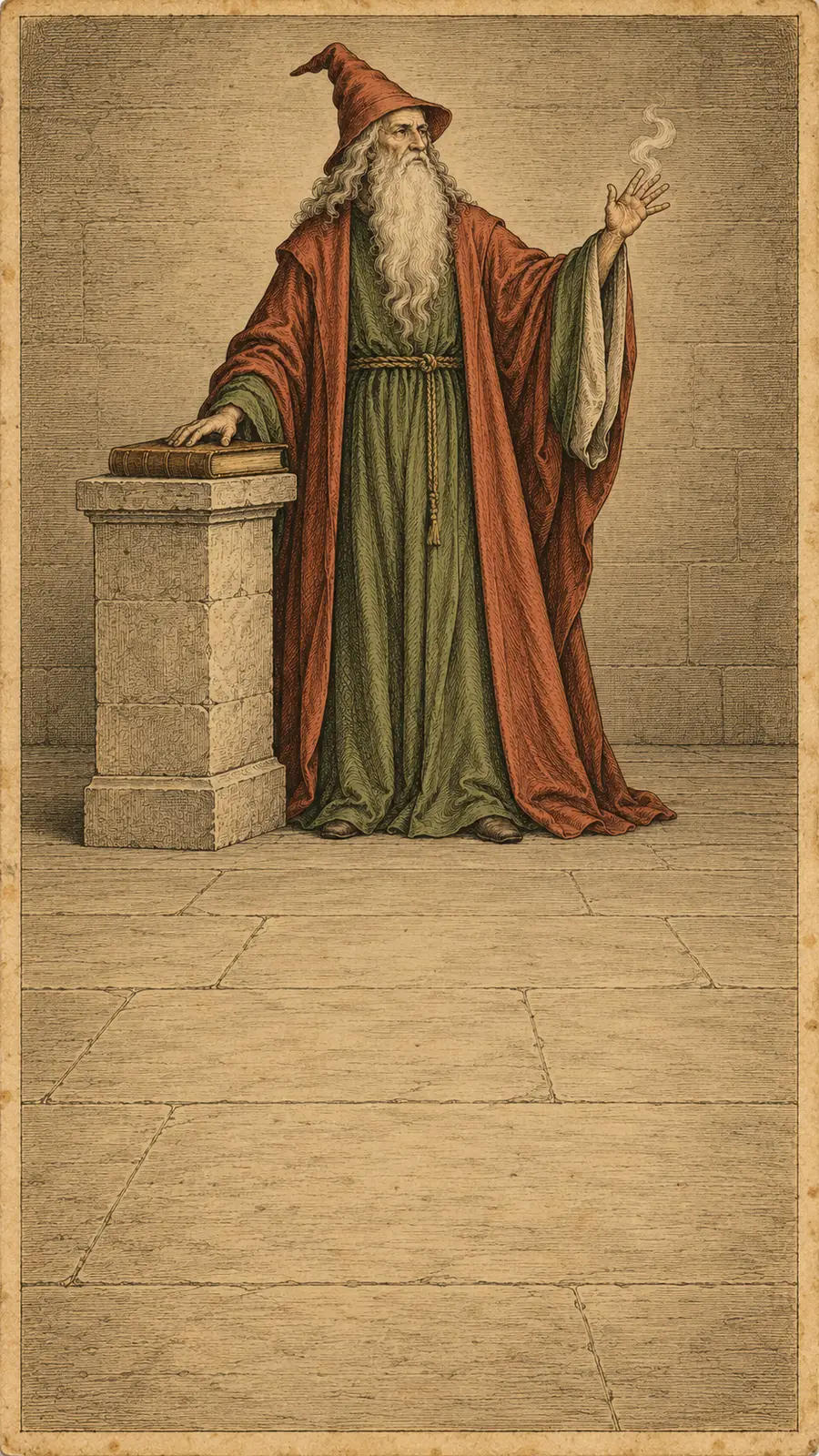
Inside the world the story would one day be set in, the legend starts far back in the ancient history of , the world of Greyhawk, well over a thousand years before the calendar its later people would call the Common Year. In those days the , the oldest human people of the eastern continent called the , built cities across the land. One of them, , is where a boy named Vecna was born into the lowest caste, the untouchables, son of a woman named who practised witchcraft and paid for it with her life. We walked through that childhood on an earlier evening, so here we only glance at it. The boy grew into one of the greatest wizards Oerth has known. Through bargains with dark powers, among them the demon prince , he became a lich, a mage who had left life behind and kept his soul hidden so that death couldn't take him.
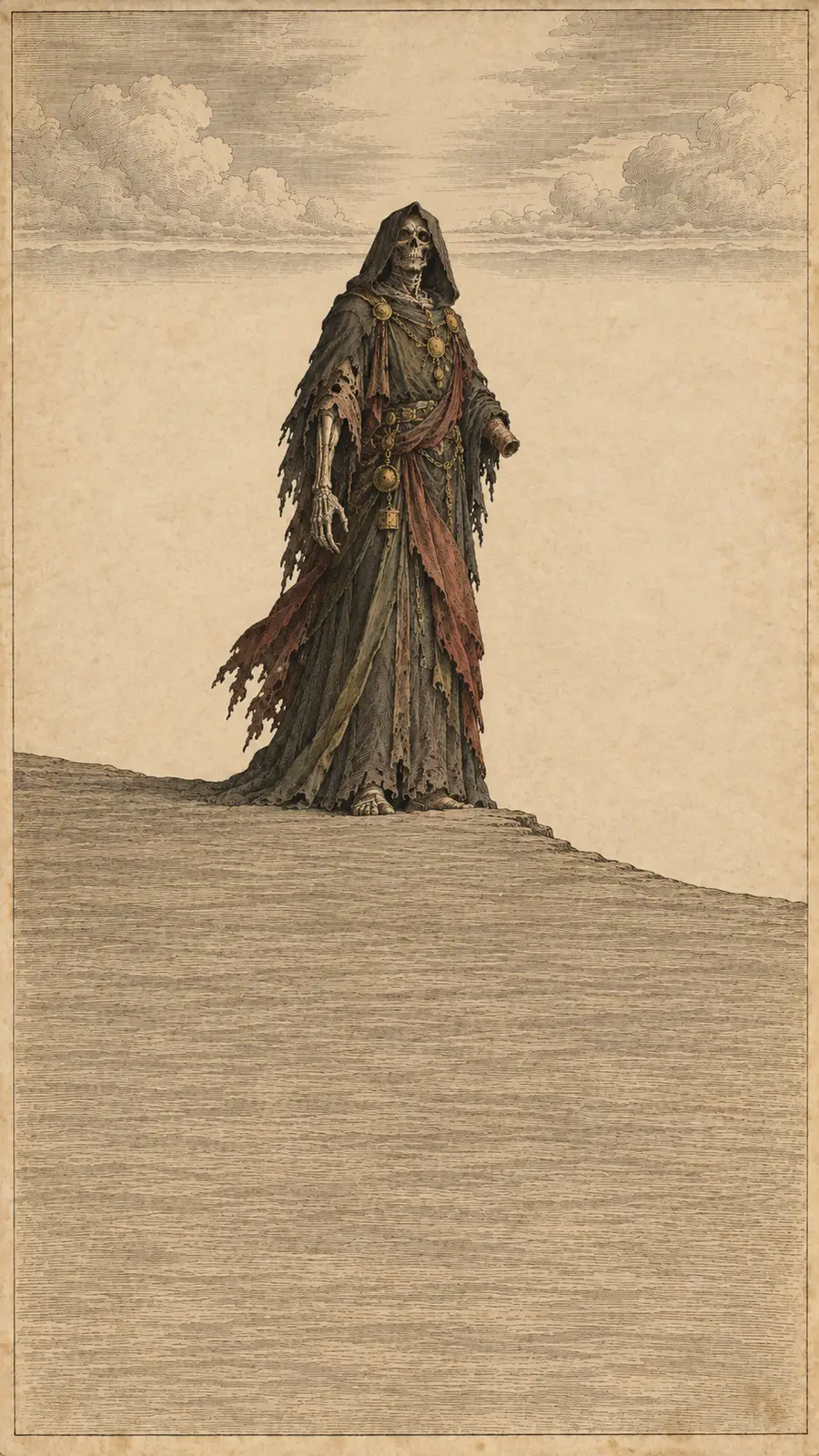
Vecna built an empire. Its heart lay in the Valley, near the marshy country later called the , and at its widest its borders may have stretched north to the , toward the great lake called the and the Wild Coast, and south to the Good Hills. From his seat on the Spidered Throne, which some call the Spider Throne, the lich ruled in a way his subjects would recall long after the empire was gone. They learned not to say his name aloud, and called him the Whispered One, the One-Named-In-Whispers and the Undying King. Much later, after the night we're heading toward, he would get one more title, the Maimed Lord.
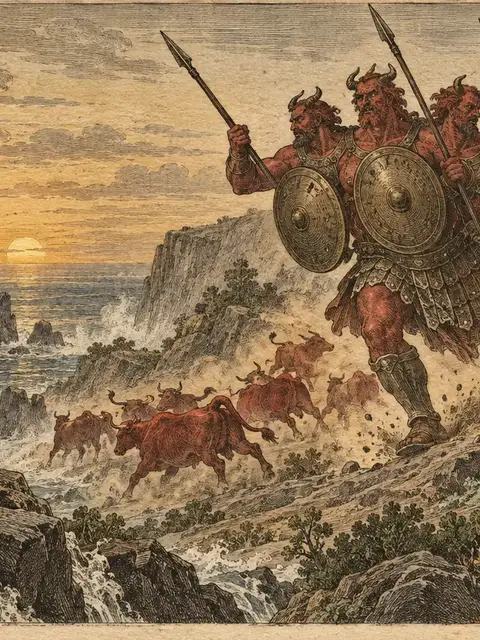
An empire like that needs a sword arm, and this is where Kas comes in. For a long time the old books said almost nothing about him, and later tellers had to give him a past. When they did, they settled on a few lasting things. He was born human. He rose through the ranks of the lich's armies on merit, if cruelty can count as merit. He had a hunger for battle and blood that was never satisfied. Vecna noticed him the way a collector notices a well-made blade, and made him bodyguard, then right hand, then adviser, warlord and assassin. In time Kas sat in the lich's place and ran the empire while his master's attention turned to deeper and stranger matters.
So the earliest form of the legend comes down to an undead king, a living servant, a gift, a whisper and a betrayal. Those pieces have stayed in every version since, even as each generation of writers set them a little differently. To see how it grew, we'll go back to the slim volume of 1976 and look at the sword as it first appeared.
Chapter II
Eldritch Wizardry and the first whisper of the blade
Players opening Eldritch Wizardry in 1976 found a crowded book. It was small, but it introduced the first true demon princes, and , who have also had evenings of their own here, along with a long list of wonders. The artifacts and relics included the Rod of Seven Parts, the Axe of the Dwarvish Lords, the Teeth of , the Wand of Orcus, and the Hand and Eye of . The Sword of Kas was among them, one of the earliest artifacts ever written for the game.
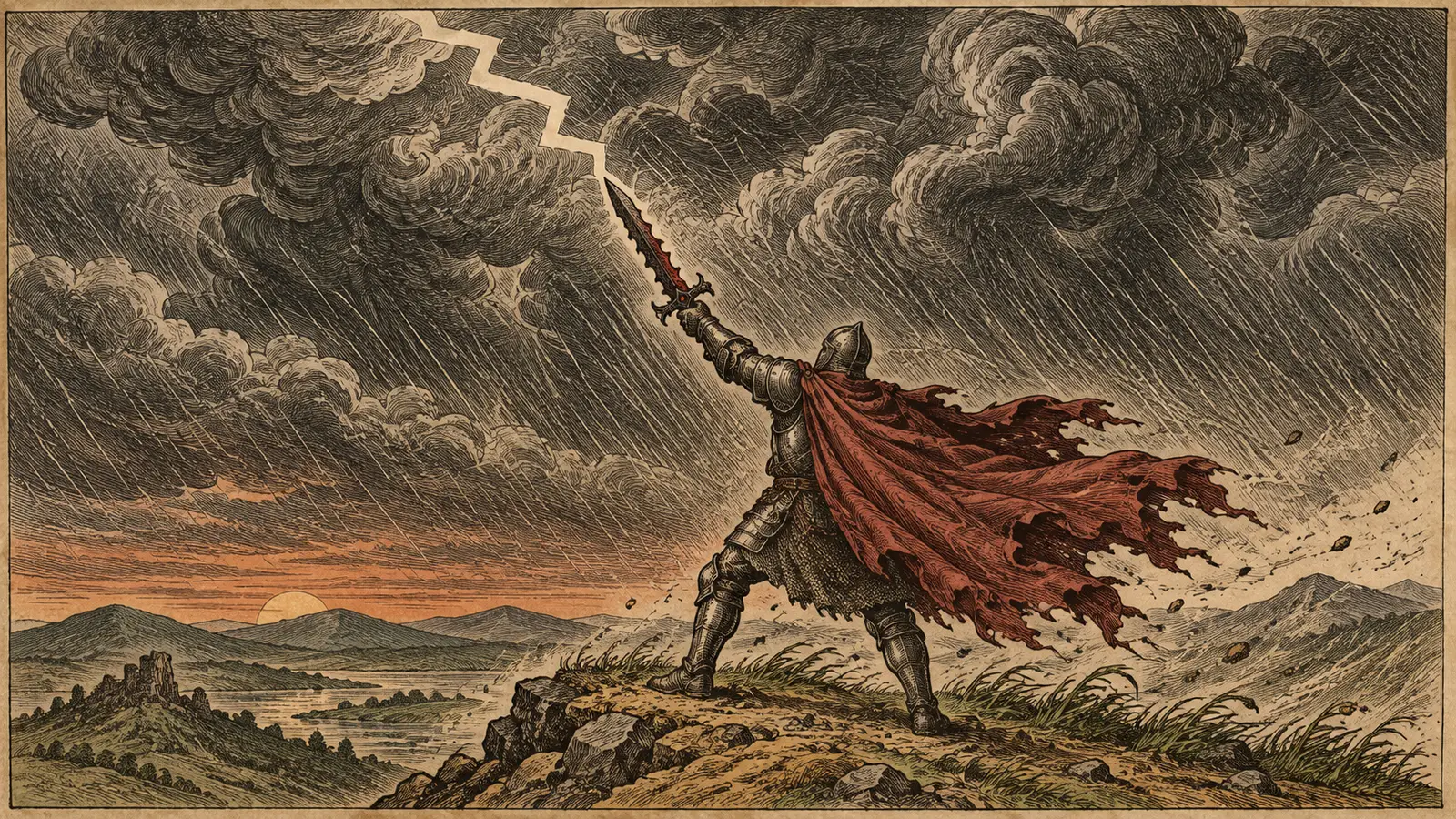
In those first pages the sword is barely a character. It's a weapon with a name and a dark reputation. The sword itself is plainly described: magically honed to a razor's edge, it lends great strength to the arm that holds it, and it can call lightning down from storm clouds overhead. Those three qualities, the edge, the strength and the lightning, became part of its identity and lasted through edition after edition, long after its shape and size had changed. Even in its oldest form there's something alive in it. The sword has a mind, and the mind is vile and murderous.
Three years later, in 1979, Gary brought the sword into Advanced Dungeons & Dragons in his Dungeon Master's Guide, the great dense rulebook that a generation of game masters read the way other people read old almanacs. The Sword of Kas sat in the section on artifacts and relics, next to the Hand and Eye of Vecna and the other wonders carried over from Eldritch Wizardry. Its first form was a short sword, a plain soldier's blade of the kind a bodyguard might wear at his hip in a crowded throne room. That's worth remembering, because much later it would grow huge.
One small phrase in the 1979 guide says a lot about how the story began. Vecna doesn't forge the sword. He procures it, obtaining it for his lieutenant from somewhere and giving it to him. That makes the gift a quieter thing, more like a king handing a trusted captain a fine weapon from the armoury than a sorcerer pouring himself into a blade. Where the sword came from before that, and who made it, the book doesn't say. In this oldest telling the sword is older than the betrayal and perhaps older than Vecna's interest in it, and its spirit is its own.
The guide gives that spirit a cunning that made it frightening at the table. The sword hid how strong its mind and will really were. A player whose character carried it couldn't know how firmly it might take hold of him. It didn't try to dominate its bearer in ordinary times. It waited until a meeting with Vecna drew near, and only then, when the stakes were highest, did it show the full force of its will. Picture carrying a blade for months of hard adventuring and trusting it in a dozen fights, only to feel it wake up and take the reins as you approach your enemy's lair. Even in this early form the sword wasn't really anyone's servant. Its one purpose was to destroy Vecna and those who followed him, and everything else was secondary.
From the start the sword was defined by its maker's enemy. The Hand and Eye are pieces of Vecna. The sword is the thing that took them from him. Put all three in one campaign and they pull against each other. In those early rulebooks the sword was something like a compass needle that always pointed at the lich.
The story behind it was still a set of hints. A lich had once ruled. His bodyguard bore this sword. Some said the sword took the lich's hand and eye. That was enough for a Dungeon Master to build an adventure around. A cult might be seeking the lich's remains, a hero might find a short sword with a cruel edge in a barrow, and old songs might tie the two together. The early game liked leaving gaps that individual tables could fill in their own ways, and many tables did.
The Dungeon Master's Guide for second edition followed in 1989 and carried the artifacts into a new era of the game. The real growth of the legend, though, came the next year, when Vecna stopped being a pair of grisly relics and stepped onto the stage himself. When he did, his bodyguard and the bodyguard's sword finally got a history.
Chapter III
Vecna Lives! and the history of the Spidered Throne
In 1990, TSR published Vecna Lives!, written by David "Zeb" Cook for the world of Greyhawk and for heroes near the height of their power. It was the first time appeared in person rather than as the remnants of a corpse, and it changed what he was. The destroyed lich of the old rulebooks had risen again as a demigod. It was a bold step, and some players thought the adventure overreached while others counted it among their favourites of the era. Either way it gave the legend of Kas more substance than it had ever had.
The adventure opens with the most powerful wizards of the . The Circle of Eight gathers in the City of Greyhawk under , who senses something terrible stirring and sends members out to investigate, among them , and Otto, names that had been on spells in players' books for years. For the opening scenes the players take the roles of these archmages. Then the wizards disappear, and the players go back to their own characters, followers of the vanished Circle, searching for their masters. The trail leads through the City of Greyhawk, the Viscounty of and the gnome warren of , through a warlord possessed by the Hand and Eye and a cult working in secret. Without the heroes knowing, an avatar of Vecna travels with them in disguise.
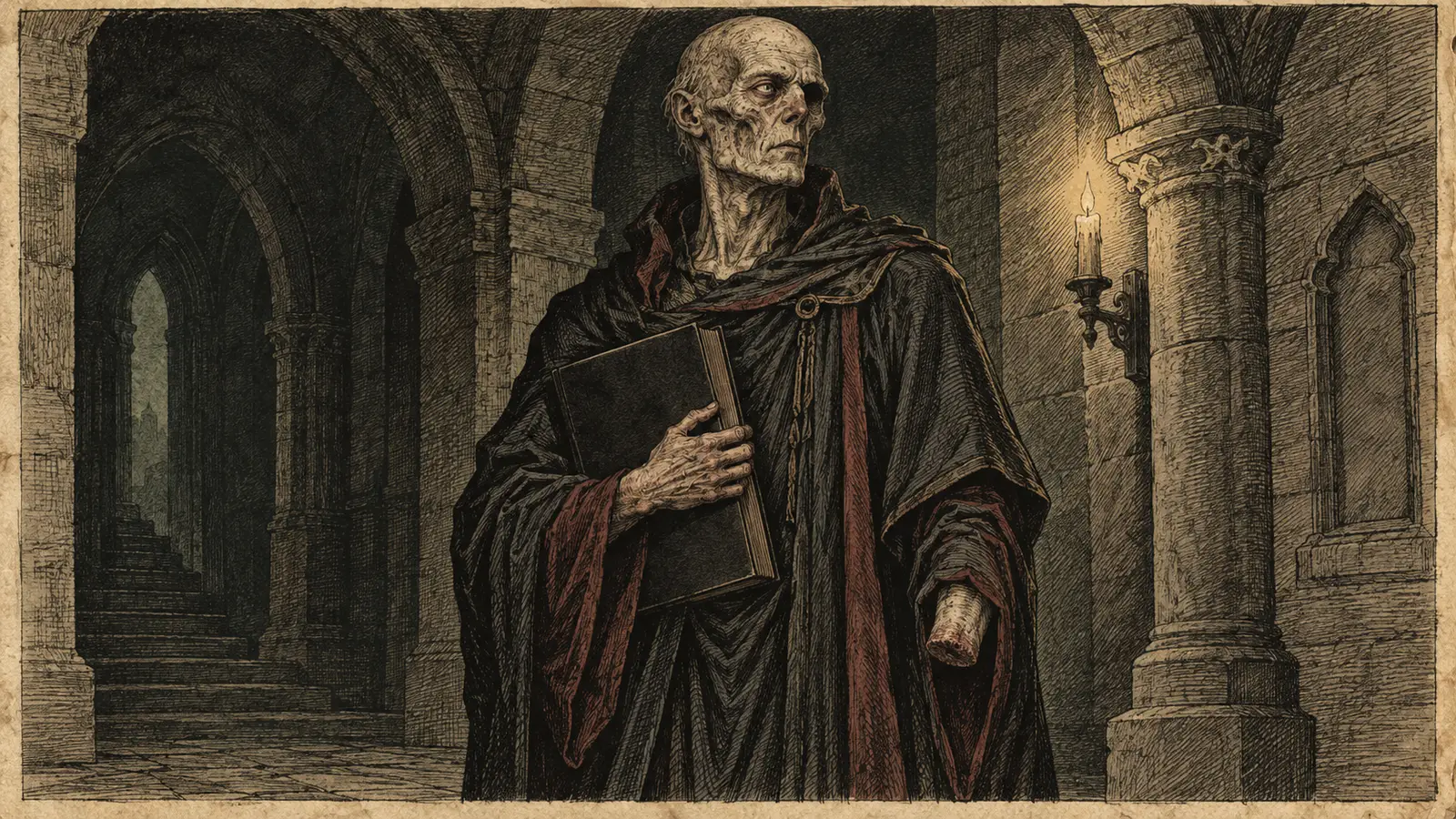
The adventure is also a history of the Spidered Throne, and that history is where Kas finally steps out of the shadows. He appears as the lich's evil counsellor, his bodyguard and most trusted lieutenant, his right-hand man, a phrase that would later carry its own dark joke. In this history, Kas is already a vampire while he serves. The lich's right hand is an undead thing, cold and hungry, standing beside a master who is cold and undead in a different way.
The history keeps a few deeds that show what that service was like. In the third year of Vecna's reign, a king named , ruler of the , refused the tribute Vecna demanded. The lich asked for heads, and Burgred wouldn't send them. Vecna didn't answer with an army. He took only his evil counsellor and went to the lands of the Mara, and with his magic he ruined them. In the end Burgred paid the tribute with his own head. The picture is of two figures walking into a defiant kingdom, the lich and his lieutenant, and the kingdom being gone when they leave.
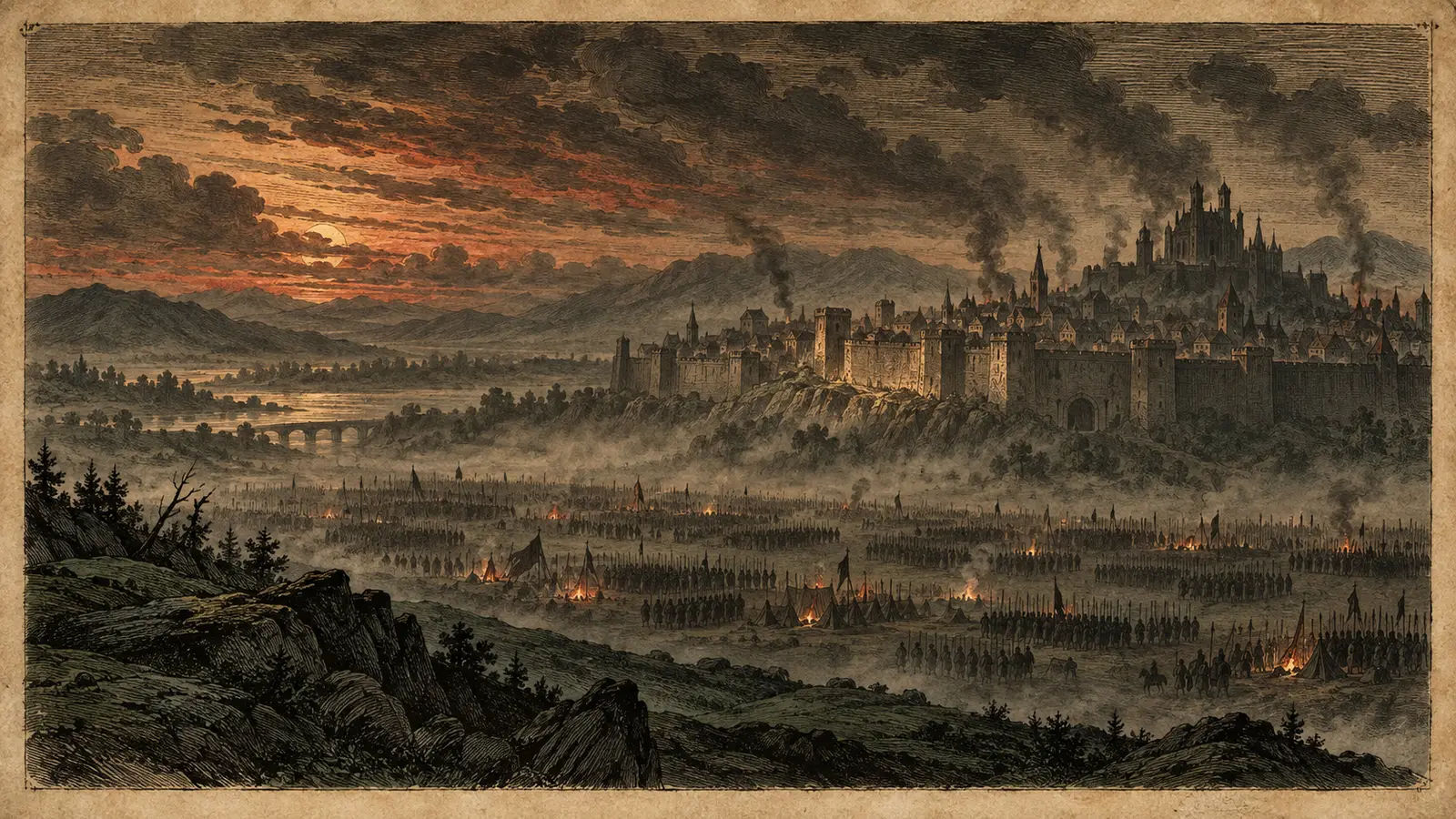
The darker deed is at , the city of Vecna's birth. About a thousand years after he was born there as an untouchable, the lich came back with an army of undead and spellcasters and laid siege to it. The leaders of Fleeth offered their treasures to save the people, and when that wasn't enough they offered their own lives. Vecna gave one official, a man named , and his family to Kas, and the hours that followed took place in front of the other leaders of the city. Of all the deeds remembered of Kas, this may be the darkest, and the histories don't dwell on it, so neither will we. It's enough to know that after that day the city of Vecna's childhood was gone, and that the name Kas the Bloody-Handed was by then fitting.
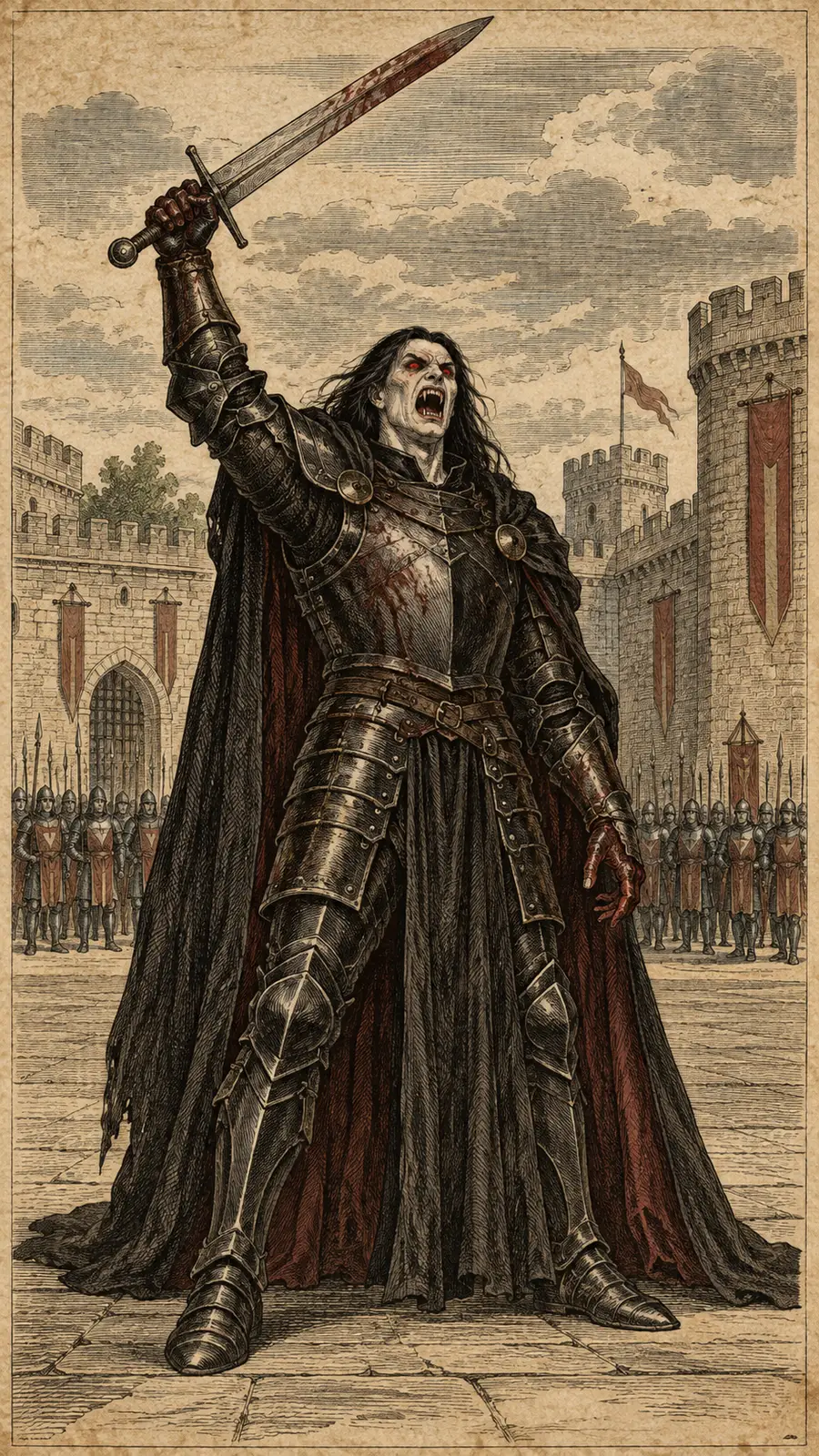
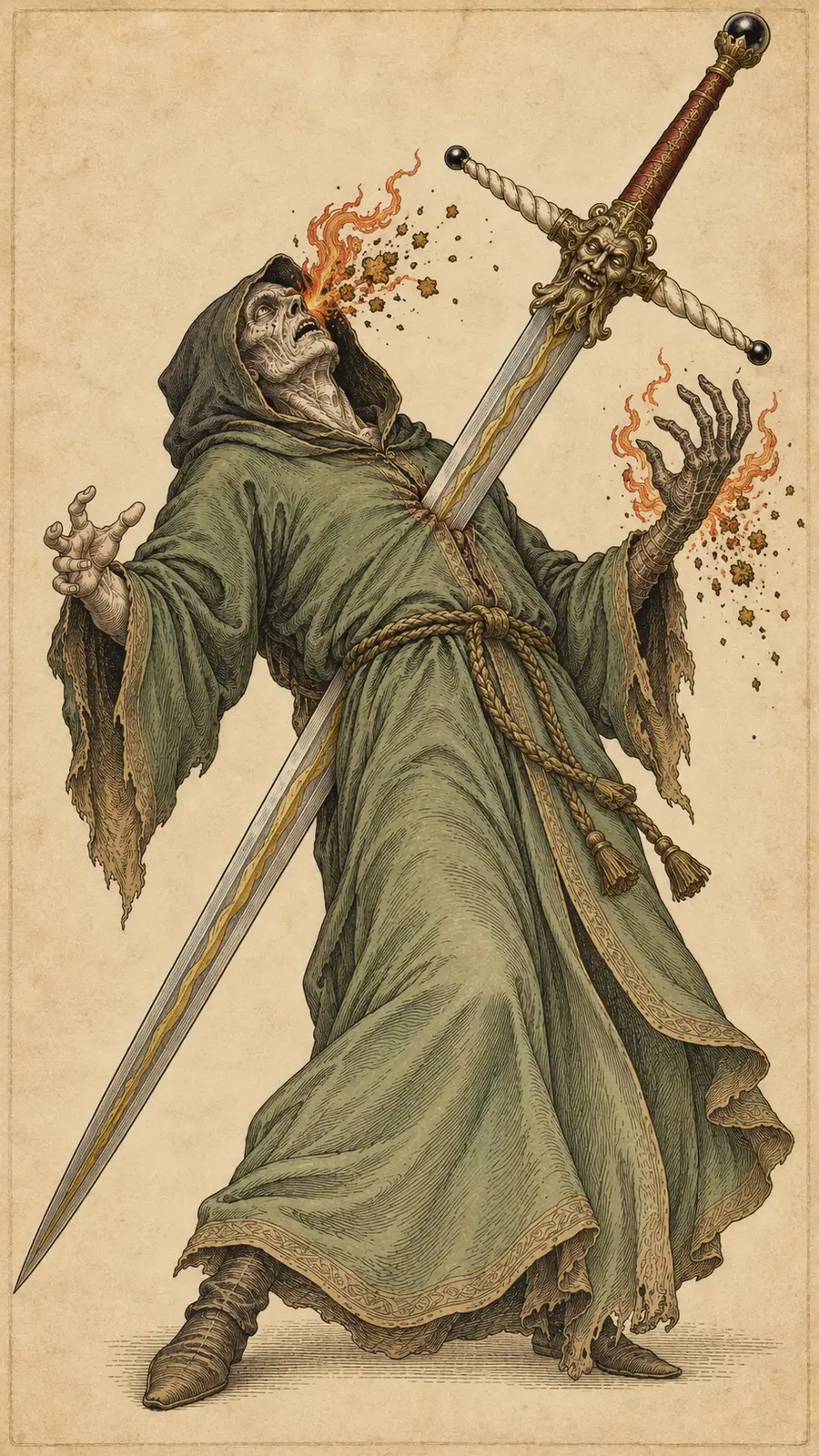
The same history tells of the betrayal as the turning point of the empire. At its height, Vecna was betrayed by the man he trusted most. Kas came against his master with a sword Vecna had given him. In the fight that followed, the lieutenant cut off the lich's left hand and gouged out his left eye. Neither was left standing. Vecna was destroyed except for the hand and the eye, and Kas was flung away to distant planes. Only three things stayed on the field: the sword, the hand and the eye. The adventure adds one more detail. Vecna had been reaching for godhood, and Kas's blade cut that first attempt short. Every age of the lich's ambition since has been haunted by that interruption.
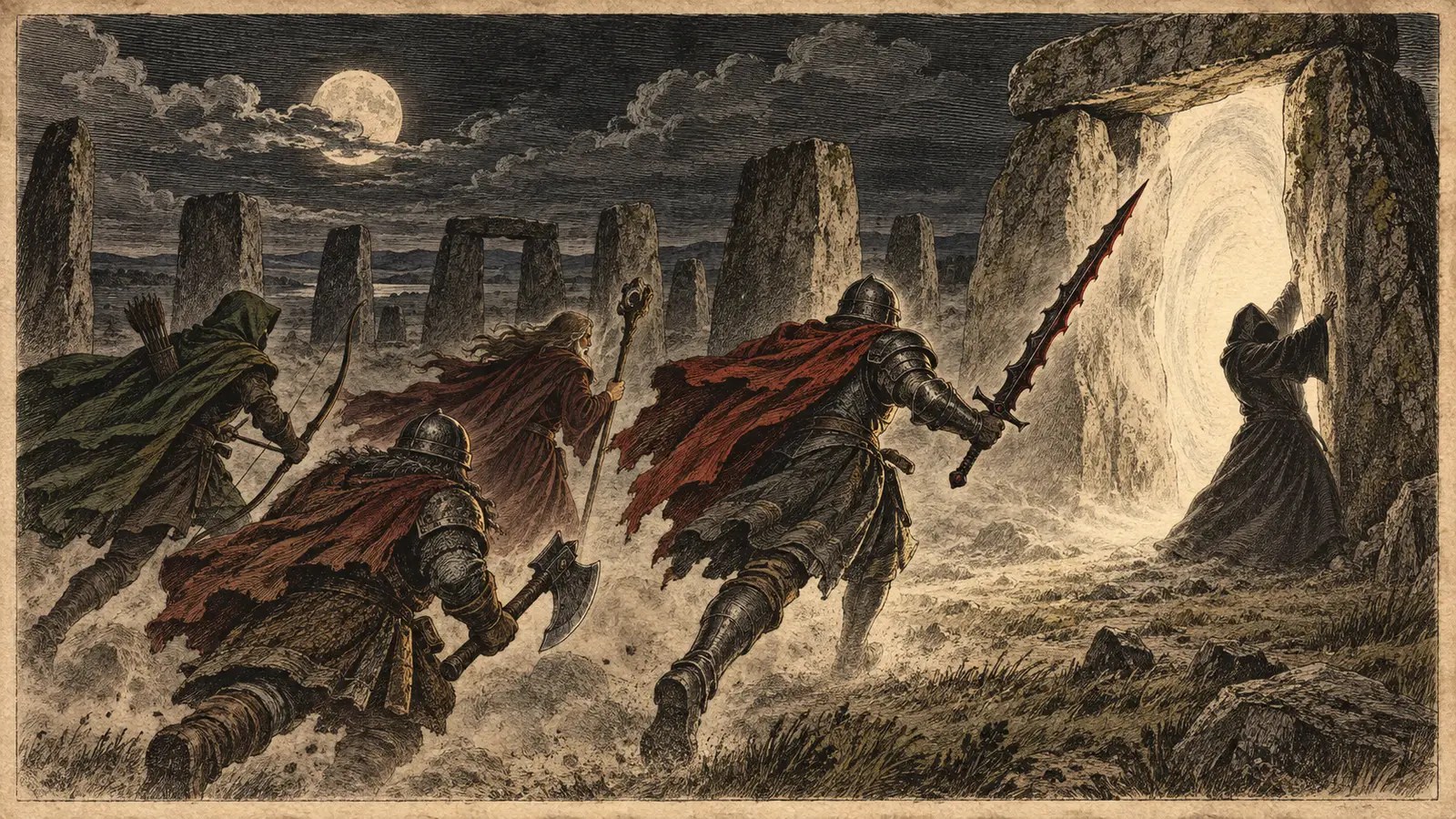
The adventure has more for Kas than a backstory, because the heroes eventually meet him. The trail leads to , a ring of standing stones out on the plains, a little like Stonehenge, whose arches open as portals to unknown places. Vecna's avatar goes there, and the heroes follow and find the demigod trying to open a doorway into the past. From there the road leads farther still, to , Vecna's own demiplane, a citadel and prison on or near the Plane of Ash, the grey borderland between elemental fire and the Negative Energy Plane, where light and life thin out into cinders.
Kas the Bloody-Handed is imprisoned in Cavitius, still bound up in the fate of the master he betrayed. Here the sword shows a power that no earlier book had mentioned. If the heroes give Kas his sword, he uses a hidden power of the blade to carry everyone, himself and the heroes alike, out of Cavitius and back to the stones of Baragu. The sword acts as a key home. In one telling Kas then simply goes his own way and pays the heroes no further attention, as if they were baggage he'd been obliged to carry for a moment. Other tellings let a clever band win help from Kas, and even from Iuz, the cambion demigod of the north, against the Whispered One. Kas doesn't fight the lich for anyone's sake but his own. His hatred happens to point the same way as the heroes' hopes, and that's enough to make him a temporary ally.
You might imagine that meeting in the ash-grey light of Cavitius. A tall figure who has waited longer than most nations have stood looks at the blade in a stranger's hands and recognises it as his own. His fingers close around the hilt, and the old weight settles back into a grip that remembers it. For a moment the sword has its first master again.
The adventure ends with a door opening into a new setting. If the heroes beat the demigod, he doesn't die. He's taken away to the Demiplane of Dread, the realm of , where the Mists and their unseen masters, the Dark Powers, imprison the worst of the wicked inside lands shaped to torment them. Vecna went into the Mists, and before long, so did Kas.
Before we follow them, there's one more book from these years that changed the sword more than any other: a catalogue of the most dangerous objects in the game, which gave the blade a new body and a voice.
Chapter IV
The Book of Artifacts and the blade made whole
In 1993, TSR published the Book of Artifacts, a second edition sourcebook describing fifty of the most powerful objects in the game. David "Zeb" Cook was principal designer again, joined by a long list of contributors including Rich Baker, Wolfgang Baur, Colin McComb and Thomas M. Reid. The book did more than list statistics. It used its artifacts to fill in the histories around them, and since three of its fifty treasures belonged to one ancient betrayal, it became one of the fullest accounts of the fall of yet written.
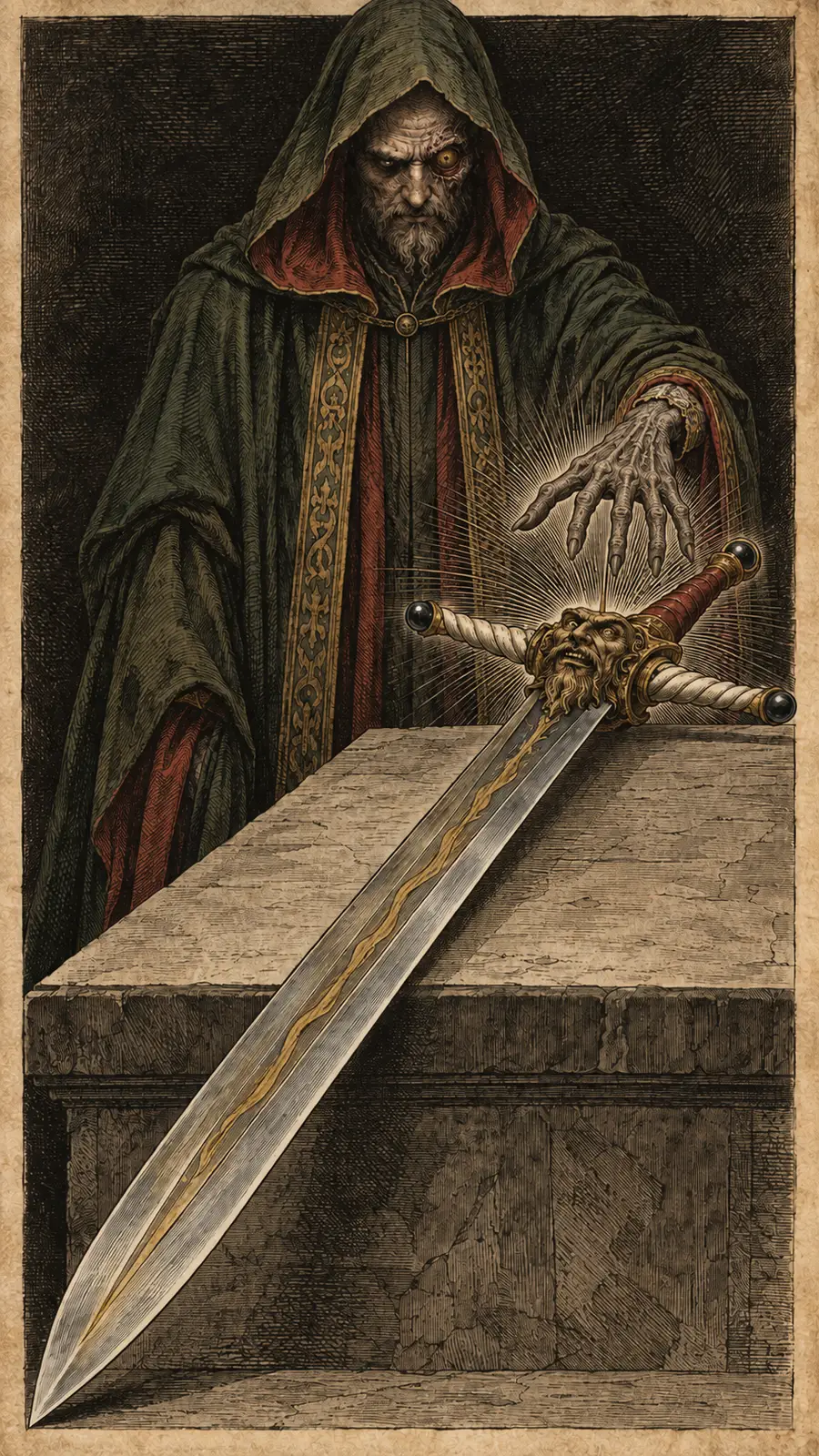
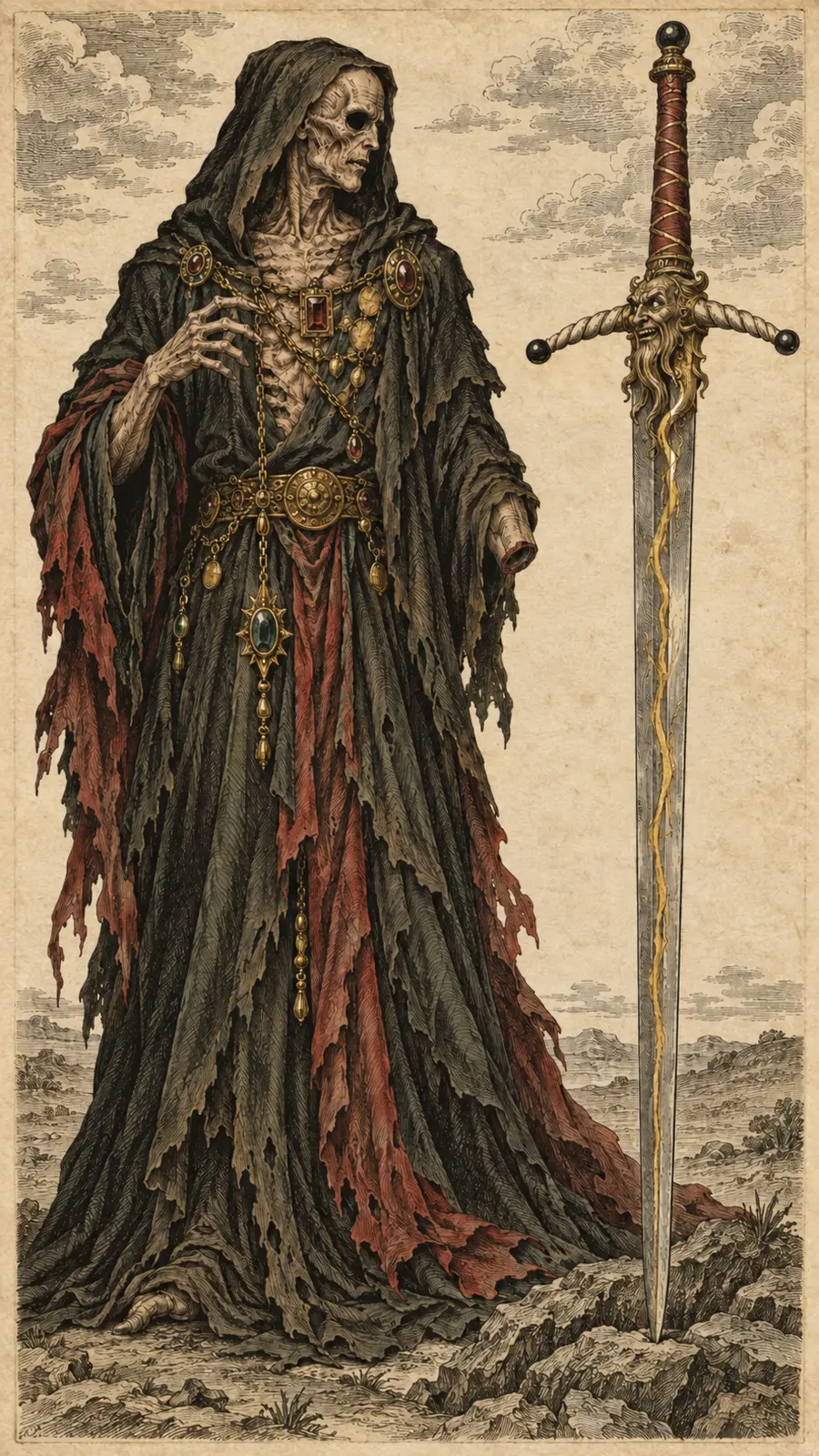
Its entry calls the sword the mighty blade of Kas the Bloody-Handed, Vecna's dreaded lieutenant and warlord. The story changes in one quiet but important way. In 1979 Vecna had only procured the sword. Here he makes it, with his own skill. The blade isn't a fine weapon taken from an armoury. It's a work of the lich's own craft, made to be the symbol of Kas's authority as lieutenant, warlord and assassin. When Kas walked into a hall wearing it, everyone there knew whose will stood behind him.
Then the book says the thing that lies at the centre of every later telling. The sword was as evil as its maker. It whispered dreams of treachery to Kas, and it kept whispering until, sword in hand, Kas confronted his master. The battle was titanic, and both are said to have died. Only the sword and the Hand and Eye of Vecna remained.
There's a quiet cruelty in this version. A wizard who has spent a thousand years learning to trust nothing and no one finally makes one gift for one servant, and he makes it in his own image. He gives it his own appetite and his own ambition, along with the conviction that whoever holds power deserves more of it. Then he hands it to the one man he lets stand behind him. The sword simply does what its maker would have done. It looks at the throne and wants it.
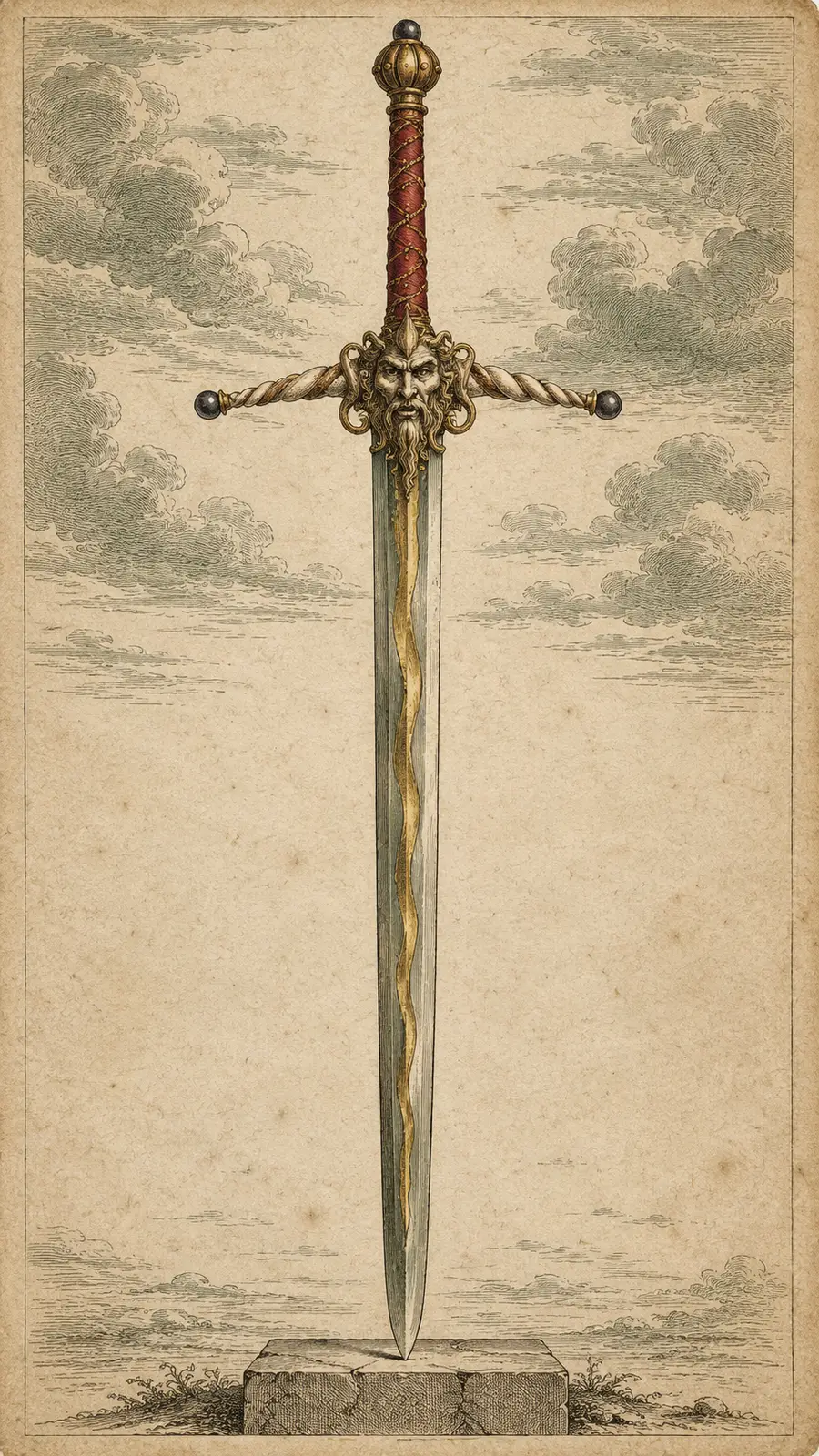
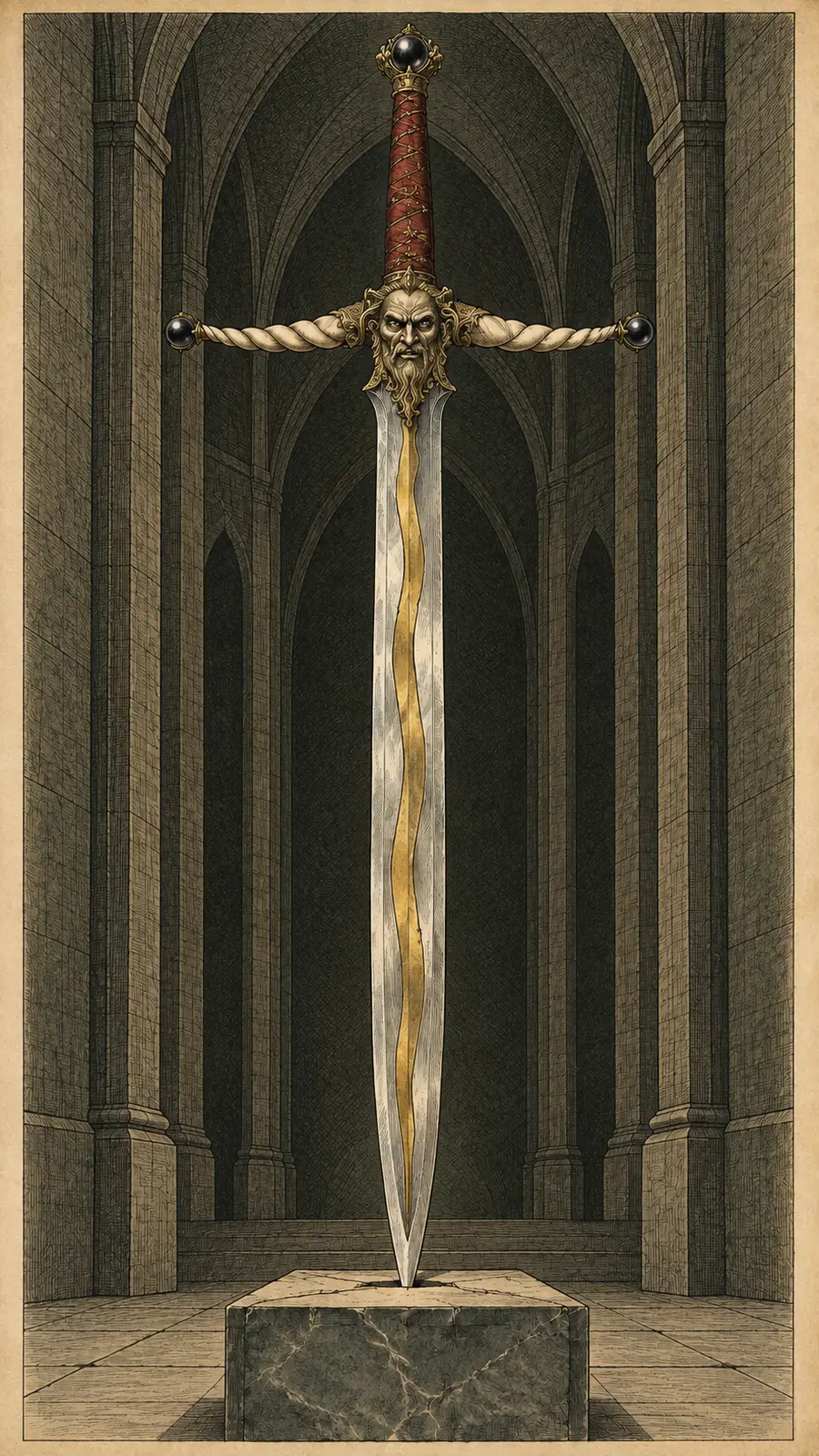
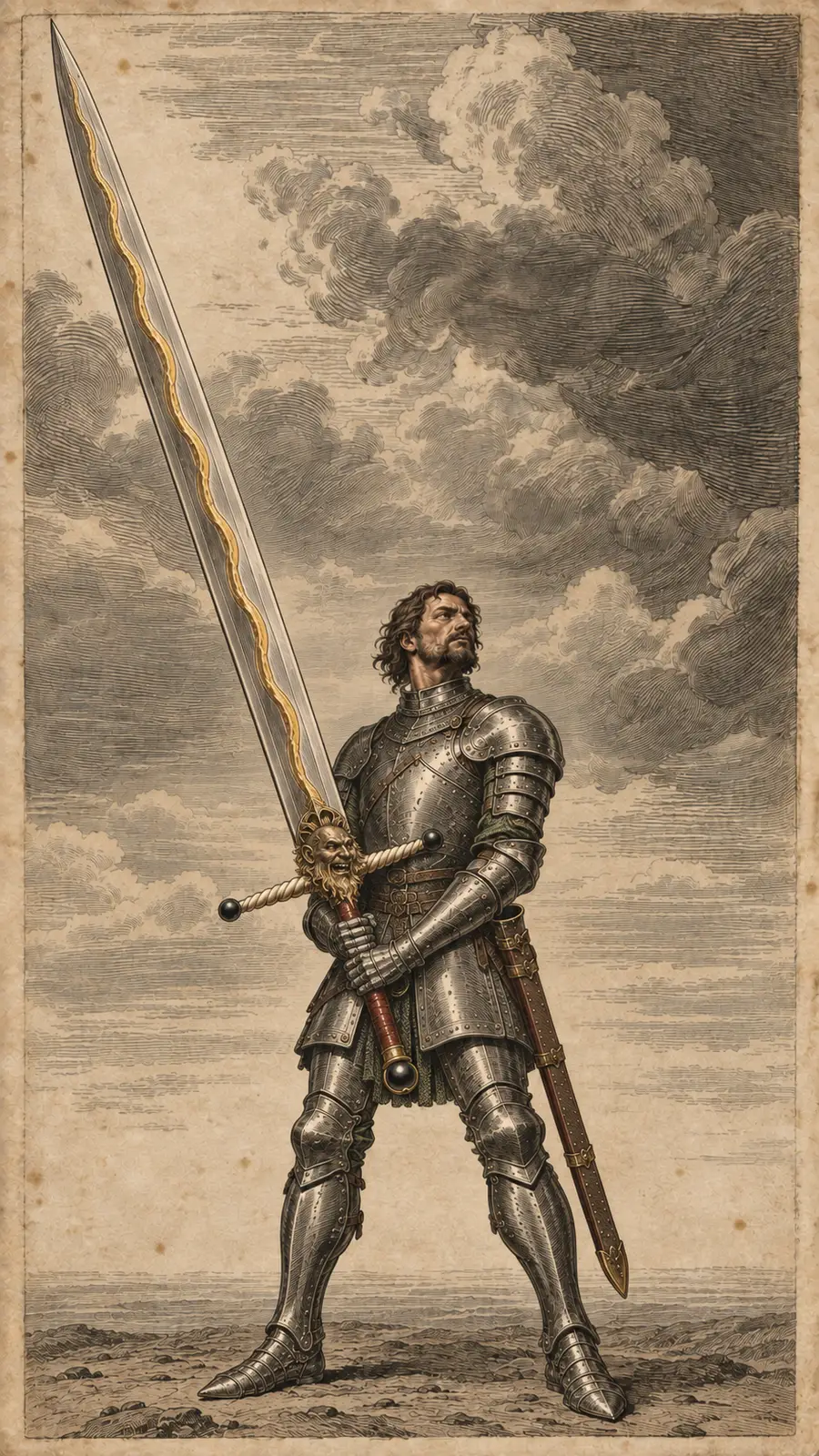
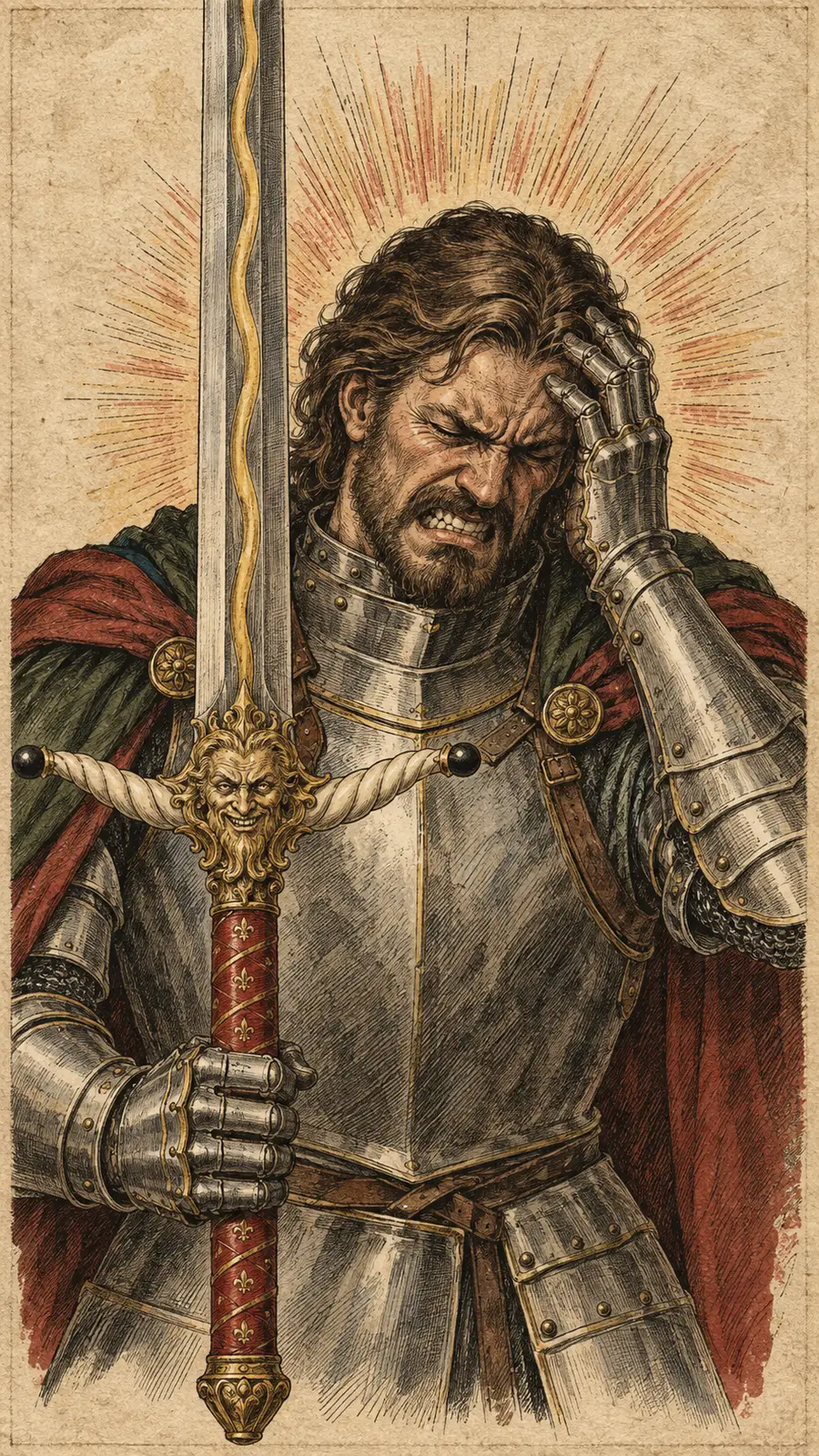
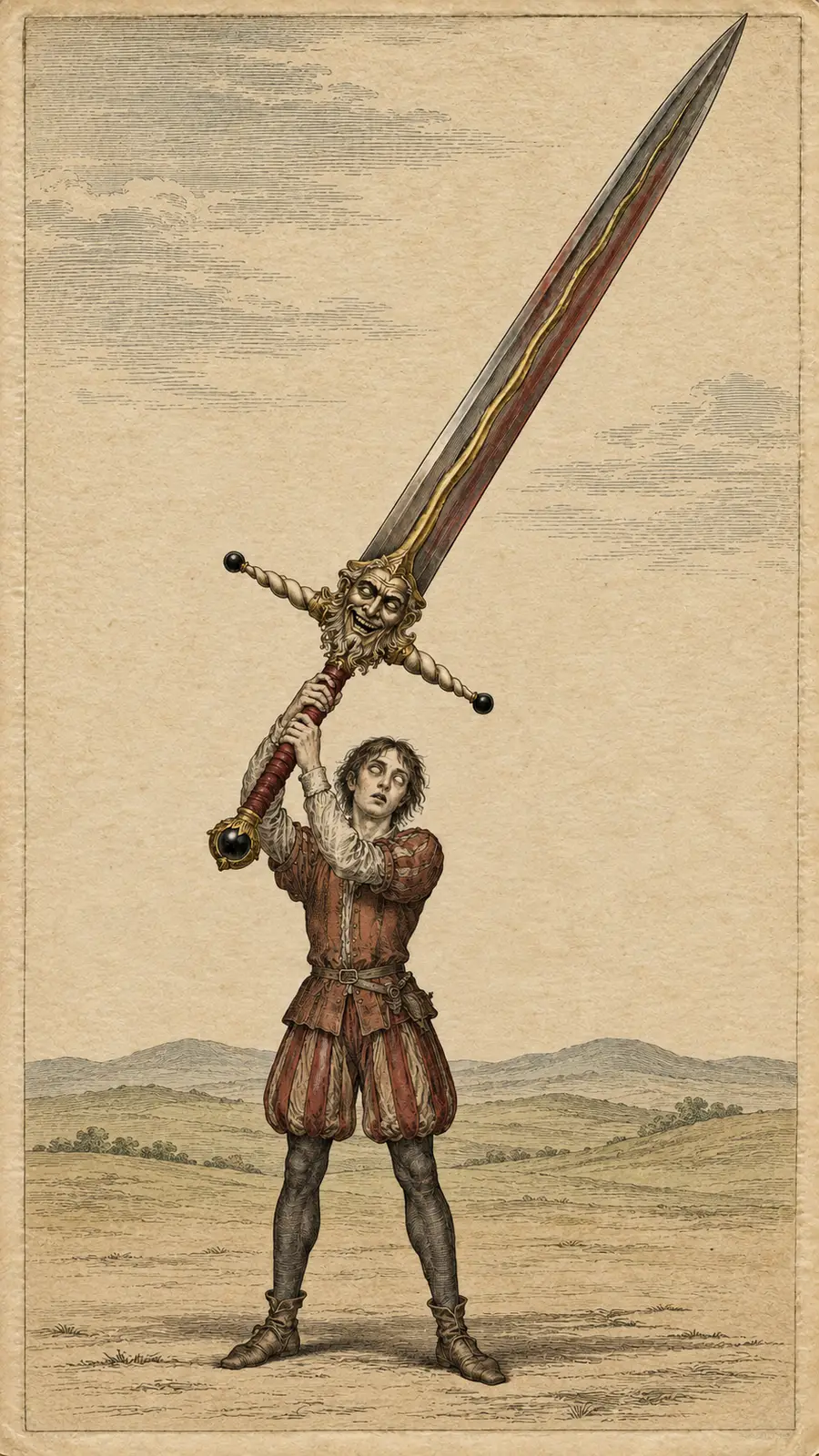
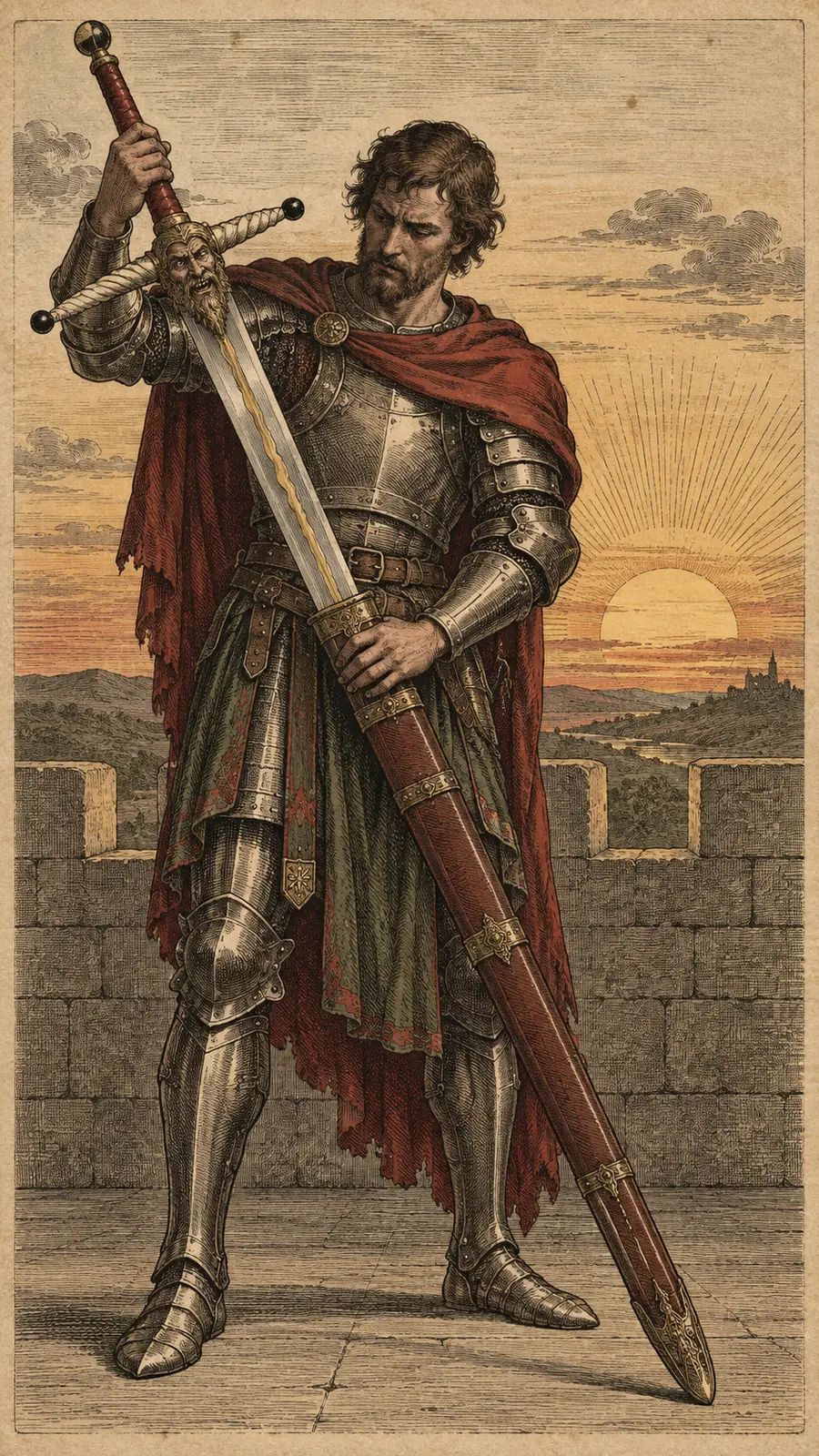
The Book of Artifacts also gave the sword its most vivid appearance in any edition, and it's nothing like the soldier's short sword of 1979. Here the Sword of Kas is a great blade, longer than most men are tall, with a hilt as long as a man's forearm, and yet any warrior can swing it easily in two hands, as if its weight belongs to someone else. A vein of gold runs down the centre of the blade, rippling like a stream of light caught in steel. The grip is wrapped in red leather flecked with gold. The quillons, the narrow arms of the crossguard, are made of unicorn horn, each tipped with a small black pearl. Around the hand, the basket of the hilt is shaped into a face, bearded and leering. So the person who holds the sword closes their fingers inside a grinning face that seems to watch them.
That's a lot to look at, and it says a lot. Unicorn horn is a symbol of purity, here turned into the guard of a murderer's blade. The gold in the steel recalls riches and empire, and the red leather has an obvious meaning. The leering face looks like someone who knows a joke the wielder hasn't heard yet. Over the years, artists and players have kept returning to this sword more than to any other version.
Its powers in this telling show a sword that guards and foresees as well as strikes. It's a defender, a blade that can turn its strength to warding off blows as easily as dealing them. It grants foresight, a sense of danger before danger comes. Holy water nearby is fouled when it's present, as though sanctity can't stand to be close to it. Its bearer can call up a shimmering magical shield and, a few times a day, the strength of a fire giant, which makes the strength-giving of the old blade both literal and enormous. It strikes beings from other planes with double force. Like every artifact in the book it also carries a few random powers of its own, so that no two Swords of Kas need be quite alike.
The book arranged artifact powers in families: constant powers that are always present, invoked powers that the wielder calls on, random powers drawn from tables, curses, and one more category, resonating powers, which wake only when matched pieces come together. For a sword whose whole existence is bound up with a severed hand and a plucked-out eye, that idea fits. The three relics of that night are linked, and bringing them close stirs something in all of them.
What the sword asks in return is described with care. The first touch of its hilt wounds the person who grips it, a painful greeting. The sword can dominate its wielder outright. It must be quenched in blood once a day, and if its owner won't do it, it tries to make them, even if the only blood nearby belongs to a companion. Over time the owner becomes obsessed with finding Vecna's artifacts and destroying them, and Vecna with them. The Book of Artifacts moved curses like these away from simple penalties toward slow stories of possession and change, and the Sword of Kas shows that shift well. The danger isn't really a number on a page. It's the gradual feeling that your goals are no longer quite yours.
Hand and Eye have their own version of this. They slowly turn their user toward evil, until some come to believe they are Vecna. So in this era the three relics corrupt their owners in mirror-image ways. The Hand and Eye make you the lich. The sword makes you the lieutenant, the one whose life is spent hunting the lich. Put them in the same campaign and you may watch two characters slowly turn into the ancient enemies they carry.
One further detail began to gather around the sword in these years and grew stronger in the decades after. Later tellings say that when Vecna forged the blade he put into it a portion of his own consciousness, a small cold shard of the Whispered One's mind. If that's true, the voice that whispered dreams of treachery to Kas was, in a way, Vecna's own voice. The lich was betrayed by a piece of himself. It's hard to imagine a neater punishment for a creature who spent his long life trusting only his own judgement.
So by the early 1990s the legend had its full shape. A lich forged a blade in his own image and gave it to his right hand. The blade whispered, and the right hand rose against its master. The tower fell, and three relics lay in the ruins. All that remained was to say what happened to the man, and the answer would come from the Mists.
Chapter V
The Burning Peaks: Kas the Destroyer in the Mists
, the Demiplane of Dread, is a place made of other places. Lands are torn from their own worlds and bound together in the grey Mists, and each is ruled by a darklord, a villain whose crimes earned that particular prison, shaped around them to give them what they want in a way that never satisfies them. The Dark Powers behind the Mists never speak plainly and never explain themselves. They collect, and in the 1990s they collected the lich and his lieutenant.
The clearest picture of what became of them comes from Domains of Dread, the great Ravenloft sourcebook TSR published in 1997, with Steve Miller among its designers. In the Demiplane's own history, and Kas were drawn into the Mists at about the same time, and with them a new piece of the land came into being, a cluster of two domains known as the Burning Peaks.
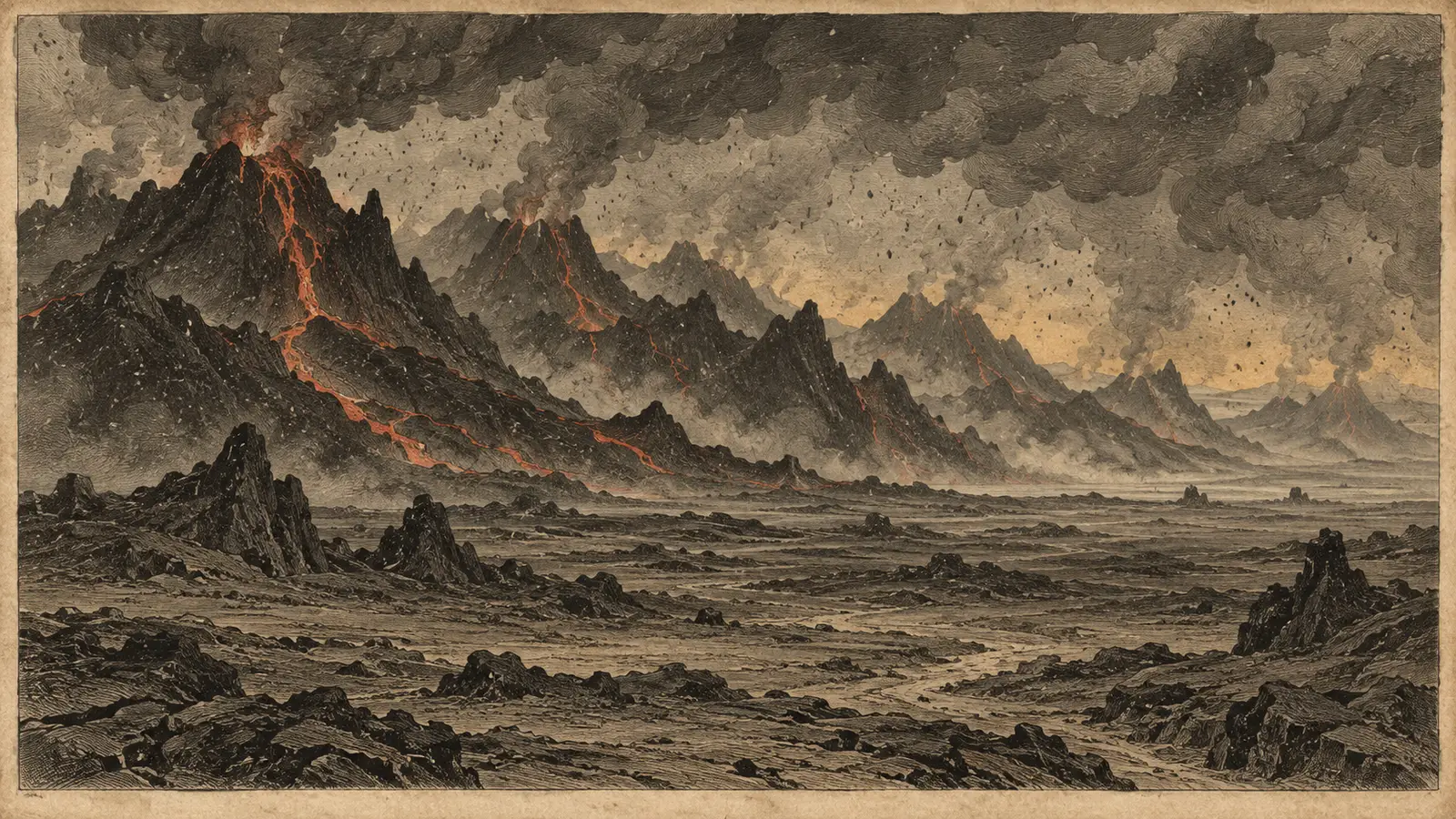
Picture a chain of volcanic mountains, black slopes running with slow fire, smoke hanging low over the summits, and ash drifting down like a dirty snow that never stops. These are the Burning Peaks themselves, a wall of flame and stone, and on either side lies a kingdom ruled by one of the two old enemies.
On one side is , Vecna's domain, a mocking copy of the demiplane he once ruled from beyond the Plane of Ash. It's a land of desert sand and volcanic ash under a twilight that never brightens into day or fades into night. Walking there is tiring in a way that goes past ordinary fatigue, because the land itself drains life from anyone who enters it. In the centre stands a vast citadel shaped like a human skull, a skull-city built around the palace of the Whispered One. The Dark Powers gave the lich a crown and a throne and an endless horizon of ash, and walls he cannot leave.
On the other side of the Burning Peaks lies , the domain of Kas. In the Mists he isn't only Kas the Bloody-Handed. He has a newer title, Kas the Destroyer.
How Kas became a vampire is a part of the legend that has been told two ways. In the history from Vecna Lives!, he was already a vampire while he served the lich, a cold thing at a cold master's side. The Ravenloft tradition tells it differently. In this version Kas was still a living man when he raised his sword against his lord. The force of the battle threw him across the multiverse, and he landed in the Citadel Cavitius on the grey Quasi-elemental Plane of Ash. There, for long ages, he lay close to the Negative Energy Plane, the source of undeath, and slowly, without anyone choosing it, the closeness changed him. The man who walked away from his master's ruin as a living traitor became, over centuries, a vampire. Then the Mists found him and gave him a land.
Either way, the vampire who rules Tovag is no longer the ambitious, flattered lieutenant of the Spidered Throne. He's something lonelier and harder, and his land is shaped around his loss.
Tovag is thickly forested, but the forest isn't healthy. Its trees are sickly and its scrub pines barely survive in the ashen air blowing down off the peaks. You might picture miles of thin, grey-green growth, needles dulled with soot, trunks bent toward a sun that never quite warms them. There's one small irony here that tells you something about the Mists. A stake cut from Tovag's own wood cannot harm its vampire lord. Only wood from his homeland of , the world he left so long ago, has that power. Anyone hoping to destroy Kas the Destroyer would have to bring a piece of his own past across the Mists to do it.
In the north of Tovag stands Kas's fortress. To the south lies the domain's only city, , which became known as the lair of Kas the Destroyer. It's a garrison city in a garrison land, because life in Tovag turns on one fact: war.
The people of Tovag live strange, short lives. They age far faster than they should, and a child of Tovag is grown, in body if not in years, by about nine years old. These child-adults are trained, armed and drafted into the armies of their lord, so the domain is a kind of endless recruiting ground. Generation follows generation at a pace no ordinary kingdom could match, and each one marches off to the same war. Kas rules his ashen wasteland with an iron fist. Across the peaks the dead of Cavitius are always ready, and the people of Tovag are born, raised and spent in the struggle against them.
The heart of Tovag, the thing that makes it a prison, is the sword. Kas the Destroyer believes that the Sword of Kas, his blade, the blade that made him and unmade his master, lies in Vecna's citadel. He believes the lich keeps it there and taunts him with it. So he wages an endless war of attrition to win it back. He sends his legions into the Mists, certain that Vecna is just beyond the edge of his domain, a short march away. The legions don't come back. The Mists swallow them, as the Mists always do. Kas rages, then begins again. He raises new armies from his fast-growing people and sends them out after the old ones. For him, the war with the Whispered One is still being fought, still close to being won and always about to be won.
He's wrong about where his sword is. That's the cruelty of a Ravenloft curse. The thing he wants most isn't where he believes it is, and so his war can't succeed. He's spending the lives of his people on an ancient mistake, and he doesn't know it.
There's more to this sorrow, because something is in Vecna's citadel that looks like the Sword of Kas. The Church of Vecna, the lich's faithful who still serve him even in the Mists, obtained a replica of the blade, a false Sword of Kas, and carried it into the Citadel Cavitius. The real sword, as the Ravenloft lore remembers it, is an enchanted short sword Vecna made for his lieutenant, the blade that drove Kas to betray him. The false one is only a copy, but it's held by someone who matters.
In the god's palace in Cavitius serves a death knight, an undead warrior bound by some old failure into service beyond death. He calls himself Kas the Bloody-Handed, and he believes it. He's convinced that he's the real Kas. His true name has never been given. He serves Vecna loyally, and his purpose in that grim palace is to make up for "his" betrayal of his master all those centuries ago.
Think about the two figures on either side of the Burning Peaks. In Tovag, the real Kas, the traitor, still at war with his master and still hungry for his sword, spends generations of his people on a blade that isn't where he thinks. In Cavitius, a false Kas who never betrayed anyone kneels before Vecna, holding a false sword, trying to atone for a crime he never committed. One is a traitor who won't stop fighting. The other is a penitent who has nothing to repent. The Dark Powers seem to have set them up as reflections of each other, and neither can see the reflection.
Vecna has his own torment. The lich who once reached for godhood rules a skull-shaped citadel in a land of ash, a god, by now, but a god inside a cage. Every army Kas sends into the Mists is a reminder that his old lieutenant still hates him. His prison stands across the mountains from the man who took his hand and eye, and he can't reach him either. The Burning Peaks are aptly named. The fire between them never goes out.
Ravenloft was patient with the cluster it had made, and before the decade ended, heroes would find their way into it, first into Tovag, then into the skull-city at the heart of Cavitius.
Chapter VI
Vecna Reborn, Die Vecna Die! and the doors between worlds
In 1998, Monte Cook wrote Vecna Reborn, a adventure for heroes of middling experience, much less seasoned than those who had faced the demigod in 1990. The they meet is now a god but still held by the Mists, ruling from while he plans his escape and his revenge on Kas the Destroyer, his traitorous lieutenant.
Pulled into the Demiplane of Dread, as visitors to Ravenloft always seem to be, the heroes come out of the Mists in . Imagine arriving there: sickly forest, ash in the air, soldiers who look too young for their armour and old beyond their years. Over everything hangs the war with the land beyond the mountains. The heroes are caught between two tyrannies, each ruling frightened subjects, and neither is the kind of power anyone sensible would want to serve.
The trouble is in . In the shadow of Kas's own lair, the Cult of Vecna has been working. Their plan is to bring their god back to life outside his own domain, a ritual that would break the curse that holds him in Cavitius. The ritual centres on a mother-to-be, and on the child she carries, through whom the cult hopes to free their lord. It's a sad, quiet thread in a grim place, and the heroes have to unravel it. In Tor Gorak there's a store of ancient lore, and by studying it the heroes follow its clues through the war-torn domain and over the mountains into the heart of Cavitius itself. Along the way, in the logic of a land where the enemy of your enemy is the only friend on offer, they may find themselves on Kas's side against the god he betrayed. It's an uneasy alliance with a creature whose people are drafted as children, but in Ravenloft one rarely chooses between a good master and a bad one.
Two years later came the last great story of the second edition era. In June 2000, Bruce R. and Steve Miller published Die Vecna Die!, an adventure for powerful heroes that crossed three settings in its three parts: Greyhawk, Ravenloft and the planar city of . It was the closing act of the game's second edition, and it rearranged the planes before the third edition arrived.
The story starts back on . A fighter called the Cruel takes up the Hand and Eye of Vecna, and with their power he hunts the Circle of Eight and kills them all except . The hand and eye cut away by the Sword of Kas long ago are now cutting down the greatest wizards of the age. Then a figure who has been travelling as a companion reveals what he really is, an avatar of Vecna, and kills Halmadar and takes back the relics. Meanwhile, in his northern realm, Iuz learns that Vecna's cult is opening portals at again. The ring of standing stones from 1990 is waking up.
In the second part, Vecna himself sends the heroes through a portal into Cavitius, his prison. There, in the land of ash and twilight, they find Kas. The sword does what it did a decade earlier. Kas uses its power to carry everyone back out of Cavitius to the stones of Tovag Baragu. Whatever else changes in his story, the blade remembers the way home.
Then the heroes call on Iuz to fight Vecna, which turns out to be exactly what Vecna wanted. His real plan was to absorb Iuz's power and become a greater god, too mighty for the Dark Powers to hold. Iuz walked into it thinking he could turn Vecna's ritual to his own use and steal the other god's power. Through a portal from Oerth he invaded Cavitius, and there Vecna devoured him. The Whispered One became fully divine. No longer bound by the Mists, he tunnelled through the fabric of Ravenloft and came out in Sigil, the City of Doors, the city at the centre of the planes.
In the third part, Vecna stands in the streets of Sigil and does something nobody had done. He meets the Lady of Pain, the silent, bladed guardian of the city, the one power that even gods avoid, and fights her to a standstill. Then he begins to unravel reality, aiming to remake all existence in his own image. The heroes, at the last, drive Vecna and the swallowed Iuz together through a random portal, and the god is cast out of Sigil. The adventure closes with a quiet remark that the planes had been changed by his passage in ways that could never be fully undone. Some of the Outer Planes drifted away and were lost for good.
The Sword of Kas plays only a small part in that enormous story. It's the key that opens the way out of Cavitius, held by a traitor who has his own reasons for helping. Still, the whole affair depends on it. If Kas and his sword hadn't been in the ash-land, the heroes could never have stepped back onto the plains of Oerth and called down the god who swallowed another god.
There's one more thing that tends to happen to a cluster of domains when its darklord escapes. In 2006, an article in Dragon magazine looked back at the Burning Peaks and told what became of them. When Vecna broke out of Cavitius, both of its domains were destroyed. The skull-city and the ash desert collapsed, and so did Tovag, with its sickly forest and its child soldiers and its fortress in the north. Kas was caught in the ruin and nearly wiped from existence.
He didn't quite vanish. He survived as a vestige. In the later third edition years, vestiges were a strange category of being, souls and fragments of power that had fallen outside time and space and no longer belonged to any plane or any afterlife. A kind of pact-making magician called a binder could reach out to them and borrow their power for a little while. So Kas the Bloody-Handed, Kas the Destroyer, who once sat in Vecna's place and ruled half an empire, became for a time an echo at the edge of everything, a voice a binder might call up and then dismiss. It's a remarkable image: the man reduced to an echo, while his sword, somewhere in the world, stayed solid and sharp and patient.
Kas wouldn't stay an echo forever. Before we follow his return, there's a smaller, stranger book to stop at, published in the same years: a single graphic novel that told the siege of with ink and colour, and remembered the betrayal differently.
Chapter VII
A siege in ink: Hand of the Revenant
Kas never appeared in Greyhawk's prose novels. Gary 's tales of Gord the Rogue, from the mid-1980s, follow their own thieves and demons, and the short line of Greyhawk novels around the turn of the century went other ways. The closest the lich and his lieutenant came to fiction in those years was a graphic novel. Vecna: Hand of the Revenant appeared in 2002 from Iron Hammer Graphics, written by Modi and drawn by Kevin McCann.
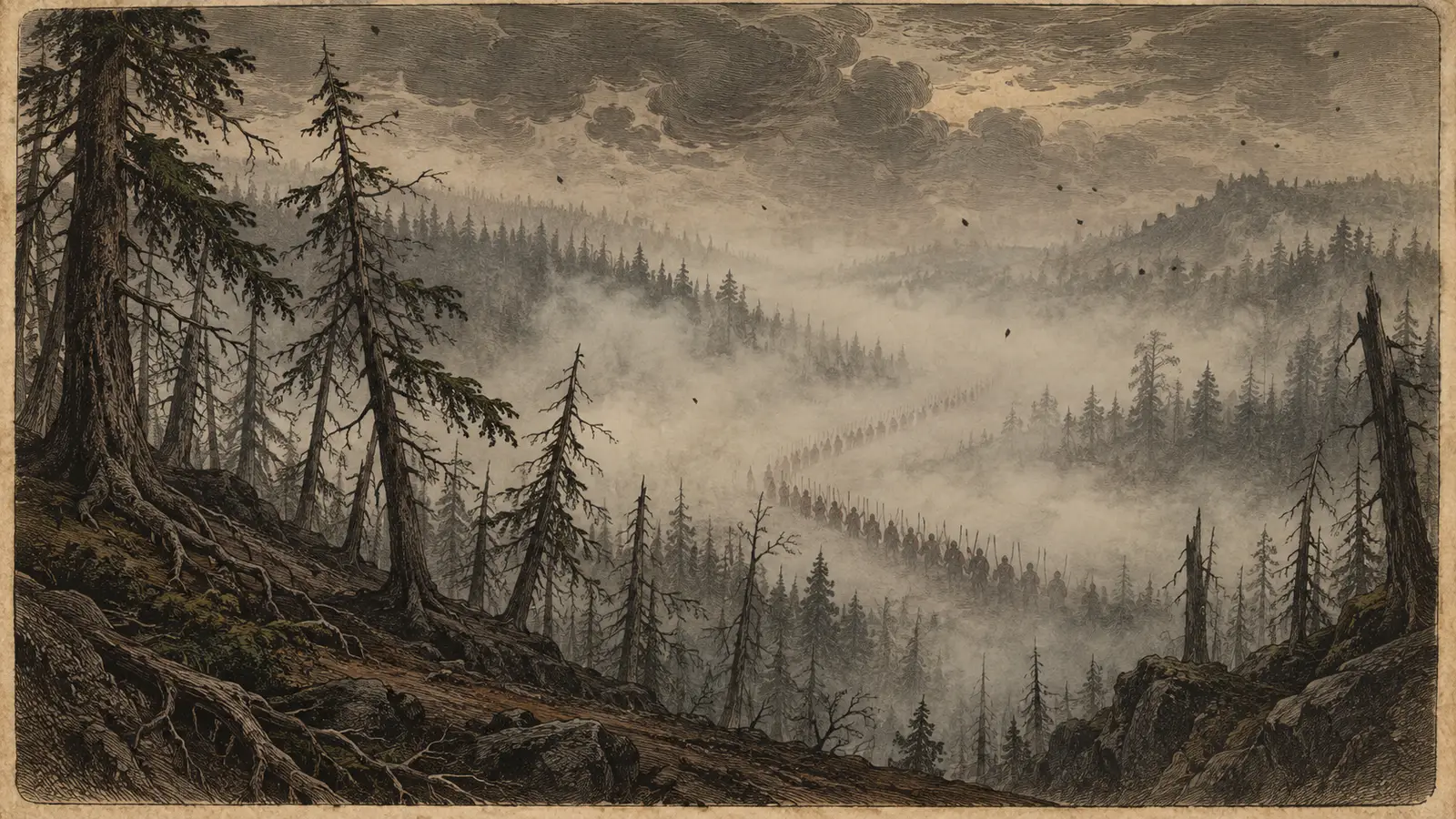
Its story is the siege of . 's army stands before the walls of the city where he was born. Across the pages, the present siege is interleaved with flashbacks to his childhood within those walls about nine centuries earlier: the boy of the lowest caste and his mother, , evil and yet loving, and her death. He has come back to destroy the city of his youth, and the book doesn't look away from why. The cast is small and memorable. Vecna is there, with Mazzel in memory, and Kas stands at the lich's side as the lieutenant he was meant to be. is there too, the figure who in later tellings learned at Vecna's side and who would one day build the deathtrap in the Vast Swamp that we walked through on an earlier evening. A figure called the Serpent rounds out the cast.
What sets the book apart, and why it belongs in this evening's story, is a change to the ending everyone knew. In Hand of the Revenant, Vecna doesn't lose his hand and eye to Kas. He loses them to holy energy, the power of Fleeth's clergy turned against him at the walls of his birthplace. In this one telling the Sword of Kas doesn't do the cutting, and the faithful of the city he came to destroy do.
The book was billed on its title page as the first of a planned six, and it ended on a cliffhanger. No second book came. So the story stops partway, and most who know the legend treat it as a beautiful aside rather than the true account. In this telling Vecna loses his hand and eye to the clergy's holy power, and Kas's sword is still in its scabbard at his side, its whispers still to come.
Meanwhile, the great rulebooks of the game had moved into a new century, and the sword was about to become sharper than ever.
Chapter VIII
Third edition: the vorpal blade and a sword that wins every argument
In 2000, Dungeons & Dragons began its third edition. The new Dungeon Master's Guide, from Monte Cook, with Jonathan Tweet and Skip Williams completing the core trio of designers, carried an artifacts section, and the Sword of Kas was there, as it had been in every version of the core rules since 1979. A revised edition of the guide followed in 2003. It sorted artifacts into two orders, minor and major. Minor artifacts might exist in more than one copy. Major artifacts are unique, each one in all the world, and each can be destroyed only by one particular means. The Sword of Kas was a major artifact. There's only one.
In this era the sword was a longsword again, plainer in shape than the leering, unicorn-hilted monster of 1993, but deadlier than it had ever been. It was unholy, a blade that bit hardest into the good. It was keen, finding the gaps in armour and the soft places in flesh more often than any ordinary edge could, and it was vorpal, the old storybook kind of sword that can take a head off with a single sweep. It lent its bearer enormous strength, as it always had, an echo of the very first lines written about it in 1976.
It could still call lightning from the storm clouds overhead. In this telling it gained darker spells as well. Once each day it could speak a word of blasphemy that staggers and slays the righteous, and it could cast unhallow, turning the ground around it to unholy earth, a place where evil walks easier and the dead rest uneasily. Once a week it could bring death outright with a spell that simply stops a living heart.
Its mind was clearer than ever, chaotic and evil, sharp of wit and persuasive in speech. Its will was overwhelming. Every intelligent weapon has a will that can contest its wielder's, and this one's will was so great that it almost always won. In older days the sword had hidden the strength of its mind until a confrontation with drew near. In third edition it didn't need to hide anything. Anyone who wanted to master it had to win an argument with it, and the sword was nearly certain to win that argument, especially when its holder wanted something it didn't. You held the Sword of Kas in this era the way you might hold a leash attached to something much larger than yourself.
The lore of the era kept the sword's purpose fixed. It hated Vecna, and it wanted vengeance on him and on those who served him. The old story of the gift remained, and the whispers inside the sword were the whispers of its maker. Vecna forged it, and a portion of his consciousness lay within it, and that piece of his evil talked Kas into murdering his master and taking his power. In the battle that followed, Kas struck off the lich's left hand, and the sword was driven into his left eye. So in this telling the blade is the direct origin of both relics: the hand that fell away from its edge and the eye that its point destroyed.
The question of when Kas became a vampire gained a third answer in these years. In one telling from this era and after, Vecna himself turned Kas, whom the stories call a loathsome man, into a greater vampire before forging the sword for him. The lich made his lieutenant undead first, then armed him. So the legend now told Kas's turning three ways: a vampire already in the old histories of the Spidered Throne, a vampire made by Vecna's own hand before the gift, or a living traitor slowly changed by centuries in the Citadel . Each version keeps something true about him. He was always going to end up cold.
In 2002, Deities and Demigods set out the gods of the third edition's default pantheon, and Vecna was among them, the god of secrets, still missing his left hand and his left eye even in divinity. The god carried the old injury into his new existence as a permanent scar. The outline of the betrayal stayed the same.
That same year Monte Cook wrote the Book of Vile Darkness, a study of evil in all its forms and the first Dungeons & Dragons book labelled for mature readers. Its link to the sword runs through Vecna. In the lore, the Book of Vile Darkness is also an artifact in its own right, a dreadful tome of black magic, evil gods and forbidden secrets, and Vecna helped develop it. Some later accounts name him as one of its authors. His cult prizes its copies. So among Vecna's legacies there's a book he helped write as well as a sword he forged. Both have a habit of leading their readers and bearers into the darkest corners of themselves.
As the third edition years went on, the cosmology of the game itself began to shift. The next edition would redraw the map of the planes, and in the new map the sword would gain a new kind of hunger.
Chapter IX
Fourth edition: the hidden blade and the art of betrayal
When the fourth edition arrived in 2008, it reshaped the universe of the game. The old wheel of outer planes gave way to new realms: the , a dim reflection of the world where the dead pass on, the , its bright and dangerous twin, the Astral Sea, where the gods keep their dominions, and the Elemental Chaos, churning far below. Over the dead in the Shadowfell ruled a newer goddess, the Raven Queen, cool, aloof and stern, who guides souls onward and frowns on any creature that tries to cheat death. The Dungeon Master's Guide of that year listed among the gods, chiefly as the god of secrets.
In the new cosmos, Vecna had several enemies in the realm of death and undeath. Kas was one. , the demon prince of the undead, his old teacher in some tellings, was another. The Raven Queen herself was a third. Of these, Vecna would still rather the Raven Queen rule the dead than Orcus. A god of secrets has his preferences, and a calm, orderly mistress of the dead is easier to plan around than a demon who wants to swallow everything.
The sword's great appearance in this edition came in January 2009, in Open Grave: Secrets of the Undead, a book about the dead who will not rest. Its lead designers were Bruce R. , who had helped write Die Vecna Die! nine years earlier, with Bernstein and Brian James. Wizards of the Coast released the sword's entry ahead of the book as part of an official preview.
Open Grave tells the legend in few words with a bitter edge. Vecna made the sword for his lieutenant Kas. Kas rewarded his former master by using it to cut off his hand and gouge out his eye. Then the book sums up the sword in a single idea that became the heart of its fourth edition self: the blade grants great power to whoever holds it, but those who wield it end up betraying what they love most.
In this telling the sword was a short sword again, as it had been in 1979, and it was made for the greatest heroes, those who had reached the epic heights of their careers. What set this version apart is how directly its powers express its nature. For the first time, the sword's love of betrayal was built into how it fought.
Start with what you'd see, or rather wouldn't. At first, only the person who carries the Sword of Kas can see it. To everyone else, its bearer seems to stand empty-handed. In battle, that gives the wielder the edge over any enemy within reach, because nobody can guard against a blade they can't see. Then the first blow lands, and the sword becomes visible to all. It reveals itself only after it has already drawn blood. Picture a duellist facing an apparently unarmed foe, and then the sudden glint of steel after the cut is already made.
When a strike from the sword fells an enemy, the wielder slips into concealment, harder to see and harder to target, as if the killing blow wrapped them in shadow. When the wielder steps back to defend themselves, or draws a second breath to steady themselves in the middle of a fight, the sword strengthens all their defences at once. It's a blade of ambush, retreat and patient readiness, the tools an assassin uses.
Then there's the sword's appetite for faithlessness. It strikes with terrible extra force against allies and former allies of its wielder. Of all the creatures in the world, the ones it most wants to hurt are those its bearer once trusted, or who once trusted its bearer. It also strikes hard at Vecna, at his servants and cultists, and at any creature working directly toward his ends. The hatred of its maker is still there, sitting beside a broader hatred of loyalty itself.
Once each day, the sword can deliver a lingering poison, a wound that keeps burning long after the cut. Against the undead, that poison becomes radiant, burning like sunlight. There's a strange echo in this: a vampire's blade, made by a lich, that scorches the dead with light. Perhaps the sword hates what its maker and its master both became.
Open Grave also gave the sword a will expressed as goals, and these read almost like a creed. It wants to betray whatever is most fiercely loved, whether its owner loves it or someone else does. It wants to harm Vecna, his plans and his creatures. And it wants to destroy all confidences, to reveal every secret and to lay bare everything kept hidden. That last goal is pointed. Vecna is the god of secrets, and the sword he made has become the enemy of secrets. It wants every whisper spoken aloud.
The book describes its manner too. It can stay silent for long stretches. Then it's quick to point out small opportunities for betrayal, especially ones that would raise its wielder's standing in the short term. A little lie here, a broken promise there, a friend's confidence passed to the right ear. It tempts in dreams. As its bond with its wielder weakens, it grows more insulting and more acerbic.
That bond was something the fourth edition gave every artifact, a measure called concordance. An artifact's mood toward its wielder rises and falls as the wielder serves or neglects its goals, and in the end every artifact moves on, slipping away to find a new bearer. With the Sword of Kas, the moving on has a dark twist. If the sword finds a wielder who pleases it again and again, one who betrays and betrays and keeps betraying, it may stay with that wielder for as long as they like. Most artifacts leave in the end. The Sword of Kas stays with whoever keeps betraying for it.
Open Grave also gave Kas himself a new body. Here he's a human vampire, a creature of terrible might, fit to face epic heroes alone. In this telling his betrayal has a sharper timing. He struck at Vecna on the eve of Vecna's apotheosis, the night before the lich was to become a god, hoping to become a god in his master's place. The old story of a cut-short first try at godhood becomes a moment of stolen divinity.
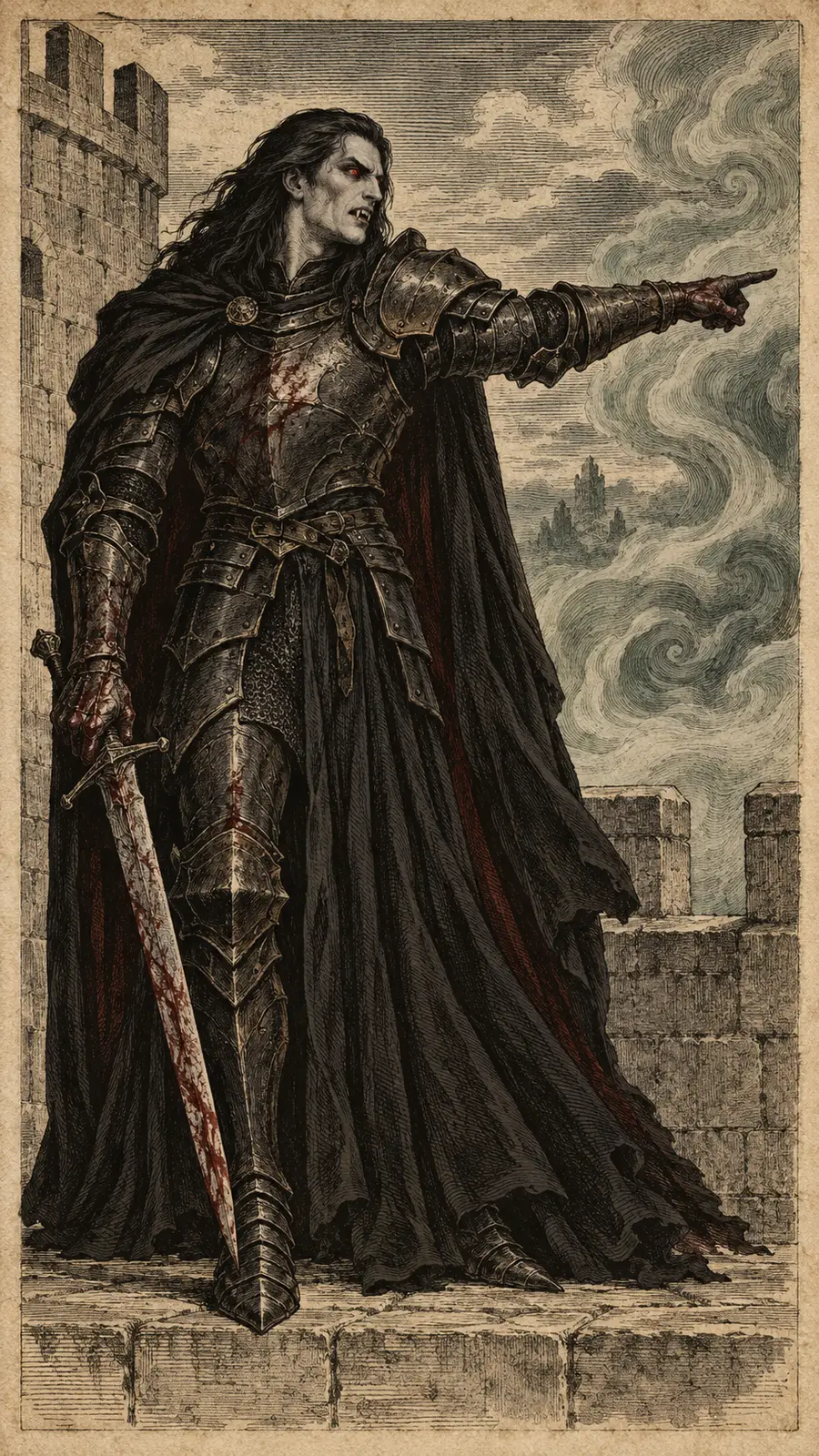
Interestingly, the Kas of Open Grave doesn't fight with a short sword. He swings a bastard sword, a heavier blade for one hand or two. The sword that bears his name isn't in his grip, which fits a man whose blade is always somewhere else. His powers tell you what kind of foe he is. He drains blood from enemies he catches off guard. He strikes blows that fill hearts with terror, and he has a dominating gaze, the vampire's old trick of bending wills with a look. His signature attack is a whirling sweep of steel through everyone around him, friend or foe, called the Betrayer's Whirlwind. His body knits its wounds closed, but not in the light of the sun. Radiance burns him, while fire and the cold force of death wash over him with little effect. Even the art had a borrowed quality. His portrait in the book was a picture first painted for a different vampire, a figure called the Black Duke, as though even his face had been taken from someone else.
The same book gave Vecna a fourth edition form and named his mightiest servant, , the Bronze Lich. With her alongside him, the god of secrets had a lieutenant again. Whether he trusted her more than he once trusted Kas, the book wisely leaves for players to wonder.
After the fourth edition, the game simplified and settled into the edition that would reach more players than any before it, and in that edition the sword would be given its most lasting words.
Chapter X
Fifth edition: a fallen paladin and the sword in the guide
The fifth edition Dungeon Master's Guide, published in 2014, gathered the old legend into a compact story that many players today know best. As grew in power, it says, he appointed an evil and ruthless lieutenant, Kas the Bloody Handed, as his bodyguard and right hand. Kas served as adviser, warlord and assassin. His successes earned Vecna's admiration and a reward: in the guide's words, a sword with as dark a pedigree as the man who would wield it.
For a long time Kas served the lich faithfully. As his power grew, so did his hubris. The sword urged him to supplant Vecna, so that the two of them could rule the lich's empire together. It's a small word, "they," but it matters. The sword didn't picture itself as Kas's tool, carrying him to the throne. It pictured itself sitting beside him there, a co-ruler. Its ambition was its own.
The guide ends with the betrayal, and with a turn that older versions hadn't quite stated. Legend says, it notes, that Vecna's destruction came at Kas's hand. But Vecna also brought about his rebellious lieutenant's doom, leaving only Kas's sword behind. The lieutenant fell along with the lich, and the sword was what was left of him.
In this edition the Sword of Kas is a sentient longsword, and only someone who has bonded with it through attunement can call on its full power. It strikes truer and harder than ordinary steel, it finds its way to deadly blows more often than most, and it deals a fearful extra wound to the undead. Think about who its maker is and what its master became, and that last power is a bitter joke. The blade that was forged by a lich and carried by a vampire is the bane of the walking dead.
It still has that strange guarding quality that runs back through its long history. While it's carried, a spirit lives in it, the spirit of Kas, as the book calls it, and that spirit lends its bearer a fierce readiness for battle, a sharper start in every fight. When the bearer strikes with it, they may choose to turn some or all of its fury into defence instead, the blade weaving a guard around them as they swing. Once each day, it can call lightning from the sky, an old power returning from the very first lines of 1976, and it can speak a divine word that strikes down the weak, and it can cast finger of death, the spell that withers life with a gesture. In the 2014 version it also carries random gifts and random curses, one small and one great of each, a quiet salute to the old tables of the 1970s.
Its mind is chaotic and evil. It hears, and sees in darkness far beyond torchlight, and speaks to its wielder without sound, in thought, and can speak and read the common tongue. Its purpose is the oldest one: to bring ruin to Vecna. Killing Vecna's worshippers, destroying the lich's works and foiling his plans all serve that purpose. And it hunts anyone corrupted by the Eye and Hand of Vecna. In the guide's words, its obsession with those artifacts eventually becomes a fixation for its wielder.
Then there's the blood. If the sword is drawn and not bathed in blood within a minute, it turns on its wielder. A strong-willed bearer resists, and feels the sword's displeasure as a searing pain in the mind. A weaker one is dominated outright, their will set aside as the sword takes control and demands blood. So the Sword of Kas can never be drawn lightly. You can't draw it to make a point, or to frighten a bandit, or to look impressive on a parapet at sunset. Every time it leaves the scabbard it means to cut something.
The guide also set down how the relics of that ancient night can be unmade, and its answer shows how closely the three are bound together. A creature attuned to both the Eye and the Hand of Vecna can use the great wish those two relics grant together to try to destroy the sword, and must then win a contest of wills against it. If the sword loses, it's gone. And the reverse: if a creature bearing both the Eye and the Hand is slain by the Sword of Kas, the eye and hand burst into flame, crumble to ash and are destroyed forever. Nothing else in the world will do. The three relics left over from that betrayal can only unmake one another.
Seven years later, in 2021, Van Richten's Guide to Ravenloft brought the Mists back to the fore and named Kas once more, a vampire and the darklord of the domain of . Whatever had become of the ruined Burning Peaks and the vestige at the edge of time, the Mists had found their prisoner again.
Kas was gathering himself. In 2024, in the game's fiftieth anniversary year, he would step back into the light, and the story told about him was the largest he'd ever been given.
Chapter XI
Eve of Ruin: the betrayer returns
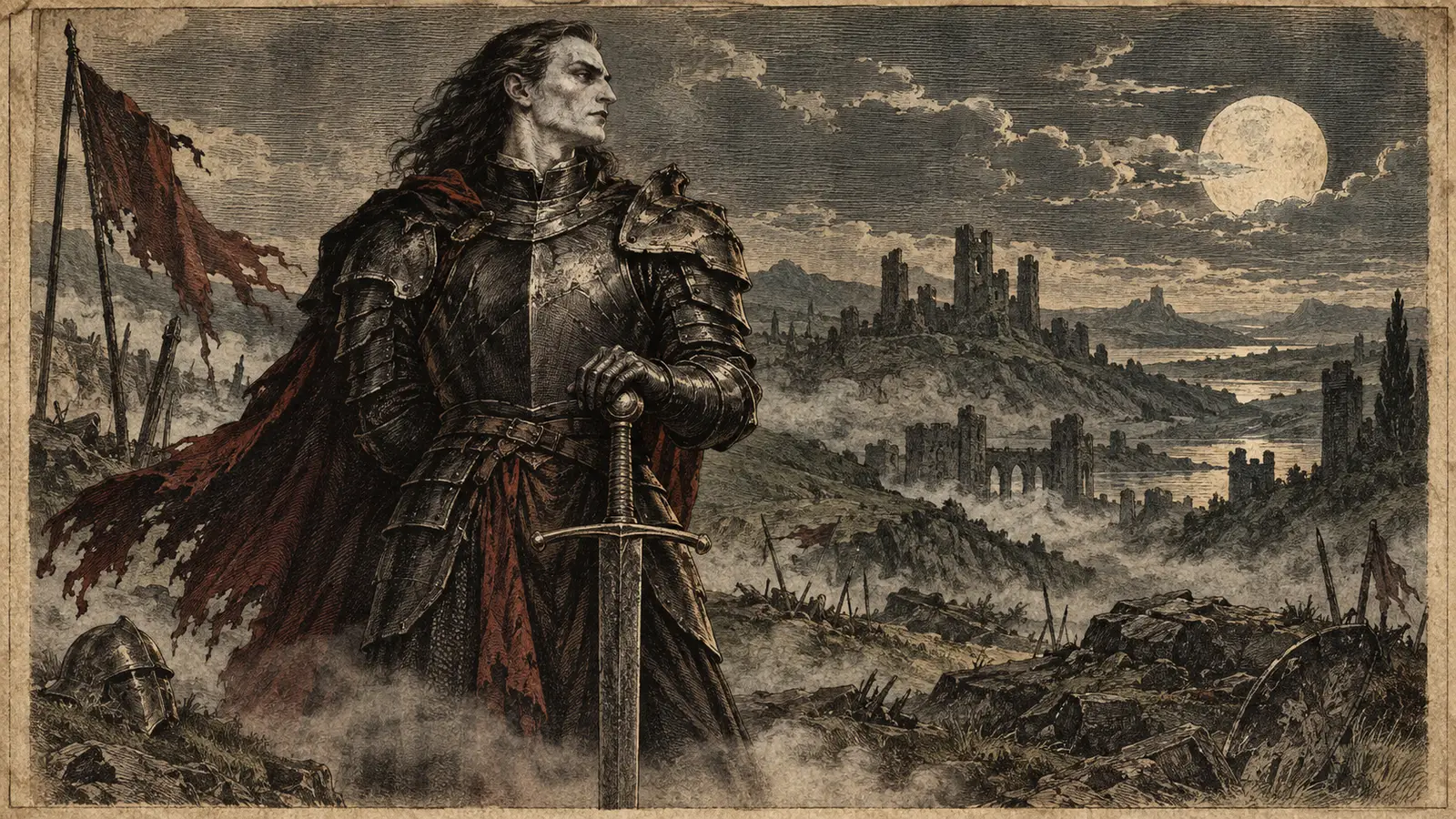
In May 2024, Wizards of the Coast published Vecna: Eve of Ruin, a great campaign that crosses the multiverse, written with Amanda Hamon as lead designer and Makenzie , Ron and Patrick Renie as additional designers. It takes heroes from the middle of their careers to the edge of legend. is its villain, and Kas stands at the centre of its twist.
Around the release, Wizards of the Coast's own retelling of the legend gave Kas a past he'd rarely had. He began, it said, as a paladin, a holy warrior sworn to an oath, who fell. In the stories that gather around him in these years he has a homeland too, the land of on , the region that would later be called . Little is known of his early days. Some say he had already forsaken his oaths before he ever met Vecna, driven by a thirst for battle and blood that nothing could satisfy. So the man who would become the most infamous traitor in the history of the may have betrayed his first vows long before he betrayed his master. A fallen paladin, a breaker of oaths, rose through Vecna's armies as the lich set out to conquer Oerth. His cruelty, his malice and, at first, his loyalty led Vecna to make him regent of his forces. When the lich turned his gaze outward toward the wider multiverse, it was Kas who carried out his will across the kingdom.
To mark that authority, Vecna forged him a sword as ruthless and cruel as its master. It was said that as long as Kas held it, he couldn't be beaten in battle. And without Vecna's knowledge, the blade urged Kas to overthrow his lord, which led to the legendary betrayal at Vecna's fortress, where both were defeated and all that remained were the Eye, the Hand and the Sword. The book gives Kas one more name to add to the long list he's collected: Kas the Betrayer, alongside Kas the Terrible, Kas the Hateful and all the rest.
The present-day Kas of Eve of Ruin is a vampire and the darklord of , which now lies among the Domains of Dread in the . He's as much a prisoner there as any of the people the Mists drag in. Fuelled by his hatred of Vecna, he still musters army after army and sends them into the Mists, still believing his enemy waits just beyond the edge of his land. The old curse of the Burning Peaks hasn't changed. Only the map around it has.
Meanwhile Vecna, now a god in full, prepares something terrible: the Ritual of Remaking. Drawing on the power of secrets and on his godlike magic, he means to unmake the multiverse and remake it in his own image. Every world, every plane, every soul would be reshaped to suit the Whispered One.
Three of the greatest wizards of the multiverse rise to stop him: of the Forgotten Realms, , the witch queen known across many worlds, and , the old archmage of Greyhawk. They send the heroes on a search for the one tool that might stop the ritual, the Rod of Seven Parts. It's an artifact first written in the same supplement that gave the world the Sword of Kas, made in ancient times by the Wind Dukes of Aaqa to imprison the demon lord the Wolf-Spider, and long since shattered into seven pieces scattered across existence. The search takes the heroes through the Forgotten Realms and Planescape's , through the starry voids of and the cities of , through and Dragonlance, and home at last to Greyhawk, a journey through nearly every world the game has built over fifty years.
Here's the twist. The Mordenkainen who sends the heroes on their way, who claims to have researched the rod and even finds the first piece himself, isn't Mordenkainen at all. The real archmage has been missing. In his place, at the Sanctum in Sigil, sits Kas.
How did he get free? The Dark Powers, the unseen masters of the Mists, whispered to him that his old enemy had returned. They bargained with him, and they let him go. Kas believes he escaped on his own, through his own strength and cunning. He doesn't know that the Dark Powers wanted him out, and that his freedom is a move in their own game. So the lieutenant who once listened to a whispering sword has listened to whispers again, and once again believes the ambition is his own.
His plan is as large as his grudge. He means to use the Rod of Seven Parts to free Miska the Wolf-Spider, a demon lord to help him destroy Vecna, and then to seize Vecna's Ritual of Remaking at the last moment before it completes, so that reality is remade in the image of Kas instead of Vecna. The old dream of the sword, that the lieutenant should take the master's place, has grown to the size of the multiverse.
The heroes begin to sense something wrong only late in the story. Returning to Sigil, they find that Alustriel's wife, , has grown suspicious of the archmage at the Sanctum, and a friend of the real Mordenkainen confirms her fear: this Mordenkainen is not the true one. Then comes the chapter called "The Betrayer Revealed." Kas casts off his disguise and strikes down both Alustriel and Tasha. The two wizards hadn't been entirely unprepared. Before the end they made sure the heroes carried a small new treasure, the Chime of Exile, whose clear note can banish a creature. Struck against a weakened Kas, it sends him reeling back to Tovag and the Mists he came from. In the Ruinous Citadel, the Rod of Seven Parts does what it was first made to do and seals Miska back in his prison.
The finale leads to the Cave of Shattered Reflection, where Vecna weaves his ritual. Around the heroes, little demiplanes show glimpses of the dark new multiverse he means to make, and the heroes must pass through them to reach the ritual's heart. Somewhere along the way they come to the Torment of Kas, the plane of torment where the betrayer is bound. There, the Sword of Kas can come into the heroes' hands, a cursed and bloodthirsty blade, quickening and dangerous, to be carried against the god who forged it.
So after fifty years the sword ends the anniversary story the way it began. It waits on the road to Vecna for a new hand to pick it up. And the heroes who take it up in the shadow of the ritual are doing what Kas once did. They're carrying the lich's own gift against him.
Fifty years of the legend have produced more than one Sword of Kas, so before going on, it's worth stopping to look at all the different forms the blade has taken.
Chapter XII
The many shapes of the sword
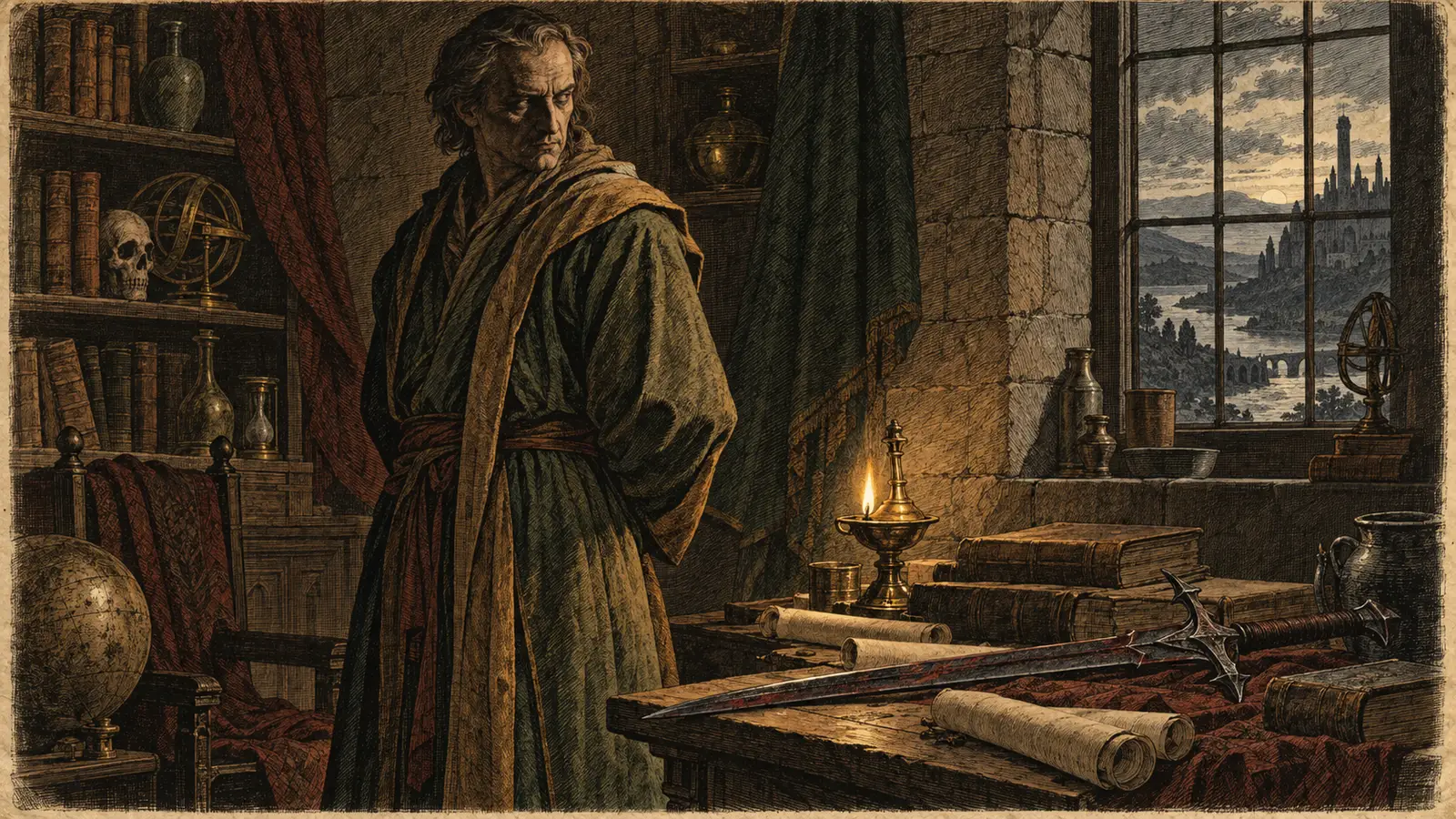
Few artifacts in the game have changed shape as often as this one. It began in 1979 as a short sword, a bodyguard's blade, and stayed short in the tradition, where it's remembered as an enchanted short sword made for Kas, and again in fourth edition's Open Grave, where it's a vicious, invisible short blade. In the Book of Artifacts it became huge, longer than a man is tall, gold-veined, unicorn-hilted, wielded in two hands. In the third and fifth editions it settled into a longsword. Some tellers have even given it a wavy blade, rippling like a flame or a serpent. Through all these changes of size the sword keeps its character. Whatever its length, it's always honed to a razor's edge, it always lends its bearer strength, it can always call the lightning, and it always has its own mind and its whispering will.
Who made it changes from telling to telling too. In the 1979 guide Vecna procured it. From 1993 on, he forged it with his own skill. Later still, he put a portion of his own consciousness into its steel, so that its whispers were his whispers. In one fan-loved variant, the shard inside the blade is a fraction of Kas's mind instead, the lieutenant's own spirit trapped in his own sword.
Then there's the false sword, the replica the Church of Vecna carried into the Citadel , held by the death knight who believed himself to be Kas and served Vecna loyally in the god's palace, seeking to atone for a betrayal he never committed. He's the oddest offshoot of all: a Kas who stayed faithful, or who tries to, holding a sword that never whispered.
The graphic novel Hand of the Revenant offered another alternate telling. There, the sword's most famous deed belongs to the clergy of , whose holy power took the lich's hand and eye at the walls of his own birthplace.
The sword has also found its way into games of quite another kind. In EvilHack, a variant of the old computer dungeon crawler NetHack, the long descent ends in Vecna's Domain. There, guarding the approach to the lich, stands Kas, and Kas always carries his sword. In this game it's an intelligent, chaotic two-handed sword made of gemstone, its edge poisoned, and it deals three times its usual harm to Vecna. So every hero who makes it that far wants to take it from Kas before going on. It can't be conjured by wishing. It has to be won from the hand of its original bearer. It has its scruples, too, or rather its wielders do. A lawful hero who uses a poisoned blade loses standing with their own principles, and priests find it awkward in the hand and risk their god's displeasure. If an adventurer dies carrying it, and their ghostly remains turn up in another player's game, the sword has lost its magic and become a plain gemstone blade. In this small corner of the gaming world, too, the sword is the key that opens the way to Vecna, and it must first be pried from Kas.
Fans have added their own chapters as well. On the Dungeon Masters Guild, where players publish their own adventures, a fan-made side quest series built around Eve of Ruin sends heroes hunting for the Bloodstones of Kas, three gems said to open the way to the sword's last resting place. The first, the Bloodstone of Betrayal, lies deep in , beneath the City of Doors. The second, the Bloodstone of Chaos, has to be won from a slaad cult lost in the shifting chaos of Limbo. The third rests in a shattered temple, and when all three are united, the vault of the sword opens, a pocket plane guarded by the deadliest traps of the Raven Queen. It's unofficial, a story one table imagined for others, and a fitting one: the betraying blade, locked away by the goddess of the dead.
Shapes and stories are one way of knowing the sword. The best way, as players have always known, is to sit at a table and feel its weight.
Chapter XIII
The sword at the table
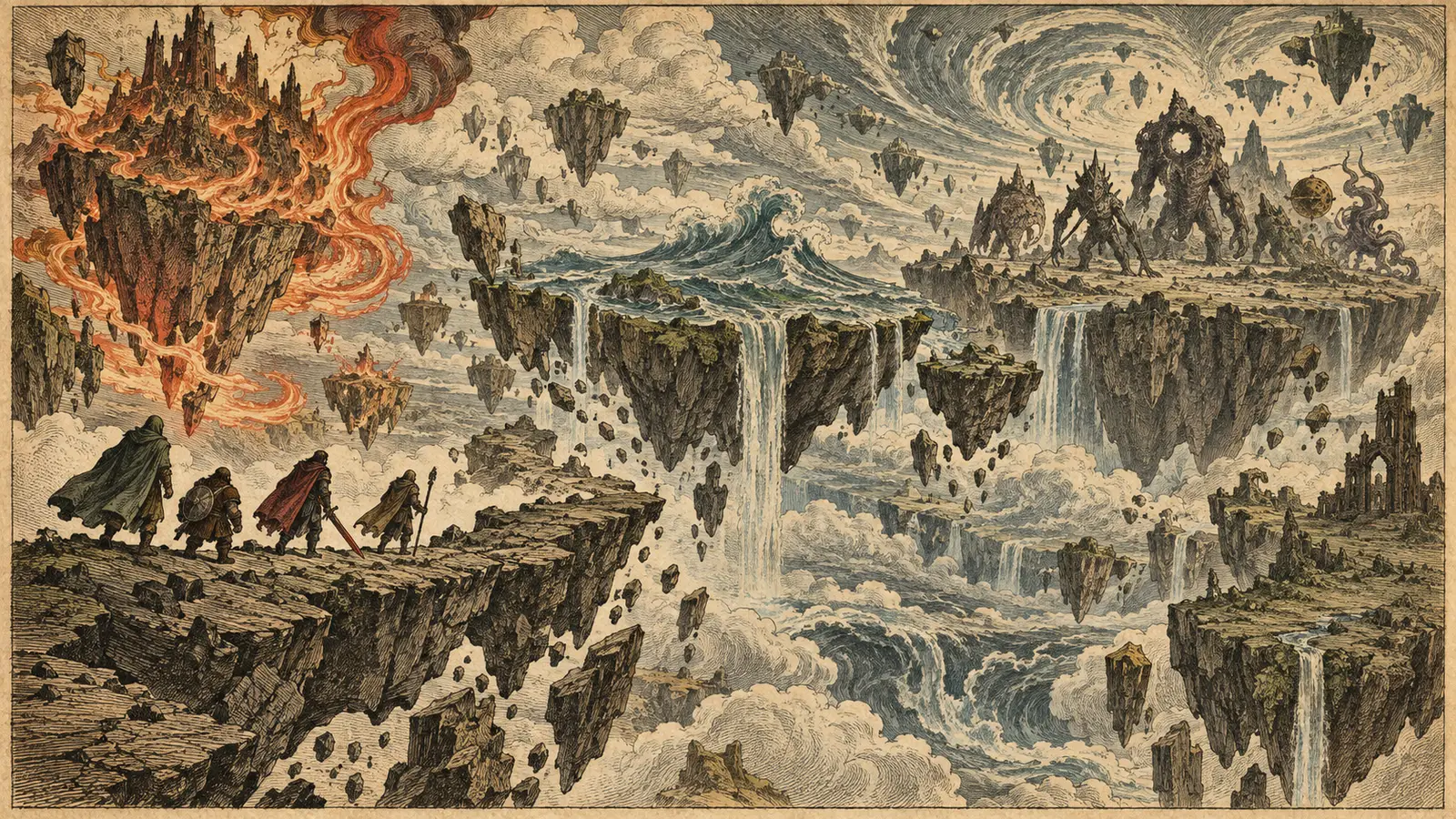
So what is it like, in the actual game, to carry the Sword of Kas?
At first it feels wonderful, as every great temptation should. Your character moves first in almost every fight, sharp and ready before anyone else has drawn breath. The sword strikes hard and finds the gaps in armour. When a blow comes at you, you can turn the blade's power into a guard, letting it weave a defence around you. When the storm clouds gather, you can call their lightning down. When an enemy stands before you, you can speak a word that kills. Few weapons in the game have ever given so much.
Then you learn the rule of the scabbard. Every time you draw it, it must taste blood, and quickly. That changes how a player thinks. You don't draw the Sword of Kas to make a threat, or to look fearsome, or in case trouble comes. You draw it when you mean to kill something, because if you don't, it will remind you whose sword it really is. Some players carry a second, plainer weapon for exactly this reason, saving the great sword for the moment when there's no doubt. Others have learned, uncomfortably, to make sure there's always something nearby to cut.
The deeper weight comes slowly. The sword is a voice in your character's mind, and the voice has an opinion about everything. It wants destroyed, it wants the Eye and Hand found, and it wants anyone touched by them cut down. Over time, as the fifth edition guide warns, its fixation becomes yours. A paladin who sets out to defend a village finds, many sessions later, that he's crossed three kingdoms chasing whispers of a cult. He doesn't quite remember deciding to.
The strength of its will has changed from edition to edition, and players have felt each version. In the oldest days the sword hid how strong it was, so a wielder never knew until the confrontation with Vecna came close and the sword woke and took hold. In third edition its will was so overwhelming that almost no one could win an argument with it. In fourth edition it worked through mood rather than force, its bond strengthening when you betrayed and souring, insult by insult, when you didn't, until it simply moved on. In fifth edition the test comes each time it's drawn, a short, sharp contest of wills that you can pass a hundred times and fail once at the worst moment.
That failure is what Dungeon Masters most often talk about when they talk about this sword. In second and fifth edition, a sword that hasn't been fed can take control of its bearer and demand blood, and the nearest blood might belong to a friend. In fourth edition, the sword's favourite targets are allies and former allies. So the Sword of Kas tends to create tension inside a party. The fighter who holds it is the strongest member of the group and also the most likely to turn on the others. Everyone at the table knows that, and the quiet glances when the sword is drawn are part of the game.
There's a second kind of tension too. Against Vecna, the sword is an ally, honest in its hatred. Its loyalty, though, is to its purpose, and the moment the party's goals and the sword's goals part ways, it stops helping. A wise party treats it the way they'd treat a mercenary with a grudge: useful as long as the grudge points the right way.
Then there's the matter of facing the sword rather than carrying it. In the hands of Kas, or of a dominated companion, it's a fast, hard-hitting and deadly blade, and in fourth edition it's invisible until the first blow. Kas himself, as more than one table has found, isn't only a monster to be fought. One group of players, in a game they later wrote about, met Kas on a battlefield. He left his death knight in command of his undead horde and crossed over to scold them, because they'd promised to hand over a companion of theirs, a woman named Jenna, and hadn't done so. Jenna flew over and began to negotiate with him herself, first in the language of giants and then in the common tongue, and in the end the players talked their way through the whole encounter without a battle. Kas, it turns out, can be bargained with. He's a soldier and a politician, and he has always been open to a deal that serves him.
The best-known table story of the Sword of Kas comes from a game watched by a great many people. In 2017, near the end of the first campaign of the show Critical Role, the heroes of Vox Machina, guided by Dungeon Master Matthew , were preparing to face a reborn and ascended Vecna. In the episode called "Dark Dealings," they went looking for an artifact that might turn the war, and , the goliath barbarian played by Travis , took up the Sword of Kas. In that world the sword had been lost in the depths of a place called Thar Amphala after Kas's death. It was gleaming, ancient and sentient. It chose to be called simply "Kas," and its refrain was always the same: the lich must die.
Grog, being Grog, asked the sword what it thought of Vecna. The sword answered that Vecna was powerful but arrogant, a creature who liked to put on a show. He weaves webs and plans so convoluted, it said, that they turn in on themselves, and his arrogance and his scheming would bring him down. It's a remarkable thing to hear from a blade with a piece of Vecna in it: a portrait of the lich drawn by the one thing in existence that knows him from the inside.
The sword changed Grog. He grew paler and more gaunt, and his eyes took on a disturbing red glow, as though the vampire who once held the blade were slowly seeping into the barbarian who held it now. In the episode called "The Final Ascent," Grog carried the sword into battle against Vecna and drove it into the god's shoulder, releasing a burst of energy through his body. It was one of very few visible wounds Vecna took in that fight. The god was defeated in the following episode, "Vecna, The Ascended." Afterwards Pike , the gnome cleric played by Ashley Johnson, sensed how deeply the sword had dug into her old friend. She broke the curse that bound it to him and left the blade in the care of a dwarven guardian, Highbearer . The sword did what it was made for, and then a friend took it away before it could do anything else. That may be the best ending any wielder of the Sword of Kas can hope for.
That story travelled far beyond one table, and it's one of many ways the sword has reached people who have never rolled a die.
Chapter XIV
The sword beyond the table
In 2022, the fourth season of the Netflix series Stranger Things opened with an episode called "The Cult of ." Its first scenes show the Hellfire Club, a school Dungeons & Dragons group run by Eddie , at the climax of a long campaign. Eddie, as Dungeon Master, describes a terrible figure, shrivelled and desiccated, missing his left arm and his left eye, and the players recognise him at once, with a cry that this is Vecna, the one who was killed by Kas. The show's own villain borrowed Vecna's name, and only his name, but that scene introduced a whole generation of viewers to the lich, his missing hand and eye, and the lieutenant whose blade took them.
The effect was striking. Millions went looking for the old lore. And as they read about Vecna they found Kas, the betrayer, and his sword. For a while a fan theory spread widely: that Eddie, with his improvised spiked shield and his fall in the shadowy Upside Down, would return as a kind of Kas, the one who betrays and brings down the show's Vecna. It was a lovely theory. It didn't come true. The show's creators said Eddie was gone, and when the series ended in 2025, it was Joyce who brought down its Vecna. Still, the theory says something. Once people learned the legend, they wanted a Kas. The idea of the servant who turns on the master, holding the master's own gift, is the kind of story people recognise instantly.
Critical Role carried the sword into the wider world in its own way. The episodes in which bore it reached a large audience. And when the campaign was adapted into the animated series The Legend of Vox Machina, its third season closed in the autumn of 2024 with cultists working to revive the Whispered One. The show has been renewed through a fifth and final season, and the road it's travelling leads toward the story in which Grog's sentient blade once waited.
Even card games have touched the legend, though only partly. In 2021, the Adventures in the Forgotten Realms set of Magic: The Gathering printed the Eye of Vecna, the Hand of Vecna and the Book of Vile Darkness as legendary artifacts. A player who gathers all three and gives them up together calls Vecna himself into play, an undying god-token rising from his own remains. The sword that cut away the eye and hand wasn't printed. The lich came back to the card table, and the lieutenant's blade stayed out of the story, perhaps the way Kas would have wanted, unaccounted for and waiting.
Meanwhile, as with any great artifact, artists keep returning to it. Painters, illustrators and modellers draw and sculpt and render the sword in all its shapes, from the soldier's short blade to the gold-veined monster with its leering hilt. In a way each new drawing is another hand taking it up.
Which brings us to the sword as it stands now, in the autumn of 2026.
Chapter XV
Where the sword rests now
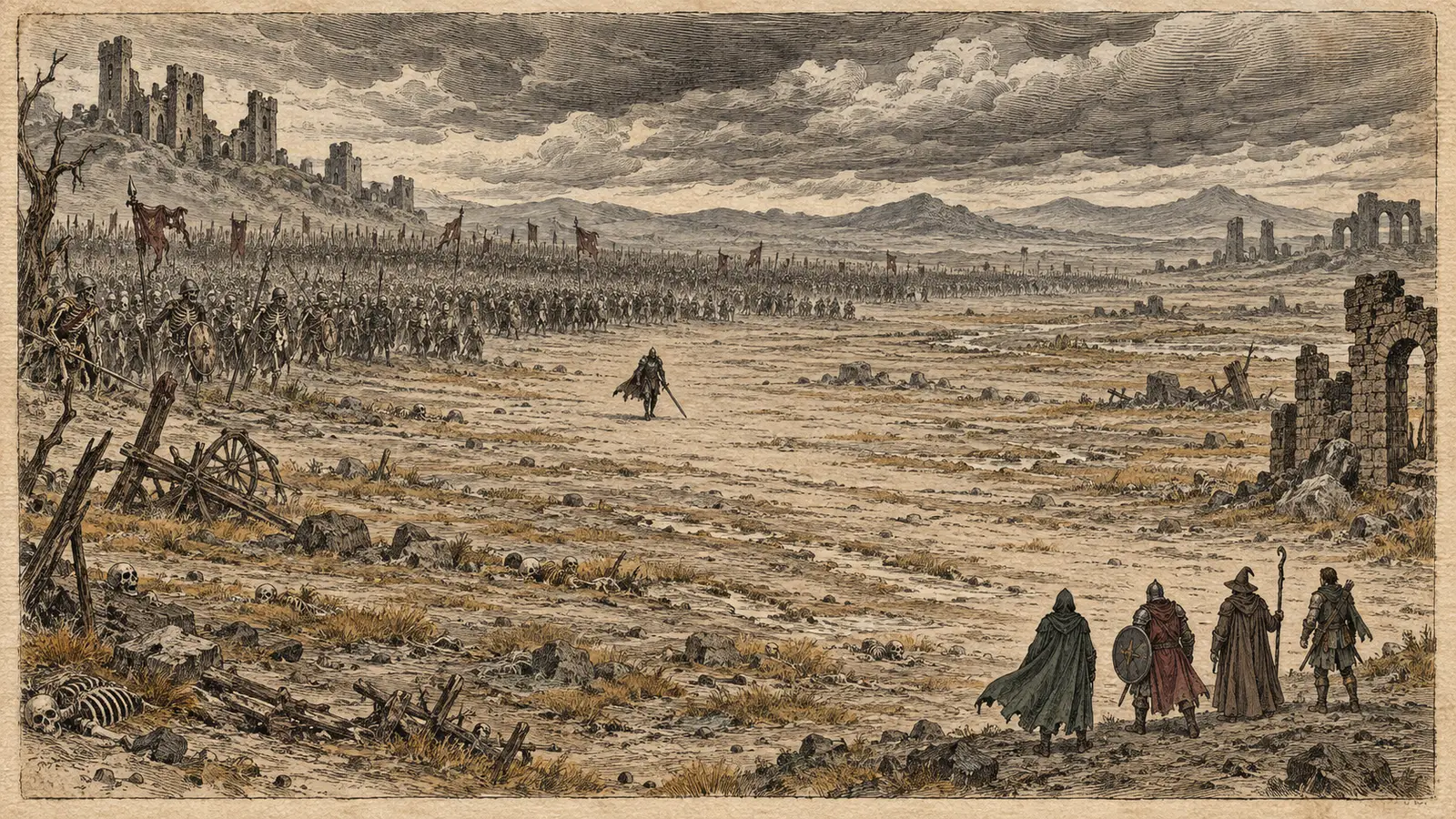
The Sword of Kas sits today where it has sat in every version of the core rules since 1979: in the pages on artifacts in the Dungeon Master's Guide, beside the Eye and Hand of . The revised guide of November 2024 kept its legend and its heart. Kas the Bloody-Handed was the evil lieutenant Vecna chose as bodyguard and right hand, adviser, warlord and assassin, and he was rewarded with this dark sword. It's still a sentient, chaotic and evil longsword, still a bane to the undead, still quick to find a killing blow.
The revised book tidied its language rather than changing its nature. The old demand that the blade be bathed in blood within a minute of being drawn became a simpler and somehow eerier phrase, Bloodthirst: the sword must taste blood. The spirit of Kas gained a name for its gift of readiness, Battle Hunger. The random gifts and curses of the older book gave way to a fixed list of spells, the lightning, the divine word and the finger of death. And the old rule of destruction remains: only the wish of the Eye and Hand together, and a contest of wills, can end the sword, as only the sword can burn the Eye and Hand to ash.
In the story as it stands, the sword was forged by Vecna as the mark of Kas's authority, a blade as cruel as its bearer, and it whispered him into betrayal. It survives, along with the Eye and Hand, as the last remnant of that final battle. Kas is a vampire, once darklord of , freed and used by the Dark Powers in the great story of 2024, banished by the clear note of a chime, and still, somewhere, nursing his ancient grudge. And the sword itself is in the world, waiting in the core rules for any Dungeon Master who wants to set it in a barrow or a vault or the hand of a ruined knight.
The Mists returned in force this summer, when Ravenloft: The Horrors Within came out in June with a new gathering of darklords. Ahead lie a few announced things. Penguin Random House has announced Dungeons & Dragons Fiends & Foes, a book about the game's great villains by Erin M. Evans, scheduled for late November 2026, and Vecna is among the villains announced for it. And , Kas's home world, is coming back. Wizards of the Coast has announced Melf's Guide to Greyhawk, led by Luke with Stephen and Les Reno, listed for January 2027. A campaign adventure, Greyhawk: Crown of the Witch Queen, has also been announced for 2027, with the vampire , daughter of , as its villain. These are announcements, and what they'll hold is still to be seen. But the lands where a fallen paladin of once rose through a lich's armies are about to be walked again.
Chapter XVI
The blade that remembers its master's hand
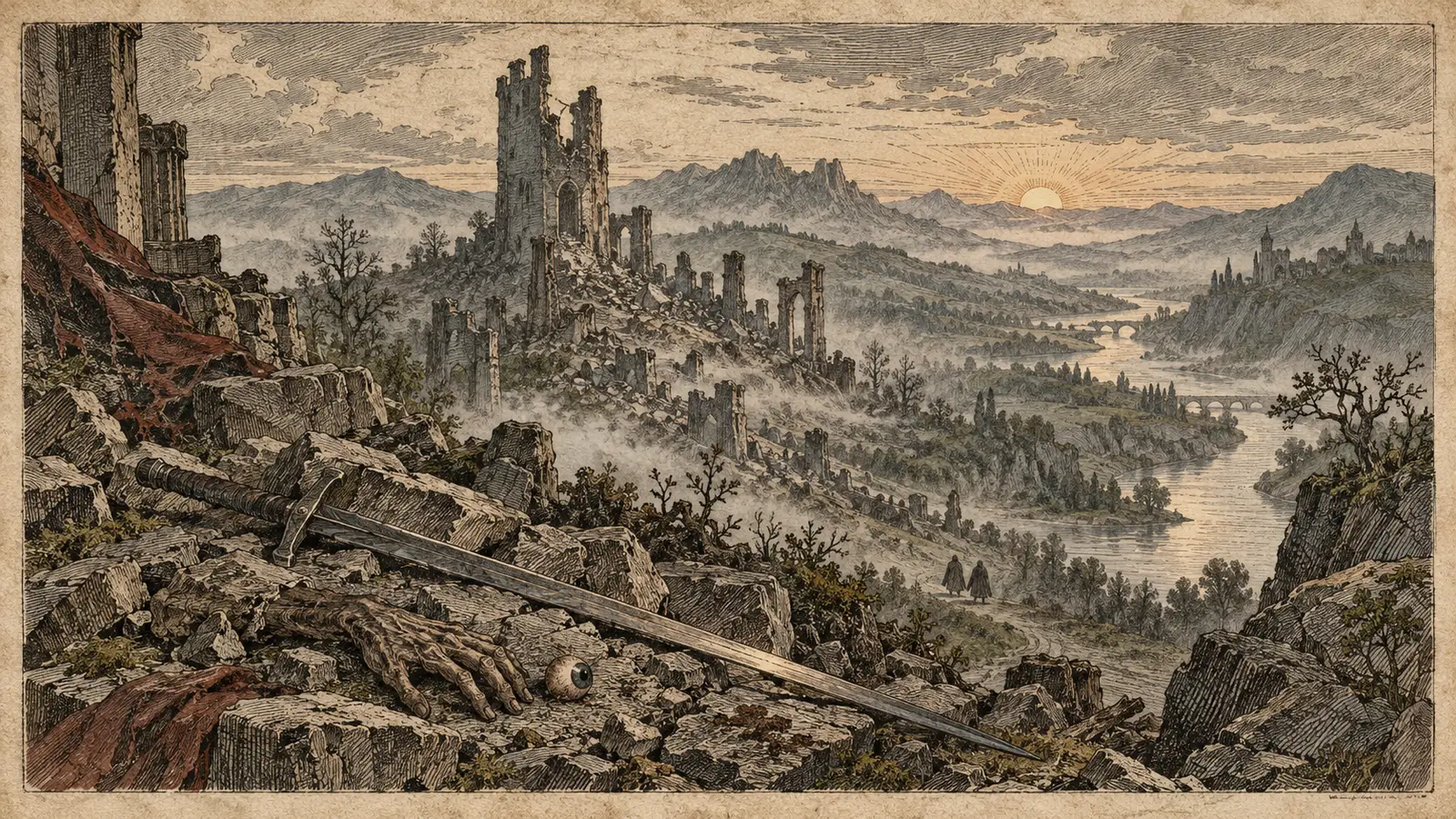
Come back now, at the end, to the ruins of the tower.
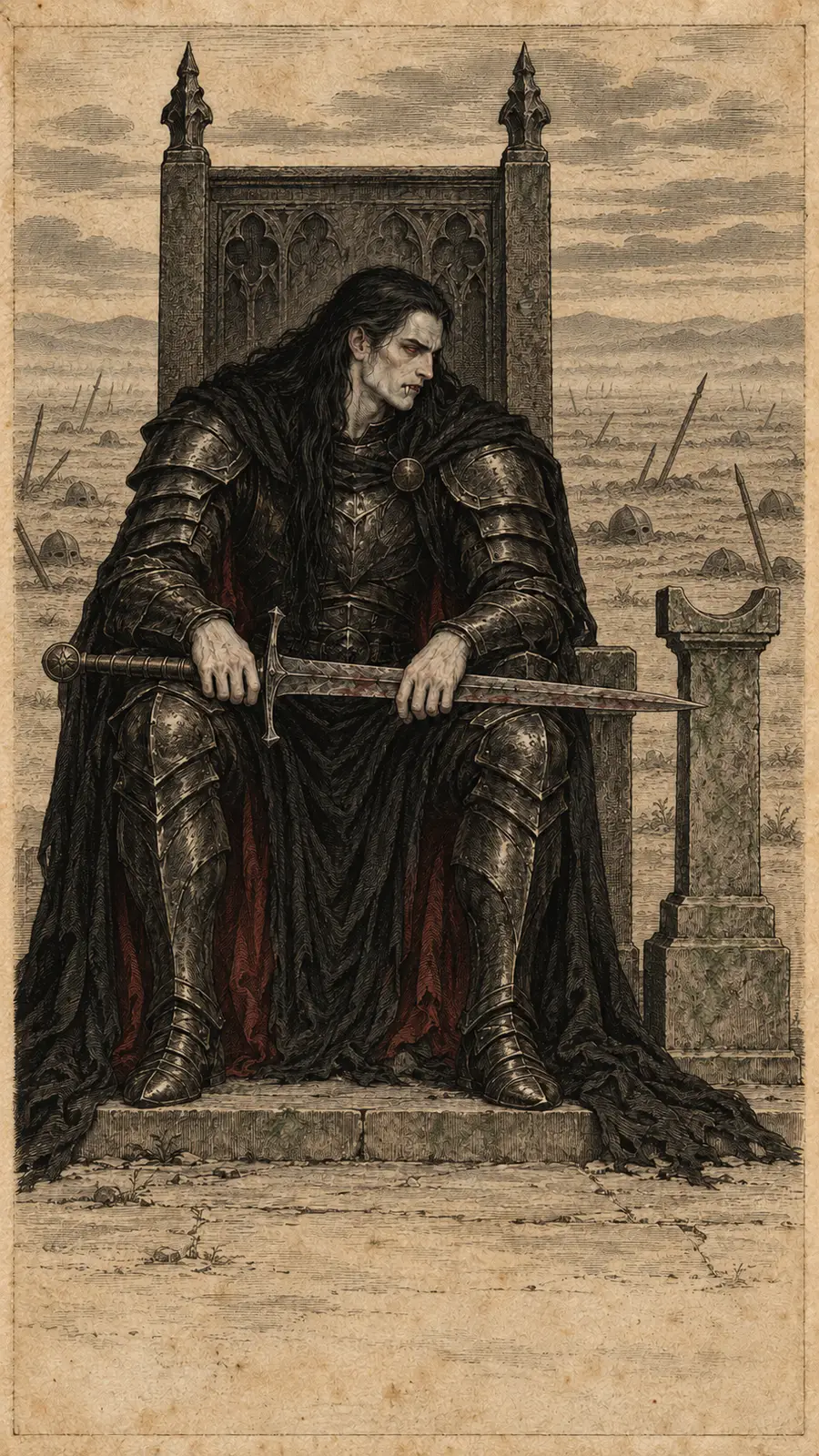
Picture it in the grey hour after the fighting. The walls that once rose above the are dust. The spidered throne is broken or buried. The lich who ruled from it is gone, and so is the lieutenant who stood behind it. In the stillness there are only three things lying in the rubble. One is a withered left hand. Another is a single left eye. The third is a sword.
There's an old, quiet symmetry in that scene. The lieutenant was called his master's right hand. The right hand rose, and with the master's own gift it struck off the master's hand. And when it was over, of the lieutenant himself, only the sword remained. The hand that held the blade was gone, and the blade was what was left of the hand.
The sword has kept that night with it ever since. It was made by and carried by Kas against him, and through every edition and every shape it has gone on hunting Vecna's relics and Vecna's servants and Vecna himself. Kas has been a vampire in a land of ash, a darklord at war with mountains of fire, an echo at the edge of everything and a betrayer wearing another man's face. Meanwhile his false double knelt in a skull-shaped palace and grieved a betrayal he never committed. The sword never forgot what it was for. It isn't loyal to the lich who made it, or to the man who carried it. It's loyal to the betrayal.
And it passes that loyalty on. Each new bearer, in the words of the old guide, takes up its fixation as their own, the ancient grudge passed from hand to hand like an inheritance nobody asked for. A barbarian in another world grows pale under its influence. A hero in the Torment of Kas closes their fingers around a hilt that once rested in the grip of a fallen paladin.
Somewhere in the ruins of the multiverse a severed hand and a lone eye are waiting to be found by someone hungry enough to use them. Somewhere else lies the sword that took them, and it's patient and blood-hungry, and it remembers the shape of the hand that held it the night the tower fell. It's waiting for another hand.