Chapter I
A note before the descent
Tonight we go down into one of the oldest and most famous places in Dungeons and Dragons: a crypt under a lonely hill, and the patient, hungry thing that built it. We'll follow it from a handwritten dungeon passed between friends in 1975, through the editions that rebuilt it and made it larger, into frozen demiplanes and jungle ruins, and finally to where it stands today. Along the way we'll walk its halls slowly, look at its painted walls and its quiet traps, and spend some time with , the skull with jewels for eyes.
Chapter II
Origins: a tomb of Ra-Hotep and a challenge among friends
Every old dungeon starts with someone who wants to see what their friends will do when the floor gives way. The Tomb of Horrors started with two people.
The first was , one of the early players who tested the game while it was still being shaped in the Midwest. In 1975 he kept pressing Gary , the game's co-creator, to build something special. Something that would make the most confident players stop and think. To show what he meant, Lucien sent Gygax a dungeon of his own. It was handwritten on a few sheets of paper, with a map drawn on graph paper, and it was called the Tomb of .
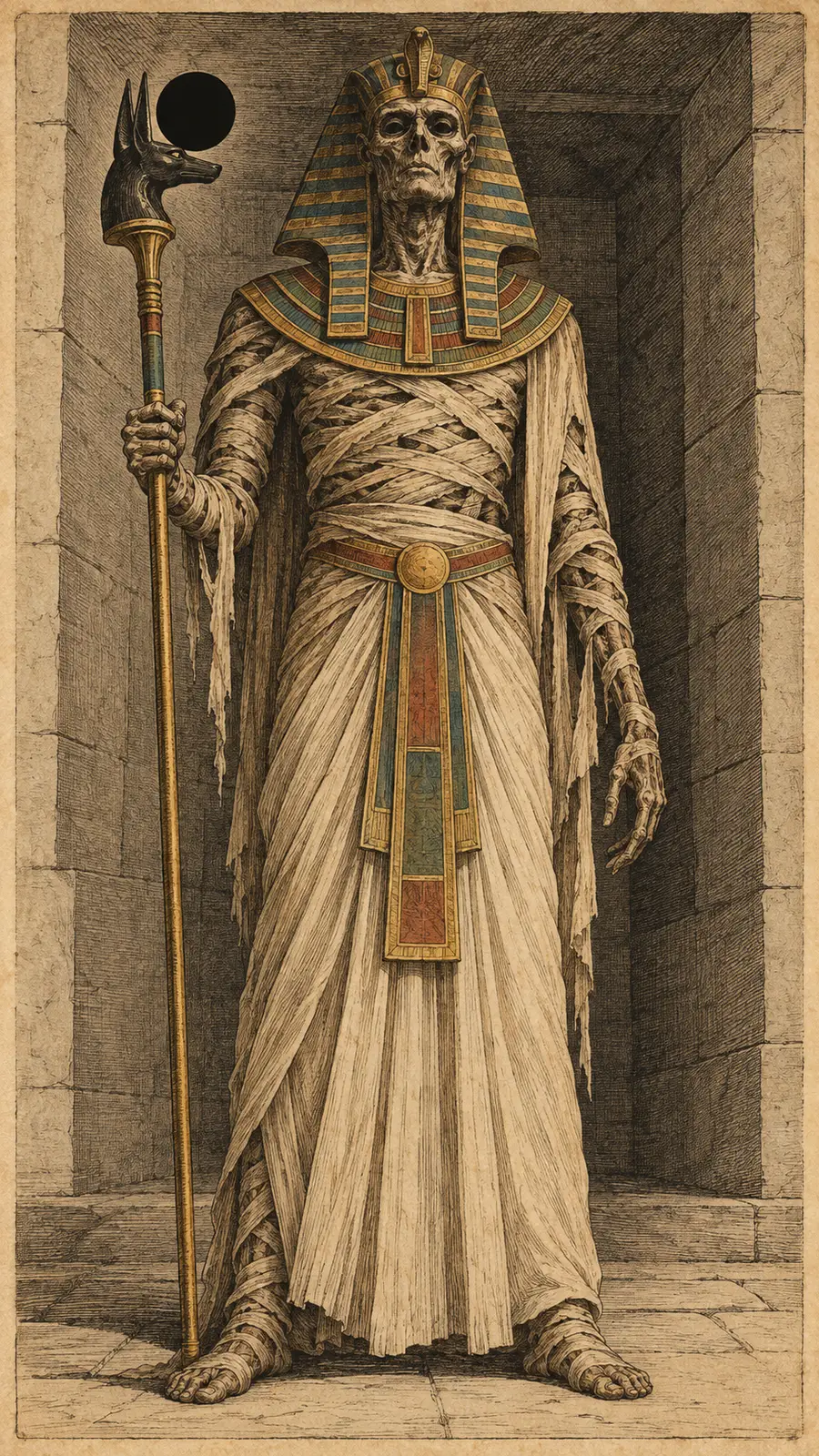
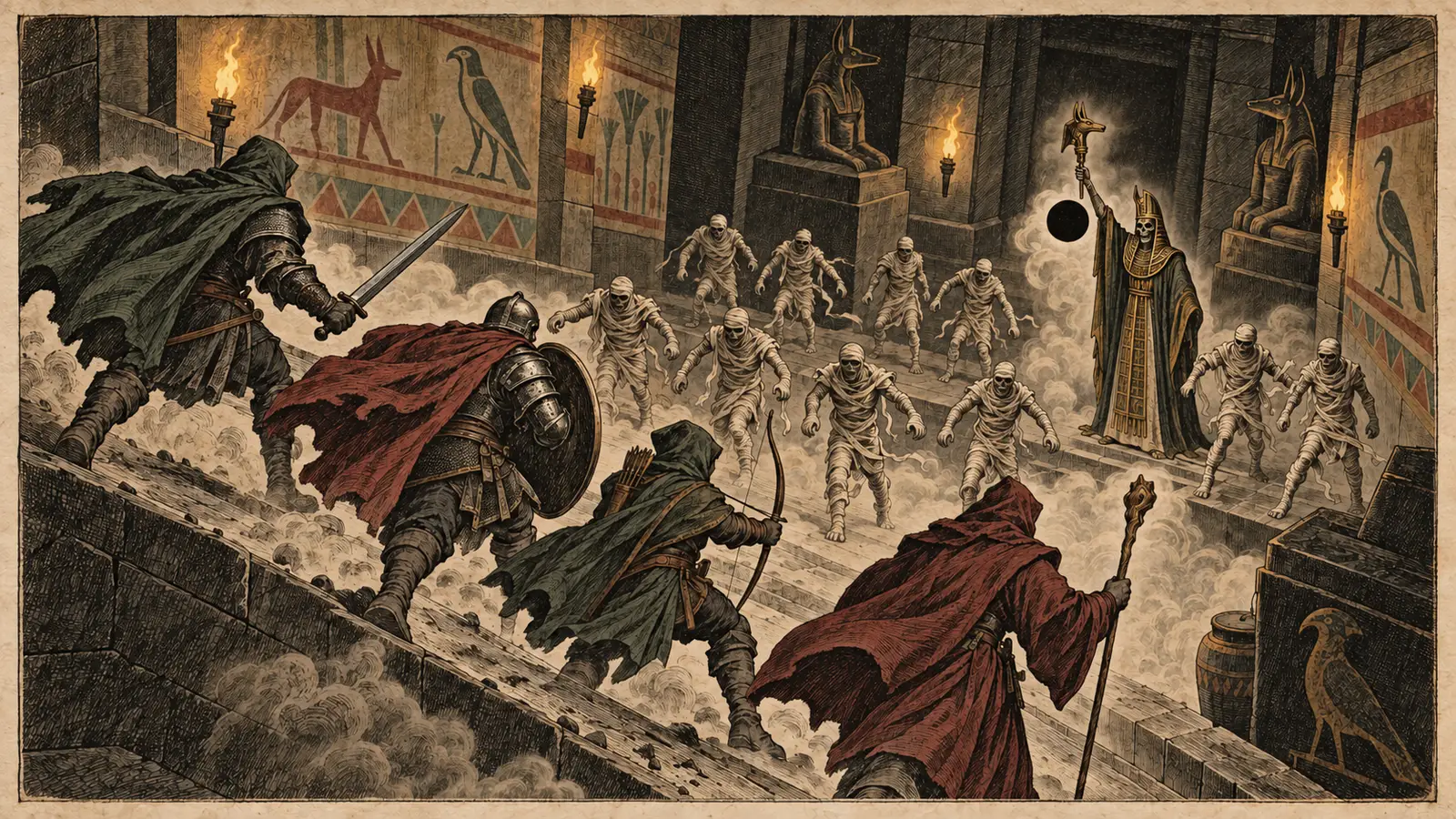
Lucien's tomb was Egyptian in feeling. Picture sand and dark stone, painted walls, and corridors that sloped down into the earth the way the passages of the old pharaohs' tombs did. It was full of traps. There were pits, secret doors, and false chambers meant to make a weary party think it had reached the end. Its master was the Lich of Ra-Hotep, a priest and wizard who had defied time and death. Lucien made him formidable in game terms: a cleric and a magic-user both, at heights of power few characters ever reached. In his hand Ra-Hotep carried a jackal stick, a sceptre topped with the head of the animal the Egyptians linked with tombs and the dead, and with it he controlled a sphere of annihilation. That's a perfect globe of nothingness that erases whatever it touches. At the end of the tomb waited a last battle against ten mummies and Ra-Hotep himself.
It's worth holding that picture for a moment, because so much of what came later is already there. A tomb that lies to the people who enter it. A false burial chamber. A secret door hidden at the bottom of a pit, where only someone who had already fallen in would think to look. A secret door hidden behind plaster, so that the wall itself has to be broken to find the way on. And the sphere of annihilation, the quiet black emptiness that would one day sit in the open mouth of a green stone devil.
Gygax took Lucien's idea and made it his own. He kept the shape of what Lucien had imagined and many of its cleverest tricks, then reworked the whole thing and added a great deal of his own. He moved it away from Egypt. The jackal-headed priest left, and in his place came a new master with a strange, clattering name: . When the finished adventure was published, it carried a line of thanks to Alan Lucien, "who was kind enough to submit the ideas for this dungeon." For decades that line was all most players knew of him. His own Tomb of Ra-Hotep stayed in a drawer, unpublished, a sort of buried tomb of its own, until it finally came to light in a special edition of the visual history Art and Arcana in 2018. That same edition included a copy of the typed version Gygax prepared in 1975, with a map he drew by hand.
The second person behind the tomb was Gygax himself, and his reasons were very human.
In his home campaign, the long-running game that grew into the World of , Gygax had players who had become very good. Their characters had survived everything. Two of them in particular seemed unbeatable. One was , played by Rob , a friend who helped Gygax build the early Greyhawk campaign. The other was , played by Gygax's son Ernie. These were characters whose names later found their way into the lore of the world itself. Gygax wanted to test them, and he wanted to test the wider circle of players who boasted that their heroes could beat anything a dungeon master put in front of them.
He later said he wrote the tomb "chuckling evilly." He aimed it at what he called "the persistence of their theretofore-invincible characters." You can almost hear the smile in that phrase. This wasn't meant as cruelty. It was the friendly rivalry of a game table, where the dungeon master and the players push against each other and both sides enjoy the struggle.
So the tomb was meant from the start to be a different kind of dungeon. It wouldn't be won by swords or long fights against hordes of monsters. It would be won by thinking. Gygax built it from mechanical puzzles, tricks, illusions and traps, some of them able to end a character in an instant, and he put very few monsters in it. The danger would come from the place itself.
There's one more thread in the tomb's origins, and it reaches back much further than 1975. In April 1934, the pulp magazine Weird Tales printed a story by Clark Ashton Smith called "The Death of ." It was the last of his tales of , the final island left of sunken Atlantis. Smith was one of the great writers of strange fiction in that era, a friend and correspondent of H. P. . His stories were full of decadent sorcerers, jewelled language and slow, creeping dread.
In the story, the sorcerer Malygris has ruled the island's capital, , for a long time, and his power is greater than that of King . Rumours spread through the city that Malygris has died. Nobody has seen him move or heard him speak in a long time, yet the people still feel his presence and fear it as they always did. The king and his chief magician, , begin to suspect something unsettling. Perhaps Malygris really is dead and has used his illusions to hide it, so that he can go on ruling from beyond the grave. They gather the magicians of the city to find out the truth through forbidden arts.
Lovecraft called the story "splendid." The magazine's editor, Farnsworth Wright, had first turned it down as "more like a prose poem than a story," which tells you something about how rich and slow Smith's prose could be. That's a fitting description for a bedtime story, as it happens.
Acererak probably drew in part on Malygris. Think about the shape of it: a mighty sorcerer whose death may or may not have happened, whose will still fills the place he once ruled, and who might be nothing more than a still body in a high tower that nobody dares approach. That's very close to the demilich in his crypt, a skull resting in dust, still powerful long after his body has gone.
When Gygax sat down to write, the game already had a creature for this kind of villain. The lich had come into Dungeons and Dragons in 1975, in the supplement called Greyhawk. We met the lich family briefly when we followed Szass Tam of Thay. In that first version a lich was a skeletal former wizard, sometimes a wizard who was also a priest, who had kept all its old powers past death. Gygax took the idea one step further. What happens to a lich after centuries more? What if it lets even its bones go, until only the skull is left, and its mind wanders elsewhere? The answer to that question was the demilich, and the Tomb of Horrors was where it would be born.
So the pieces were ready: a friend's Egyptian tomb, a set of champions who needed humbling, an old pulp tale of a sorcerer who might be dead, and a new kind of undead. All that remained was to set them down under a hill and invite the bravest players in. That happened in the summer of 1975, at a gathering in Baltimore.
Chapter III
First appearance: the tournament at Origins and the module of 1978
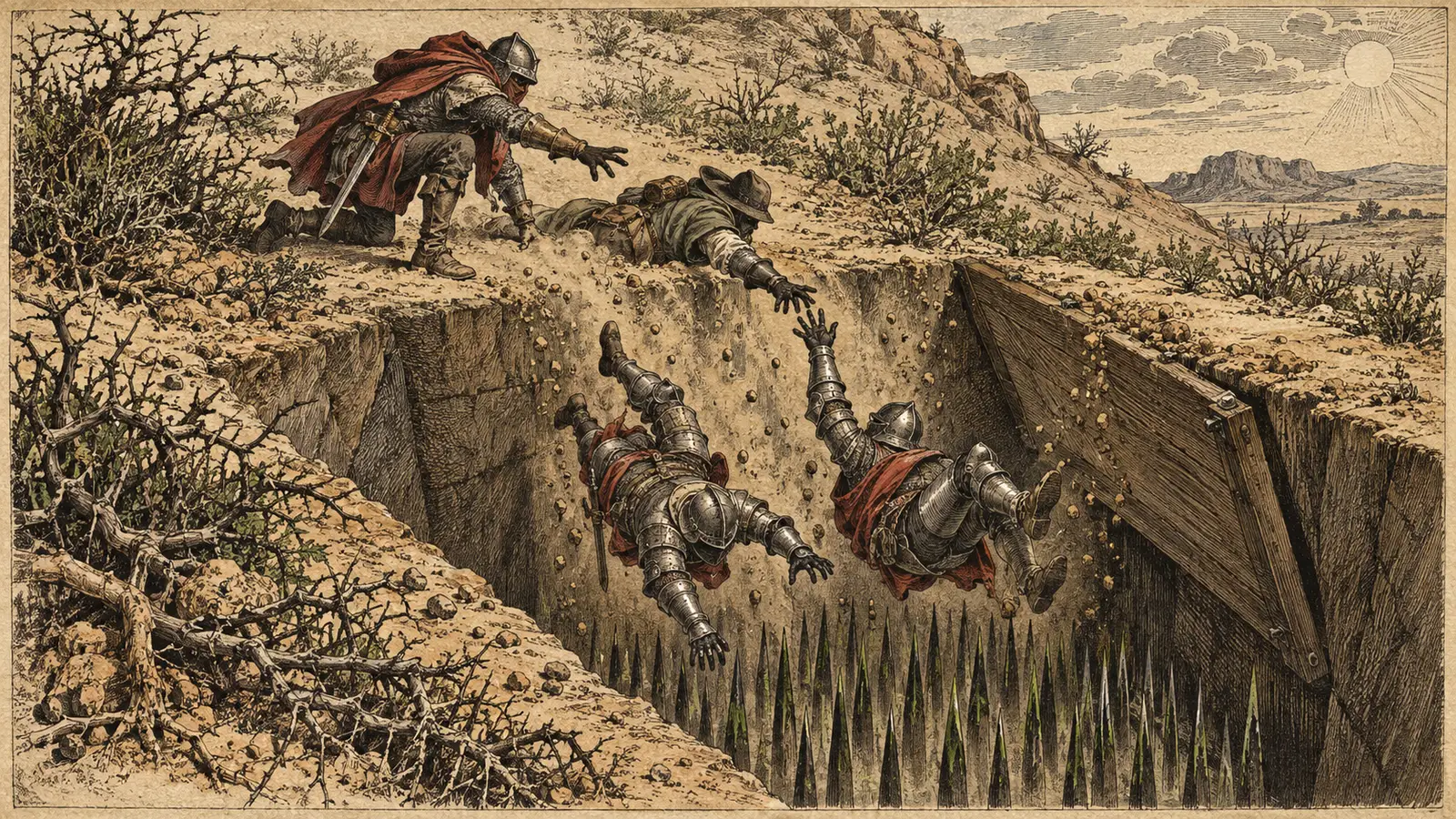
In late July of 1975, the first Origins convention was held at Johns Hopkins University in Baltimore, Maryland. It was a gathering of wargamers and players of the new tabletop games, organised by a local wargaming club called the Interest Group Baltimore together with the Avalon Hill game company. Dungeons and Dragons was only a year and a half old. brought the Tomb of Horrors to run as the official tournament dungeon.
The tournament ran in a particular way. Each team was handed the same group of fifteen ready-made characters, ranging from a powerful twelfth-level magic-user down to a modest fourth-level fighter. Each team had roughly two hours. The aim wasn't to beat the tomb, which wasn't really expected of anyone. Teams were scored on how far they got, meaning how many rooms they explored before their characters were lost.
Eight groups went in. Every one of them was decimated. In one party, two fighters died before the group had even found the true entrance. That gives you a sense of the place: the dying began at the threshold.
It's a gentle thing to imagine, all these years later. A university building on a summer weekend, tables of players leaning over their papers, a referee reading out descriptions of painted corridors and silent arches, and fifteen characters at a time walking slowly toward the end of the story while the clock ticks. Every group carried the same names and the same equipment into the same hill, and each found its own way to fall.
Three years later, in 1978, TSR published the tomb for the wider world as an adventure module for the new Advanced Dungeons and Dragons. It carried the code S1, the first of a series of "special" modules, and it was one of the earliest published adventures in the game. The first printing had a plain two-tone cover. In 1981 that was replaced with the full-colour painting by Jeff Dee that many people now picture when they hear the name: a party of adventurers struggling against the floating demilich.
The words on the module told you what you were getting into. "In the far reaches of the world, under a lost and lonely hill, lies the sinister Tomb of Horrors. This labyrinthine crypt is filled with terrible traps, strange and ferocious monsters, rich and magical treasures, and somewhere within rests the evil Demi-Lich."
Inside was Gygax's famous warning to the dungeon master. In the original it's printed in capital letters, as though he were raising his voice a little across the table. "This is a thinking person's module, and if your group is a hack and slay gathering, they will be unhappy." It's one of the most quoted lines in the history of the game, and it's still true.
The module was laid out as thirty-three numbered encounters. It opened with two false entrances and ended at a place called "The Crypt of the Demi-Lich." Between those two points lay the halls, the arches, the chapels and the traps we'll walk through more slowly later tonight.
The module's most loved feature was the separate booklet of pictures that came with it. As players moved from room to room, the dungeon master could open the booklet and show them what their characters saw: the painted hallway, the strange arches, the chambers and their contents. The interior art was by Dave Sutherland and Dave , two of the artists who defined the look of early Dungeons and Dragons. Their drawings were black and white, clean and careful, and somehow more unsettling for being so plain. Players still remember the image of the middle entrance to the tomb, the four-armed gargoyle, and the charred remains of some unlucky earlier visitor.
There's something quiet and patient about this way of playing. The dungeon master turns a page. Everyone at the table leans in to look at a drawing of a stone room with a single object in it. Then the questions begin. What is that? Is the floor safe? Does the paint look fresh? The pictures didn't tell you what was dangerous. They only showed you what was there, and the rest was up to you.
When the module reached Britain, Don Turnbull reviewed it in White Dwarf magazine and gave it a perfect score of ten out of ten. He praised a dungeon "sprinkled extensively with subtle, insidious and carefully laid traps," and he felt the picture booklet added a great deal of atmosphere. That was the response of a careful reader who saw what Gygax was after.
So the tomb that reached players in 1978 was a slender thing. It had a single villain, a single hill, and thirty-three rooms of careful malice. There were no kingdoms around it, no cults, no armies and no great cosmic scheme. All of that would come later, over many years. In its first form, the Tomb of Horrors was a place and a puzzle, with a legend wrapped around it. That legend is where we turn next, to see what the first edition told of Acererak and the lonely hill.
Chapter IV
The demi-lich in the lonely hill: Acererak in first-edition lore
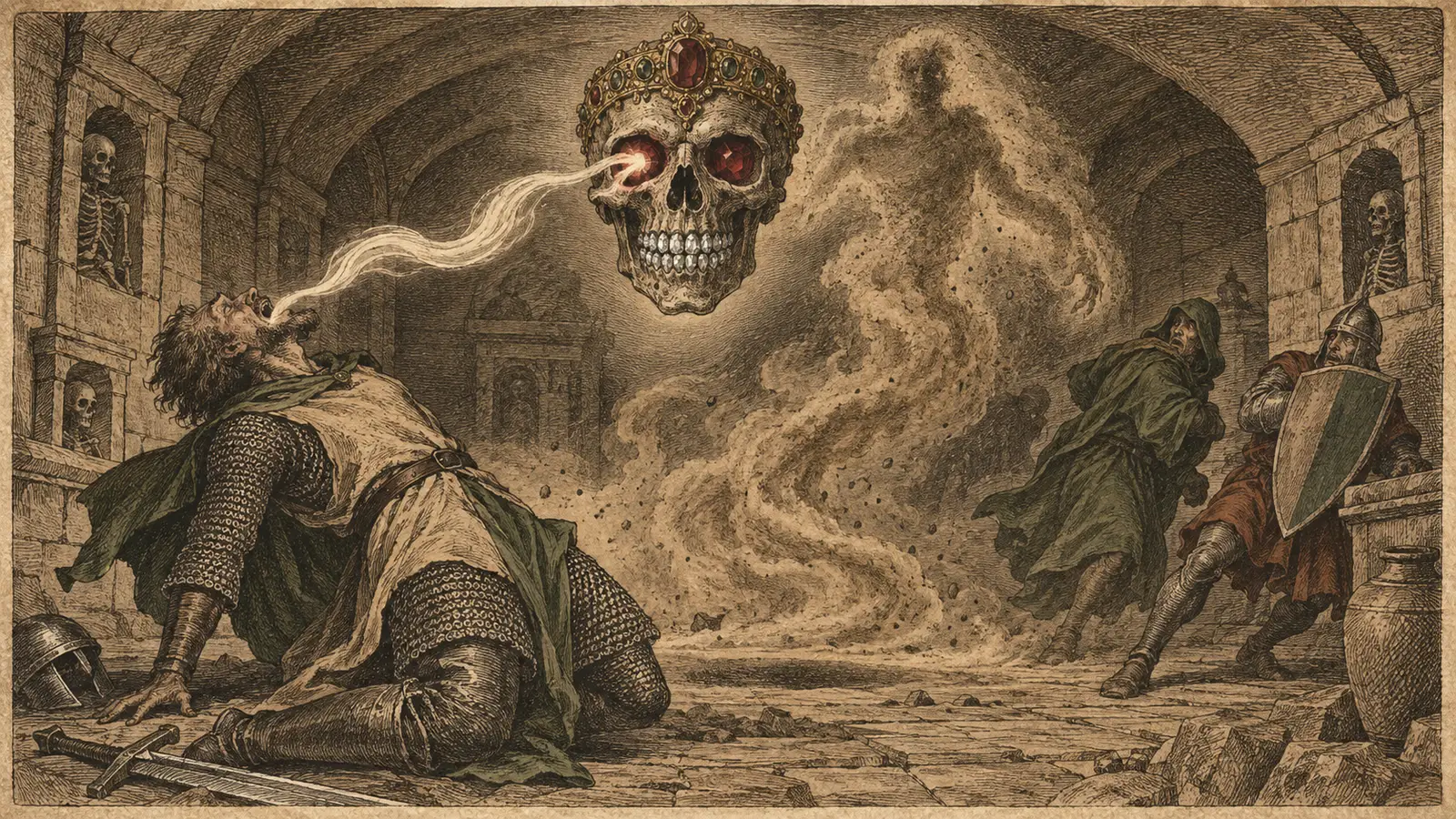
The module began with a legend that the dungeon master read aloud to the players before they set out. It went like this. "Somewhere under a lost and lonely hill of grim and foreboding aspect lies a labyrinthine crypt. It is filled with terrible traps and not a few strange and ferocious monsters to slay the unwary. It is filled with rich treasures both precious and magical, but in addition to the aforementioned guardians, there is said to be a demi-lich who still wards his final haunt." Then came the last warning: tales had it that this being, called , held powers that made him nearly undefeatable.
That was the story as the players heard it. The dungeon master's text gave a little more.
Acererak, it said, had been a human, a magic-user and a cleric both, "of surpassing evil." Over the long centuries of his life he took the dark steps needed to keep his life force from fading. He became a lich, an undead sorcerer whose will held him to the world after his body should have failed. And he made his home here, in the gloomy stone halls inside this very hill, surrounded by hordes of ghastly servants.
It helps to imagine those years. The hill as it was then, not yet a ruin. Its halls lit by whatever dim light an undead lord might want. His servants, living and dead, moved through the corridors carrying stone and cutting passages. They worked for a very long time. The building of the tomb took eight decades. Generations of labourers could have lived and died in that span, and perhaps they did, carving and painting and setting the slow mechanisms of the traps.
When the tomb was finished, Acererak destroyed all his slaves and servants. Every one who had built it, and every one who knew its secrets, was gone. Then he hid the entrance to his halls by magic and withdrew to what the legend calls his "final haunt." His body stayed behind in the crypt. His soul went elsewhere, roaming strange planes that even the wisest sages didn't know.
Later still, the text says, Acererak chose to let go of his physical form altogether. Over ages his body crumbled. What remained was a demi-lich, which the first edition spelled with a hyphen, as though the word were still being worked out. In that first telling, the demi-lich wasn't a type of monster you could find in a book of creatures. It was simply Acererak, a single unique being and the next step beyond the lich.
So what does a demi-lich look like after all those years?
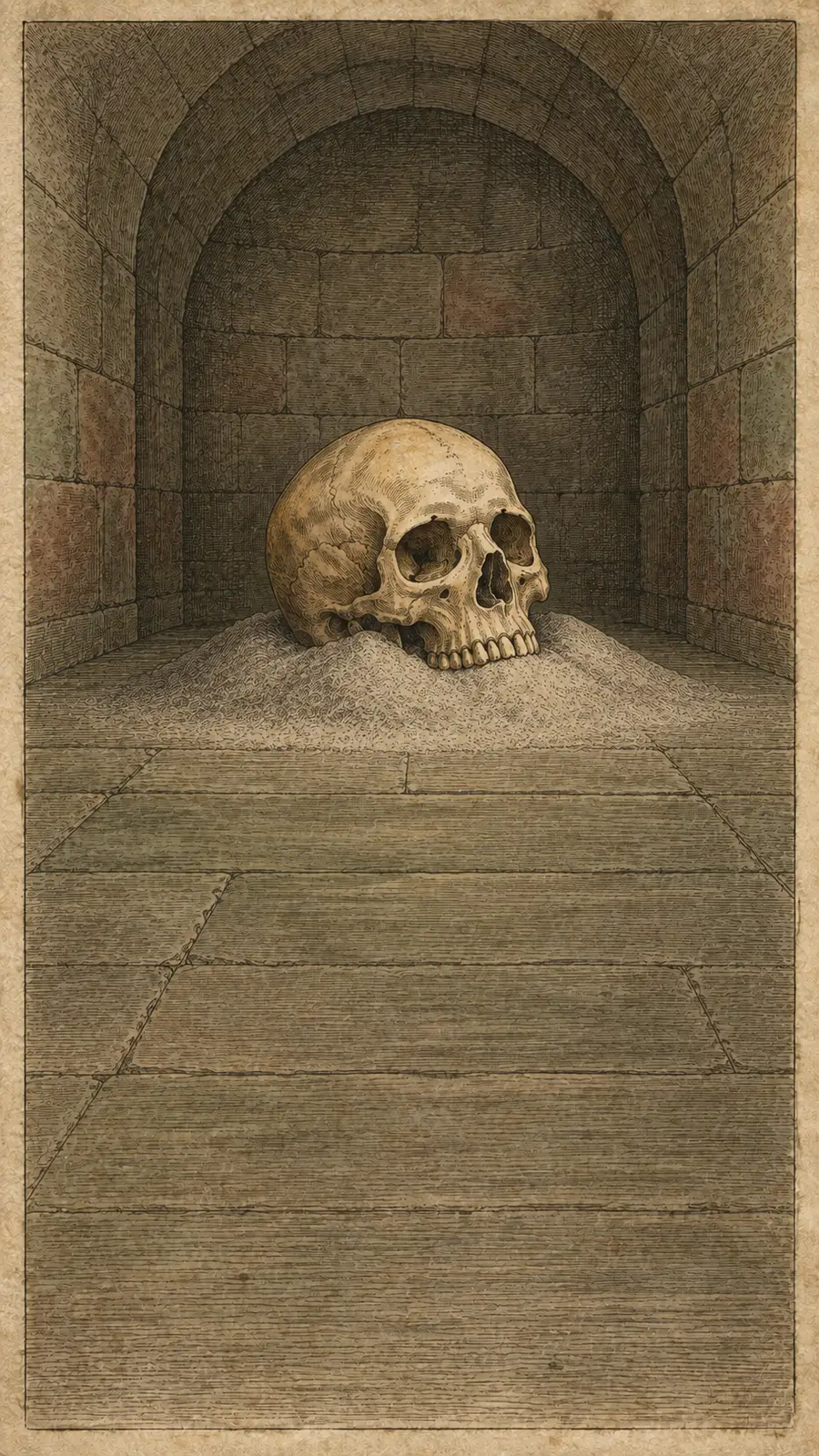
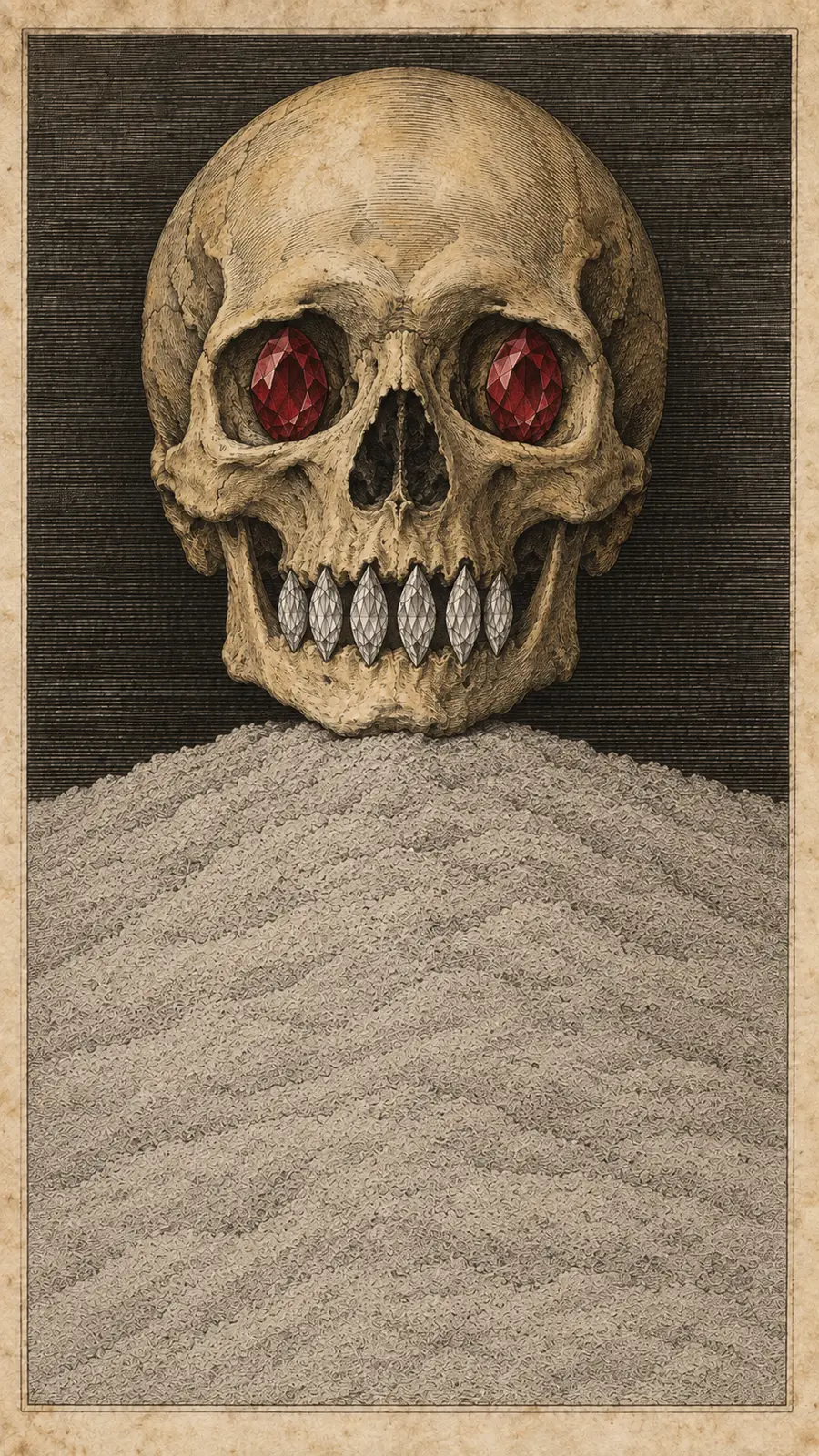
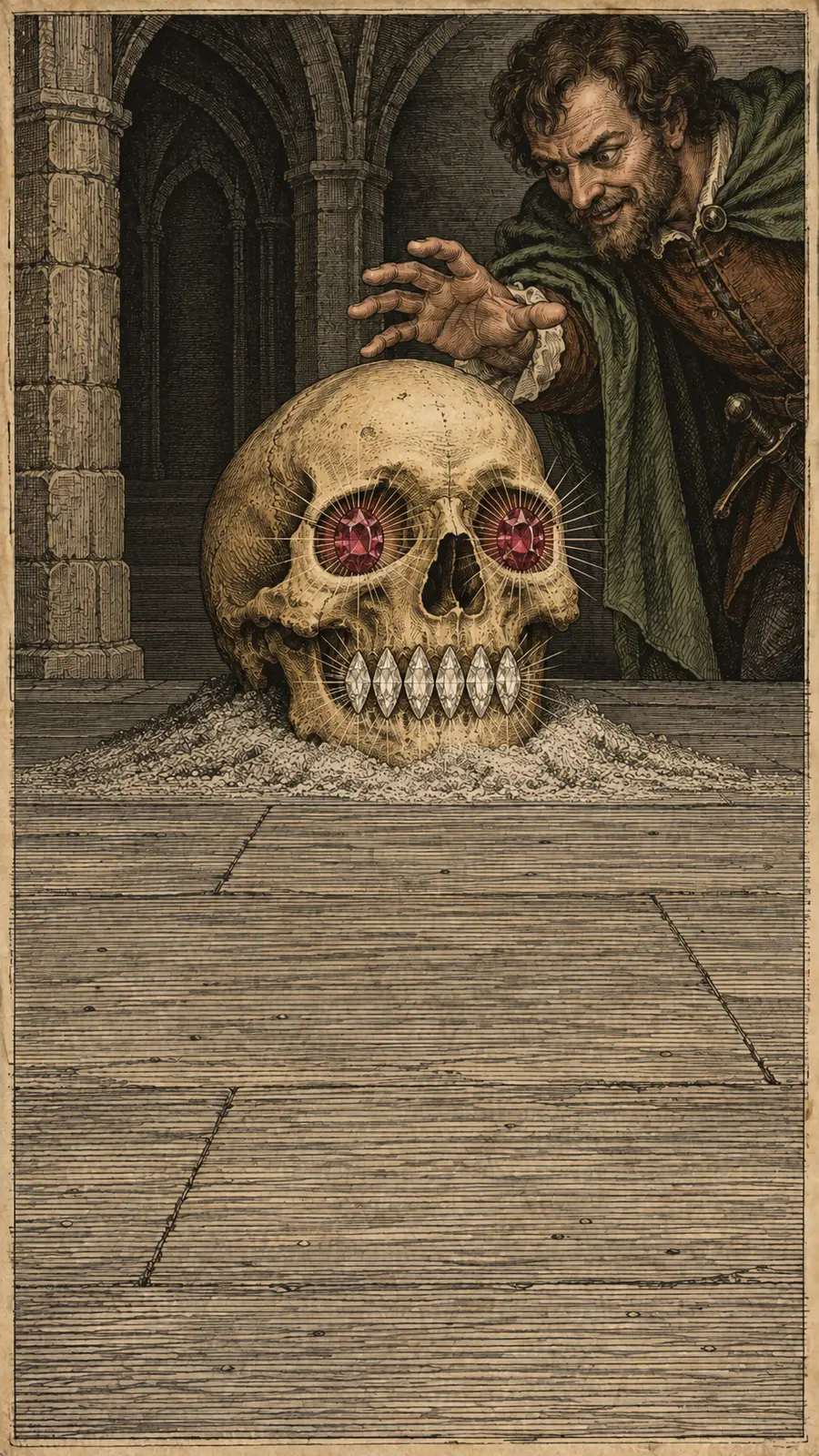
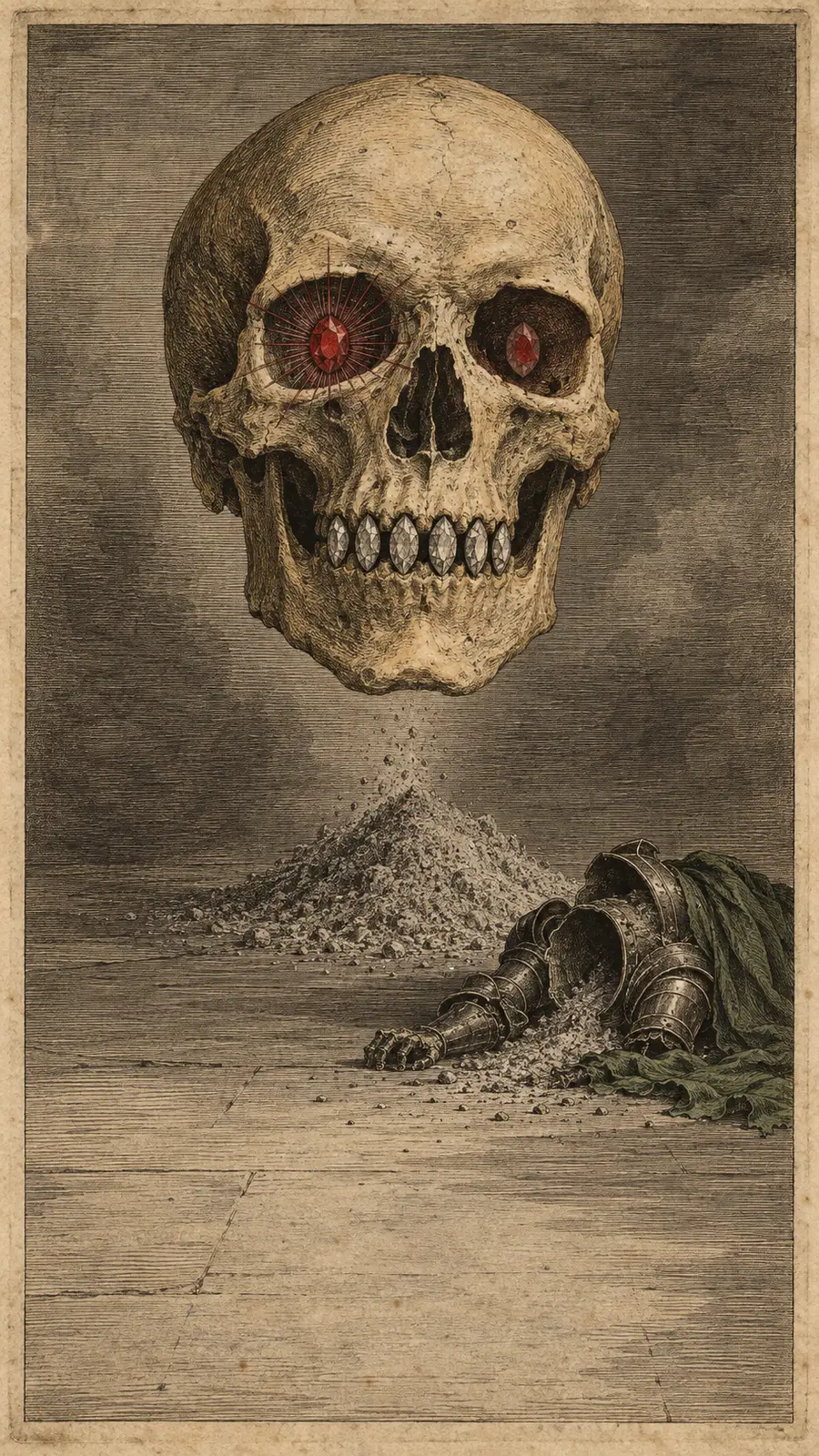
At the very end of the tomb, behind a secret door at the back of the dungeon, there's a crypt. In it lies very little: a fine dust that was once his bones, and a skull. That's all that's left of Acererak. The skull isn't bare, though. Two great rubies sit in its eye sockets, each worth a fortune. Six pointed diamonds, cut in the long marquise shape, are set in its jaw where teeth once were.
It's a striking image. A human skull, alone in the dust, glittering. You might first take it for a treasure, a jewelled ornament left in a forgotten vault. Many adventurers did exactly that.
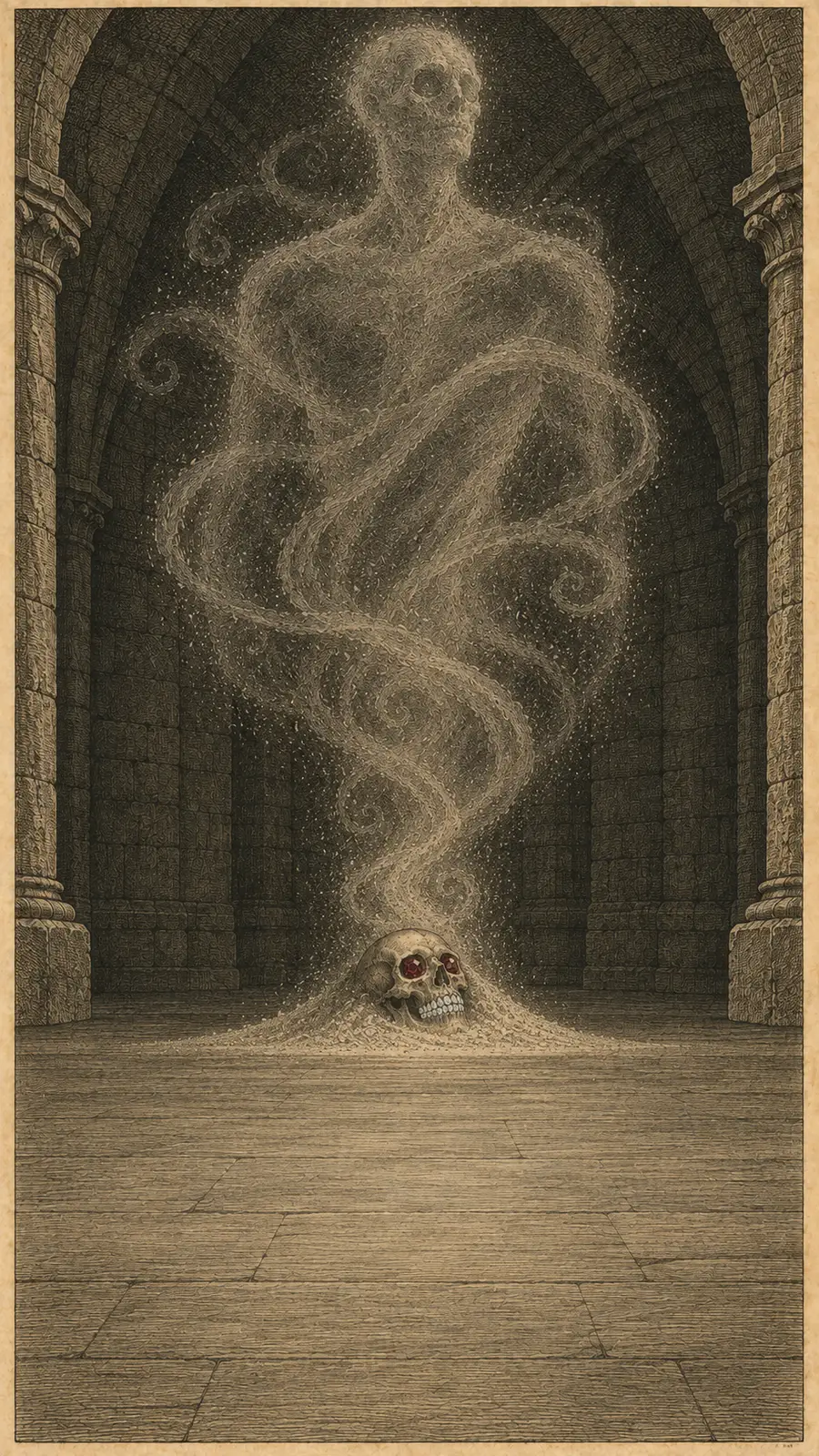
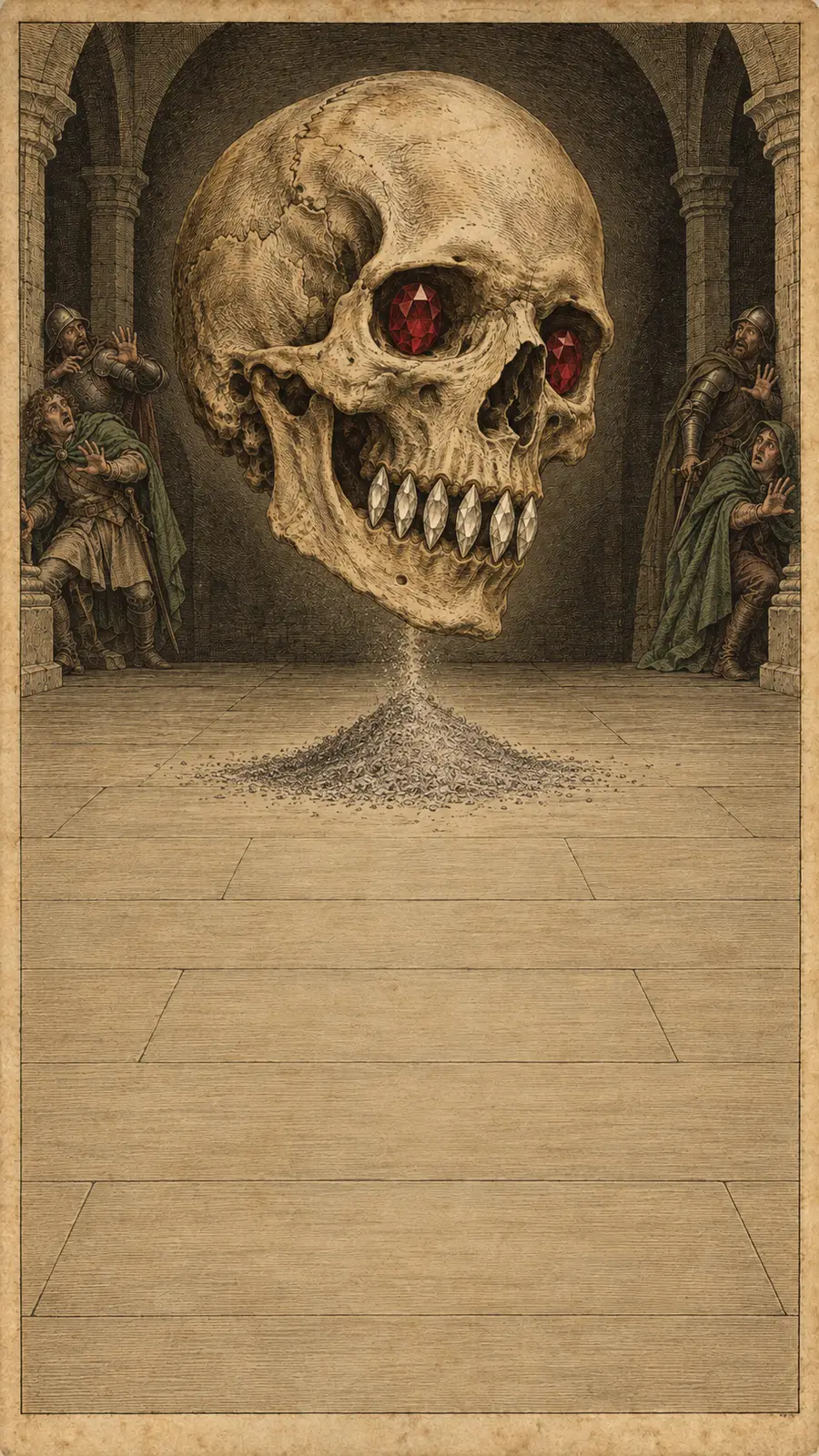
The gems aren't for seeing, though, and they aren't decoration. They're prisons. If someone disturbs the treasure in the crypt, the dust begins to stir and swirl, rising into the rough shape of a man, a ghostly memory of the body that once stood here. And if someone is foolish enough to touch the skull itself, it rises into the air. Slowly, almost thoughtfully, it turns and looks over the people in the room. It's searching for the strongest among them.
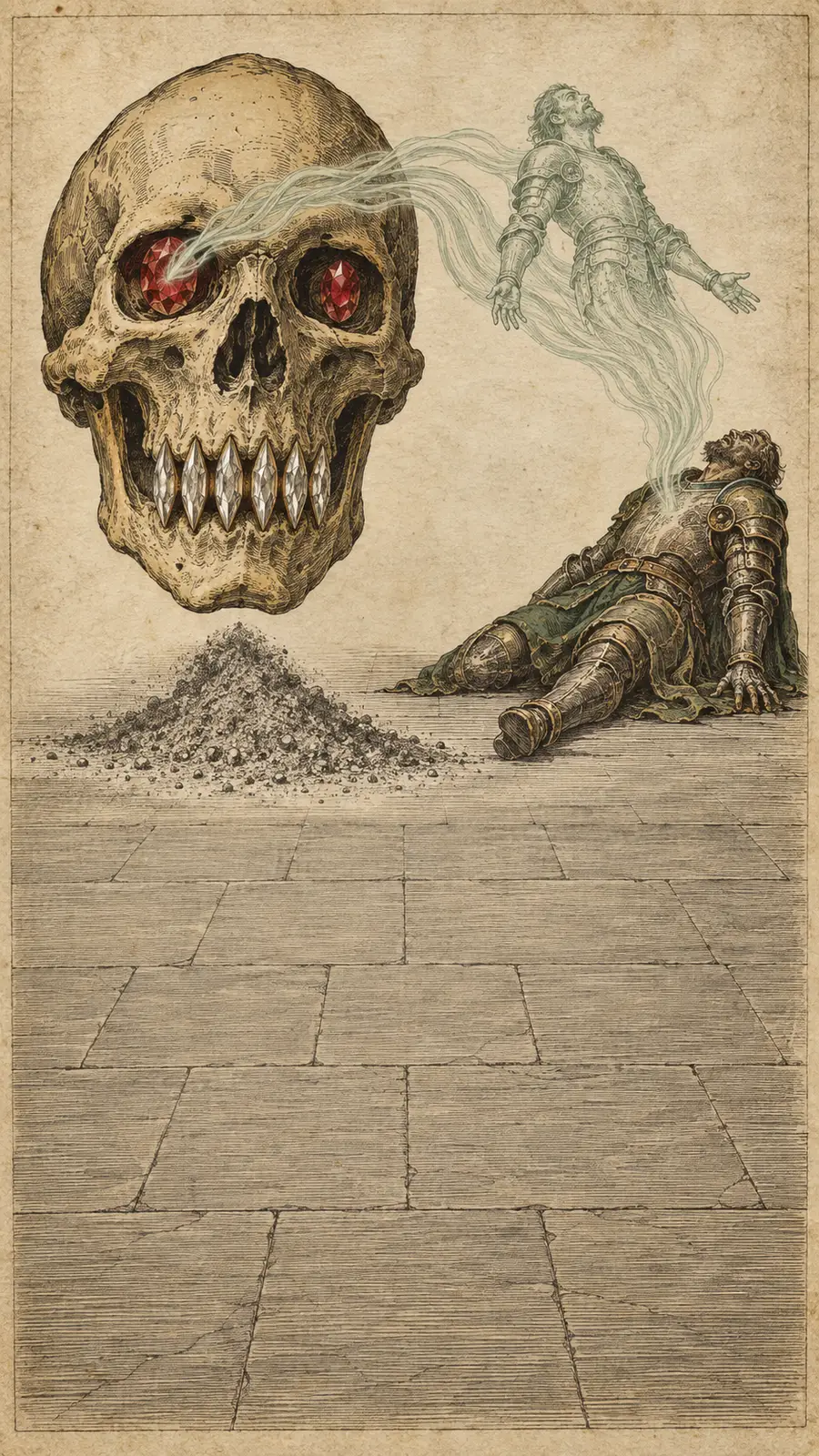
When it finds that one, the soul is pulled instantly from the body and drawn into the jewel of the right eye, which then gleams with what the module calls "wickedly evil lights." The body left behind collapses and moulders away almost at once. The skull can do this again for each of its gems, up to eight souls in all, one for each eye and each tooth. And if the survivors keep troubling it after it has fed, it speaks a curse that scatters them across the world, each sent to some random place hundreds of miles away.
In the first edition, very little could harm this skull. Only a handful of uncommon spells, and a few weapons of great power that couldn't be found in the tomb itself, would touch it. Certain spells could hold it off for a while without destroying it. A party had to arrive already carrying the right tools, or the right knowledge, or both. That was the legend's warning made real: nearly undefeatable, except by those who came prepared and thought carefully.
There's an idea folded into this picture that's easy to miss. The skull in the crypt isn't quite all of Acererak. His soul is out wandering the planes. What sits in the dust is what he left behind to guard his final haunt: a remnant with his hunger and his power, waiting for the moment someone reaches out a hand. Whether Acererak himself is truly present in that moment, or only some echo of him, is left in shadow, the way Smith left the death of uncertain. Later editions would have a great deal to say about this question.
Now, where is the hill?
The module was written so that a dungeon master could place it anywhere, in any world. For those playing in 's own World of , though, it offered suggestions, and they're a lovely little tour of that world's far corners. The tomb might lie inside the highest hill on the Plains of Iuz, in the cold north where a demigod rules. It might stand on an unmapped island in the , the great inland lake at the heart of the . It might be hidden in the Bright Desert, or on the western border of the Duchy of , among hills and old forests. It might wait somewhere in the Vast Swamp, south of the land of . Or it might lie on an island beyond the realm of the Sea Barons, out in the eastern waters.
Six places, far apart, each one remote. The hill was truly lost. It could be anywhere, and every table that played the module put it somewhere of its own. In time, Greyhawk lore settled on one of them, the Vast Swamp south of Sunndi, and that's where we'll find the hill when the story picks up again. In these early years, though, the tomb drifted across the map like a rumour.
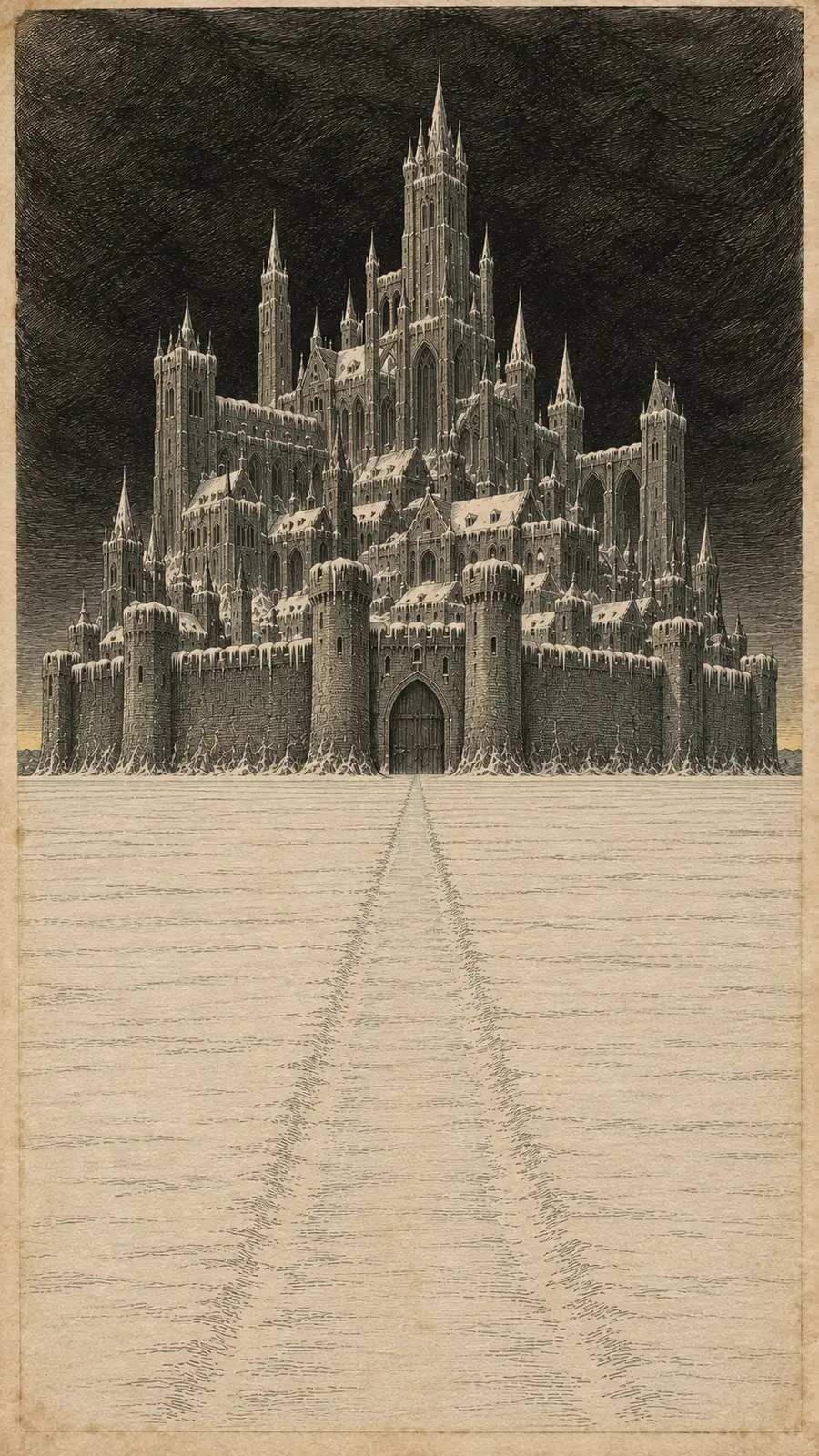
We've spoken of the hill as the legend describes it, but the module also describes it plainly, and the picture is worth carrying with you. It's a low hill with a flat top, a few hundred yards across and about sixty feet high. Ugly weeds, thorns and briars grow on its steep sides and its bald crown. Black rocks sit scattered across the top. On the north side, the hill has worn away into a crumbling cliff of sand and gravel, about twenty feet high in the middle, with a low stone ledge jutting out above it. Shrubs and bushes grow thickly enough that from any distance you wouldn't notice anything there at all.
Here's the quiet secret of the hill. If you could rise up into the air, about two hundred feet above it, and look down, the black rocks would arrange themselves into a shape. The heaps of stone would become the eye holes, the nose hole and the jagged grinning teeth of a human skull. The whole hilltop is a death's head looking up at the sky. You can't see it from the ground. Only birds, or the sky, or a very curious wizard on a flying carpet, would ever know.
That's very like Acererak. The truth of the place is hidden in plain sight, waiting to be understood from the right angle.
The first edition had one more piece of lore that bears on Acererak, though it isn't about him directly. The 1977 Monster Manual described the lich as a creature that had reached "a non-human, non-living existence through force of will." Conjurations and enchantments kept it going, along with something called a phylactery. The book didn't say what the phylactery did. It was a word with a mystery inside it. Later editions would explain it as the vessel where the lich's soul is kept safe. In the first edition, it was simply part of the dark machinery that let a sorcerer refuse to die.
In 1987, during the later years of the first edition, TSR gathered the four special modules into a single volume called Realms of Horror. It linked the Tomb of Horrors with White Plume Mountain, Expedition to the Barrier Peaks and The Lost Caverns of Tsojcanth into one long campaign meant to be played together. Lawrence Schick, who had written White Plume Mountain, shared credit with Gygax, and Larry Elmore painted the cover. It was a sign of how much these adventures already meant to players. They were becoming classics, gathered and bound together like a collection of old stories.
For ten years or so after that, the tomb rested. The game moved into a second edition. Greyhawk itself went through wars and changes. The hill stayed where it was, wherever each table had put it, with its briars and its black stones. Then, near the end of the second edition, a designer who had played the tomb as a teenager came back to it with a question. What if the adventurers who "destroyed" Acererak had been wrong?
Chapter V
Second edition: Skull City, Moil and the Fortress of Conclusion
By the time we reach the late 1990s, the game had changed hands. TSR, the company co-founded, had been bought by Wizards of the Coast, and the TSR name was still used on the books. Among the projects of those years was a series of returns to classic adventures, and in 1998 the most ambitious of them arrived: a boxed set called Return to the Tomb of Horrors.
Its author was Bruce . He'd played the original tomb in high school with his friend Monte Cook, who also became a game designer, and TSR had hired Cordell as a full-time designer a few years earlier. In a sense he was going home to a place he'd known since he was young, and this time he was holding the map.
The box was generous. It held a long adventure book, a book of pictures to show the players in the spirit of the original, handouts, and maps. It also held a copy of the original monochrome tomb, with a new introduction by Gary Gygax. The old and the new sat side by side, which suited the story inside, because the new adventure was built on top of the old one. It won the Origins Award for best roleplaying adventure that year, a gentle circle back to the convention where the tomb first ran. One reviewer called it "the slickest, sickest, most vicious official campaign."
The adventure was set in , and the hill was now firmly placed in the Vast Swamp, south of , one of the six locations Gygax had suggested twenty years earlier. Twenty years had passed in the world too, and much had changed around the hill.
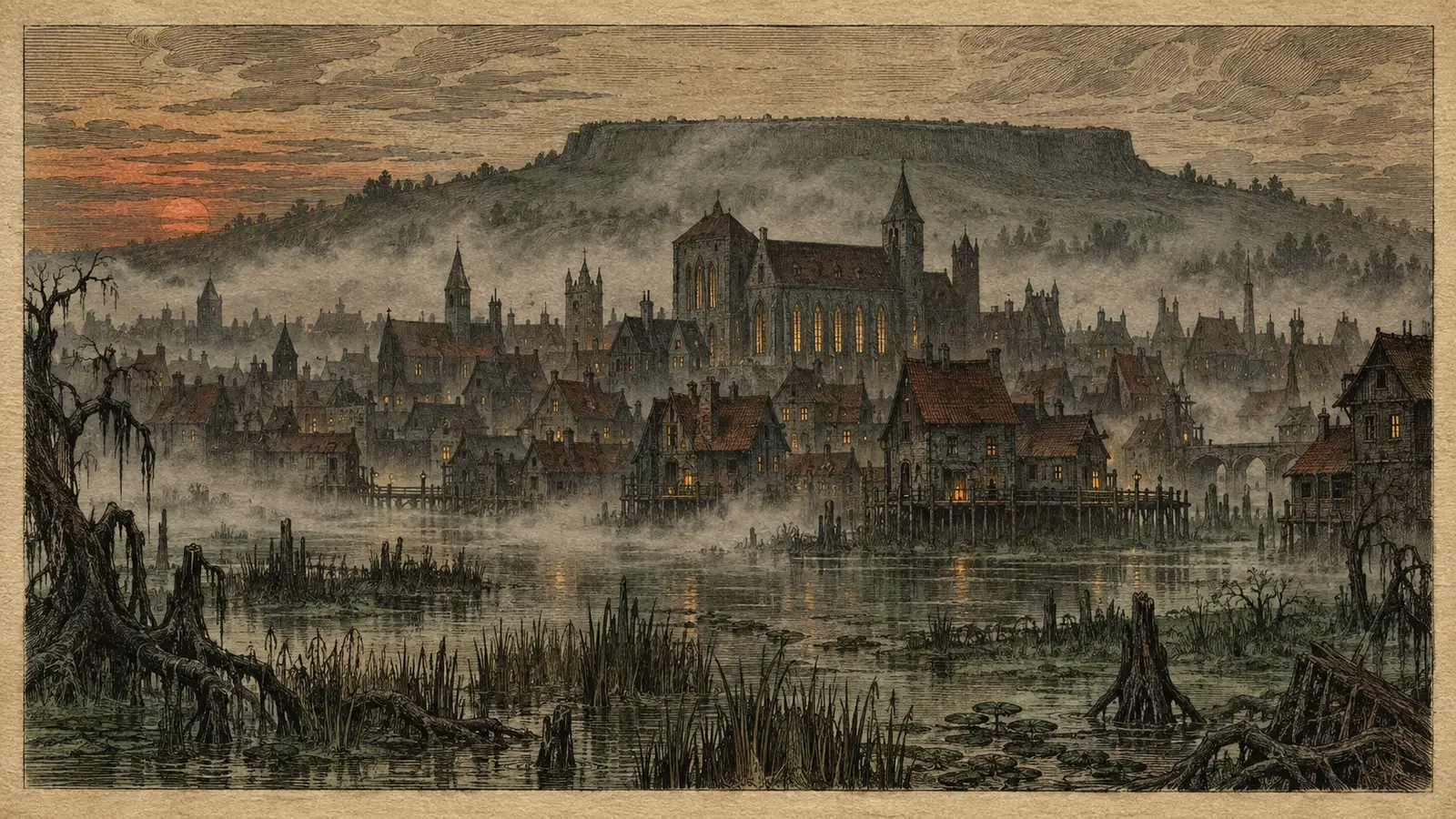
The tomb had become famous. Stories spread of the adventurers who went into it, of the treasures said to lie within, and of the demi-lich who had been defeated there. Fame draws people, and not all of them are heroes. Over those twenty years, necromancers and dark pilgrims began to gather in the swamp, drawn to the place where so much death had happened and where one of the great undead sorcerers had made his home. They came slowly, a few at a time, and they settled. They built.
In time a settlement grew in the shadow of the tomb, devoted to the dark arts. It was called Skull City. Some of its people were simply necromancers looking for a place where their studies would be welcome. Others were something stranger: mad worshippers of , who treated the demi-lich as something close to a god and the tomb as a holy site.
Picture it, if you like. A town rising out of the swamp, its buildings close together, mist curling between them, and over everything the low shape of the hill. In a place like this the tomb wasn't a rumour anymore. It was a landmark and a shrine, and a lesson to everyone who lived nearby.
At the heart of Skull City stood the Black Academy, a school of necromancy. Students came there to learn how to speak with the dead, raise them and command them. It was heavily guarded, so well protected that no band of adventurers could hope to storm it directly. Anyone who wanted to reach what lay beyond the Academy would have to go in quietly, under pressure, pretending to be something they weren't.
The head of the Black Academy was Mistress , who had led it since its founding. She was served by the Dim Triad, three evil vampires who carried out her will. Under her the Academy grew into something like a dark university, with the tomb itself as the old building at the centre of the campus that every student knows about and few dare enter.
The adventurers' journey began far from the swamp, in . In those years of Greyhawk's history, after the great Greyhawk Wars had redrawn the map, Kalstrand was the ancestral seat of the ruling line of , one of the kingdoms that rose from the ashes of the old Great Kingdom. From there the heroes travelled south, about a week through the Vast Swamp, toward Skull City and the Black Academy.
They had a guide of sorts: a journal. It belonged to a wizard named Gerik , who came from a place called Burntstone. Desatysso had made it his life's work to find Acererak's true tomb. His journal was full of clues, scraps of history and notes in the margins, and it gave the heroes a picture of Acererak they'd never had before. It pointed toward an object called the Amulet of the Void, which could guide its bearer to what Desatysso called the true tomb: the Fortress of Conclusion.
The true tomb. That phrase holds the great turn of the story.
Here's the tale as the second edition told it. Everyone believed, and the original adventure itself seemed to say, that a band of heroes who reached the final crypt and overcame the jewelled skull had destroyed Acererak. The skull crumbled. The demi-lich was gone. The hill was a ruin with nothing left to guard.
That wasn't quite true. The tomb under the hill, all thirty-three rooms of it, with its painted halls and its pits and its green devil face, had only ever been an antechamber, a doorway to something deeper. And the skull the heroes destroyed was two things at once. It was a decoy, meant to make them believe they'd won. It was also a key. The dust of the destroyed skull opened the way onward.
The way onward ran through the most famous trap in the tomb. In the original, at the end of the entry hall, a great green devil's face was set into the wall, its mouth a wide circle of pure blackness, and that blackness was a sphere of annihilation that destroyed whatever entered it. In the new story, the heroes passed through the green devil's mouth and came out somewhere else entirely. The many deaths that had happened inside the tomb over the years had helped open this gateway. Every adventurer who fell there had, without knowing it, added a little to the strength of the door.
On the far side lay , the City That Waits.
Moil has one of the saddest histories in all of the game's lore, and it deserves to be told slowly.
Long ago, Moil was a city on a world called . It was a real city under a real sky, with streets, homes and families. Its people worshipped , the demon prince of undeath, the bloated ram-horned lord of the Abyss whom we've met at the edges of earlier episodes, standing beside in Milton's court of chaos. For a long time the people of Moil gave Orcus their devotion.
Then they began to turn away. They looked toward other powers, gentler ones, gods who didn't demand what Orcus demanded. Orcus noticed, and his anger was patient and terrible.
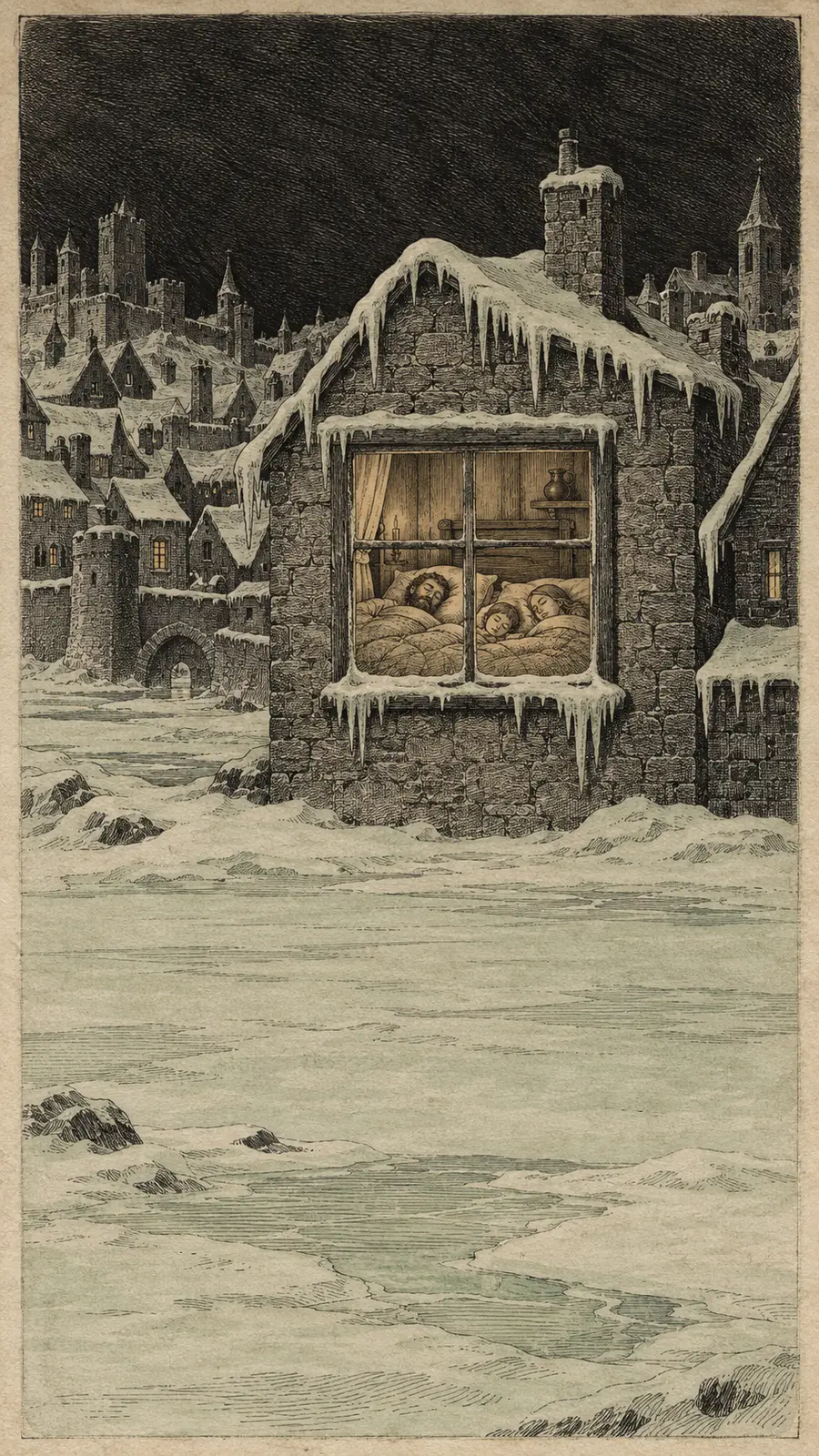
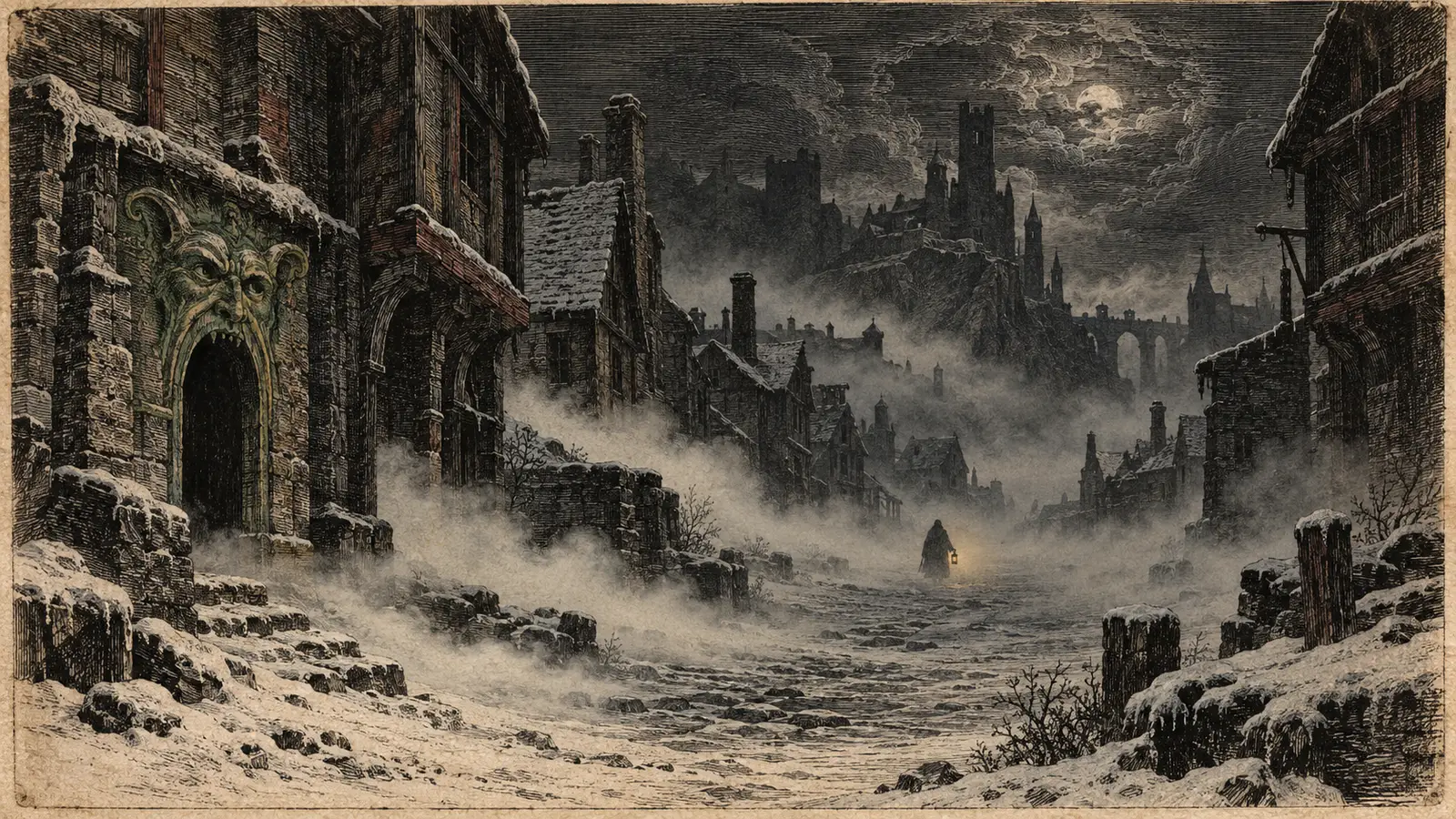
He laid a magical sleep over the whole city. Every man, woman and child in Moil lay down and slept, and the curse was such that only the rising of the sun could wake them. Then Orcus did something more. He tore the city off the face of its world, buildings and streets and sleepers and all, and cast it into a demiplane of endless darkness and ice, in the shadow of the Negative Energy Plane. In that place the sun never rises.
So the people of Moil slept. They couldn't eat or drink, and they couldn't keep warm. One by one, in their beds and their chairs and wherever the sleep had found them, they died, still waiting for a dawn that would never come. That's why Moil is called the City That Waits. In some tellings the world of Ranais didn't survive the loss of its city either. It fell into chaos after Moil was taken, and the whole world died.
You can picture the city now, in the darkness. Frost on every surface. Streets silent and white. Houses where the sleepers still lie as they fell, their faces turned toward windows that will never brighten. It's a place of stillness and cold, and in the quiet there's a long, slow sorrow.
Centuries later, Acererak found it. In one reading of the wider cosmology, this was in the years after Orcus himself had fallen. A planar adventure from 1997, Dead Gods, written by Monte Cook, told how the drow goddess of vengeance, , slew Orcus, and how he returned as an undead god called . With the demon prince gone, the city he had cursed lay waiting for whoever came next.
What came next was Acererak. He saw in Moil something useful. He raised some of the dead Moilians as undead labourers, the long-dead sleepers rising from their beds at last to work for a new master. With them he built his fortress, and he made Moil the gateway to it. The city became a frozen antechamber between the tomb under the hill and his true home.
Moil has its own guardian, though Acererak didn't make it. As the sleepers died, they dreamed. Their dreams were nightmares, the fears and griefs of people dying slowly in the cold and the dark without knowing why. Those nightmares didn't fade. They gathered and took form.
The thing they became is called the Vestige. It's a slow, rolling fog that drifts through the frozen streets, and it's full of sound. If you stood in its path you would hear whispers, moans and soft murmurs: the sounds the sleepers made as they died. The Vestige wants the living. It wants to draw them in, absorb them and give them its suffering, so they can share in what the people of Moil endured. Even the mightiest heroes find it almost impossible to destroy. It's grief that has become a place, moving slowly through a city that never woke.
Beyond Moil, at the edge of the Negative Energy Plane, hangs the Fortress of Conclusion.
The Negative Energy Plane is a realm of pure entropy, the opposite of life, the source of the power that animates the undead. It can snuff out even souls. On its very edge, where the darkness grows absolute, Acererak built his true stronghold. Its name is quiet and final. Conclusion. The end of the journey, and perhaps the end of everything.
Acererak's elite servants walked its halls. They were called winterwights: skeletons coated in ice, their skulls burning with black fire. He made them himself from lesser undead. He bathed ordinary skeletons and zombies in amplified negative energy and then worked powerful rites of binding and animation over them until they rose again as something colder and stronger. Picture them standing guard in frozen corridors, rime glittering along their bones and dark flames flickering where their eyes should be, perfectly still until called.
And Acererak himself? In this telling he had become an incorporeal spirit, without a body of his own. Inside the Fortress of Conclusion, though, he could step into any undead creature and wear it like a cloak. He might come to you as a skeleton, or as a winterwight with its burning skull. Often, out of habit or pride, he took the old familiar form: a floating skull with jewels for eyes and teeth, the same image that had waited in the dust of the crypt.
This is where the second edition revealed the purpose behind everything. Acererak had a plan, and he'd been working at it for thousands of years.
His goal was godhood. He meant to bind his essence to the Negative Energy Plane itself, to merge with it completely through enormous arcane effort, the sacrifice of thousands of souls and magic nobody else understood. All undead creatures draw their power from that plane. If Acererak became one with it, every undead creature on every plane would answer to him. Every skeleton in every crypt, every vampire in every castle, every lich in every tower would be his.
The power for this transformation came from souls, the souls he had consumed over the ages. That brings us back to the gems in the skull, and the strongest member of the party drawn into the right eye. Every soul taken was fuel.
He was very close. He needed only three more souls. They couldn't be just any souls, though. They had to be of exceptional purity and strength, souls of the very finest heroes in the world.
And that, the second edition revealed, was why the Tomb of Horrors existed at all. It was a test, the ultimate test, built to winnow out all but the very best. Every trap and pit, every false door, every room designed to kill the careless and the hasty, was a sieve. The weak would die in the corridors. The clever would go further. Only the truly exceptional would reach the final crypt and destroy the skull, and in doing so they'd mark themselves as exactly the souls Acererak needed. The tomb that had seemed like a dead wizard's spiteful joke was really a long, patient search for the worthy.
The heroes who followed the trail all the way to the Fortress of Conclusion faced a hard road. To save the stolen souls and end Acererak, they had to destroy every undead creature within the fortress, leaving him no body to hide in, and then dissolve his phylactery, the vessel that held his existence together. When that was done, Acererak ceased to be. That, at least, was how the second edition ended its story. As we'll see, Acererak has a habit of not staying ended.
Years later, in 2009, Cordell looked back on what he'd imagined about Acererak's beginnings. He spoke of him as "a persecuted tiefling child," someone born with the blood of fiends, who grew up to become a wizard and a priest of Orcus. That's a quieter, sadder origin than a simple tale of evil. It gives the skull in the dust a childhood. He also said plainly that the tomb "was actually a test to winnow souls," the idea that sat at the heart of his adventure.
The second edition added one more thing to the demilich's story, outside the tomb. In 1989, the first volume of the Monstrous Compendium gave the demilich its own general entry alongside the lich, and the Monstrous Manual carried it forward in 1993. The second edition also gave the lich's phylactery a clear purpose: it was the hidden vessel of the lich's soul. What had been one unique being, Acererak alone, became a kind of creature that other ancient liches might grow into. Acererak was no longer the only skull in the dust. He was simply the first and the most famous.
So by the end of the second edition, the lonely hill had become something much larger. It had a city of necromancers growing around it and a school of dark arts at its heart. Through the mouth of its green devil lay a frozen city full of dead sleepers, and beyond that a fortress at the edge of entropy, where a patient spirit had spent thousands of years reaching for the throne of all undeath. The game was about to enter a new edition, and that edition would inherit all of this.
Chapter VI
Third edition: the inheritance and the Devourer
In 2000 the game entered its third edition, and in 2003 a revised version often called three point five. The rules changed a great deal in those years. The story of the tomb mostly carried forward. Third edition didn't tear down what the 1998 box had built. It accepted it as the new foundation and added to it in small, careful ways.
In the lore of this era, the picture stayed as the second edition had painted it. The tomb under the hill was an antechamber. The skull in the crypt was a decoy and a key. Its dust opened the way to , the City That Waits, and beyond Moil lay the fortress at the edge of the Negative Energy Plane, where spent his thousands of years working toward union with that plane and command over every undead thing in the multiverse.
One piece of lore took a firmer shape in 's history during these years, and it gives a little more depth to the tomb's beginnings. In this telling, back while Acererak was still alive, before he became a lich, he built the complex under the hill as a temple. It was an unholy underground temple raised to a dark power. Some tellings name that power as . Others say only that it was a power now dead. When the temple was finished, he buried its architect and every worker who had built it inside its walls.
It's an echo of the first edition's tale, where the servants spent eight decades building the tomb and were destroyed when it was done. Here the idea is sharpened. The tomb began as a place of worship, a sacred building in a terrible faith, and its builders became its first dead. Later, after he had become a demilich, Acererak moved on to Moil to complete his plans, leaving the temple behind as the first gate on the long road to his door.
In 2002, a novel brought the tomb into prose for the first time. Keith Francis Strohm's The Tomb of Horrors told the story of a fallen paladin and his companions who seek the lost crypt of Acererak. We'll walk alongside them later, when we come to the variants and offshoots of the tomb.
In 2004, two things happened that touched the tomb from different directions. The first was a book called Libris Mortis, subtitled The Book of Undead, a large guide to the walking dead in the three point five rules. It set out how the game's undead worked, the demilich among them, and its rules would shape how the old tomb was rebuilt soon after.
The second was a celebration. To mark the game's thirtieth anniversary, Dungeon magazine published a list of the thirty greatest adventures of all time. The original Tomb of Horrors came third, behind only Queen of the Spiders and Ravenloft. Return to the Tomb of Horrors came tenth. Both the old door and the new road beyond it were honoured.
For Halloween of 2005, Wizards of the Coast gave players a gift: Bruce 's conversion of the original tomb to the three point five rules, offered as a free download. It kept nearly all of 's original, the hill, the halls, the traps and the skull, and updated the undead with material from Libris Mortis. The premise didn't change. Adventurers travel to the tomb to face the demilich Acererak and take whatever treasure they survive to find. A new generation of players met the green devil face and the jewelled skull just as their parents might have, with only the numbers on the page made new.
The richest new lore of the third edition came in 2006, from a book with a long title: Tome of Magic: Pact, Shadow, and Truename Magic. It introduced a new kind of spellcaster called a binder, and to understand where Acererak fits, we need to know what a binder does.
A binder makes pacts with beings called vestiges. Vestiges are strange. They aren't gods or demons, and they aren't ghosts in any ordinary sense. They're ineffable, amoral entities that exist outside the normal order of life, death and the planes. Some were once mighty beings who were destroyed or forgotten in such a way that they fell out of existence entirely, yet didn't quite cease to be. They linger in a place beyond places. A binder draws a sign, speaks the right words, summons one of these vestiges and binds it into their own body for a time, borrowing its powers in exchange for letting it see the world again through living eyes.
In Tome of Magic, Acererak is one of these vestiges.
The story it tells is this. Adventurers completed the Tomb of Horrors and destroyed Acererak. And in that destruction, he passed on, though not into nothingness. He became a vestige. Here he carries a name that's official in the game for the first time: Acererak, the Devourer. It fits a being who has fed on souls for so long.
When a binder summons him, he appears in his most famous form: a floating skull, with precious gems where its eyes and teeth should be. The old image from the crypt, now drifting up out of the dark beyond death to answer a stranger's call.
He won't come for just anyone. Before Acererak will appear, the summoner has to place a gemstone in his seal, the drawn symbol that calls him. The gem must be about the size of a human tooth, or a human eye. It's an offering that echoes exactly what he once was: a skull set with stones that held souls. You could imagine a binder kneeling in a dim room, setting a single ruby at the centre of a chalked circle, and waiting in silence until the air above it grows cold and a skull begins to take shape.
What he grants is what a lich would grant. A binder who carries Acererak can sense the undead nearby, and can pass among them without being noticed. Cold and lightning slide off them. Their touch can freeze a living creature in place. They can speak with the dead whenever they wish. And negative energy, which harms the living, instead heals them, as it heals the undead. For a little while the binder becomes something halfway between the living and the long-dead.
A vestige also exerts influence on whoever carries it. It leaves something of its personality behind in the binder's mind. Acererak's influence is telling. Whenever a binder carrying him sees a chance to fill an empty seat of power, any vacuum of authority over a group of creatures, Acererak demands that the binder try to seize it. Even reduced to a vestige, even destroyed and lingering beyond death, he can't stop reaching for command. It's the same ambition that drove him in his fortress at the edge of entropy, the hunger to rule all the undead of every plane, now shrunk to a whisper at the back of a stranger's thoughts.
Notice that Tome of Magic tells a different story from the 1998 box. In the second-edition telling, Acererak waited alive, in his strange way, at the Fortress of Conclusion, scheming and gathering souls. In Tome of Magic, he has already been destroyed, and what remains is a vestige, a remnant that can be summoned and bound. These were two threads of his fate, and for a few years they ran side by side, each true in its own book.
Third edition is where the Devourer's name settled on him, and where his story gained a strange afterlife beyond his own destruction. When the next edition came, its writers looked at those two threads, the Acererak of the fortress and the Acererak of the vestige, and braided them together into a single story.
Chapter VII
Fourth edition: the dead gods and the four tombs
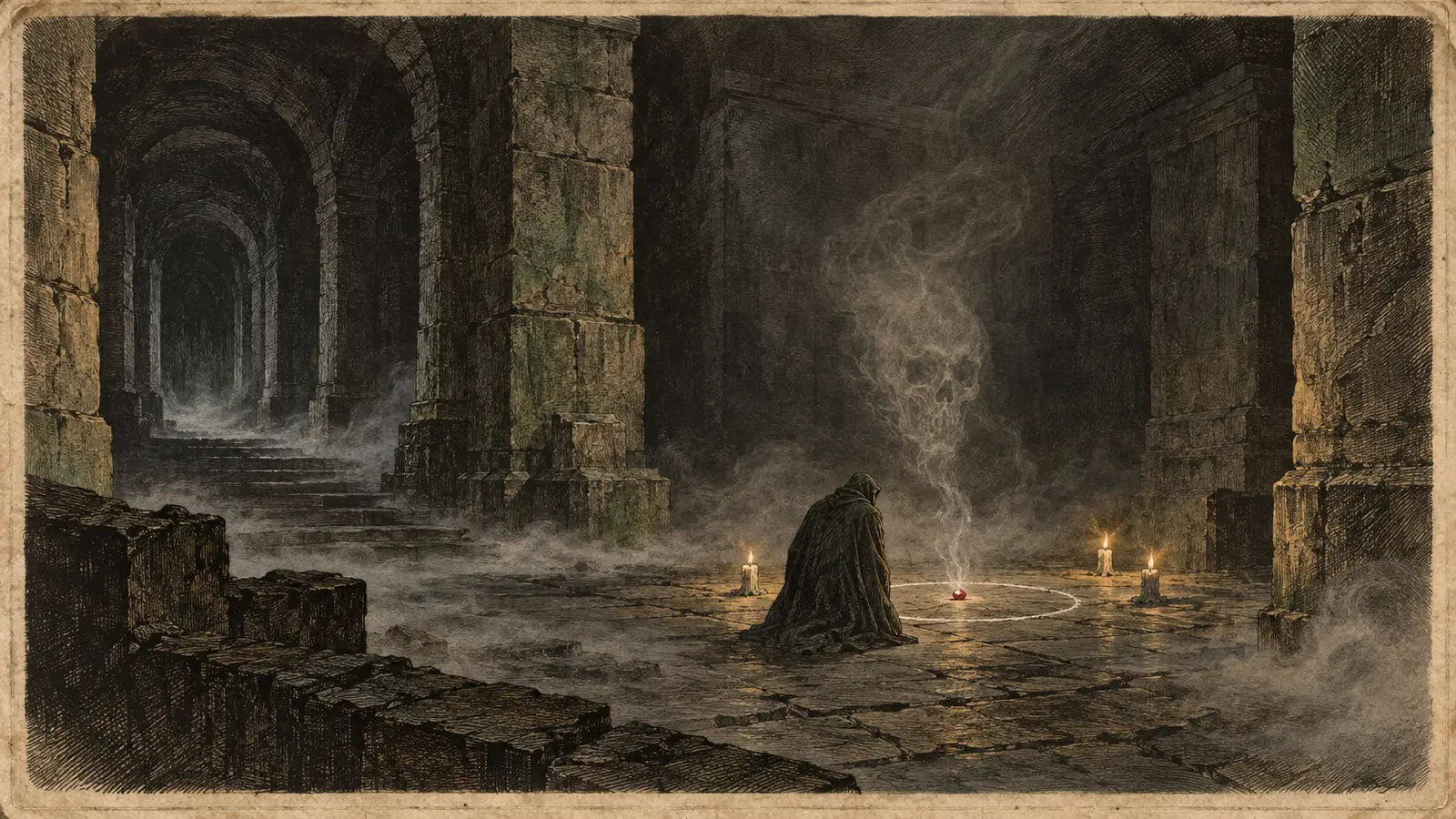
In July of 2010, during the fourth edition of the game, Wizards of the Coast published a large hardcover adventure called simply Tomb of Horrors. Ari and Scott Fitzgerald Gray wrote it. It was a long campaign meant to carry characters from the middle of their careers to the very height of their power, and it was built so a dungeon master could run it all as one long journey or take out pieces and use them on their own. It was a direct sequel to Return to the Tomb of Horrors, and it took the canon of the 1998 box as its starting point.
In the same season, Scott Fitzgerald Gray also prepared a separate, simpler fourth-edition version of the original module, given to members of the RPGA, the game's organised play network, as a reward for running games. So once again the old hill and the new road beyond it stood side by side.
also appeared elsewhere in the fourth edition. Open Grave: Secrets of the Undead, a book about the undead from 2009, gave him a place in what it called the Undead Hall of Infamy, a roll of the most notorious dead beings in the game's history. He turned up too in a side quest in the adventure Revenge of the Giants. He was becoming a figure who drifted through the edges of other stories, a name that meant danger wherever it appeared.
The fourth edition brought a new shape to the cosmos, and that matters for our story. The old planes of earlier editions were reimagined. There was now the , a dim, grey echo of the world where the dead pass on their way to whatever lies beyond. There was the , a bright, wild echo full of fey and old magic. There was the Astral Sea, where the gods kept their dominions like islands in a silver ocean. And in this new cosmos, the realm of negative energy where Acererak had always dwelled was described differently. It was no longer a plane of its own. It was a void-like region inside the Shadowfell, a deep hollow of darkness within the land of shadows. itself became one of the best-known places in the Shadowfell.
The story of the fourth-edition tomb takes place about a century after the events of Return to the Tomb of Horrors. In that century, everyone believed Acererak had been destroyed. The heroes of the Fortress of Conclusion had done their work, and the demilich was gone.
His spirit had survived, though. This is where the two threads of the third edition come together. The fourth-edition adventure tells how Acererak lasted after his destruction: as a vestige. The very idea from Tome of Magic, an amoral remnant beyond the normal order of life and death, became the bridge across his apparent ending. Destroyed in the fortress, he lingered as a vestige, and through ages of patience he gathered himself again. Now he was plotting once more. The promise that went with the book was simple: Acererak, long thought dead, is rising.
His new plan was subtler than the old one, and grander. Before, he had tried to merge with the Negative Energy Plane and become the master of all undeath. Now he looked at the gods. He didn't try to compete with the living gods. That would be a war he might lose. Instead, he turned his attention to the dead gods.
In the fourth edition's cosmos, gods could die. When they did, something of their divine essence lingered, scattered through the places they once ruled and the places where they fell. Acererak meant to gather those leftover fragments of divinity. Piece by piece, he would build himself into a god from the remains of the slain. His aim was godhood, and beyond it.
The dead gods named in his schemes were the old powers of the fourth edition's history. One was , the old god of death, whose throne the Raven Queen now holds. The Raven Queen had been a mortal once, and she rose to replace Nerull. When she took up his mantle, she abandoned his old realm, a place called , and made her home in the Shadowfell instead. Another of the dead gods had been thrown down by and , the two great demon princes, in some ancient struggle. Another had been murdered by , the lord of the Nine Hells, in the rebellion that made him a god. These were the scattered treasures Acererak sought: crowns without heads, thrones without kings, and divine power lying unclaimed in the dust of heaven.
To pursue this plan, Acererak worked through four tombs. The adventure leads the heroes from one to the next, each deeper and stranger than the last.
The first is a graveyard in the Feywild. The opening chapters take place here, in the bright and wild echo of the world, where even the dead lie among strange flowers and old enchantments. It's a fitting place to begin, with something lovely gone wrong.
The second is Moil, the City That Waits. It's the same frozen city, its sleepers long dead in their beds, now a place within the Shadowfell. Acererak built his fortress there because negative energy had always fascinated him. As in the older telling, the many deaths inside the original tomb had opened a gateway from its crypt to Moil. The heroes walk again through its cold streets, where the Vestige once drifted, and where the stillness of the never-risen dawn lies over everything.
The third tomb is the site of the original Tomb of Horrors itself, the lonely hill. After the events of 1998 the tomb had fallen. Around its ruins, Skull City had grown, and the Black Academy, the school of necromancy, still stood. A century on, the necromancers' city was built on the broken bones of the old dungeon. The heroes return there, to the place where everything began, and find it changed and crowded with the living who serve the dead.
The fourth tomb, the last, lies in Pluton, the fallen realm of Nerull, adrift in the Astral Sea. Pluton was the dead god's dominion, abandoned when the Raven Queen took his throne and went to the Shadowfell. It still floats in the silver void, empty and silent. At its heart stands Nerull's old palace, the . Beneath that palace, in the dark under the house of a dead god of death, Acererak hid his final tomb.
It's a striking idea. The demilich who once hid under a hill now hides under the throne room of a god. As his ambition grew, so did the places he chose to sleep.
At the climax of the adventure, the heroes find Acererak restored. He is once again a true demilich, with all his old and terrible powers. The vestige has become the skull again, and the long patience of a century has borne fruit. The heroes have to face him at the height of his strength, in the deepest place of the four tombs.
The fourth-edition adventure was less lethal than the original, as befitted the gentler rules of that edition, but it was still very deadly. Many of its encounters were intricate battles, a change from Gygax's tomb with its few monsters, though it kept a good share of traps and tricks that recalled the old module. Something of the original spirit survived in it: the sense that the place itself was the enemy and that careless steps had consequences.
So by the end of the fourth edition, Acererak's story had grown again. He had been a lich in a hill, then a schemer at the edge of entropy, then a vestige beyond death, and now he was a scavenger among the corpses of gods, gathering divinity from the places they fell. When the fifth edition came, it took him somewhere new: away from altogether, into the jungles of another world.
Chapter VIII
Fifth edition: the skull on the cover and the tomb in the jungle
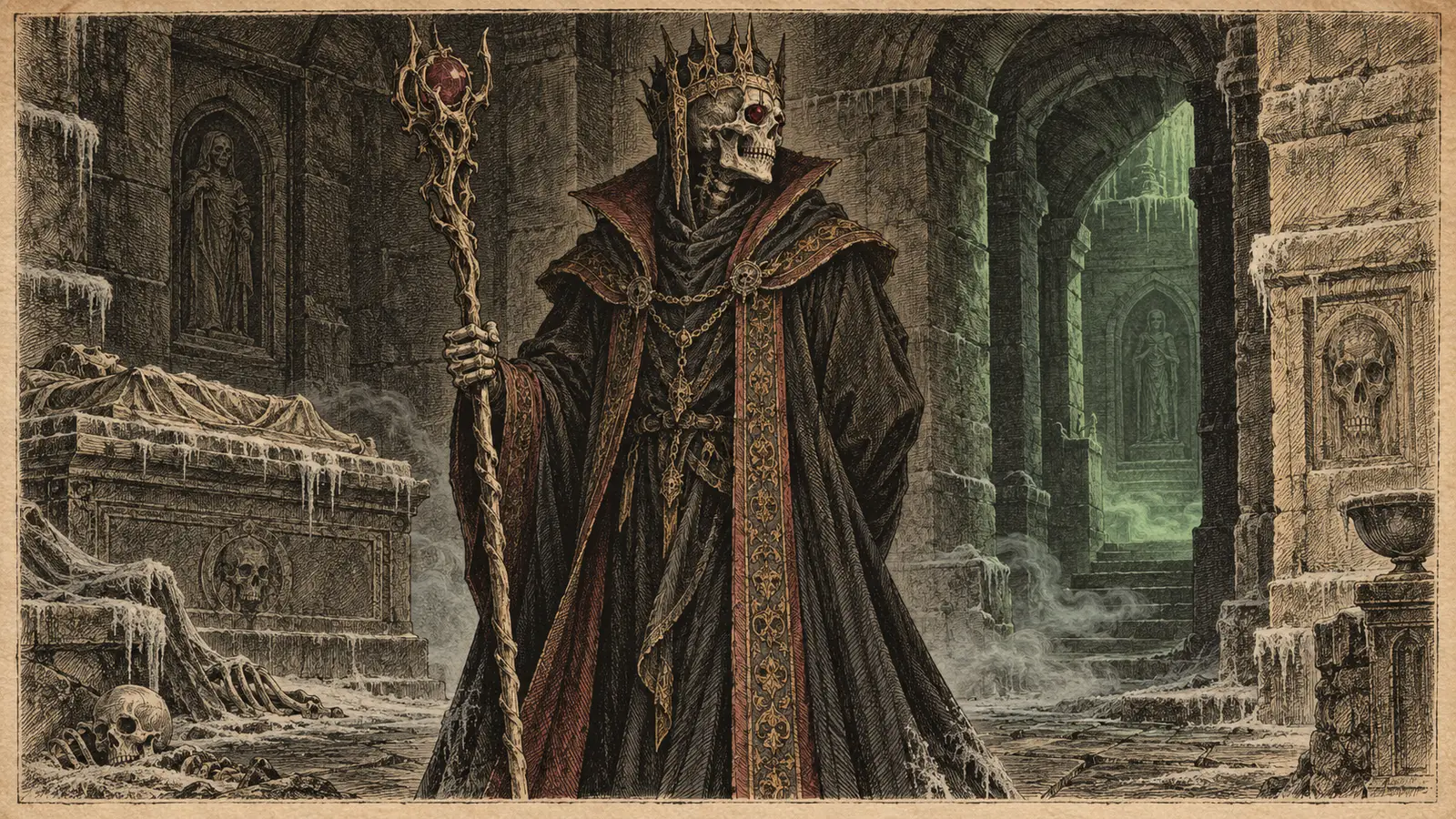
The fifth edition of Dungeons and Dragons arrived in 2014, and with it came a picture that many players would see every time they opened their dungeon master's guide. On the cover of the 2014 Dungeon Master's Guide was . For about ten years his image looked out from the book that dungeon masters kept closest at hand. In a way, he had become the face of the person behind the screen: the patient architect who builds traps and waits to see who will fall into them.
The 2014 Monster Manual gave the demilich its own entry, and it named Acererak directly. It described him as a powerful wizard and demonologist, the infamous master of the Tomb of Horrors. It told a small detail that fits him well. In anticipation of becoming a demilich, Acererak set enchanted gemstones into the eye sockets and teeth of his own skull. He prepared his jewels before he needed them, the way a careful person lays out tomorrow's clothes the night before. Then he abandoned his physical body to moulder into dust and travelled the planes as a disembodied consciousness. Among the powers the book gave him, or any demilich like him, was one called Trap Soul, which draws a creature's soul into one of the gems. The old image from 1978 lived on, almost unchanged.
Before the fifth edition was finished, there had been a long period of public testing, when the new rules were called D&D Next. In 2013, Dungeon magazine carried Chris Perkins's conversion of the Tomb of Horrors for those testing rules. Even while the edition was still being shaped, the tomb was one of the places its designers wanted to try.
The full fifth-edition version came in 2017, in a book called Tales from the Yawning Portal. The Yawning Portal is a famous tavern in the city of Waterdeep, in the Forgotten Realms, built around a great well that drops into the dungeon of Undermountain. The book imagines adventurers gathered at its tables, swapping stories of the classic dungeons of the game's history. It gathered seven of them, updated for the new rules, and the Tomb of Horrors was the most dangerous, set for characters at the very top of their power.
In this version the old rooms are kept. The hill is there with its briars, and the painted hall, the arches and the jewelled skull. One small change of rules gives a little more hope to the careful. A character who studies the green devil face and knows enough of the arcane can recognise what fills its mouth: a sphere of annihilation, fixed in place, that can't be moved or controlled. In 1978 you had to find that out with a ten-foot pole, or worse. In the fifth edition, learning can save you.
That same year, 2017, Acererak returned in a brand-new adventure, and this one carried him into a world and a story far from his old home.
The adventure was Tomb of Annihilation, set in the Forgotten Realms. It was written by Christopher Perkins, Will Doyle and Steve Winter, with additional design by Adam Lee. An unusual name joined them as story consultant: Pendleton Ward, the creator of the animated series Adventure Time. The designers wanted humour in the story to balance its feeling of being trapped and hemmed in. The adventure is a love letter to three classic modules: the dinosaurs and lost world of Isle of Dread, the overgrown jungle ruins of Dwellers of the Forbidden City, and above all a deathtrap dungeon in the spirit of the Tomb of Horrors. Players could begin it as brand-new adventurers and grow into seasoned heroes over its long course.
Its story begins with a curse.
Across the world of , something is wrong with death. Everyone who has ever been raised from the dead, everyone who once died and was brought back by a priest's prayers or a wizard's magic, begins to waste away. Day by day they grow thinner and weaker, sliding slowly back toward the death they once escaped. When they die, they can't be raised again. Nor can anyone else. No matter how powerful the priest or how sincere the prayer, the dead stay dead. Somewhere, something is catching the souls of the dying and keeping them.
This is the death curse, and its source lies far to the south, in .
Chult is a remote peninsula on the southern edge of the known Realms, ringed by mountains and thick with rainforest. It's a land of jungles, rivers and ancient ruins, where dinosaurs still walk and the air is heavy with heat and the calls of strange birds. Travellers reach it through Port , a bustling gateway city on its coast. From there they head inland, into the green.
Somewhere deep in those jungles lies a lost city, and beneath the lost city lies a tomb.
The city is called Omu. Its history is long, and it forms the ground that Acererak's new tomb was built on, so let's walk through it slowly.
Omu was once a prosperous city of mining and trade. Its people were wealthy, and their city was beautiful. Wealth breeds wanting, though, and Omu grew greedy. It began to demand slaves as tribute from its neighbours, to work its mines, and its armies marched across Chult to collect them.
This angered , the great god of Chult, who had watched over the land and its people for ages. Sometime in the late thirteenth century by the Dale Reckoning, the calendar of the Realms, Ubtao abandoned the . He turned his face away. Without their god, the city faltered. The slaves rose up, and Omu fell into ruin.
A city without a god is a city that other things can notice. In the jungles around Omu lived primal spirits, ancient and wild, bound to the creatures and places of the land. They saw the scattered Omuans, godless and afraid, and they made an offer: power, in exchange for worship. The Omuans accepted. They tore down Ubtao's temples and turned to these new powers.
These were the nine trickster gods. They were brutal and quarrelsome, and they weren't kind masters. They demanded sacrifices and blood trials, contests that tested their clerics and entertained the people. Their reign over Omu lasted about ninety years, a long season of violent festivals and bitter rivalries among the gods themselves.
It was those quarrels that drew the attention of a traveller.
Late in the fourteenth century by the Dale Reckoning, the bickering of the trickster gods caught the curiosity of Acererak, here a lich who travels the cosmos. Curiosity, for a being like him, is never idle. He came to Omu. He invaded the city, killed the trickster gods and enslaved the people.
Then he set them to work. Just as his servants had once laboured for eight decades under a lonely hill, the Omuans laboured now beneath their own ruined city, carving a new tomb into the living rock. It was to be a murderous place, every chamber a trial, every passage a test. When it was done, Acererak sealed the malevolent spirits of the dead trickster gods inside it, one spirit to each burial chamber, imprisoned in the tomb their own worshippers had built. Then he slaughtered the remaining Omuans and bound their fate to the fate of their gods.
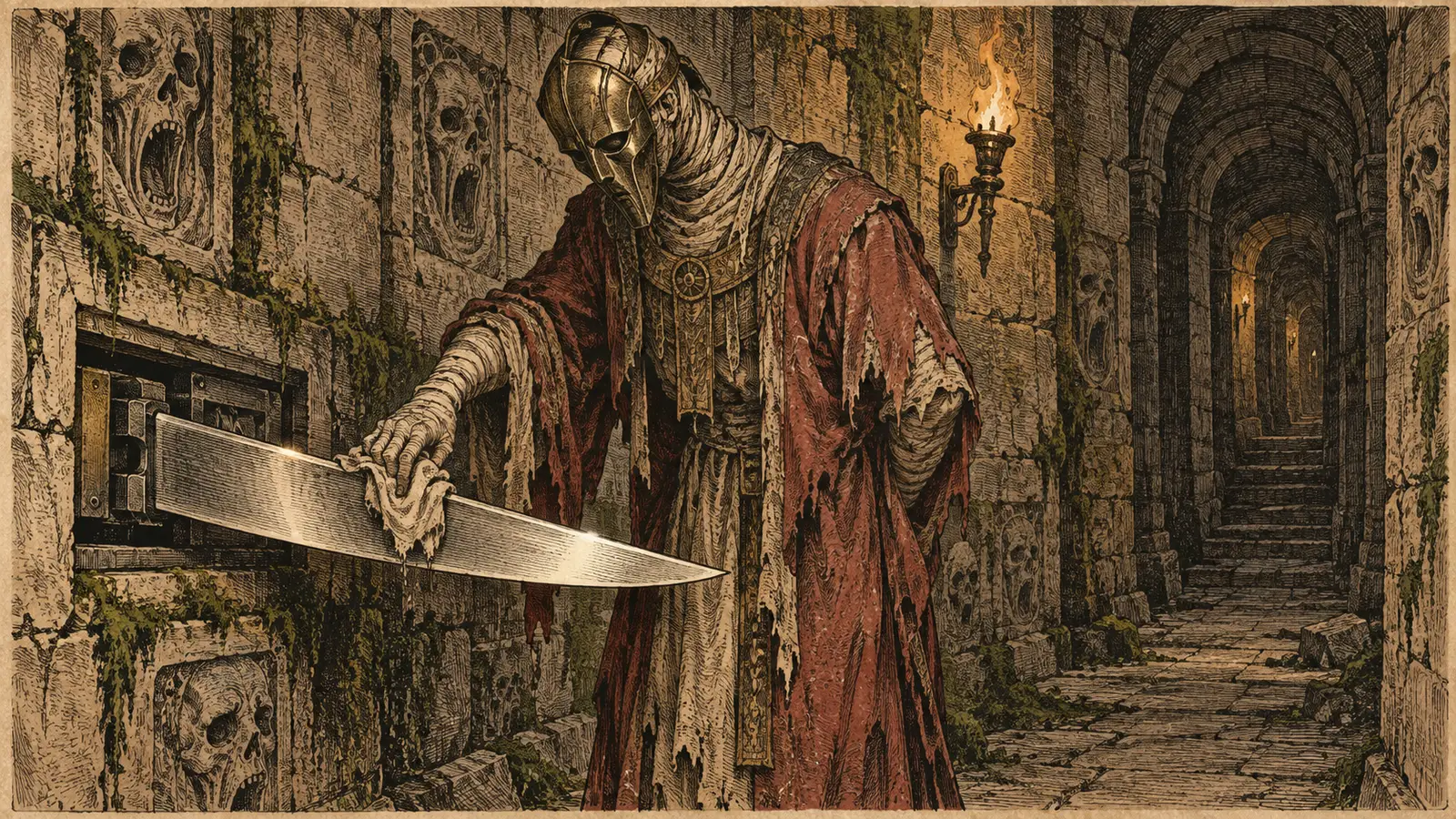
One Omuan was spared that ending, after a fashion. The architect who had designed the deadliest traps was made undead and set to watch over the tomb. He is called Withers. He's a masked custodian who walks the halls, keeps the mechanisms in good order and oversees the place he once designed. There's something melancholy about him: an artist who has to tend his terrible work forever, unable to rest, polishing the blades of traps meant for strangers.
This tomb is called the Tomb of the Nine Gods. Some know it by another name: the Tomb of Horrors.
The ruins of Omu didn't stay empty. In the middle of the fifteenth century by the Dale Reckoning, yuan-ti came and settled among them. The yuan-ti are serpent folk, part human and part snake, old and cold and clever, and these came from a place called . Following them came , fleeing from the city of . When a natural disaster killed the yuan-ti abomination who had led the settlers, Ras Nsi performed a ritual that turned him into a malison, one of the serpent folk, and he took command. He rules now from a temple called the Fane of the Night.
Ras Nsi has his own reasons for seeking the tomb. The death curse is eating away at him too, wasting him slowly as it wastes everyone who has been raised from death. Like the heroes, he wants into the Tomb of the Nine Gods. Like them, he needs the keys.
The keys are puzzle cubes. Each of the nine trickster gods has a trapped shrine somewhere in the ruins of Omu, and in each shrine waits a small stone cube carved with that god's symbol. The cubes can't be broken. If someone carries one more than a mile from the city, it vanishes and reappears in its shrine, as though the city itself refuses to let it go. All nine cubes are needed to open the tomb. So the heroes have to wander the ruins shrine by shrine, facing each trickster's trial, while the yuan-ti hunt the same treasures.
The nine gods each take the form of a creature of the jungle. Moa is the truthful one, and he appears as a jaculi, a snake that springs from the trees. takes the form of an almiraj, a small horned hare. appears as a froghemoth, a great tentacled thing of the swamps. , the cruel one, appears as a su-monster, a grasping beast of the treetops. appears as a zorbo, a small creature that can draw strength from what it touches. is the greedy one. is the proud one. and complete the nine.
Their spirits are more than names on a shrine. Inside the tomb, the spirits of the trickster gods can enter the heroes, slipping into their bodies and offering advice, each in its own voice and nature. In one chamber, the heroes find a bottle that holds a dao, a genie of the earth. The tricksters each have something to say. Truthful Moa tells his host not to break any bargain made with the dao. Greedy Nangnang urges self-serving deals, the sharper the better. Proud Papazotl suggests treating the dao as a servant. It's a lovely piece of lore: the ghosts of jealous gods, locked in a dead lich's tomb, still quarrelling inside the heads of the people trying to escape it.
And what does the tomb look like?
It's vast, far larger than the original under the lonely hill. It descends through about six levels and something like eighty rooms, filled with puzzles, riddles, illusions and traps. Acererak gave each burial chamber its own brutal trial. Stairs are cut into the living rock, each step capped with a single slab of cut stone. Along every staircase, niches hold the skulls and bones of the dead Omuans, so that as you climb down you pass between rows of the people who built the stairs.
The first level is called the Rotten Halls. The air there is stale and humid, heavy with the breath of the jungle above. Moss covers the walls, and the walls are carved with screaming skulls. Rotting roots and dead vines hang down from the ceiling, brushing your face as you pass. Deeper down are places with quiet names that hint at their dangers: the Veils of Fear, a Sandfall Cell, an Oubliette, the kind of deep pit where prisoners were once dropped and forgotten.
At the very bottom lies the Cradle of the Death God.
Here we reach the heart of Acererak's scheme in this telling, and it's one of the strangest things in all his long story. Acererak brought to Toril an atropal. An atropal is the undead fetus of a stillborn god, a divine being that died before it was ever born and was then animated by negative energy. It holds the potential of a deity and the hunger of the undead, unfinished and waiting.
Acererak placed it in a cradle at the heart of his tomb and fed it necromantic energy, hoping it would grow into a god with dominion over death. Not a god he would become, as in the older tales, but a god he would raise.
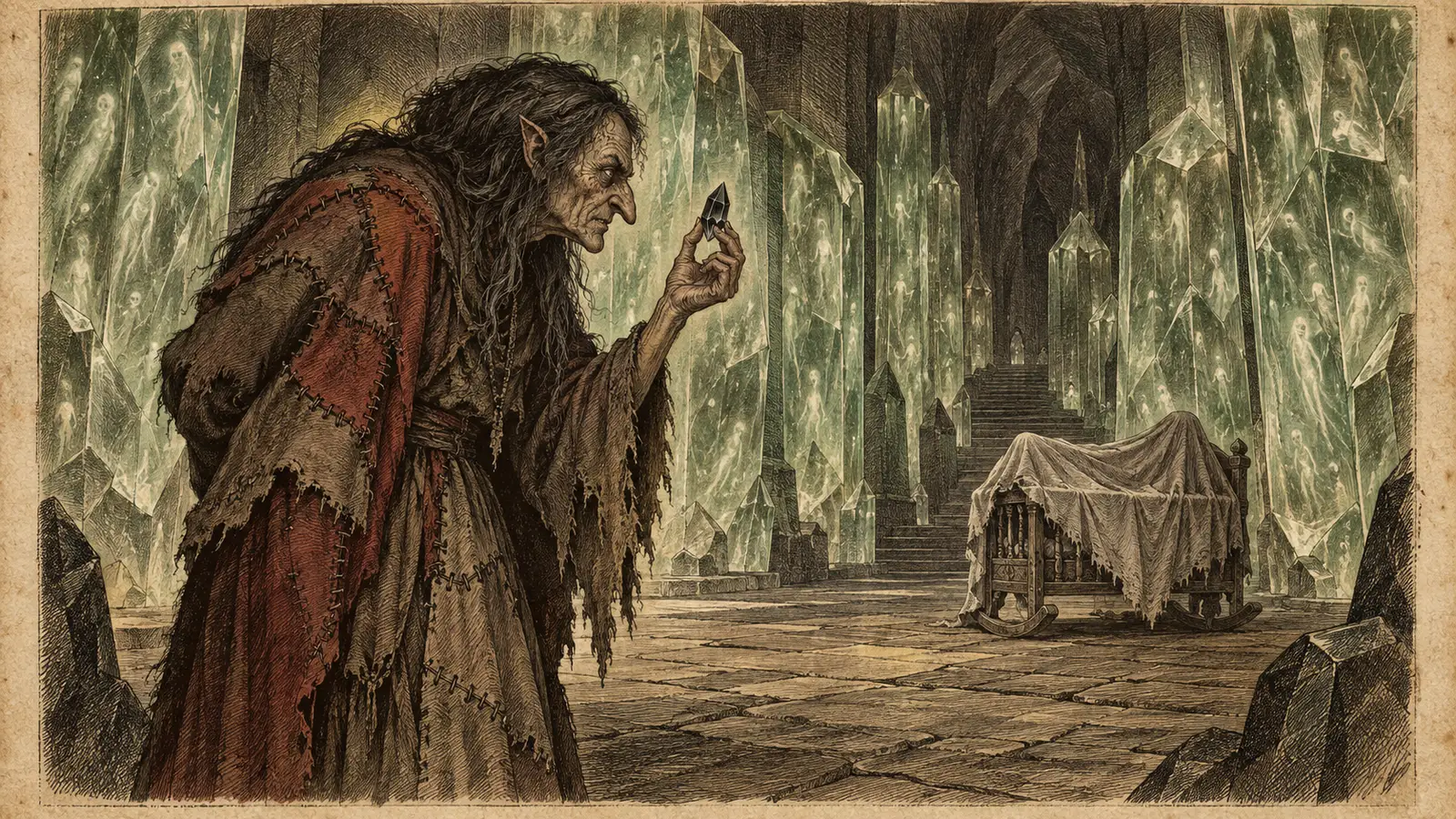
Feeding an unborn god takes a great deal. It takes souls, an untold number of them. To find so many, Acererak bargained with the Sewn Sisters, a coven of night hags feared throughout the Lower Planes. Night hags trade in souls. They harvest them, buy and sell them, and keep them in little gems. The Sewn Sisters were tempted by Acererak's offer of a nearly endless supply, and they joined him in the tomb. One of them is called Peggy Deadbells, a night hag who harvested souls for the atropal in the Tomb of the Nine Gods.
Together, the lich and the hags built a device called the . It's hidden at the heart of the tomb, and it does one thing. It reaps the souls of the dying, from all across Toril, and feeds them to the atropal. When someone dies anywhere in the world, the Soulmonger catches their soul before it can pass on and draws it down into the crystal chamber under the jungle. That's why no one can be raised. The souls aren't where the priests are calling for them. And the same reaping is what drains those who were raised from death in the past. Their souls were once loosened from their bodies, and now the Soulmonger pulls at them, slowly, every day.
So the Cradle of the Death God is a huge chamber of crystal, filled with the souls of the dead. Picture it glimmering with them, countless faint lights drifting in the stone. Acererak waits there, and the atropal in its cradle, and the Soulmonger humming quietly as it works.
The atropal is dangerous. Its wail, the cry of an unborn god, can kill. Radiant power, the light of the living gods, works well against it, and its bond with the Soulmonger can be broken. When heroes breach the tomb and reach the cradle, Acererak's scheme is thwarted, and the souls caught in the crystal can at last go free.
It's worth noticing how this story fits with what came before. The Acererak of 1978 drew souls into jewels set in his own skull. The Acererak of 1998 needed souls to fuel his merging with the plane of negative energy. In Tomb of Annihilation he gathers souls from an entire world to feed a god he hopes to raise. The scale grows, from one adventurer at a time to every death on a continent, but the hunger is always the same. He collects the best of what lives, and he keeps it.
The adventure was loved, and its jungle tomb spread into other games, which we'll come to when we gather the tomb's many offshoots. In the same year it also took the stage. A live show called Force Grey: Survive the Tomb was played in Brooklyn, with Matthew Mercer as dungeon master and a table of players including Joe , Deborah Ann Woll, Dylan Sprouse, Utkarsh Ambudkar and Marisha Ray, all facing the death curse and the demilich who caused it.
With the fifth edition, then, the Tomb of Horrors had become two places at once. There was the old hill, kept almost unchanged in Tales from the Yawning Portal, its traps faithfully rebuilt for new players. And there was the Tomb of the Nine Gods, under the ruins of Omu in a far-off jungle, where the same patient architect had built a larger trap for a larger purpose. Between those two places, many other versions of the tomb had grown up over the years.
Chapter IX
Variants and offshoots: a novel, many conversions and a jungle in other games
A place this old casts many shadows. Over the decades the Tomb of Horrors has been retold, rebuilt, collected and echoed in all kinds of forms, and some of those forms added their own small pieces to its story.
The first full retelling in prose came in 2002, in Keith Francis Strohm's novel The Tomb of Horrors. It was part of a series called the Classics, seven novels drawn from famous adventures of the game's first decade. Strohm set his story in the World of Greyhawk and built it around the original module.
At its centre is Whitehart, a fallen paladin of , the god of valour and chivalry. About ten years before the story begins, Kaerion was captured by the forces of Iuz, the cruel demigod of the north, and held in , Iuz's capital. Something happened to him there that broke him. He fell from grace. Since then he has lost his faith and tried to drown his sorrow in drink.
There's one thing he can't escape. His holy sword, , won't leave him. Whenever he throws it away, it turns up again among his belongings. You can picture it: a weary man in some tavern, tossing a sword into a river or leaving it in a ditch, and then waking the next morning to find it lying beside his pack, patient and silent, waiting for him to remember who he was. It's a gentle, persistent kind of grace.
Kaerion's best friend is , an elven archer with a magic bow. Gerwyth has taken service with a group of nobles from , a kingdom in decline, who want to find and enter the lost tomb of the evil wizard . Gerwyth needs a strong arm and a brave heart, and reluctantly he recruits Kaerion.
The novel moves between several viewpoints. One of them belongs to an enemy: , a priest of , the imprisoned god of eternal darkness and entropy, whose worshippers seek always to free him. Durgoth has allied with the Scarlet Brotherhood, a secretive and ambitious order from the south, in hope of releasing his god. His path also leads to the tomb. So the heroes face more than Acererak, the demilich who built it. They face a rival band of evil adventurers, all of them threading their way through the same painted halls toward the same final crypt.
Then there are the collections. We've already met Realms of Horror from 1987, which bound the four special modules into a single linked campaign. In 2013, Wizards of the Coast published another gathering, called Dungeons of Dread. This one reprinted the four special modules exactly as they first appeared, with the original black and white art. The pieces that once pulled out of the modules were bound into the book, including the picture booklet for the Tomb of Horrors. A new generation could turn those same pages and see the same drawings Sutherland and made decades earlier.
The tomb has also been carried, faithfully, through every edition of the rules. There was the three point five conversion of 2005, given away for Halloween. There was the simpler fourth-edition version of 2010, given to dungeon masters in the organised play network. There was the playtest version of 2013, made while the fifth edition was taking shape, and then the full fifth-edition version in Tales from the Yawning Portal in 2017. Each kept the same bones: the hill, the false entrances, the painted hall, the green devil face, the jewelled skull. Each changed only the numbers. It's rare for an adventure to be rebuilt so carefully, so many times, with so little altered. The tomb became something like a cathedral, restored by each generation and kept as close as possible to the original.
The tomb also gave the game a whole tradition. It's widely seen as the first official deathtrap dungeon, a place built purely to torment, test and destroy the characters who enter it. Every later tomb adventure is measured against it. Among the successors in spirit is Rappan Athuk, a famously lethal dungeon full of tombs from Necromancer Games in 2001. In 2002 the same company published Gary 's Necropolis, a sourcebook and adventure of tombs set in southern desert kingdoms. It began as Gygax's own earlier work and was thoroughly revised by the Necromancer Games designers, with his blessing and his input. It's a different place entirely, with no tie to Acererak, but it shares the same family resemblance: dust, sand, and the long patience of the dead.
When it comes to games beyond the tabletop, most of the tomb's journeys went through its fifth-edition descendant, the Tomb of the Nine Gods.
In 2017 the company WizKids released a board game in its Adventure System line called Tomb of Annihilation. Players explore the jungles of and descend into the Tomb of the Nine Gods, which Acererak controls as an archlich. It can be played alone or together, with up to five players cooperating through a series of scenarios.
That same autumn, a digital game called Tales from Candlekeep: Tomb of Annihilation came out, a turn-based dungeon crawl based on the board games. Players guided four heroes, , , Birdsong and Dragonbait, through jungles, labyrinths and dungeons, searching for the cause of the death curse and working to end Acererak's reign of terror over Chult. It was later withdrawn from sale, in 2022, and now lives on mostly in the memories of those who played it.
In 2018 the online game Neverwinter brought the story to its world in an update called Tomb of Annihilation, also known as The Lost City of Omu. Players fought yuan-ti among the ruins of Omu and descended into the Tomb of the Nine Gods, where Withers and waited among the bosses, and at last they faced Acererak himself and an undead tyrannosaurus to break the death curse. In that telling, Acererak's aim was to trap the mightiest heroes of the Forgotten Realms in his deathtrap, an aim very much in keeping with the old idea of a tomb built to winnow souls.
And in Idle Champions of the Forgotten Realms, a lighter, gentler sort of game, there's a campaign that follows the same road through Chult. It ends in an adventure called Tomb of the Nine Gods, where the heroes destroy the and save the world.
So the tomb has many cousins now: a fallen paladin's quest in prose, careful restorations across the editions, a lineage of lethal dungeons, and a jungle tomb that walked off the page into board games and screens. Every one of them goes back to the same small set of rooms under a lonely hill. It's time we went inside those rooms, slowly, and saw what it's like to face them.
Chapter X
At the table: poles, painted halls and the patience of the careful
Imagine you're one of the adventurers. You've travelled a long way, perhaps across a swamp, perhaps through a desert, perhaps by boat to an island no map shows. You've found a low, flat-topped hill, covered in weeds and thorns, with black rocks scattered across its top. You don't know about the skull those rocks make. You can't see it from where you stand.
The first thing you do, if you're wise, is dig.
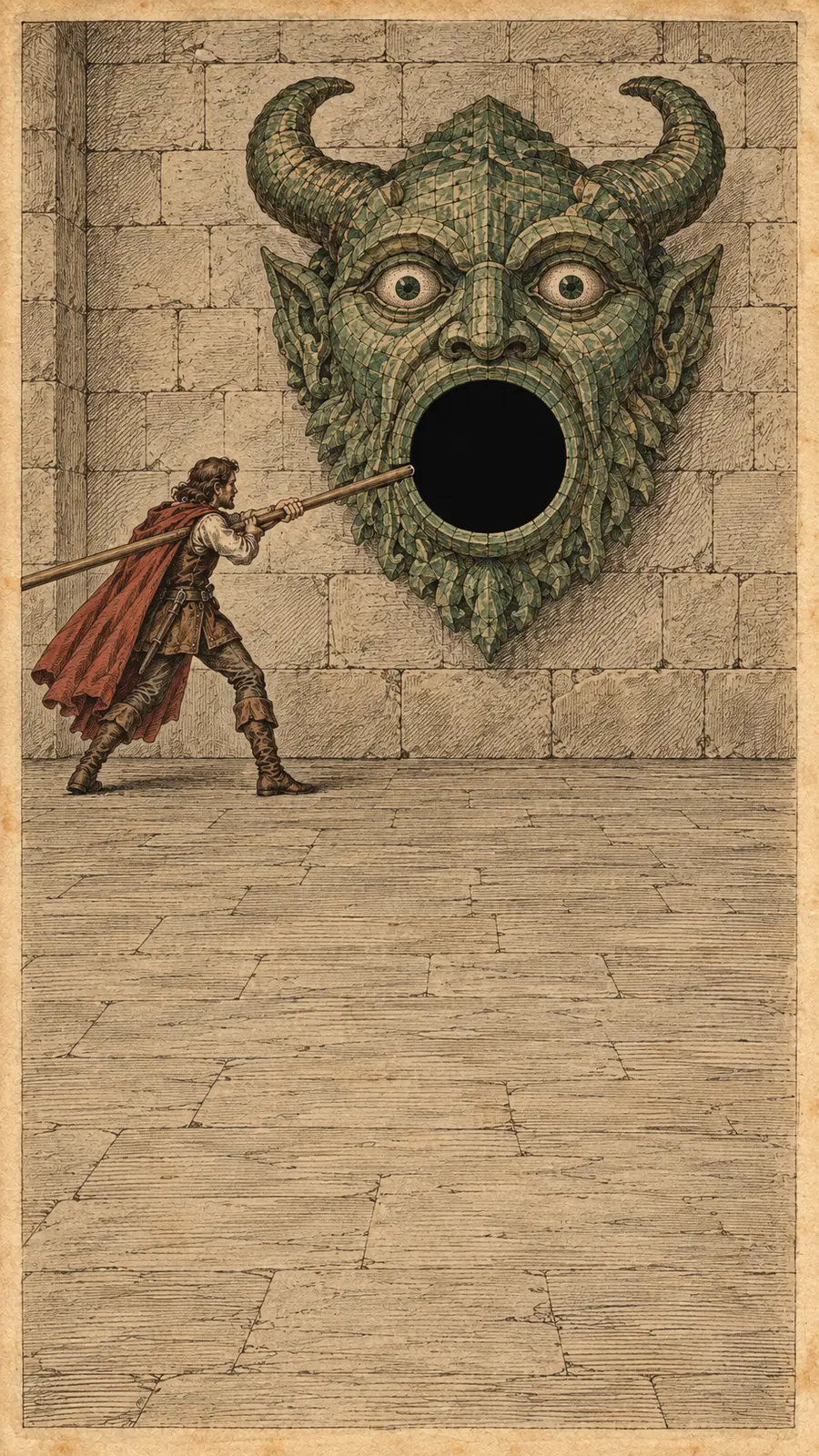
The hillside is loose and sandy. Players at the table spend a long time here, prodding the slopes with spears or with ten-foot poles, the long wooden poles that became one of the oldest jokes and best tools in the game. They poke and probe, looking for tunnels under the sand. On the north side, under the overhanging ledge, behind the bushes, they'll find a way in.
But there are three ways in, and two of them are lies.
The first two entrances are false, and both are guarded by deadly traps. One of them is a corridor hung with cobwebs. It looks old and abandoned, the kind of passage nobody has walked in a long time. The webs hide something above them: a ceiling on the verge of collapse. At the far end of the corridor stand doors. They're false doors, and when someone opens them, the ceiling comes down.
So before the tomb has even begun, it's taught its first lesson. Things that look like the way forward may not be. A door is not always a door.
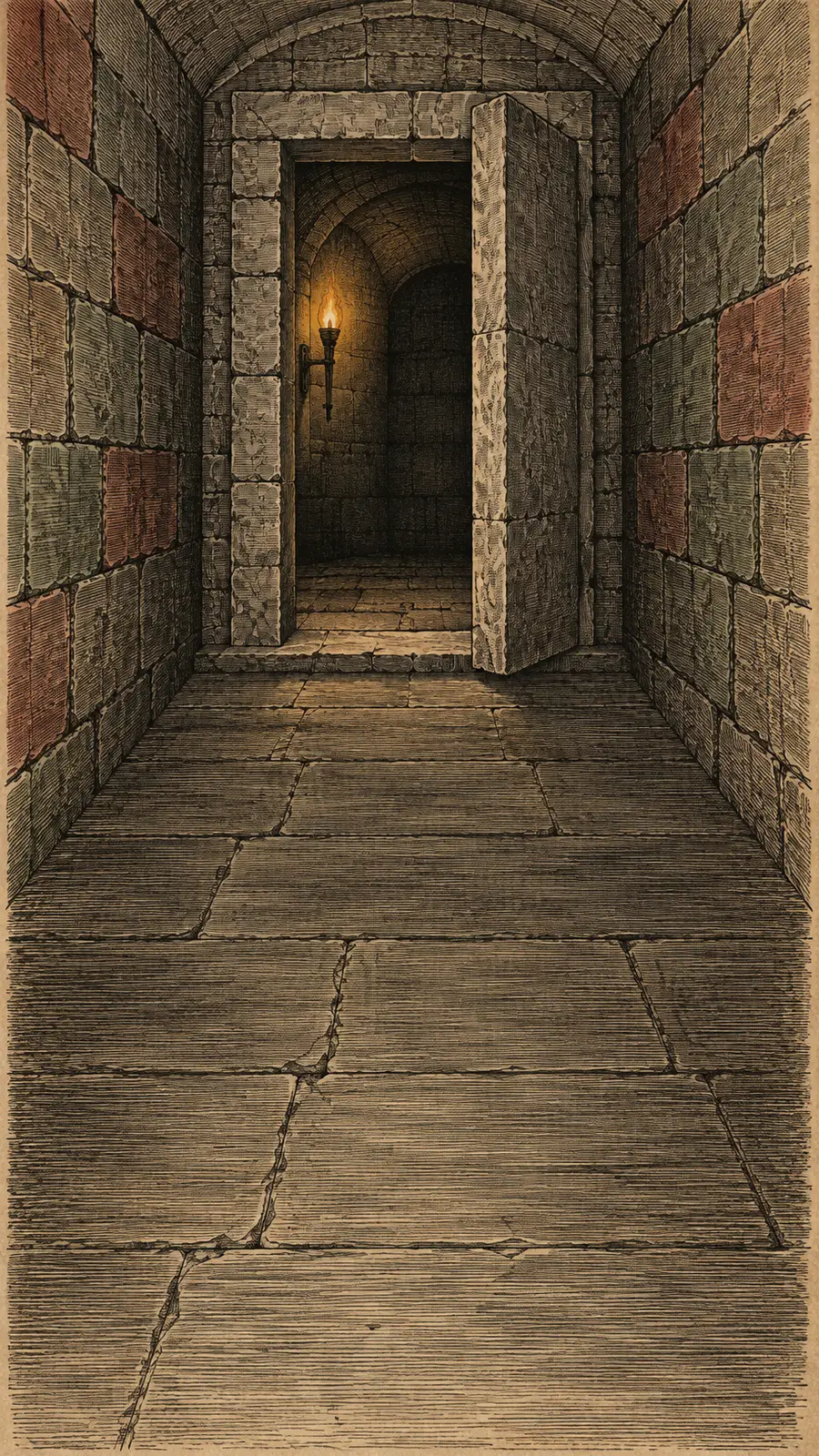
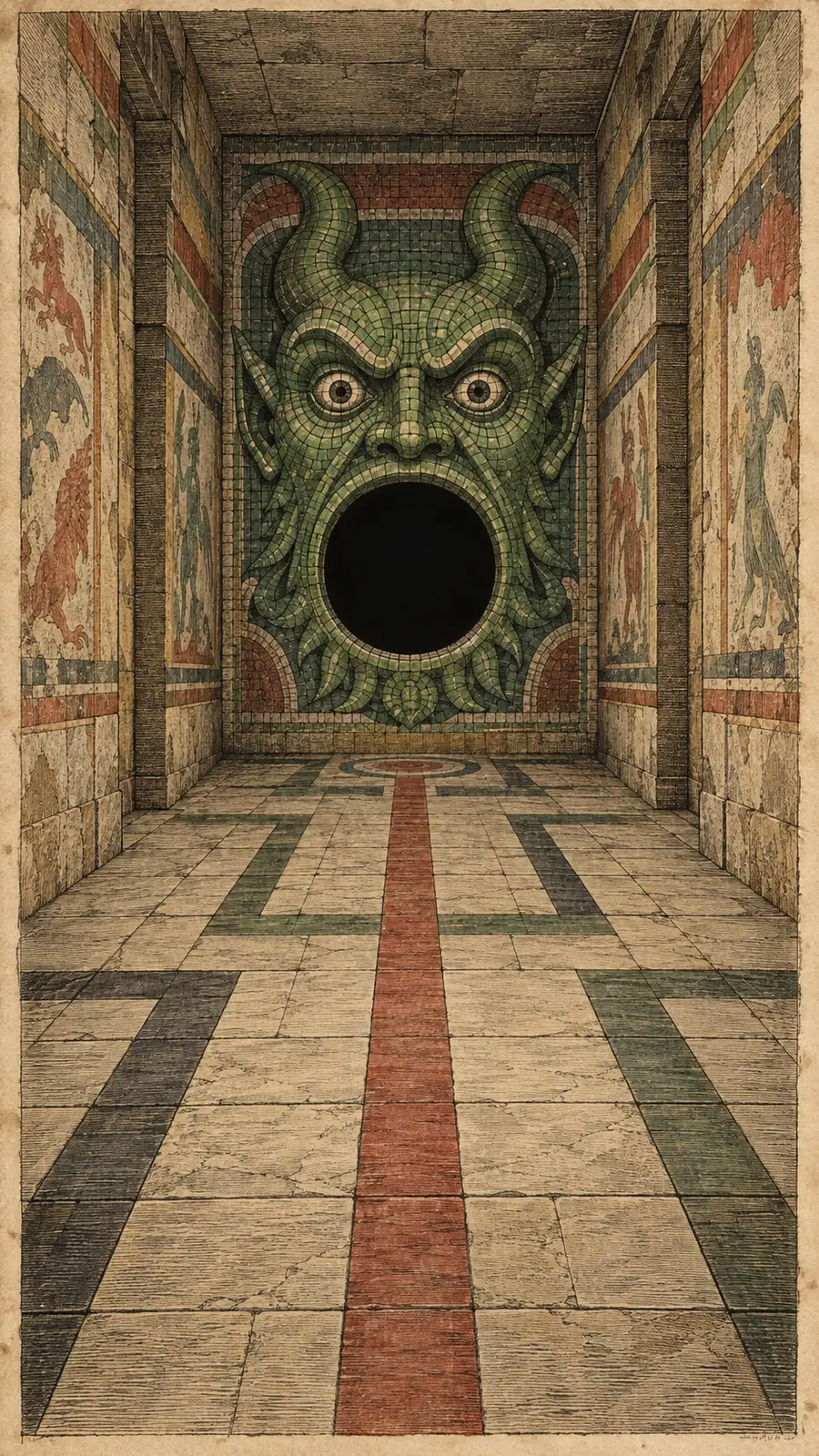
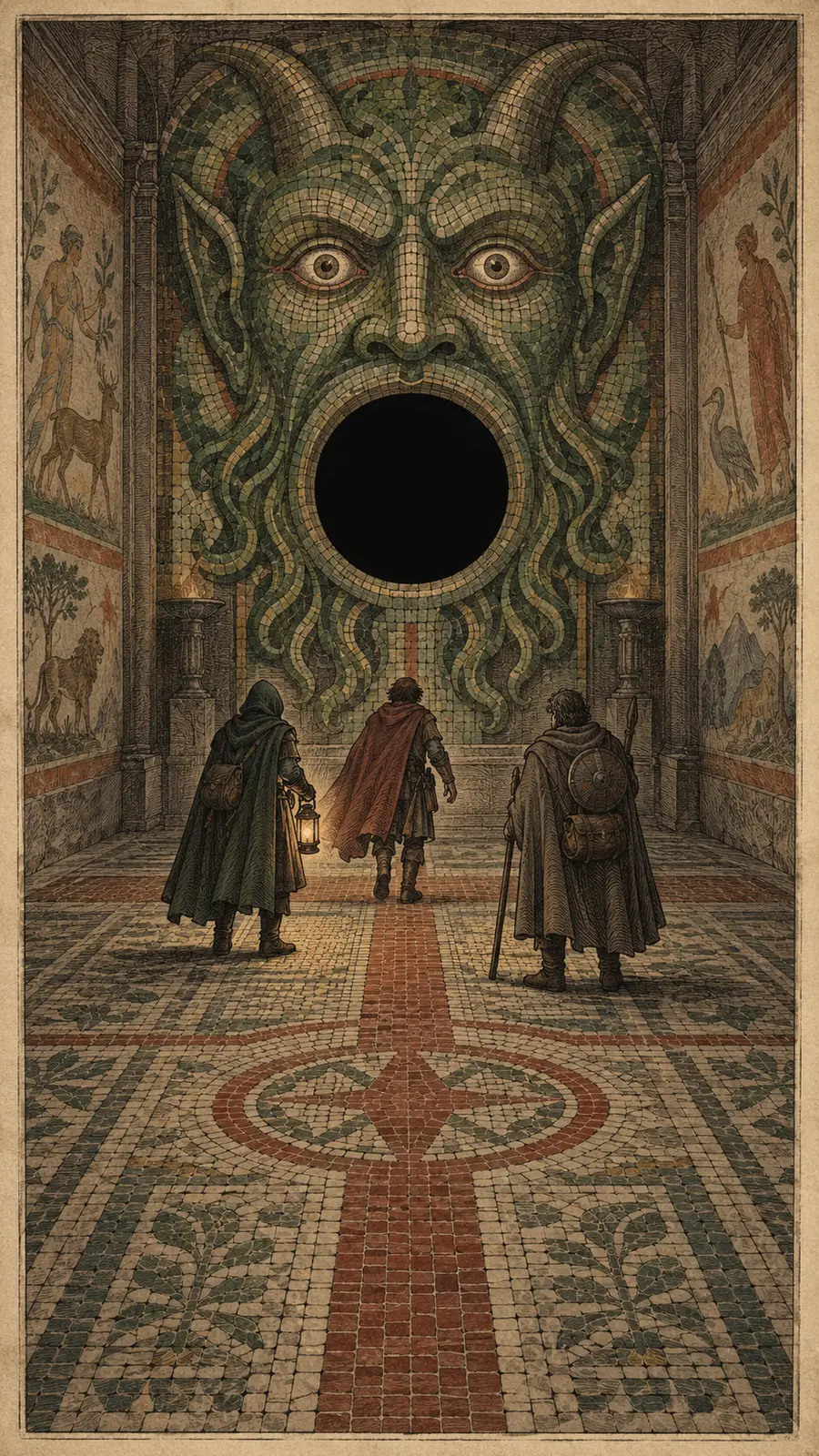
The true entrance leads into a corridor that the module calls the Great Hallway. It's a long passage, and it's beautiful in its way. The walls are painted with frescoes, and the floor is laid with a mosaic: coloured paths running away down the length of the hall. One of those paths is red. It leads deeper into the hall, and it looks as if it's showing you the way.
The red path leads straight into pits. There are five pits in the Great Hallway, three of them on the red path. Across the whole tomb there are ten such pits, each hidden under a trap door that swings on a counterweight, each about ten feet deep, with poisoned spikes waiting at the bottom. A fall of ten feet isn't so far. The poison is what makes it deadly. Players who probe ahead with their poles will find a pit perhaps two times in three. The other time, the floor gives way under someone's feet.
This is where you begin to understand the rhythm of the place. Every step is a question. Is this stone safe? Is this one? The party moves slowly, one pole length at a time, tapping and listening, and the dungeon master waits.
There's something hidden in that floor beyond the pits. If you stand at the entrance and study the mosaic pattern carefully, all the way to a certain point at the back of the hall, you might suddenly understand something. Among the tiles, faint runes are set into the pattern, spelling out a message. It's written in red tiles, and it begins: " congratulates you on your powers of observation."
Then comes a poem, a verse of about nineteen lines. It's a guide through the whole tomb, a set of riddles that, in principle, will lead you all the way to Acererak's crypt, if you can work out which line belongs to which place. One of its lines says: "Go back to the tormentor or through the arch, and the second great hall you'll discover." The message ends with a taunt. Make of this whatever you wish, Acererak says, for you will be mine in the end no matter what.
It's a strange gift. He tells you the way, truly, and at the same time tells you he doesn't care whether you know it. Most groups spend hours puzzling over those lines, comparing them to what they find and arguing gently about what each word means.
What is the tormentor? Along the walls of the Great Hallway are the painted frescoes, and one of them shows a scene with a door, the door to a torture chamber. If you investigate it closely, the paint crumbles away, and behind the painted door is a real one. The picture of a door was hiding a door. The tomb loves this kind of trick. It rewards people who look closely at what everyone else walks past.
At the end of the corridor is the tomb's most famous face.
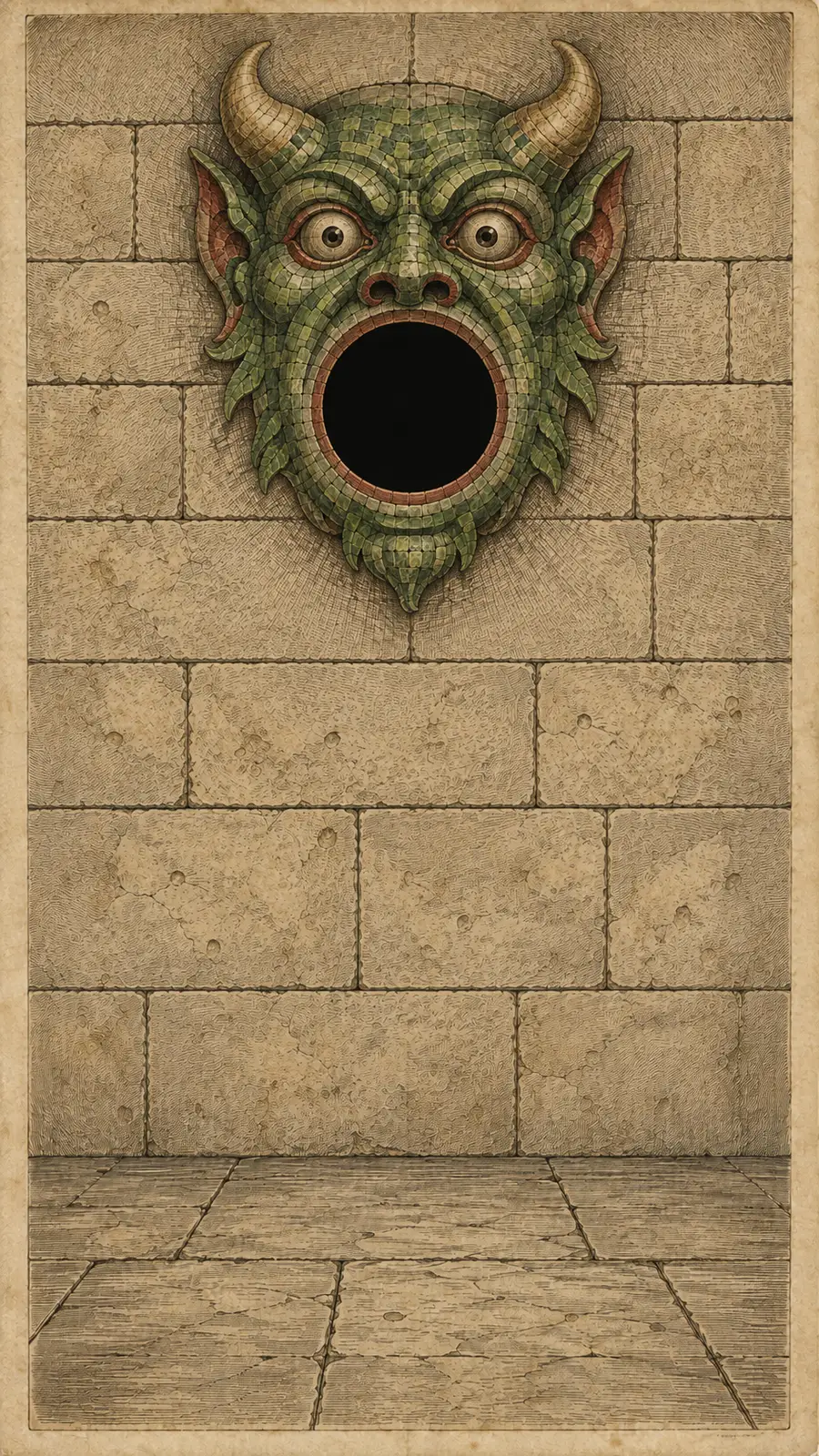
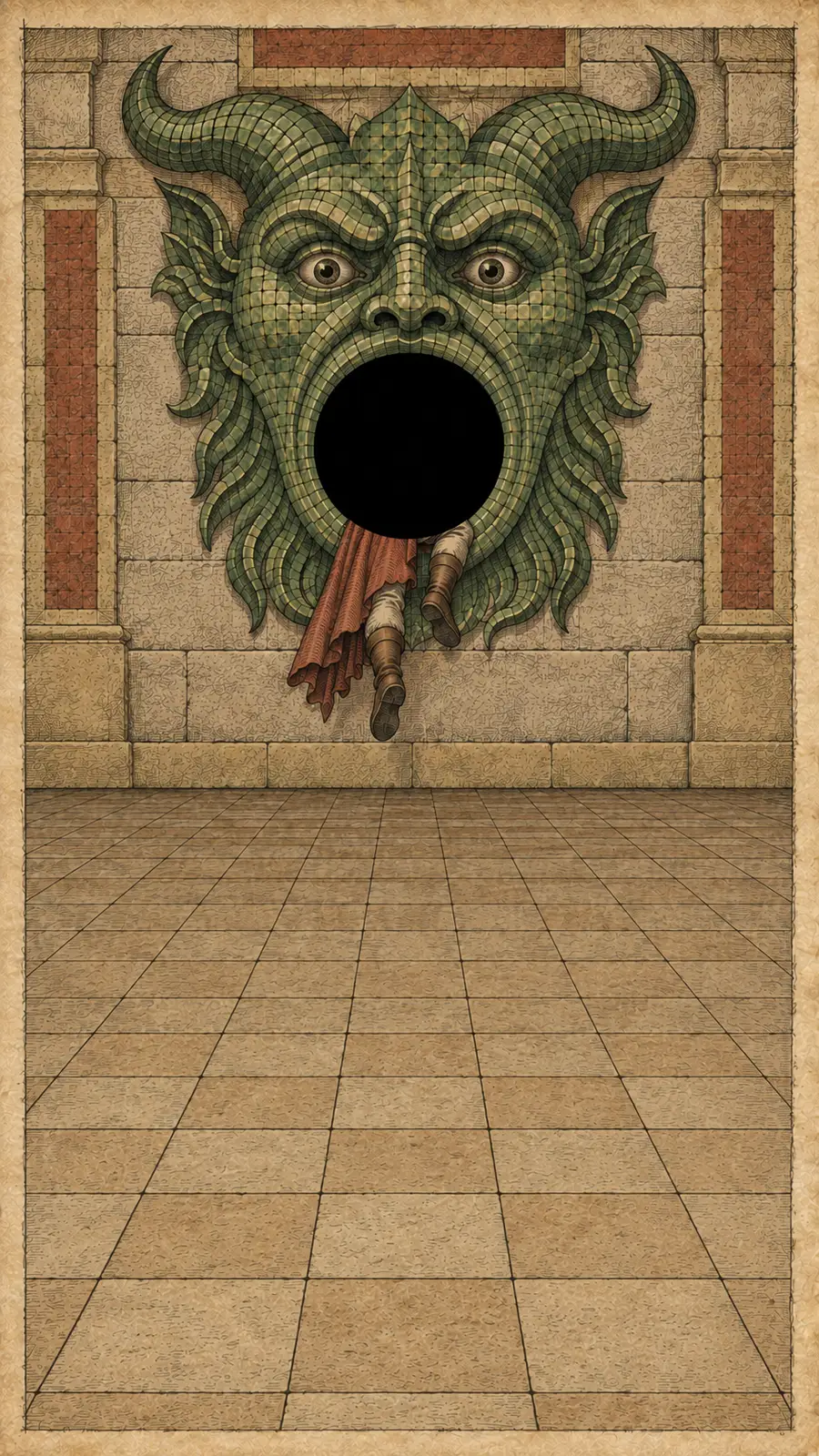
Set into the wall is a great green devil, made of mosaic tiles, with horns and staring eyes. Its mouth is wide open in a huge round O, and inside that mouth is only blackness, dead and total. No light enters it. Nothing reflects from it.
That darkness is a sphere of annihilation, a little over a yard across, fixed in place in the devil's mouth. It's the same thing Lucien's once carried at the end of his jackal stick, and now it waits here, still and silent. Anything that enters it is gone. A character who climbs in is gone forever, with no body left, no soul to call back, nothing at all.
Over the years, this has become the most retold moment in the tomb. A curious adventurer looks into the mouth. Someone pokes a ten-foot pole into the darkness, and the end of the pole simply isn't there anymore. A quiet falls over the table. Then, almost always, someone asks whether it might be a secret passage. Sometimes, very bravely or very foolishly, someone tries to find out.
Beyond the hall the tomb opens into its many chambers, each a small mystery of its own.
In one room waits a gargoyle with four arms, held in a kind of frozen time, wearing a necklace of huge, gleaming gems. It's still. It's beautiful in a grim way. And it isn't as harmless as its stillness suggests.
Elsewhere stands a statue of the same gargoyle, eight feet tall, with one of its four arms broken off. If you place large gems in its hands, it crushes them to powder. If you keep placing gems, until ten have been ground to dust, something appears in the hand of the broken arm, invisible at first: a gem of seeing, a stone that lets its holder see through illusions and disguises. It's a riddle about sacrifice. How much will you give up to see the truth?
There's a chapel too, the Chapel of Evil, with a blue altar that shoots lightning if touched and then explodes. In the chapel there's also an archway, and anyone who passes through it is changed: their sex reversed, and their alignment too, so that the good become wicked and the wicked good. It's one of the gentler dangers in the tomb, since it doesn't kill you, but it's unsettling to walk under an arch and come out as somebody else.
There are misty arches whose fogs lead to different places, and a hall full of spheres. There's a siren held in a cave misted with gold and silver. She's a captive, not a monster, and she can be freed if the party simply asks her to join them. It's a quiet moment of kindness in a cruel place, and many groups never find it, because they're too frightened to speak to anything in the tomb. There's a stone juggernaut, a great rolling machine. Each room has its own logic and its own lesson.
Then, after much wandering, many groups come to what looks like the end.
They walk down stairs into a passage filled with a faint, cloudy haze. It's fear gas, and it chills the heart and makes even brave people want to turn and run. Beyond the gas is a doorway sealed with spiderwebs, magically protected, which have to be burned away. Past the webs lies a magic mace of silver. And beyond that, in a crypt, a lich lies on a couch of solid gold, wearing a crown.
The party fights. The lich falls. The treasure is theirs. They've won.
Except they haven't. The lich was a zombie in a crown, a lure, placed there to make the party believe they'd reached the end. This is the false crypt, and it's perhaps the cruellest trick in the tomb, because it lets you feel triumphant. Many adventurers have gathered up the gold and walked out into the daylight thinking they'd defeated Acererak, when the real crypt still lay waiting behind a secret door at the very back of the dungeon.
That real crypt is quiet. There's the dust, and the skull, with its rubies and its diamonds. If the treasure is touched, the dust rises into the shape of a man. If the skull is touched, it rises too. It turns slowly, searching. In the original rules it takes a little while to fully consume a soul, but the drawing in is instant. The strongest among you goes first.
To defeat it, a party needs exactly the right tools. Certain spells will hold it off and stop the draining of souls for a time. Certain weapons, the mightiest kinds of enchanted blades, will strike it true. Without them, the skull is very nearly invincible. The tomb asks you, at the very end, whether you came prepared. Not whether you're strong, but whether you thought ahead.
Now, let's go back to the beginning, to those two champions had in mind when he built the place.
Rob 's character went in as a powerful lord of evil, with fourteen orcs and a couple of minor henchmen at his side. The orcs went first, as orcs often did in those early games, and they all died in the entry corridors. His whole party was lost. Robilar himself went on. In about four hours of real time he made his way through the entire tomb to the final crypt, gathered up the treasure, and fled rather than face Acererak.
, Ernie Gygax's character, also reached Acererak. And when he did, he scooped up all the treasure he could carry and ran.
In the terms of the tomb, both of these counted as victories. It wasn't cowardice. It was wisdom. They knew when the thing in front of them was beyond them, and they took what they'd come for and left. The tomb doesn't demand that you defeat it. It only asks that you survive it.
Later adventurers were far less fortunate. Over the years, thousands of characters died in the Tomb of Horrors. Some fell in the pits of the Great Hallway. Some vanished into the devil's mouth. Some walked happily out of the false crypt, wearing a zombie's crown and believing themselves the conquerors of the demi-lich, until the dungeon master gently told them otherwise.
What does it feel like to play? It feels slow. Groups spend hours probing walls and floors, tapping each stone, whispering over the lines of the riddle, debating whether a painted door might be real. It's tense and careful. When something goes wrong, it often can't be undone. One reviewer called it a funhouse that hates you. But it's fair, in its own odd way. It punishes recklessness, and it rewards patience and careful thought. Everything that can kill you leaves some clue, if only you look closely enough.
In 2020, during the year when so many gatherings moved online, the San Diego Comic-Con held its event at home, and one of its games was a journey through the Tomb of Horrors. Leading it was Luke Gygax, Gary's son, guiding a table of celebrity players through the halls his father had built forty-five years before. It's a lovely image to keep: a son reading his father's words aloud, watching a new group of players lean in toward the green devil's face, and waiting, perhaps with the same quiet smile, to see what they'd do.
So the tomb at the table is a place of slow questions and sudden answers. It's patience against malice, curiosity against caution. And because it has been played so many times, by so many people, it has grown beyond the game itself and into the wider world.
Chapter XI
Legacy: the killer dungeon in the wider world
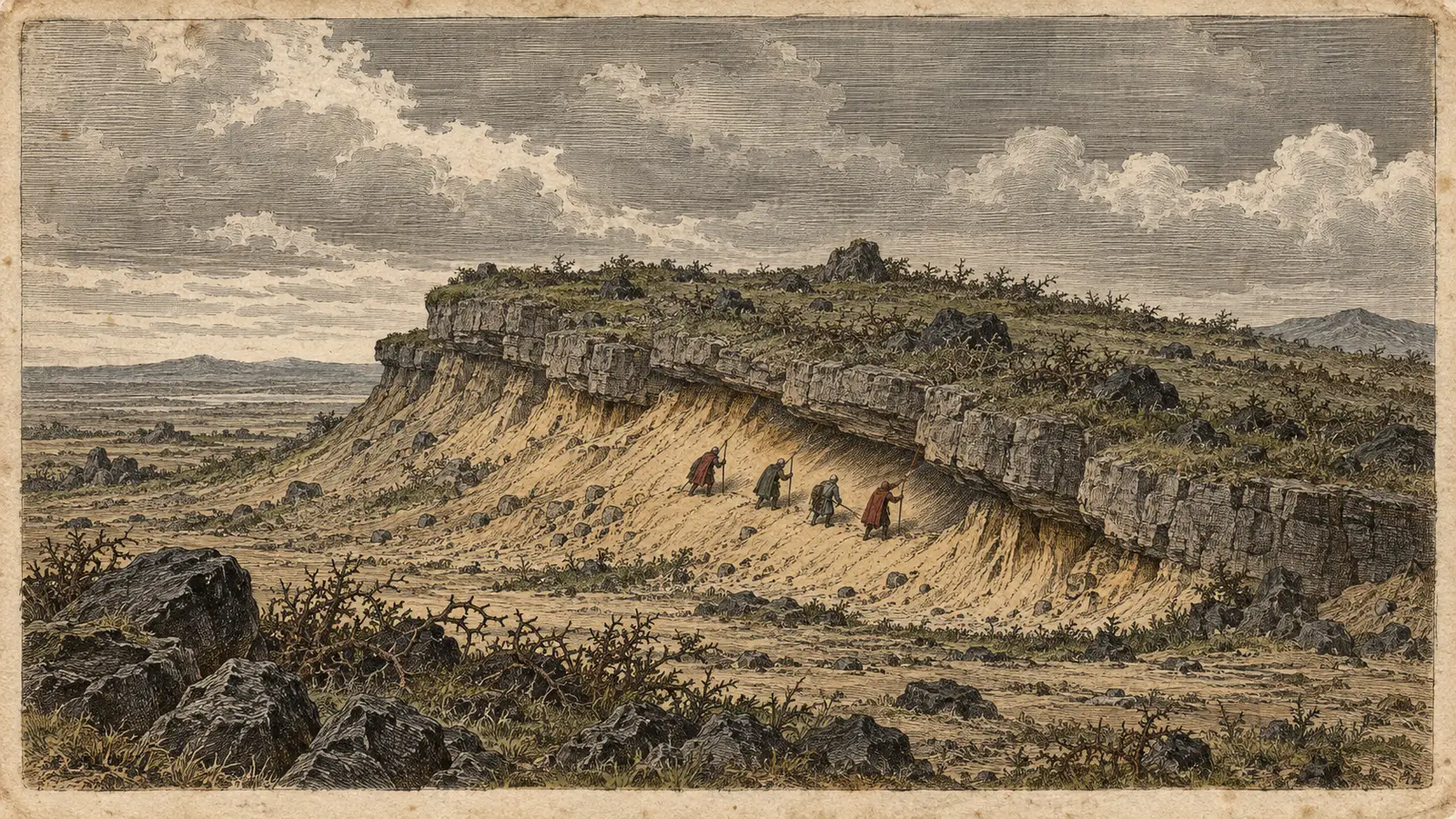
Among people who play Dungeons and Dragons, the Tomb of Horrors has a simple nickname: the killer dungeon. Ask an experienced player about it, and you'll likely hear a story, either a character they lost there or a friend who walked out with a zombie's crown. Its fame doesn't come from big battles or vast armies. It comes from tension, mystery and the quiet ingenuity it demands. Players remember it because it made them think, and because thinking didn't always save them.
Over the years it gathered honours. In 2004, Dungeon magazine's list of the thirty greatest adventures placed it third. Lawrence Schick, who knew the special modules well, called it "a very difficult scenario" in his 1991 survey of roleplaying games, Heroic Worlds, which is a fine example of understatement. A popular guide for new dungeon masters named it among the ten best classic adventures. And in the lead-up to their twenty-fifth ceremony in 2025, the ENNIE Awards, one of the hobby's best-known honours, inducted the Tomb of Horrors into their new Hall of Fame. The name on the honour was simple and fitting: Tomb of Horrors, 1978.
Its influence spread through the game itself. It inspired many later killer dungeons and shaped how later designers thought about traps, puzzles and the relationship between players and a dangerous place. It's still one of the most discussed adventures in the hobby, argued over, admired and retold.
The tomb has also wandered out of the game and into fiction. The most famous of these journeys is in Ernest Cline's 2011 novel Ready Player One.
The story imagines a future in which most of humanity spends its days in a vast virtual world called the OASIS. Its creator, a reclusive game designer named James , has died, and he left behind a contest. Somewhere in the OASIS he hid three keys, and whoever finds them all will inherit his fortune and his world. Halliday loved the games of his youth, and he loved the Tomb of Horrors. He rebuilt it in loving detail on a planet called Ludus, and there he hid the first of the keys, the Copper Key.
The hero of the novel is a young man named Wade Watts, whose avatar in the OASIS is called . He finds his way to the tomb, through its halls, and down to the crypt. Waiting for him there is . In this telling the demilich sits on a throne, an artificial intelligence made in the image of the old skull, and he offers a challenge.
The throne transforms. It becomes an arcade cabinet, a coin-operated machine for the game Joust, from 1982, in which knights ride flying ostriches and try to knock each other down. Wade and Acererak play best of three. If Wade wins, he gets the key. If he loses, he dies.
He loses the first game. He watches the patterns of the machine, learns how it thinks, and wins the next two. Then Acererak changes. The skull becomes , Halliday's own wizard avatar, the face the game's creator wore inside his world, and he hands over the Copper Key. Wade's name appears on the scoreboard, and on his way out of the tomb he meets , another player who had found the tomb on her own but hadn't yet beaten Acererak.
There's something gentle in that image. The demilich, the hungriest skull in the game, playing an arcade game with a boy and then turning out to be a kindly old designer handing over a prize. It's a love letter to a whole childhood of games, and the Tomb of Horrors sits at its very centre.
When Steven Spielberg made the film in 2018, the tomb was replaced by a race through a city. A small nod survived, though. On the back of a van belonging to Wade's friend , there's graffiti drawn from the Tomb of Horrors, a tiny echo for those who know where to look.
The tomb has crossed into card games too. In the 2021 Magic: The Gathering set Adventures in the Forgotten Realms, there's a card called Acererak the Archlich. When he enters play, unless you've already completed the Tomb of Annihilation, he returns to your hand and you venture into that dungeon. Even in a card game, he won't stay on the table until you've been through his tomb. When he attacks, each opponent must sacrifice a creature, or else you create a zombie. There's also a land card named Tomb of Annihilation, the jungle tomb itself, printed on cardboard.
Wizards of the Coast's own descriptions still describe the tomb as a crypt buried beneath a lonely hill, home to the demilich Acererak, appearing in nearly every edition of the game. They still call it the deadliest dungeon a character can undertake.
And there's a small, warm aside from 2009. The actor Wil Wheaton, a lifelong player of the game, wrote on his blog that starting a new player out with the Tomb of Horrors is like introducing someone to Rock Band with "Green Grass and High Tides," a famously long and difficult song. He meant it kindly, and with the authority of someone who knew. He even titled his post with a line from the tomb's own legend: there is said to be a demi-lich who still wards his final haunt.
So the killer dungeon has become part of how people talk about games, and about difficulty, and about the pleasure of being challenged by something clever. It sits in novels and films, on cards and in blogs, as a shorthand for a place that tests you. And it's still being built and rebuilt today.
Chapter XII
The present day: back on the map of Greyhawk
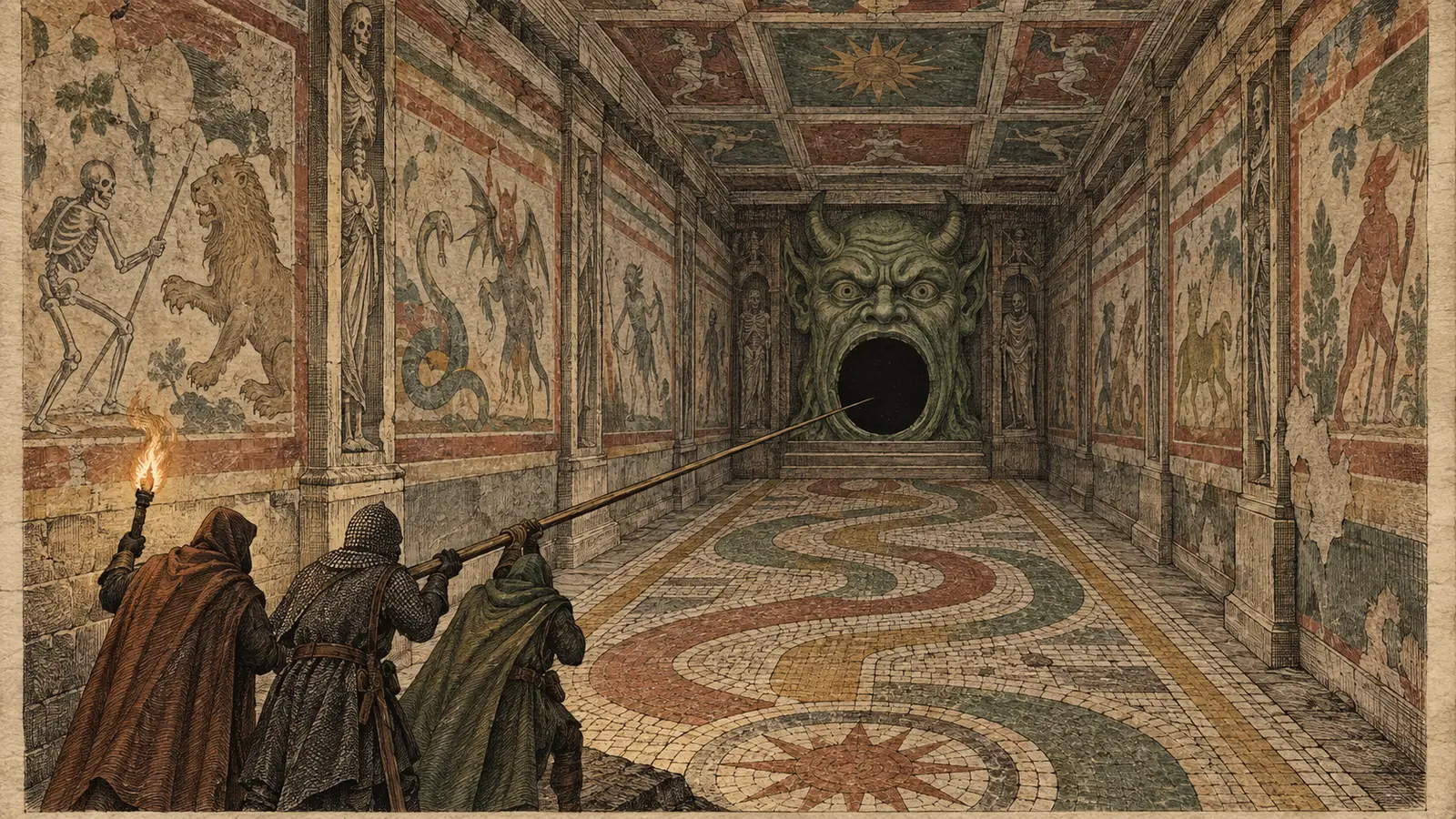
In November of 2024, a revised version of the fifth edition's Dungeon Master's Guide arrived. For the first time in many years, it offered a sample setting for dungeon masters to use, and the setting it chose was , the tomb's first home. With the book came a large poster map. One side showed the City of Greyhawk. The other showed Eastern , the wide lands of the , with its kingdoms and forests and rivers.
On that map, the Tomb of Horrors is marked.
After all its wanderings, across six possible locations, into a demiplane of ice, into the , into the Astral Sea, into the jungles of another world, the tomb is back on the official map of the place where it began. Inside the book, has an entry in the lore glossary at the back, a short note on the demilich for any dungeon master who wants to know who he is.
He gave up one thing in that change. For ten years he'd looked out from the cover of the old guide. The new cover gave that place to others: Venger, the villain of the 1980s Dungeons and Dragons cartoon, and Warduke and Skylla from the old action figure line. We met Venger when we followed Tiamat, the only being he feared. The demilich left the cover, but he stayed in the book. That seems right for him. He's always preferred to wait inside.
In February of 2025 came a new Monster Manual, and the demilich is still there. The rules now set the demilich slightly apart from the ordinary lich. The lich keeps its soul in a vessel, as liches always have, while the demilich draws on a different kind of restoration, a power it shares with the mummy lord, another ancient thing that won't stay in its grave. The skull in the dust remains its own kind of creature, a little older and stranger than the liches that came after it.
The faithful fifth-edition version of the original tomb is still the one in Tales from the Yawning Portal. A 2024 collection of classic adventures updated for the new rules, Quests from the Infinite Staircase, gathered other old favourites and left the tomb as it was, still waiting in the tavern's stories.
There's a quieter kind of presence in these years too: things you can hold in your hand. In 2022, WizKids made a life-sized replica of a demilich skull inspired by Acererak, an "unlife-sized" skull, as they put it, with carved gemstones for teeth and larger gems in the eye sockets lit softly from within. It could rest on a pile of its own bones and dust, or rise from a vortex of its mouldering remains, just as it does when someone foolish touches the treasure. Diamond Select Toys announced a painted statue of Acererak for late 2025, sculpted by Sandro Luis , showing the demilich whose soul rests in a gem-studded skull.
In 2026, the tomb found yet another form. WizKids released an expansion for its miniatures game D&D Onslaught, called Tomb of Horrors. In it, players band together, or play alone, to try to survive the dungeon. The layout and its dangers are generated anew each time, so no two journeys through the tomb are the same. Players face deadly traps and undead guardians and, at the end, the evil demilich. It's a strange and fitting idea, a Tomb of Horrors that rearranges itself every time you enter, so that even the most experienced explorer can't memorise the way.
As for what lies ahead, the announcements of 2026 have turned the game's attention back toward Greyhawk. At Gen Con in the summer of 2026, Wizards of the Coast announced a new line called D&D Icons, with Joe as its chief creative officer, bringing classic creators back to classic settings. Greyhawk is announced to return as the focus of a season in 2027, the Season of Sword and Sorcery. The first book of the line, Greyhawk: Crown of the Witch Queen, is announced for the latter half of 2027. It centres on , the vampire daughter of the witch , with preview art hinting at Castle Greyhawk. Luke has also announced that he is completing an unfinished, never-seen adventure left by his father, which may arrive as early as 2027.
None of these announcements speaks of the tomb or of Acererak. But the world where the lonely hill first stood is announced to return to the light, and the hill is already back on its map, marked and waiting, among the swamps and kingdoms of the Flanaess.
Chapter XIII
The last door in the hill
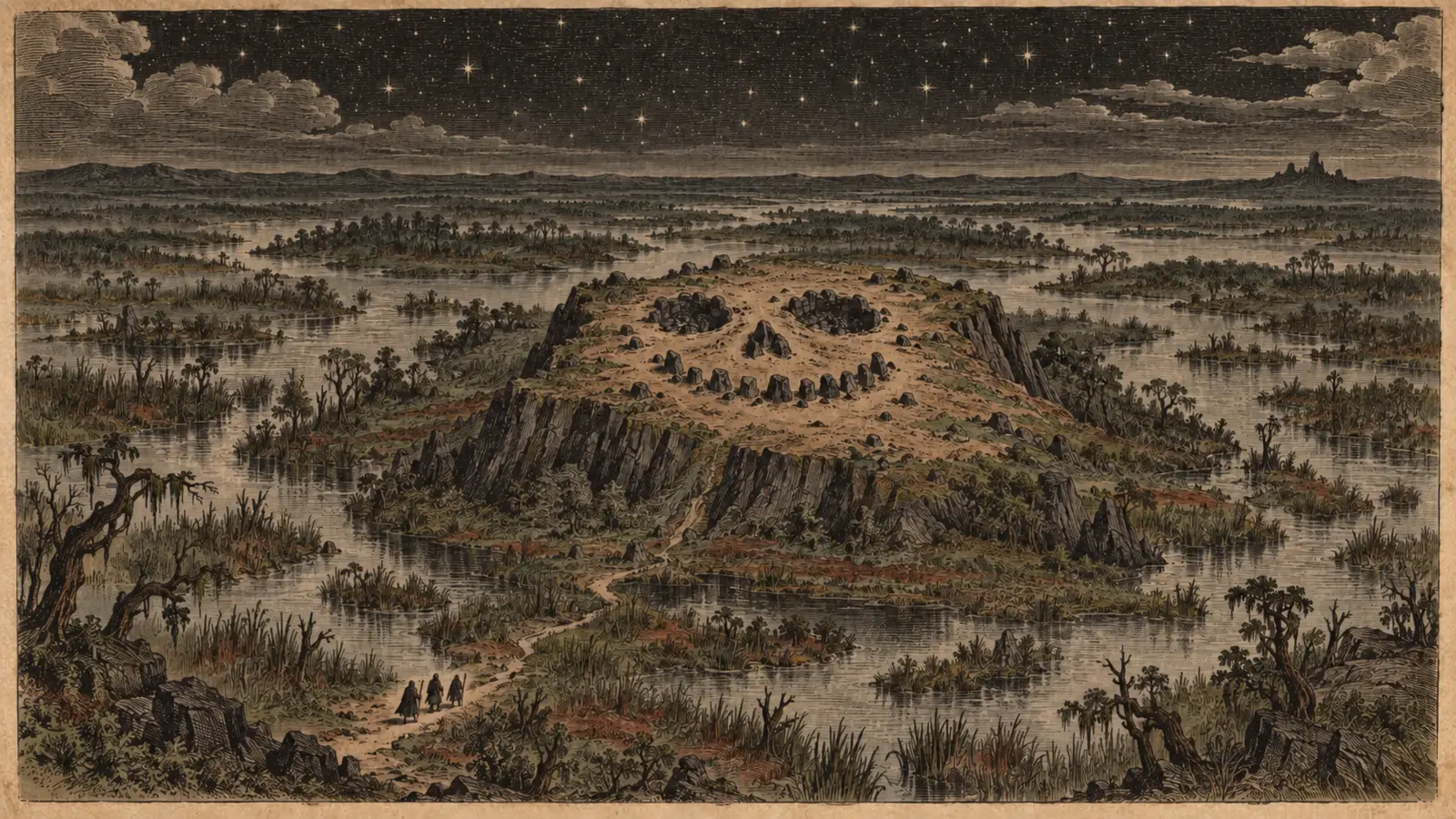
Let's go back, one last time, to the hill.
It's a low hill with a flat top, a few hundred yards across and about sixty feet high. Weeds grow on it, and thorns and briars, across its steep sides and over its bald crown. Wind moves through them. Nobody comes here often. Perhaps a bird lands on one of the black rocks and lifts away again.
On the north side, the sand and gravel have crumbled into a low cliff. Above it the stone ledge leans out, and below the ledge, behind the shrubs, the sand has slid down again over the old entrance. Every few years, someone comes and digs it out. They find the plain stone corridor with its paving underfoot, lit by enough daylight to see by, and the door at its end. They go in. Some come back. Then the sand drifts down again, slowly, and covers the place, and the bushes grow thick, and the hill looks as it always did.
Inside, the halls are still. The painted frescoes line the Great Hallway. The red path runs across the mosaic floor toward the pits. Somewhere in the pattern, the faint runes still spell out their message, waiting for someone patient enough to read them. At the end of the corridor, the green devil keeps its mouth open on its perfect darkness, and nothing in all the years has filled it.
Far at the back, behind a secret door, there's a crypt. When the last door has been passed and the skull has fallen, the old module simply ends. There's no epilogue and no word of what comes after. The story stops, and the silence of the place goes on.
Elsewhere, on planes no sage has mapped, a soul is wandering. Perhaps it's thinking of frozen cities, or dead gods, or an unborn god in a cradle of crystal. Perhaps it's thinking of nothing at all, only drifting, the way a mind drifts at the edge of sleep. And perhaps, now and then, it remembers the hill.
The hill itself doesn't remember anything. It just stays where it is, wherever each of us has put it, on an island or in a desert or deep in a quiet swamp. Night comes. The stars rise over the briars. And on the bald top of the hill, the black rocks lie in their pattern, a grinning skull turned up toward the open sky, seen by no one on the ground, only by the stars.