Chapter I
The lich who meant to outlast himself
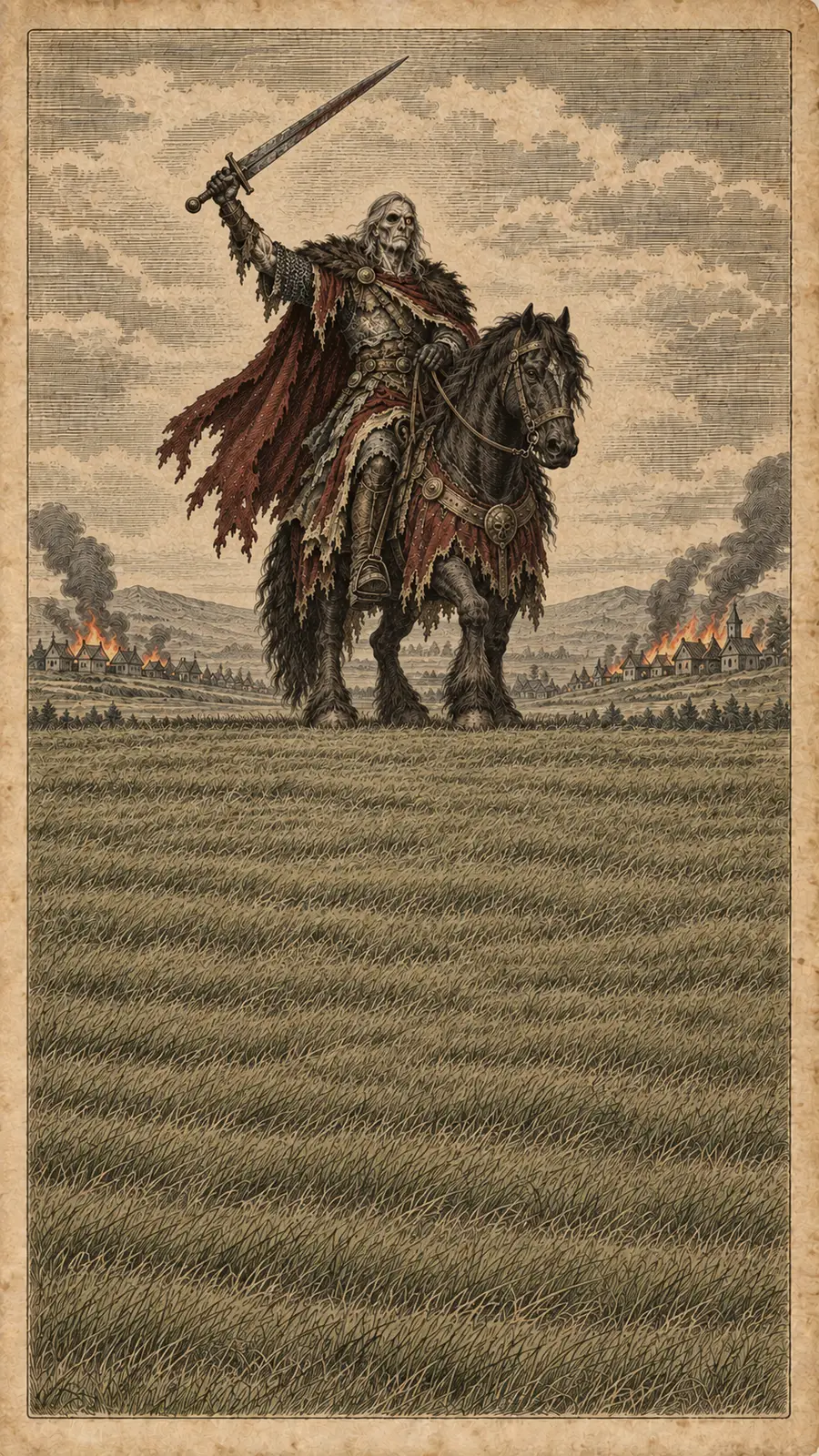
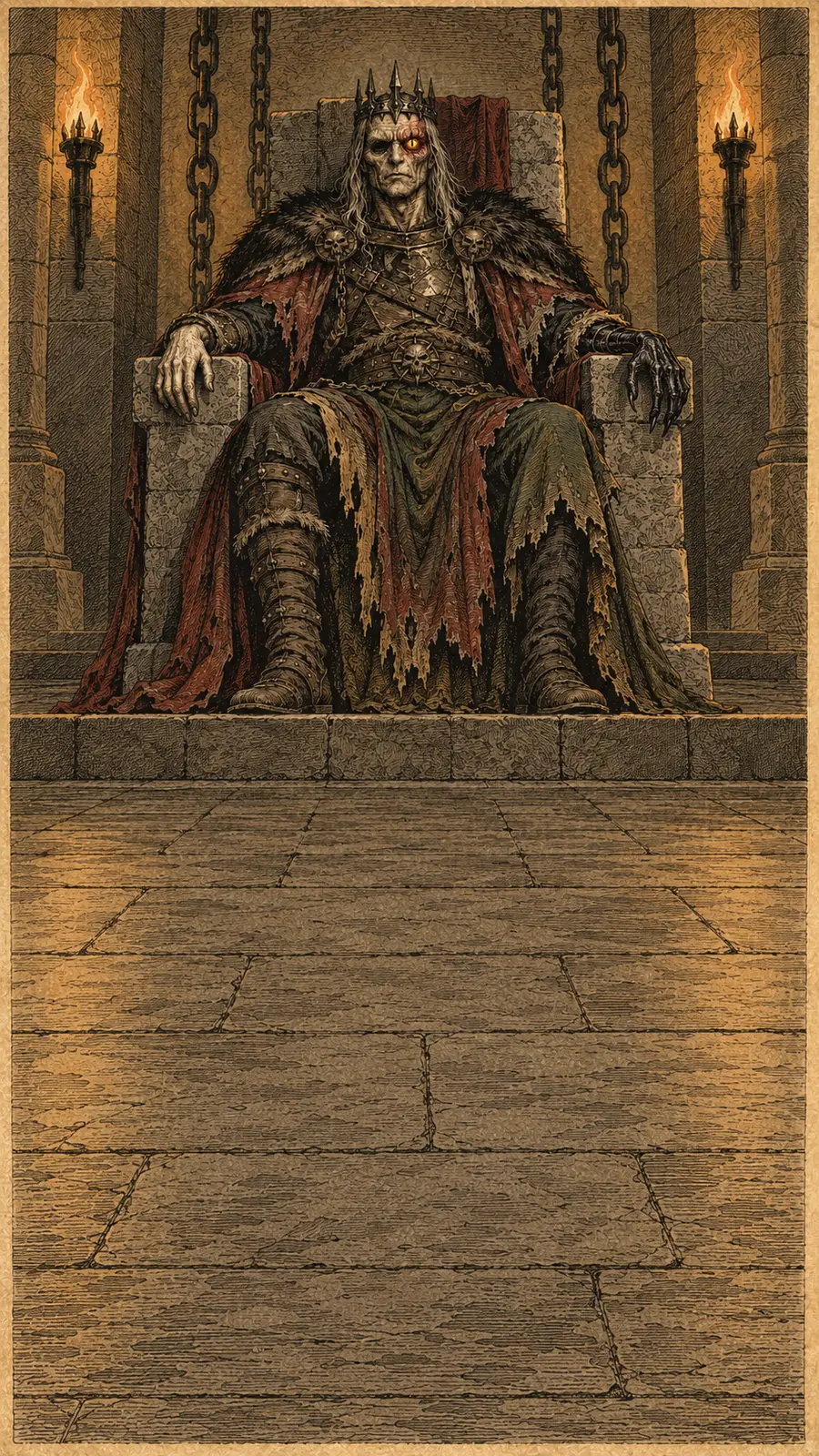
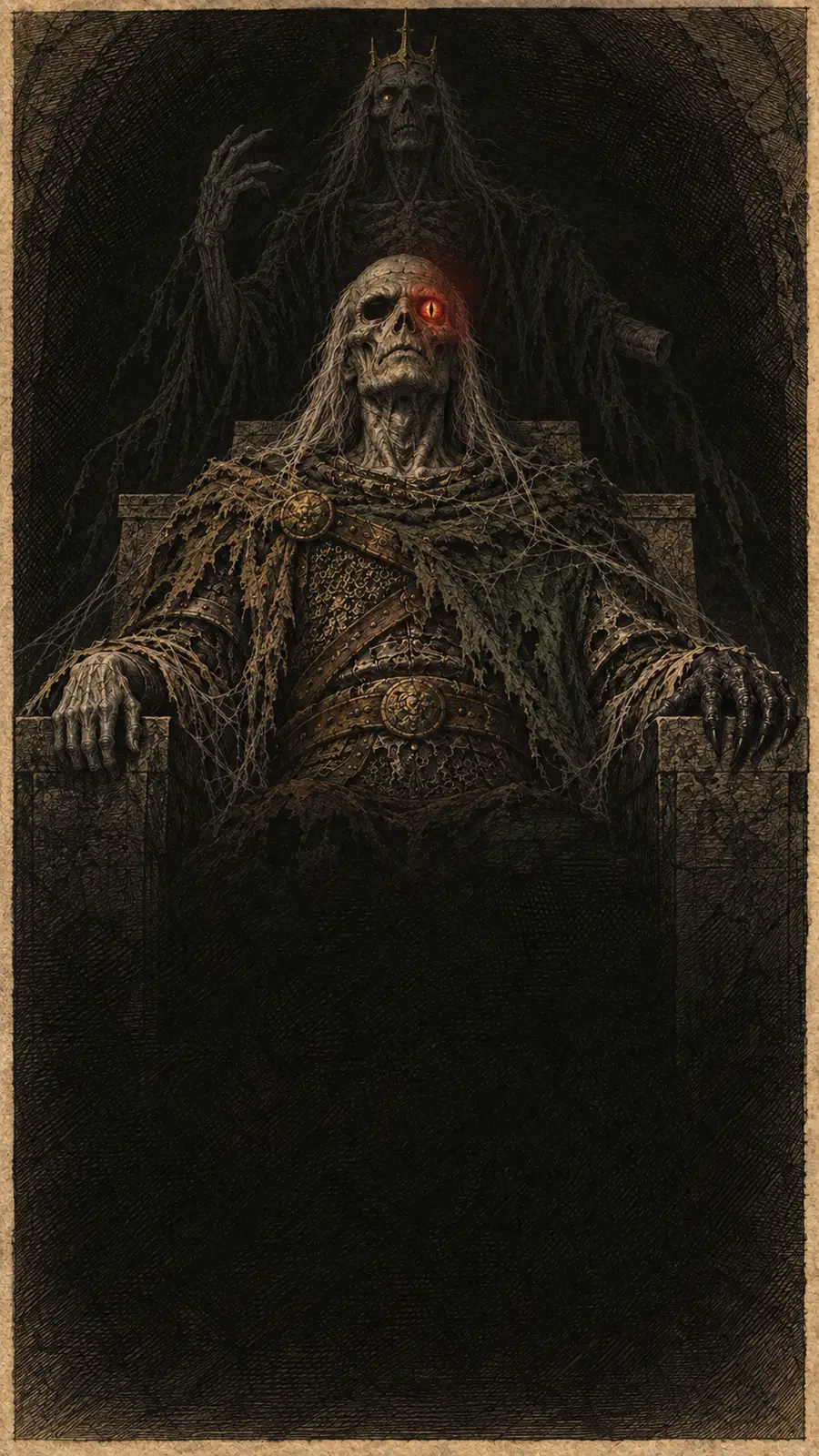
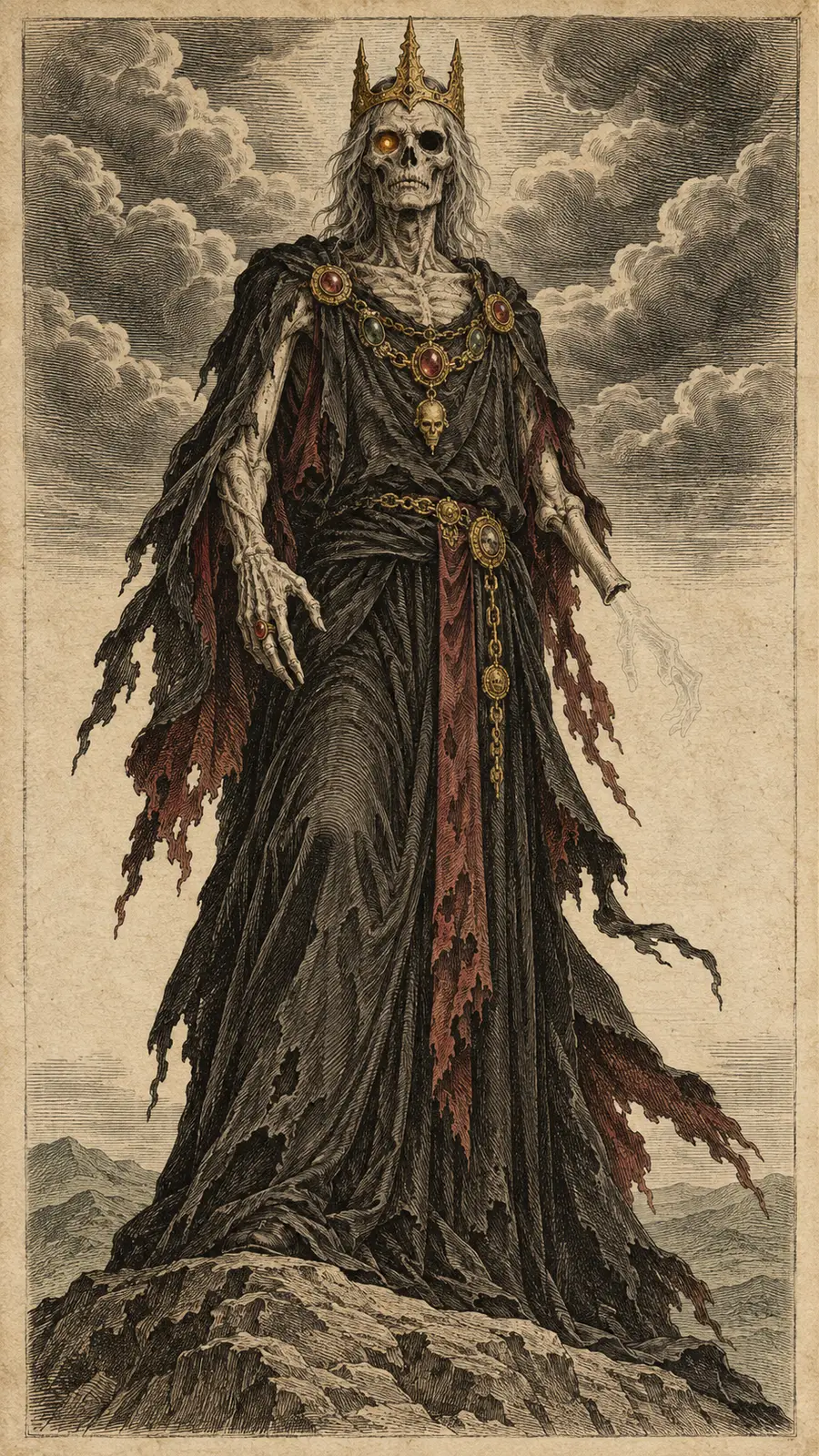
Every relic needs a body it once belonged to, so we'll begin with that body, and we'll keep this part short. Long ago, on the world of , in the wide eastern lands called the , there lived a wizard named . Later tellings give him a hard childhood. He was born into the lowest, untouchable caste of a city called , and his mother, , taught him magic in secret. Fleeth burned her as a witch, and the boy fled, carrying that fire inside him for the rest of a very long life. He grew into one of the mightiest wizards of his age. Through dark magic and conquest he carved out an empire in the country around the Valley, and he ruled it from a seat called the Spider Throne, in a fortress later remembered as the Rotted Tower.
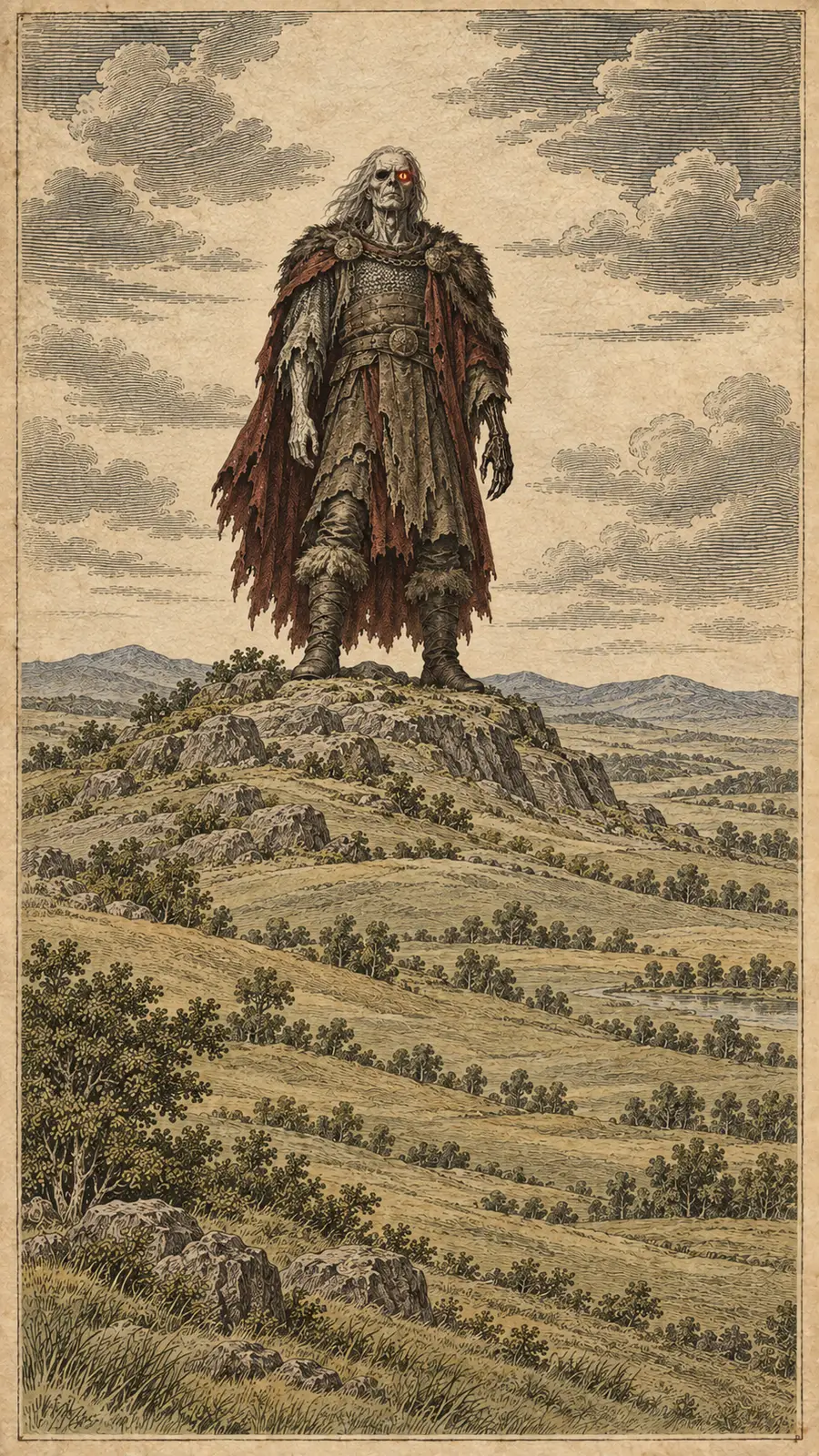
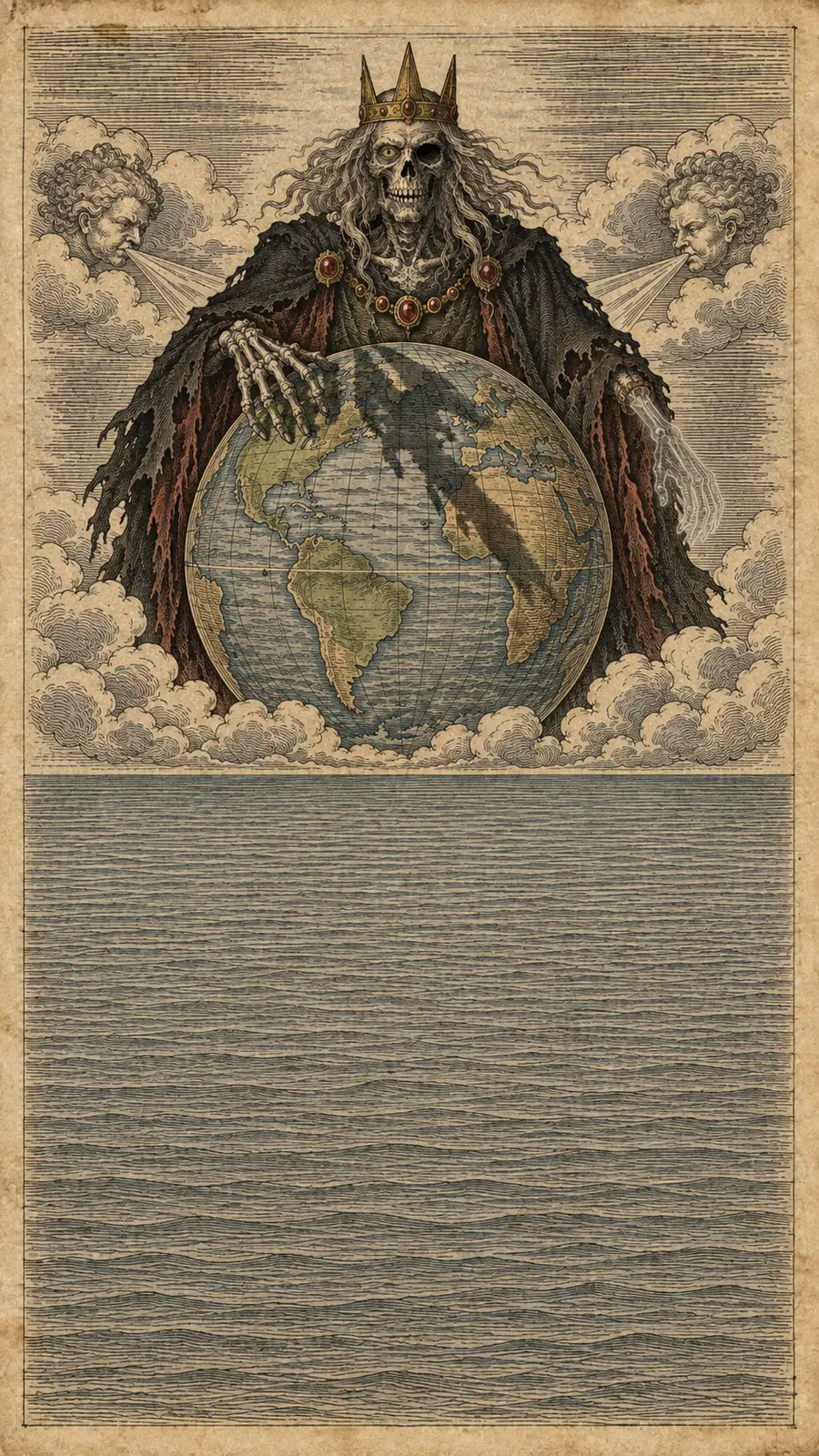
Vecna feared death more than he feared anything else. The best-known telling says that , the demon prince of undeath, taught him a ritual that let him go on existing after his body should have failed. So Vecna became a lich, and in time he was counted the greatest lich of all. His flesh slowly withered and dried while his empire kept growing. His temper was so terrible that his subjects were afraid to say his name aloud. They called him the Whispered One, the Undying King, the Master of the Spider Throne and the Lord of the Rotted Tower. The fifth-edition telling of his relics opens with that hush: "Seldom is the name of Vecna spoken except in a hushed voice."
If you heard our earlier evening with Vecna himself, you'll know the rest of his long story, so we'll leave most of it there and keep only the part that touches the hand and the eye. That part begins with another man, Kas.
Kas was Vecna's most trusted lieutenant. Later tellers liked to call him the lich's right-hand man, a phrase that turns out to be a quiet, grim joke. People called him Kas the Bloody-Handed, and sometimes Kas of . Vecna handed him most of the daily work of running the empire, and he gave Kas a sword as the badge and instrument of that authority. In the oldest tellings Vecna simply obtained the blade for his servant. In later ones he forged it himself and poured a portion of his own consciousness into the steel. Either way, the sword was meant to carry out Vecna's will through Kas's arm.
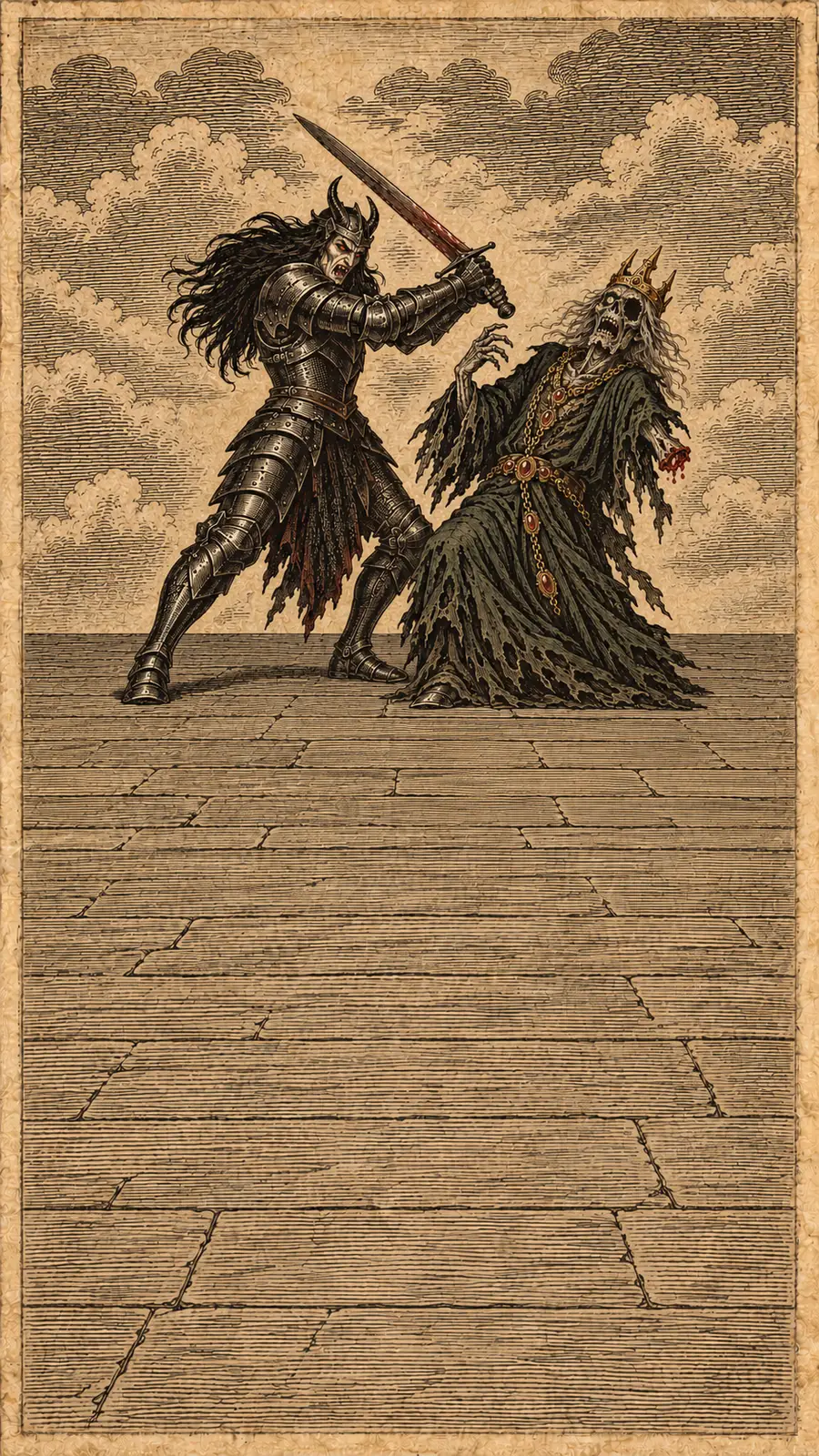
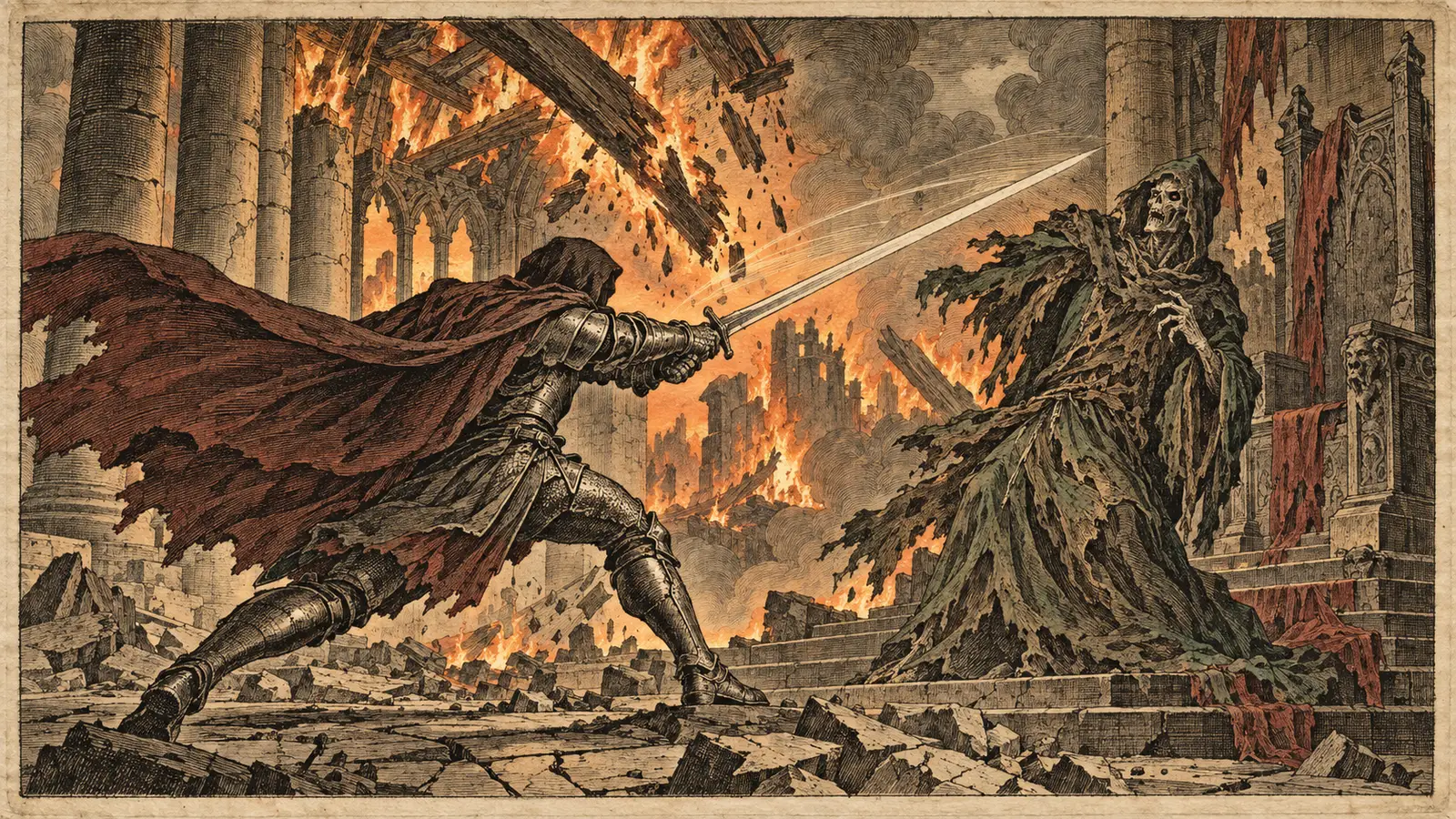
Then Kas turned on his master. The tellings disagree about why, and the disagreement is itself part of the legend, handed down as rumour. Some say Kas came to covet the Spider Throne. Others say the sword whispered to him, and that something of Vecna's own pride and hunger, poured into the blade, seduced Kas into rebellion. Whichever it was, the two of them met in a battle so terrible that the tower burned to the ground. The fifth-edition account says it was left a heap of ash.
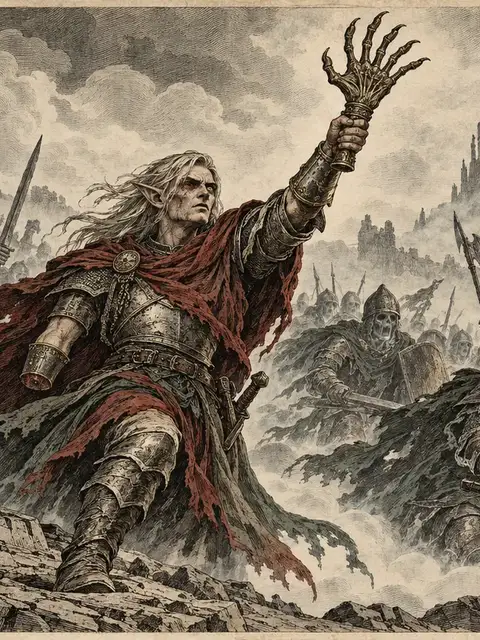
Neither of them was left standing. Kas was flung away across the planes. Vecna's long-withered body was destroyed. When the ash settled, three things lay on the field: the sword, a left hand and a left eye.
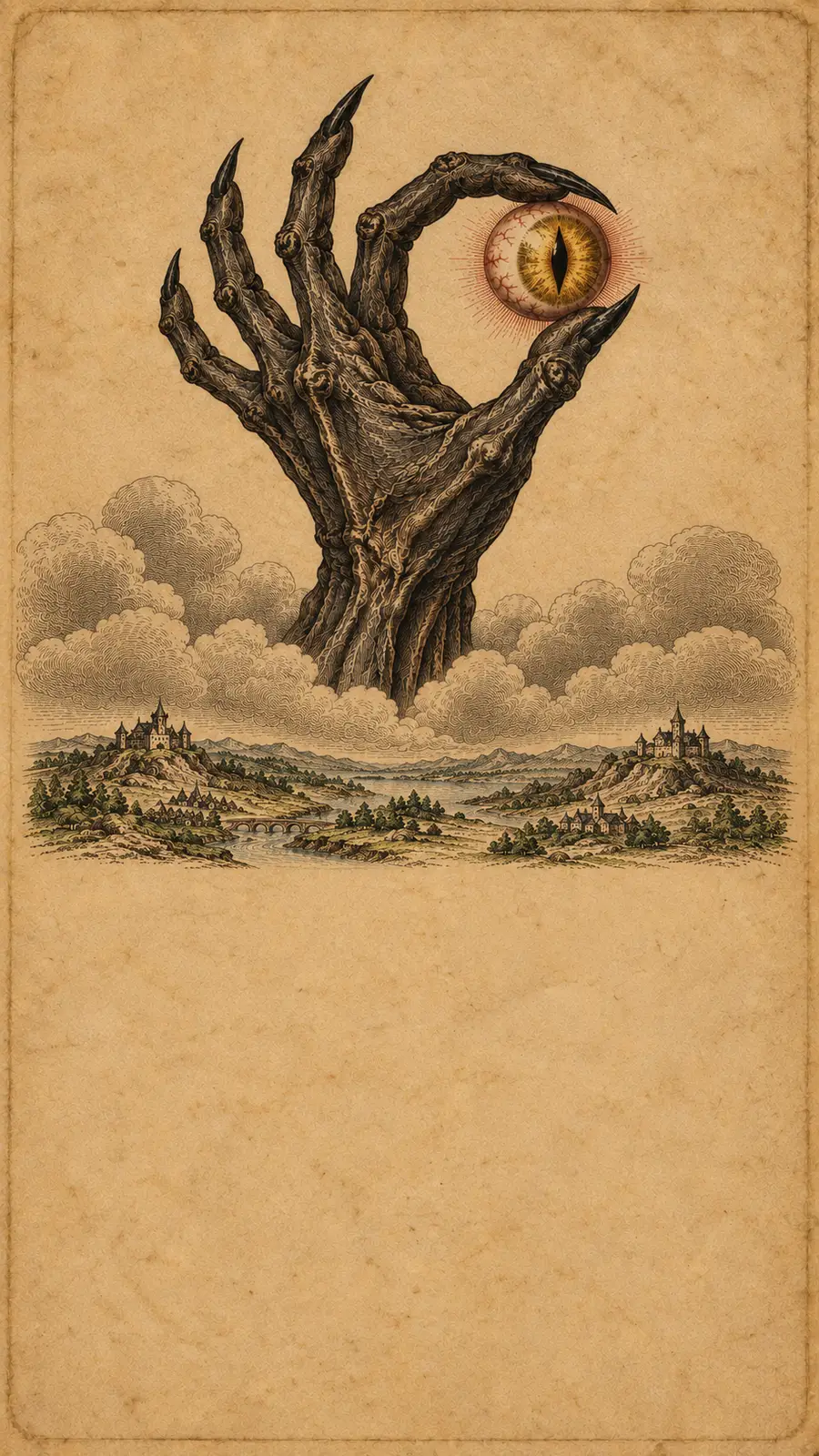
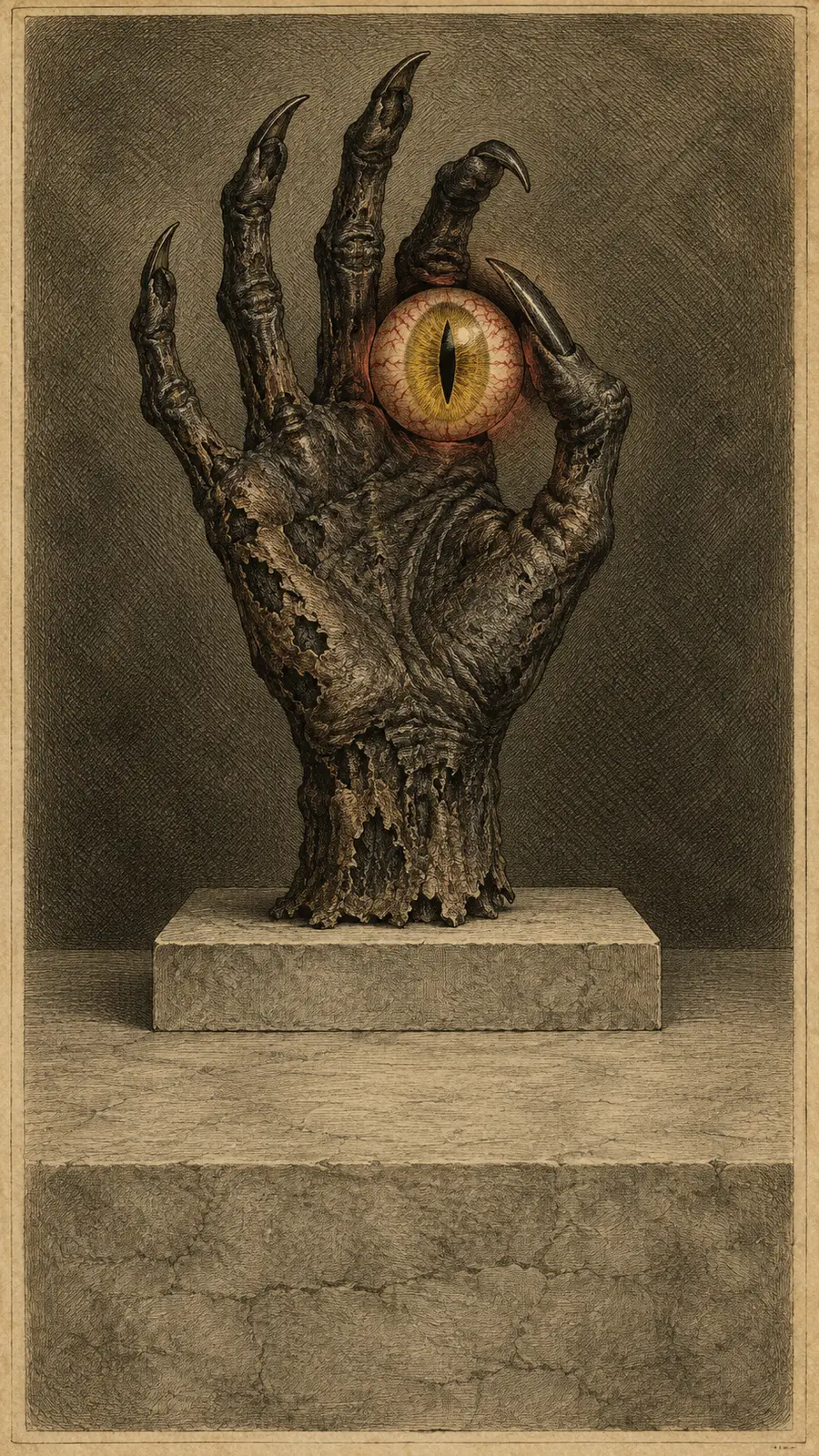
That's the moment our story really starts. The hand and the eye had been part of the greatest lich who ever lived, and something of him stayed in them. A fragment of his will, the stubborn wanting that had kept his dead body moving for so long, remained in that small amount of flesh. Its latent power turned them into artifacts, the Hand of Vecna and the Eye of Vecna. One much later rulebook says these grisly relics still seek to work the Whispered One's will in the world.
There's one more old thread worth holding onto. The very first description of the Hand called it the sole remains of an ancient lich so powerful that he was able to imbue his hand with wondrous and horrible powers, and to let it survive after his body had ceased to exist. Read that way, the hand didn't just happen to survive. Vecna put his power into it on purpose, as a lich puts his life into a hidden vessel, so that some part of him would outlast whatever came. So you can tell the story two ways. In one, the hand and eye are accidents of a betrayal, scraps left behind. In the other, they're a design, a plan made long before Kas ever drew his sword. Either reading leaves the same objects lying on the same scorched ground.
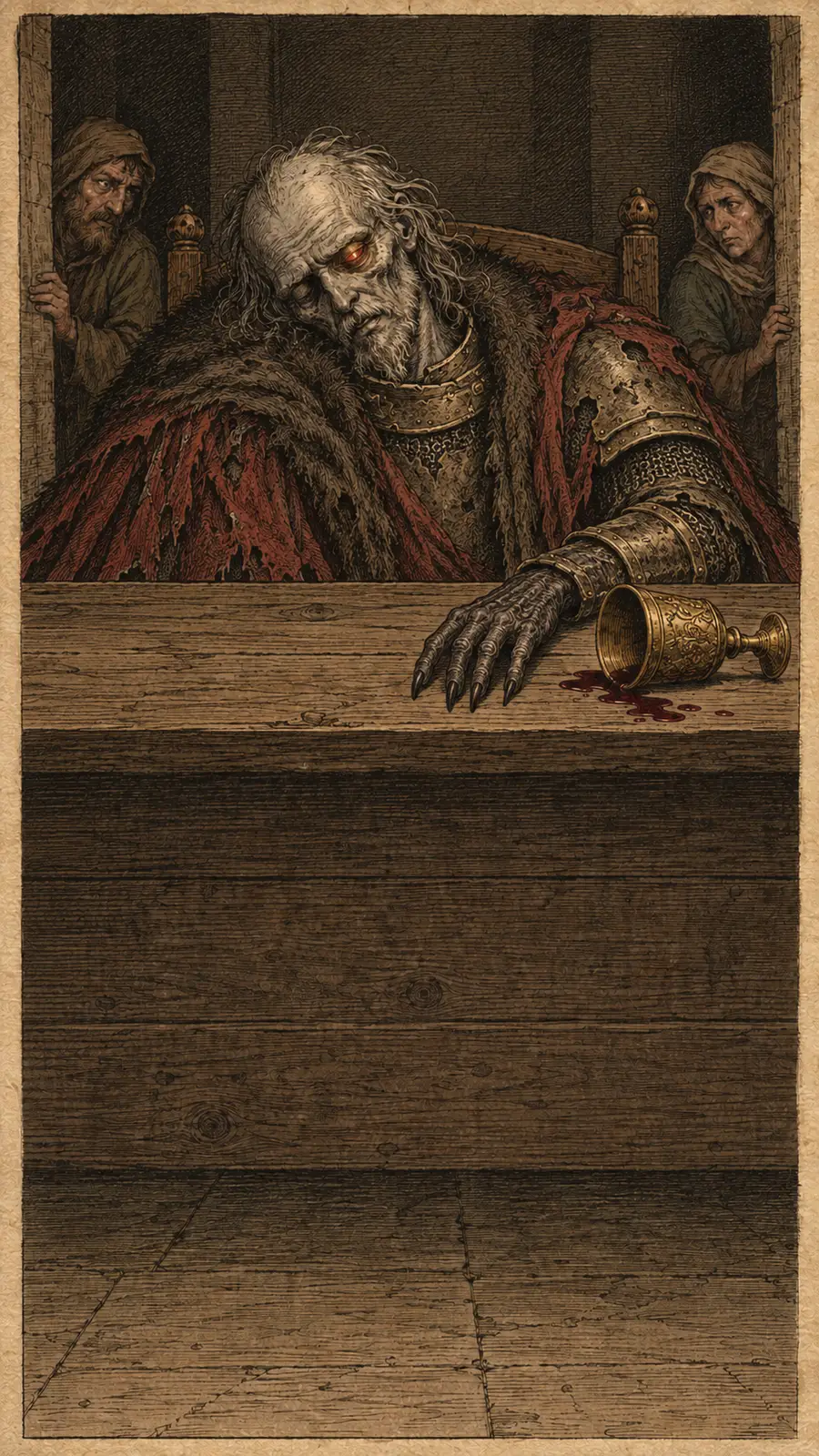
As for Vecna, he wasn't quite finished. He was too hateful to vanish completely, and his spirit drifted on without a body. In time he became something greater, first a demigod and later a god. But in every later form, however mighty, he is still pictured missing his left hand and his left eye. He never got them back, and that absence follows him everywhere.
Outside the story, in our own world, the order of events ran the other way round. The relics came first. Before there was a Spider Throne or a Rotted Tower, before Kas had a reason to rebel, before Mazzel or Fleeth, there was only a hand and a rumour of an eye. The man who first imagined them was , one of the owners of TSR, the small company in Lake Geneva, Wisconsin, that published Dungeons & Dragons. The name he chose, Vecna, rearranges the letters of Vance, after Jack Vance, the author whose dying-earth sorcerers gave the game its way of preparing and forgetting spells. Readers have long seen another echo in Michael 's novels, which began in 1971. In them, a hero loses his left hand and an eye to his enemies and receives two strange replacements from a mad sorcerer: the six-fingered Hand of Kwll and the Eye of , relics of vanished gods. A lost hand, a lost eye, and something uncanny pressed into the empty places. That's the shape Blume's relics would take, turned toward the dark.
Gary , who wrote much of the early game with him, said years later that Blume never told him the story behind the hand and eye. Nary a detail of those items, Gygax said, did Blume ever reveal. So the history we just walked through was built afterwards, edition by edition, by many hands, all of them working backwards from two pieces of a body that came with no explanation. In a way that suits the subject. The relics have always been fragments, and so has their legend.
So let's go back to 1976, to the moment the hand first appeared on a page.
Chapter II
A hand rumoured in dark passageways
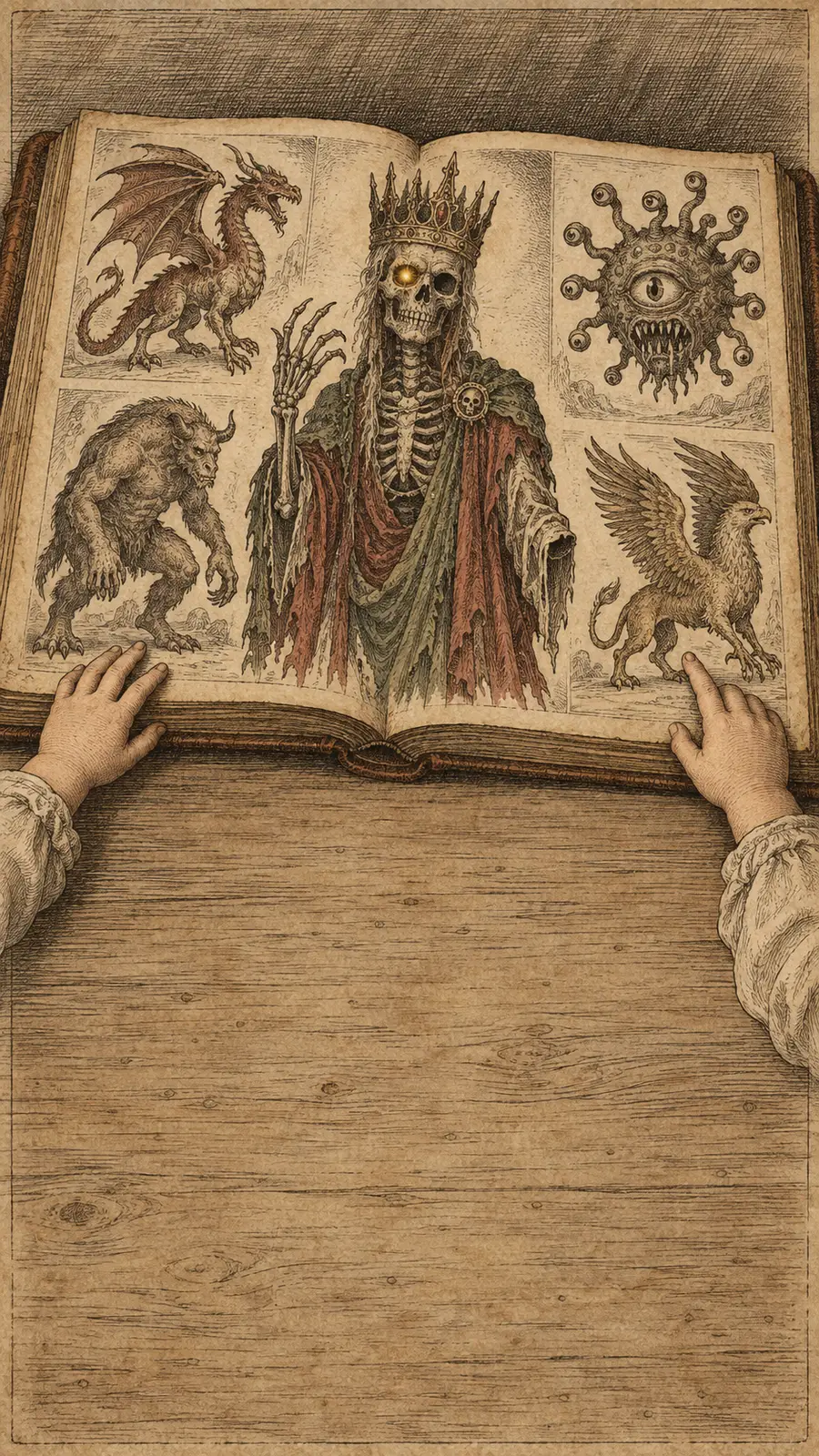
In 1976 TSR published a slim booklet called Eldritch Wizardry, the third supplement to the original Dungeons & Dragons rules, written by and together. It's remembered for bringing demons and psionics into the game. Near the back, though, it had a section of more than twenty artifacts and relics: objects of enormous power, meant to be one of a kind, that a referee might hide at the bottom of a whole campaign's worth of danger.
These were a new sort of treasure. An ordinary magic sword or wand did what its rules said. The artifacts in Eldritch Wizardry came with suggested powers that the referee was encouraged to change, so that no two campaigns had quite the same relic. Players weren't supposed to know what an artifact did. They'd learn it the way people in legends do, through rumour, old songs, guesswork and dangerous trial. One principle ran through the whole section: great power came with a price. Every artifact carried a curse or a cost alongside its gifts.
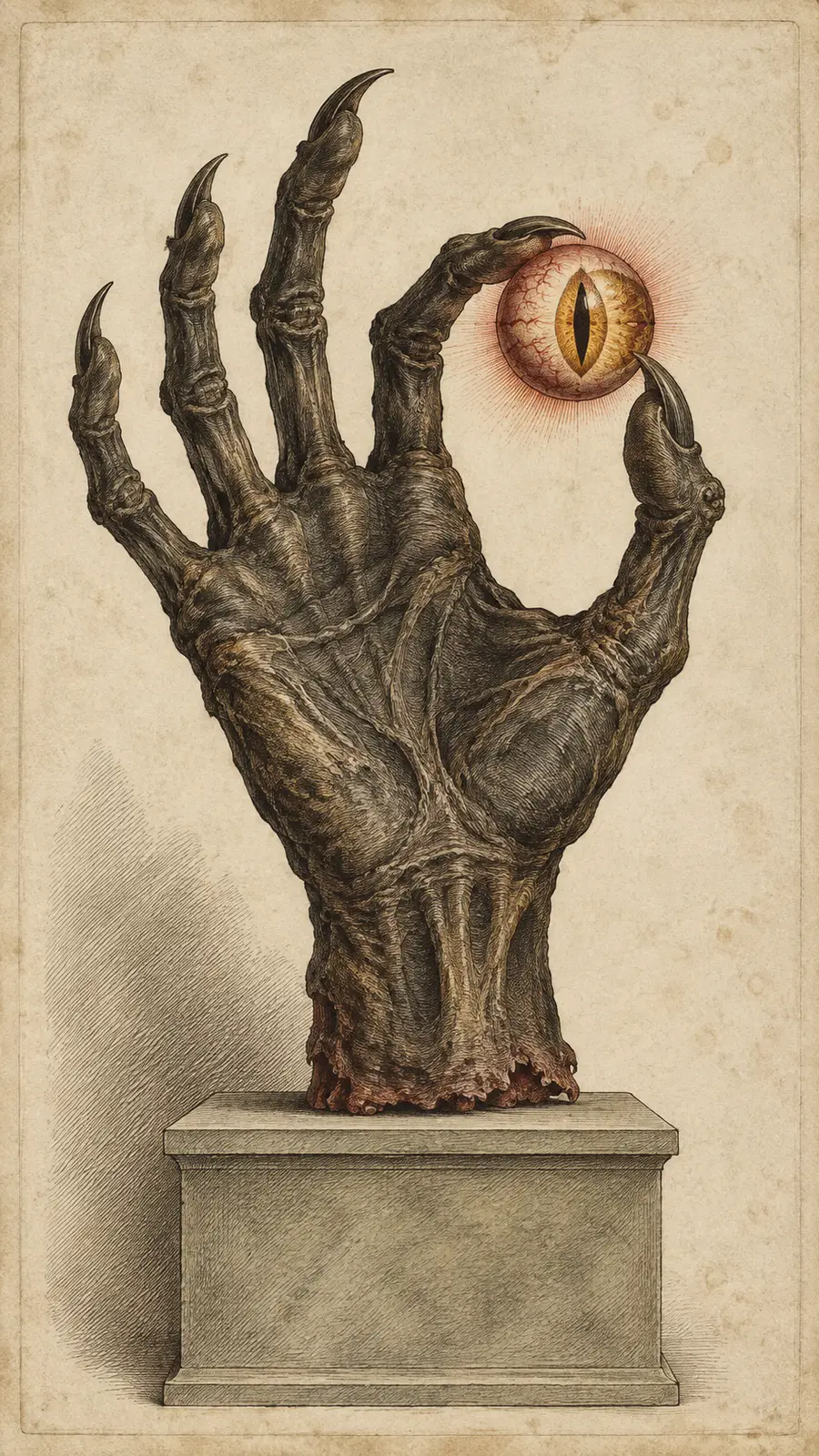
The Hand of was one of these, and its description was brief and strange. The Hand of Vecna, the text said, appears to be a dried, shriveled and blackened hand, such as could have been caused by having been burned. It is the sole remains of an ancient lich, so powerful that he could give his hand wondrous and horrible powers and let it survive after his long-undead body had ceased to exist.
Picture finding it. You're deep in some forgotten vault, and on a stone shelf, or in a box lined with rotted cloth, lies a small black thing that might be a charred root, or a bundle of twigs, until your lantern shows the knuckles. It's light, as burned things are light, and it doesn't look like treasure. It looks like something left over.
Tucked inside that sentence was a smaller phrase that would grow into half of our story. The hand, the text said, and it is also rumoured in dark passageways, an eye. That was all the Hand's own entry said about it, a rumour murmured in the dark. And yet the Eye had an entry of its own in the same book, so it was already real, waiting a few paragraphs away.
The Eye of Vecna, the book said, survived from the mighty lich, Vecna, when he finally met his doom. It appears to be an agate until it is placed in an empty eye socket of a living character. It was said to glitter like the eye of a cat, and to glow the way a wild animal's eyes glow when light catches them at night. Once it was set in place, the text said, it immediately grafts itself in place and starts glowing with a red, sinister light.
So, an agate. You might roll it in your palm and think you'd found a pretty stone. Nothing about it says eye until it touches the place where an eye should be. Then it takes hold, and it begins to glow red.
Here we meet the bargain that would define these relics for the next fifty years. Neither would work just because you held it. The Hand had to replace your own hand, so the would-be bearer cut off their own and set Vecna's in its place. The Eye had to sit in an empty socket, so the bearer plucked out their own eye first. The price came at the very start. A character had to give up part of their body before gaining anything at all, and on top of that, the powers weren't revealed beforehand. The referee knew what the relic would grant, and the player could only guess.
The curse was blunt in that first text. The Hand made its user totally evil. Worse, a spell for detecting evil wouldn't reveal the change. The bearer's companions could look at their friend with every magical sense they had and see nothing wrong. The darkness worked from inside and left no mark you could read from outside.
That's very nearly everything the first appearance said. It gave Vecna no homeland, no empire and no reason for his fall. In 1976 he wasn't a god or a schemer. He was simply an ancient lich, a mighty one, who had met his doom at some point lost to history, and the only proof he had ever existed was a burned hand and a stone that turned into an eye. A sword of Kas belonged to the same first generation of artifacts, but in these earliest pages the story that would bind the sword, the hand and the eye together hadn't yet been told.
The relics also kept some notable company in that section. The Rod of Seven Parts was there, a staff broken into pieces whose power grew as they were brought back together. So was the Machine of Lum the Mad, a strange siege tower whose operator faced a great horseshoe of levers, dials and switches with no idea what most of them did. These were the game's first attempts at objects that were bigger than a single adventure, objects that could hold a whole campaign together. Of them all, the hand and the eye proved the most memorable, perhaps because they asked the most of the player who wanted them.
Think about what a referee in 1976 actually had in front of them: a handful of sentences, a name, a rumour, and permission to decide the rest. Every group that met the Hand of Vecna met a different one. In one campaign its fingers might summon fire. In another it might command the dead, or open any lock in the world. The one thing every table shared was the moment of choice, a player looking at a shriveled black hand and deciding whether to give up their own for it.
Three years later, a much larger book would gather the relics up, give them firmer rules, and set down for the first time how their curse worked.
Chapter III
Fingers that fold into spells
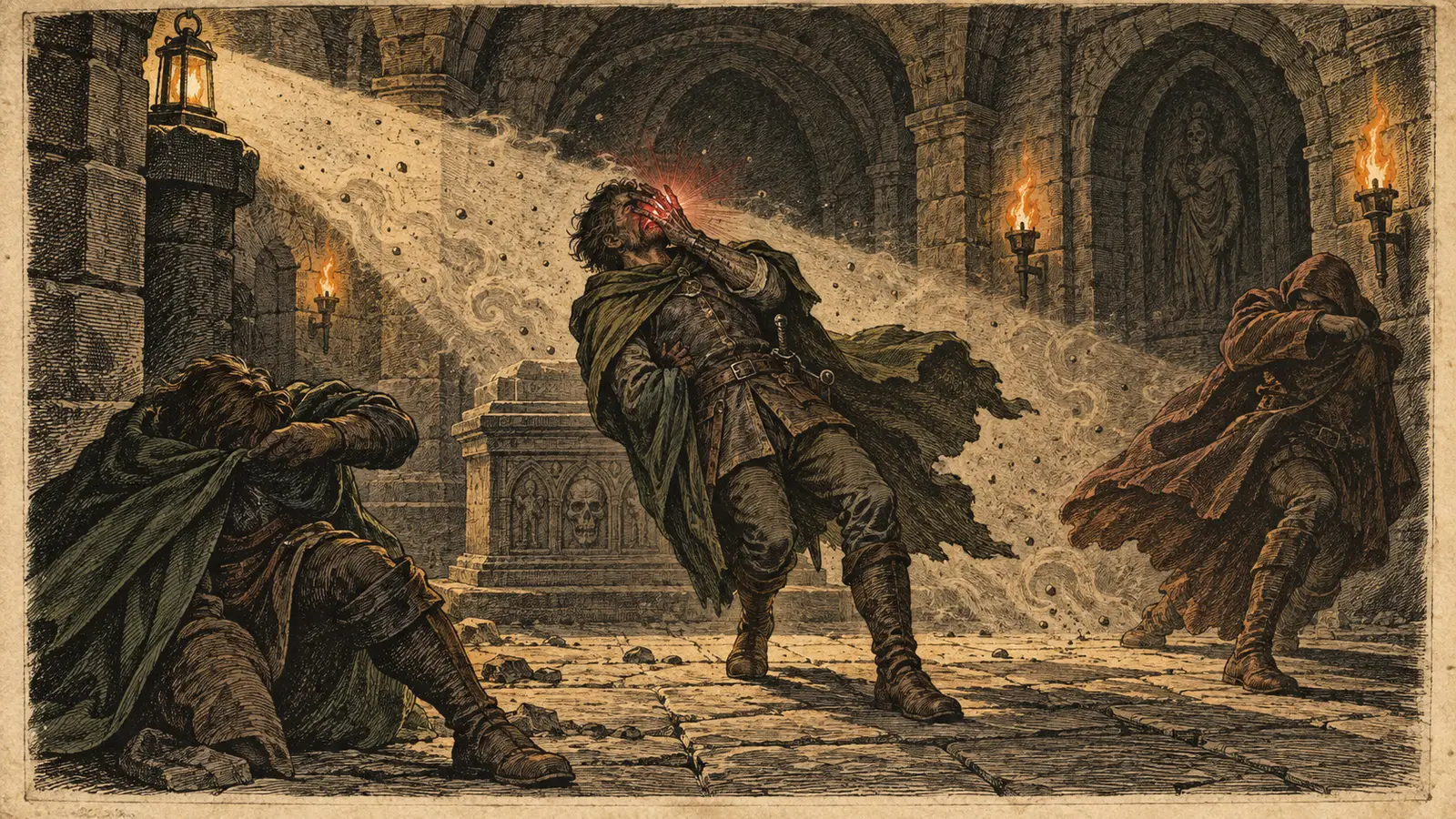
In 1979 TSR published the Dungeon Masters Guide for Advanced Dungeons & Dragons, written by Gary . It was a heavy hardcover, and for many players it became the book that defined how the game's hidden machinery worked. In its treasure section, under artifacts and relics, the Hand of and the Eye of Vecna appear as two separate entries. Around them in that chapter stood the Sword of Kas, the Cup and Talisman of , 's Mask, Kuroth's Quill, the Recorder of Ye'Cind and the Teeth of . By now the sword stood right beside the hand and eye in the same company, three relics from one ruined story, even though the story itself was still mostly unwritten.
The first edition added very little to Vecna's own tale. It didn't say how he died. It didn't say that Kas's blade cut anything off. It said only that the hand, the eye and the sword were what survived. But it left behind one sentence that hangs in the air like a chill draught in an old hall: the phantom of this once supreme lich still roams the Material Plane.
That one line changes how the relics feel. In 1976 Vecna was simply gone. Now something of him was still out there, a phantom, unseen, roaming. And the relics, holding a fragment of his will, tried to carry out his work wherever they went. A hand and an eye wandering the world, and a ghost wandering it too. It's easy to imagine the two being drawn toward each other.
Let's look at the Eye first, as the first edition set it down. It looked like an agate until it was used, as before. Once it was in use it glowed like a wild creature's eye, the way a cat's eyes shine at the edge of firelight. It had to be placed in the empty socket of a living character. Once pressed in, it grafted itself to the head instantly and irrevocably. It couldn't be removed, and it couldn't even be harmed, without killing its bearer.
So the first edition closed the last door. In 1976 the Eye might have been something you could take out again if things went badly. Now the graft was permanent and the stakes were total: take the Eye, and the only way to be free of it was to die. Its bearer's alignment changed at once to neutral evil, and it could never change back. The book gave the Eye's gifts in part. It granted infravision, the ability to see the heat of living things in darkness, and ultravision, sight by light beyond the violet end of the spectrum. Everything else it could do was left to the Dungeon Master.
Now the Hand. Here the first edition is more specific: a withered, blackened, mummified human left hand. It worked when touched to the stump of the user's own left forearm, which meant, in practice, that the would-be user first had to cut off their own left hand. In return the Hand gave great strength, the very highest exceptional strength a human character could have in those rules, the strength of legendary warriors. And using any of its primary powers turned the bearer neutral evil.
The loveliest and eeriest detail in the first-edition Hand is how its powers were called up. They were triggered by gestures. Picture the dead fingers on the end of someone's arm: four fingers, each either extended or curled, which gives sixteen possible combinations. Ten of those sixteen called up a different power each. The rest did nothing. One more power worked by touch alone. The book left it to the Dungeon Master to decide which gesture did what, so a bearer would learn the Hand the way you'd learn a strange instrument, slowly folding and unfolding the black fingers, testing shapes, never quite sure whether the next arrangement would do something wonderful, something terrible, or nothing at all.
Picture a bearer alone at night, practising. Two fingers curled, two extended, and nothing happens. Three curled and one extended, and the air in the room goes cold. They'd have to remember which shape did what, and every discovery, every new power found, would be another step toward the evil that came with using it.
The first edition treated all its artifacts the same way. The Dungeon Master chose or rolled each relic's powers from tables at the back of the section: lists of benign powers, malevolent effects, prime powers and side effects. Somewhere in those tables were mighty things, including a wish once a day, alongside curses and strange penalties. So even though the Hand and Eye now had rules, each campaign's versions still differed. Two groups who both found the Eye of Vecna might later compare stories and find that their relics shared almost nothing except the way they were used.
What the first edition did fix in place were the parts that made up the curse. The graft couldn't be undone. The turn to neutral evil was forced and permanent. And the lich's will worked on through his remains, trying to finish what he'd begun. Everything else could move. Those three things couldn't.
It's worth noting what the first edition didn't yet say. It didn't say the bearer would slowly become Vecna, or that they might forget their own name. That idea, which would become one of the most haunting parts of the legend, came later. In 1979 the relics corrupted you, but they hadn't yet started to replace you.
The first-edition pages weren't forgotten, either. Many years later, in 2018, Wizards of the Coast reissued the old Vecna artifact entries as a small extra for its digital magazine Dragon+, so a new generation could read the phantom's sentence just as it first appeared.
For ten years the relics sat in that book much as Gygax left them: a hand that folded into spells, an eye that glowed in the dark, and a ghost that roamed. Then a new edition of the game came along, and with it the Hand got something it had never had before, a history.
Chapter IV
The Hand's long road through Tyrus
In 1989 the second edition of Advanced Dungeons & Dragons arrived, and with it a new Dungeon Master's Guide, shaped largely by David "Zeb" Cook. The new book kept only a few sample artifacts, as examples for Dungeon Masters to learn from, and the Hand of was one of them. What made this entry special wasn't its rules. It was that, for the first time, the Hand came with a story about where it had been.
The entry begins by calling Vecna this most supreme of all liches. It says legends, spoken in hushed tones, claim that Vecna still roams the world as a shade, and it hints that his spirit may linger in the hand itself. His doom came, the book says, in some awesome conflagration that destroyed his body, and rumour holds that a single hand, and perhaps an eye, survived.
That "perhaps an eye" echoes the 1976 phrase, "rumoured in dark passageways." Thirteen years later the Eye was still half a rumour, while the Hand had become the relic with a past.
The past it was given reads like an old chronicle, the kind of history a scholar might piece together from scraps of records in different archives. It's one of the gentlest and saddest parts of the whole legend, so we'll walk through it slowly.
The Hand's first recorded appearance, the chronicle says, came during the Insurrection of the , a hundred and thirty-six years after Vecna's passing. So for more than a century after the fire, nothing at all was written about it. It lay wherever it lay. Then it surfaced among the Yaheetes, a clan in revolt, and when the clan's leader, a man remembered as the Vain, was overthrown, the Hand vanished again. The chronicle doesn't say Paddin used it, or how it came to him. It says only that it was there, and that when he fell, it was gone.
The next time it appears, it's in humble hands. During the reign of a king named of , a fisherman called found it. Perhaps it came up in his nets, or he found it washed onto the shore. The chronicle doesn't say. What it does say is that Gisel kept it as a curiosity, for several decades.
That's a strange thought to sit with. For years the hand of the greatest lich of all lay in a fisherman's house, maybe on a shelf beside his tackle, maybe in a chest. He never cut off his own hand to wear it. He never learned what it could do. He simply kept it, a black, dried oddity from the sea, and went out to fish each morning and came home each evening, and the Hand waited. Of everyone who ever held it, Gisel may be the only one who held it the way you'd hold a pebble you picked up on a beach, without wanting anything from it.
The waiting ended with Gisel's own brother. He killed Gisel and stole the Hand. The chronicle doesn't tell us whether the relic whispered to him, whether he'd always resented his brother's odd treasure, or whether the Hand's will had simply found a nearer, hungrier vessel. We know only that the brother set out on the road to Tyrus with it, and that he never arrived. He was waylaid on the road, and the Hand passed to the man who robbed him, an outlaw named Mace.
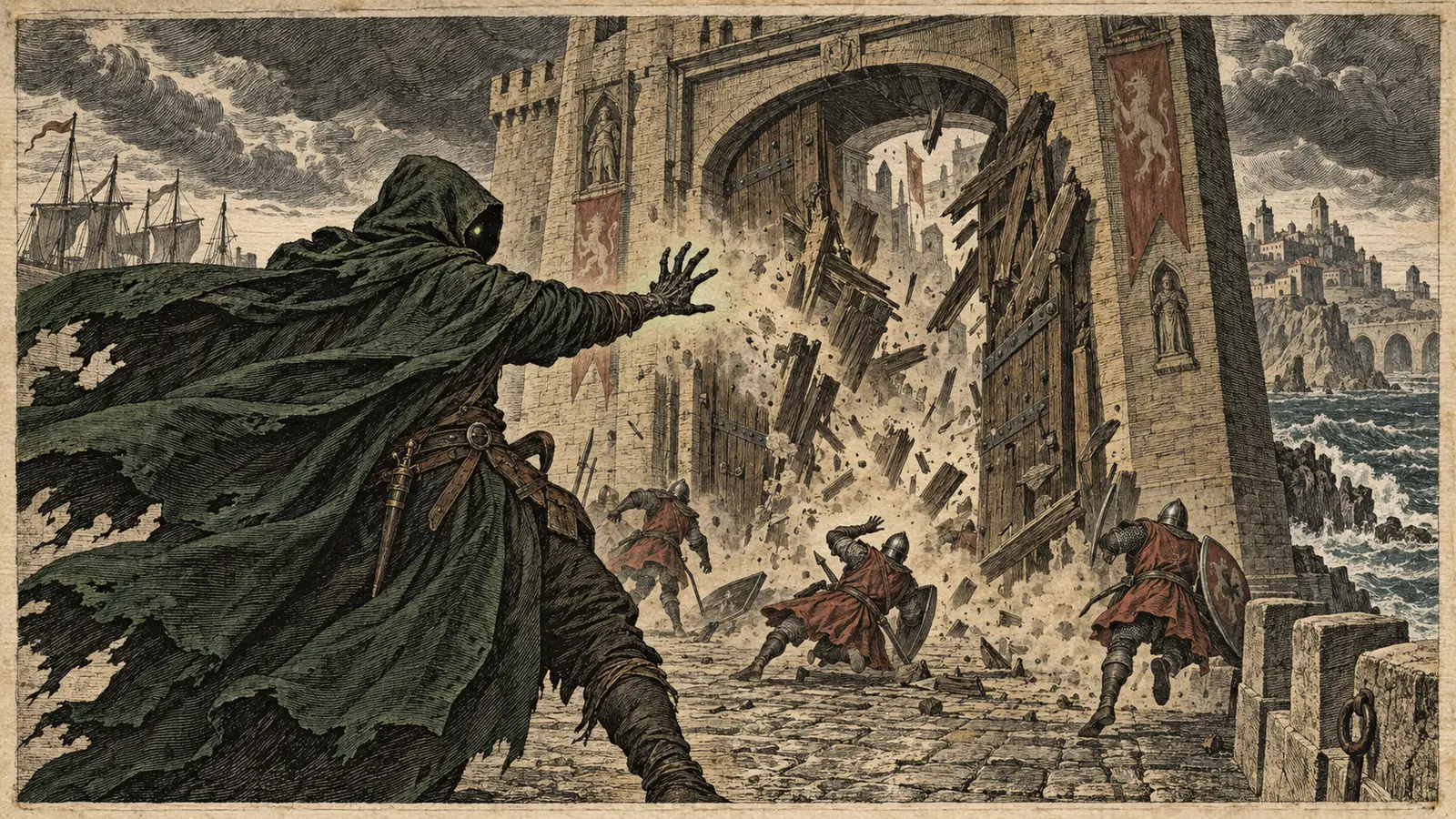
Mace was the bearer the Hand had been waiting for. With a single gesture of the Hand, the chronicle says, he struck down the gates of Tyrus and brought plague upon its royal house. Think of the old first-edition picture of the folding fingers. Mace found the right gesture, and a city's gates fell.
He ruled Tyrus for a hundred years. That span alone tells you something about what the Hand did for its bearer, because ordinary outlaws don't reign for a century. He took a new name for himself, Vecna the Second. Under him Tyrus grew powerful, but it also grew infamous, and people along that coast came to call it the Slaughterhouse of the Western Shore.
And then, the chronicle says, the power of the Hand inexplicably failed him. After a hundred years of serving him, the relic simply stopped. In that moment an assassin of the struck him down.
The chronicle doesn't explain why the Hand failed. Perhaps the fragment of Vecna inside it had finished with Mace. Perhaps it had found the man too small for its purposes, or it had always meant to discard him. Perhaps a self-proclaimed Vecna the Second was an insult to the first. The book leaves the silence there, and the silence is more unsettling than any explanation would be. The Hand serves its bearer only as long as it chooses to.
So the 1989 entry gave the Hand a pattern that would echo through all its later stories. It surfaces in a time of upheaval. It passes from hand to hand, often through violence. It finds a bearer ambitious enough to use it, raises that bearer to terrible heights, lets them believe for a while that its power is theirs, and then abandons them. The bearer takes Vecna's name, and the bearer falls. Then the Hand vanishes again, to wait.
The second edition also deepened the curse. In this era the Hand came to be described as slowly wearing away the bearer's own self, until in the end they believed they were Vecna. Mace calling himself Vecna the Second foreshadows exactly that. In second-edition play, each use of the Hand's primary powers was said to add to a growing chance that it could never be taken off again, so the grip tightened with every use and the way back narrowed with every gesture. The Hand gave its bearer great strength, beyond even the old exceptional strength. And the voice of the relic, once it had settled in, was the voice of someone who had ruled an empire and wanted it back.
From here the story of the relics moves out of chronicles and into adventures. The next bearer we'll meet doesn't come from an old history at all. He's sealed in a tomb, waiting for heroes to open it.
Chapter V
Halmadar, who forgot his own name
As the nineties began, TSR published an adventure called Vecna Lives!, written by Zeb Cook for the second edition and set in the World of Greyhawk. It was meant for experienced characters, and it was the first published adventure built around , fourteen years after Eldritch Wizardry first named him. Its premise was simple and old-fashioned. The Hand and Eye have been found, and Vecna wants them back.
Jeff painted the cover, and it's worth picturing, because it puts the Hand at the very centre. A withered, clawed hand rises out of a golden chalice, as though the cup had poured it out, and behind it stands a ring of ancient standing stones under a dark sky. The relic isn't a small thing in a corner of that painting. It's the whole subject.
By now the larger story had changed around the relics. Vecna was no longer a phantom. He had become a demigod, and the adventure treats him as a power that can act in the world through cults, plots and borrowed bodies. But our concern is the hand and the eye, and in Vecna Lives! they belong, at first, to a man named .
Halmadar the Cruel was a warlord of the Shield Lands, a region in the northeast of the . Long before the adventure's present day, in roughly the years 420 to 455 of the Common Year, as reckons time, he terrorised that country. He was already a powerful fighter before the relics came to him, a hard man in a hard place. With the Hand and the Eye he became the master of several northern counties. And the relics changed him. He had been cruel before. They made him sadistic.
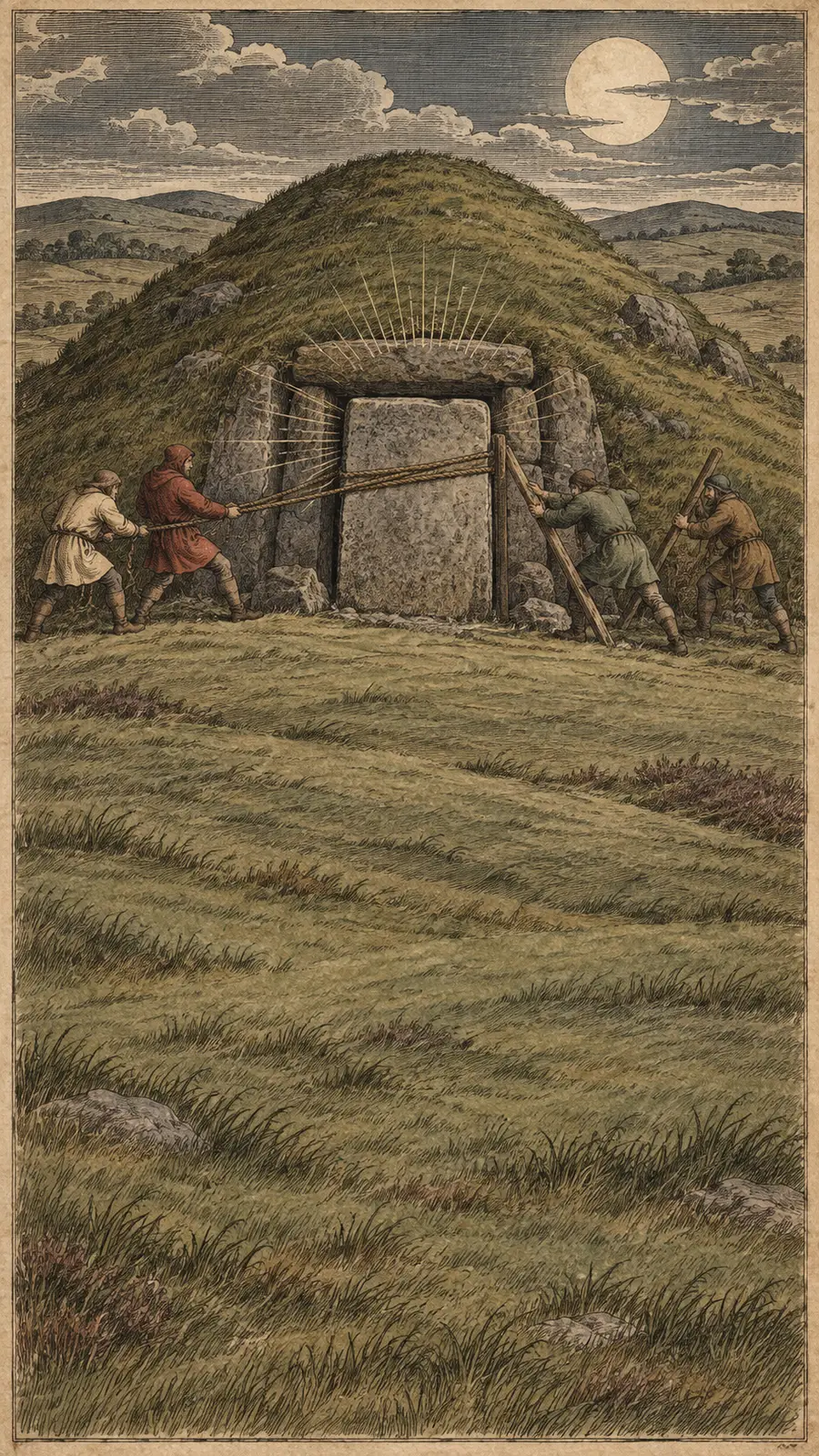
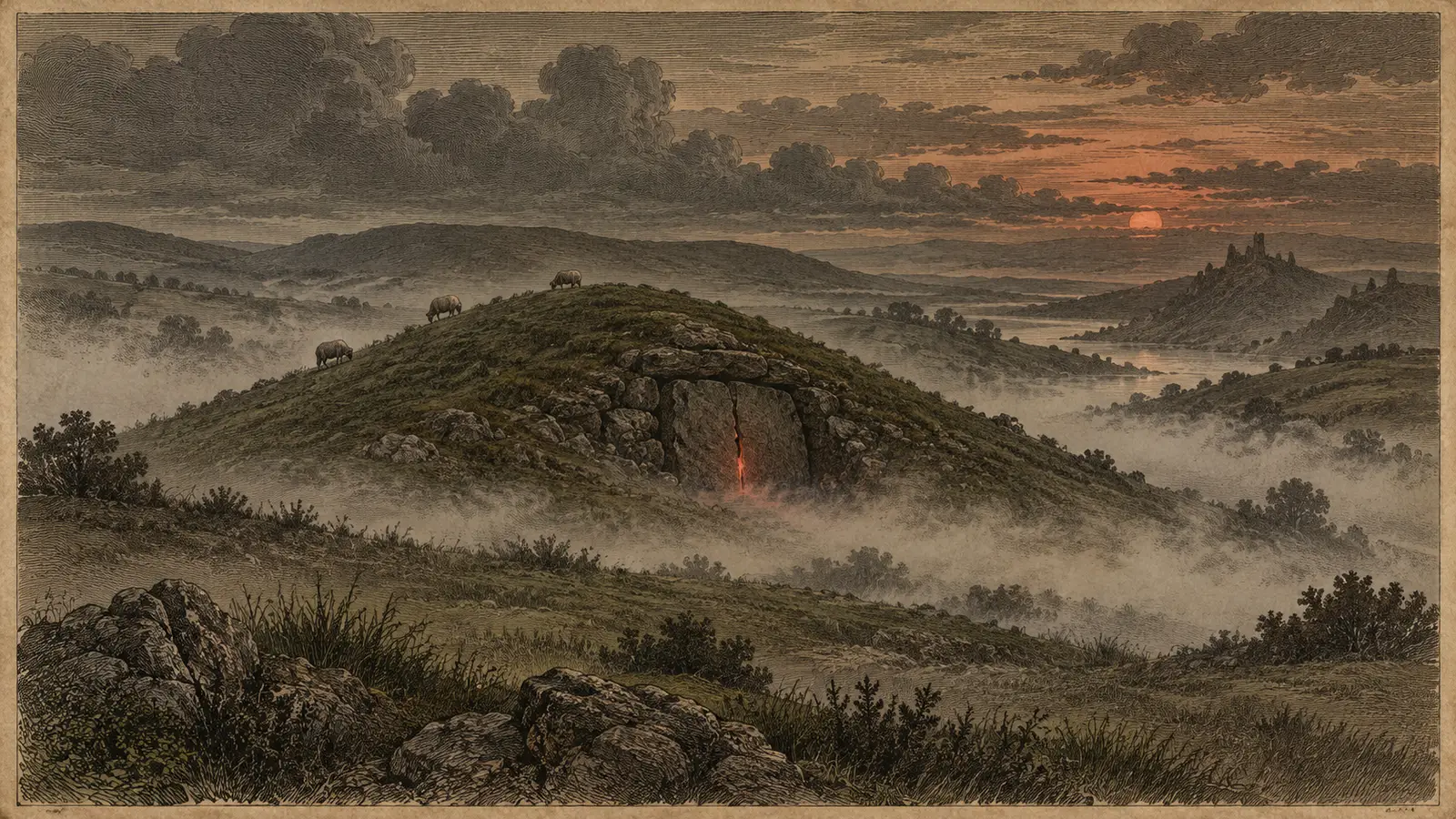
His end came from his own people. Unable to defeat him by force, his subjects drugged him to sleep. While he lay senseless, they carried him into a burial mound in the and sealed him inside, alive, under powerful enchantments, so that he could never come out.
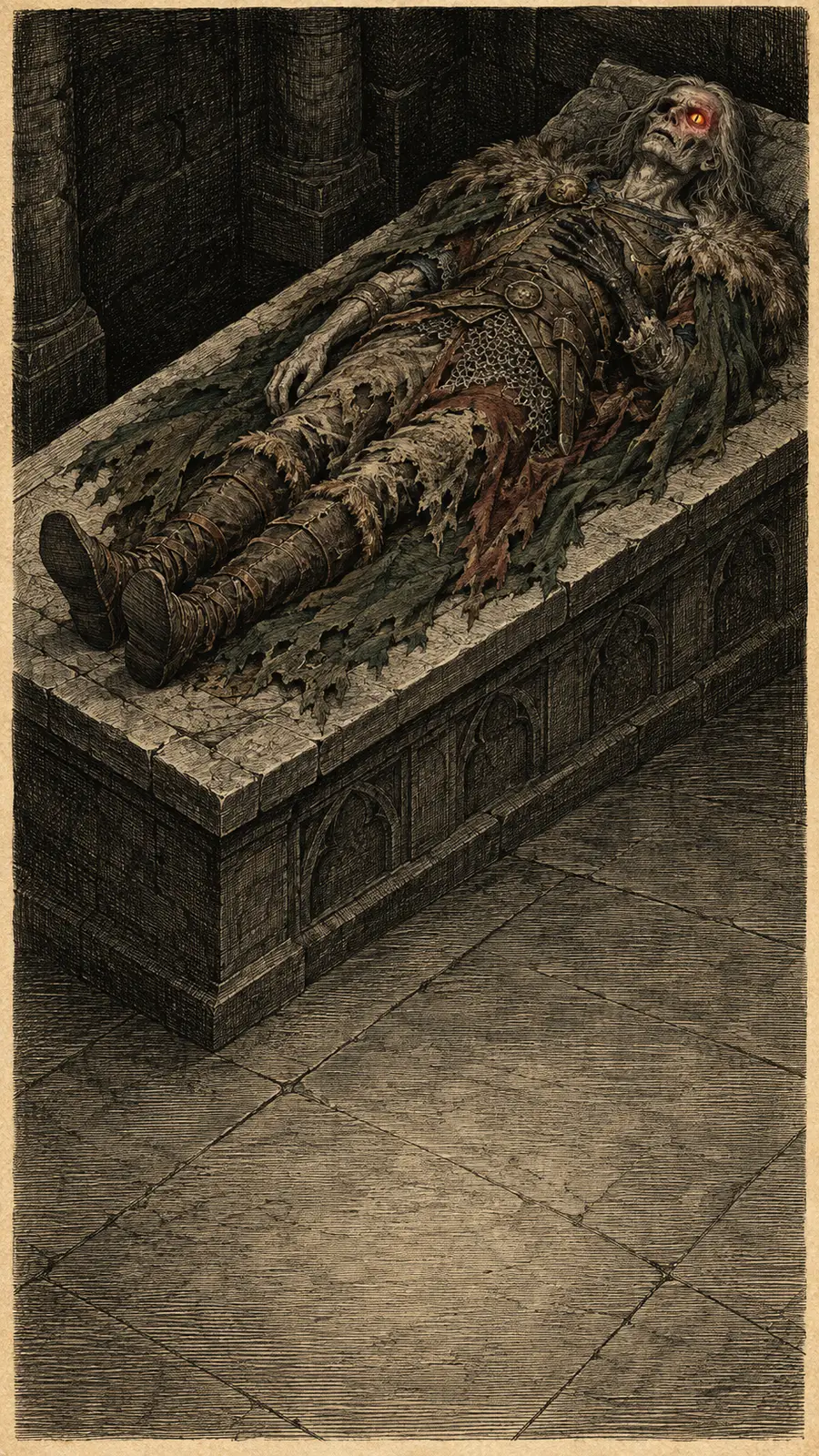
That might have been the end of Halmadar. A man sealed in a tomb starves. But Halmadar wore the Hand of Vecna and the Eye of Vecna, and they weren't ready to let their bearer go. As he starved, the relics held his body in a condition between life and death. The adventure calls it a quasi-lich state. He became grey and bony, gaunt like the walking dead, yet his flesh never rotted. He wasn't undead, and he wasn't alive either. He hovered between the two, sustained by the fragments of the greatest lich who ever lived, for more than a century in the dark of the mound.
Picture it gently, if you can. A low hill under the grass of the Kron Hills, sheep perhaps grazing over it in some later century. Inside, in the stillness, a grey figure sits or lies, one hand black, one eye glowing faintly red, and nothing moves for years. The relics wait. And all that while they're doing what they always do, slowly wearing away the self of the person who carries them.
By the time the adventure begins, that work is finished. Halmadar has forgotten his own name. He is completely dominated by the artifacts, and he believes he is Vecna. He answers only to Lord Vecna. This is the second-edition curse told as a single figure: the bearer doesn't just turn evil, he disappears, and something wearing Vecna's hand and seeing through Vecna's eye calls itself by the lich's name.
The adventure's opening is one of the most famous things about it, and it begins with the relics' power. Before the players meet their own characters, they play members of the Circle of Eight, the great wizards of Greyhawk, figures like , , Otto and , gathered under the archmage . Mordenkainen senses a danger rising and sends the Circle to look into it. What they find is Halmadar, and Halmadar, driven by the hand and the eye, kills every one of them except Mordenkainen.
It's a remarkable way to introduce two artifacts. The players are put in the shoes of some of the mightiest wizards in their world, and they find those wizards helpless against a man who wears the relics. Before their real characters ever lay eyes on the Hand or the Eye, the players have felt what the relics can do. Greyhawk's later lore went on to use this as the reason the Circle suffered such losses in the year 581.
Then, in that year, Halmadar comes out of his tomb. Vecna, now a god, helps him escape the mound. But the god has no affection for his borrowed puppet. He wants his hand and his eye.
As the heroes take up the trail, a figure joins them who seems to help. Only late do they learn that this helper is secretly an avatar of Vecna himself, a body the god has sent into the world. What this avatar wants is Halmadar dead, so that the relics will come free. And that's how Halmadar's long half-life ends. The avatar destroys him and claims the hand and the eye at last. After all those centuries, the god holds his own lost pieces again, if only for a while.
From there the story leaves the Shield Lands far behind. It runs through the City of Greyhawk, the Viscounty of and a gnome warren called , and finally out to a strange monument called Tovag Baragu, many weeks' ride away. Tovag Baragu is a great ring of standing stones, like Stonehenge, and its arches are full of portals. Remember the stones on the cover behind the rising hand. They were always here waiting at the end.
At Tovag Baragu, Vecna, made stronger by his recovered relics, tries to open a portal into the past and bring his ancient followers into the present. He banishes the heroes through another portal to , a realm he made himself, a demiplane prison. There they meet a figure out of the oldest part of the story, Kas the Bloody-Handed, the betrayer, still alive in his fashion after all these ages. The heroes have the Sword of Kas, and they give it back to him, and he uses its power to carry everyone back to Tovag Baragu. So, for a moment, the betrayer and his blade stand again against the master whose hand and eye they once took.
The heroes are far too weak to face a god directly. The adventure's answer is to summon another power, Iuz, an evil demigod of the same world, and to slip away while the two of them fight. If the heroes succeed, Vecna is driven out of Greyhawk, and later stories have him carried off into the misty prison of .
As for the relics, they didn't stay with him. Once again they were separated from their maker, and they vanished back into the Flanaess, to be found, sooner or later, by someone else.
The adventure also gave the Eye a clearer set of gifts for its own pages. In this version, the Eye granted constant true seeing, sight through every illusion and disguise, along with foresight, a warning of danger before it arrives, plus some lesser powers. Seeing truly and seeing ahead suits an eye that once belonged to someone who trusted no one.
The adventure wasn't kindly received by everyone. In Dragon magazine, Allen Varney called it yet another way to scare players, and other reviewers found it built too firmly around the heroes losing. But the figure of Halmadar stayed with people: the grey warlord in the mound, kept alive by the relics, who had forgotten his own name.
A few years later the same designer came back to the relics once more, this time to write them down as fully as they'd ever been written.
Chapter VI
Flesh that remembers its master
In 1993 TSR published the Book of Artifacts, a hardcover for the second edition with Zeb Cook as its chief designer. It set out to do for the game's great relics what no single book had done before: give each one a full history, a firm set of powers and, most interestingly, a suggested way to destroy it. Around fifty artifacts were gathered there, and every entry followed the same pattern. First came a description and history. Then constant powers, which were always on; invoked powers, which the bearer could call up; random powers, rolled from the book's own tables; and a curse. At the end of each entry came a suggested means of destruction.
The Hand and the Eye both had entries, and the book gave their origin the shape it has kept ever since. The hand and eye, it says, are all that remained of the arch-lich after his trusted lieutenant, the vampire Kas the Bloody-Handed, betrayed him. Kas wielded a sword that Vecna himself had made for him, and with it he cut off his master's left hand and took his left eye. Kas was destroyed in turn.
So by 1993 the old gap in the story was filled. The first edition had said only that the hand, eye and sword survived the battle. Now the sword had done the cutting. The betrayer's blade, made by Vecna's own hand, had taken Vecna's hand. There's a cold symmetry in it that later editions would never let go of.
And the book said one more thing about the relics, which explains everything else about them. They were once Vecna's living flesh. That's why they carry his will. They aren't enchanted objects that a lich happened to own, like a ring or a staff. They're parts of him. They remember being his, in a way a stone or a sword could never remember.
Let's look at the Hand as this book drew it. It's blackened, charred and mummified, with long fingers that end like claws, and it's icy cold to the touch. You can imagine picking it up and feeling that cold sink into your palm, an unnatural chill that no fire warms. Like the Eye, it has to be attached to its owner's body, replacing the owner's own left hand.
Its constant powers were modest and strange. The bearer's strength rose to nineteen, past the old exceptional range, into the territory of giants. The bearer became immune to magic missiles, those darts of force that wizards fire. And the Hand's touch harmed plant creatures, burning living green things that it touched. There's an image in that last power that's easy to miss: things that grow, shrinking from the dead hand.
Its invoked power was terrible: once a day, a touch that brought instant death, with no chance to resist. And beyond those, the Hand carried a whole store of random powers, eight lesser spell-like powers and seven greater ones, each rolled for the particular hand in a particular campaign. Here the book kept the oldest and loveliest idea from 1979. Each of those powers was triggered by a unique gesture of the hand. The dead fingers still folded and opened to call up the magic, each shape its own spell.
Now the Eye. The Book of Artifacts moved it away from the old agate. Here the Eye is little more than a shriveled clot or a small pebble, blood red in colour. Picture a tiny dark-red thing like a dried berry, easy to overlook. It has to be pressed into an empty socket. Once in place it changes, and it becomes a golden eye with a slitted pupil, like a cat's. The old cat-like glow from the very first description comes back here, made literal. Whoever wears the Eye looks out at the world through a cat's golden gaze.
Its constant power was true seeing. Its bearer saw through every illusion, every disguise and every invisibility, and saw things as they really were. Its invoked powers turned that sight into a weapon. Three times a day it could cast eyebite, a gaze that sickens or terrifies or puts to sleep, and once a day it could dominate a person entirely and bend their will to the bearer's. And it carried three random divination powers, ways of seeing far or knowing hidden things.
The two relics could be used alone or together, and the book gave them one shared curse that grew stronger when a single person held both. Because they were once Vecna's living tissue, every use of their powers called for a test of will to avoid being dominated by the artifact itself. Holding both made that test much harder to pass. So the more you used them, and the more of Vecna you carried, the more likely you were to stop being yourself.
The book also named what the relics wanted. These were their goals, the work Vecna's lingering will pushed its bearer toward. The bearer would seek more magical power, and would try to found an empire. They would want to destroy the Sword of Kas, the blade that had once severed the hand and taken the eye. And they would work to summon Vecna, the demigod, back to .
Look at how neatly those goals describe the relics' past. Mace founded something like an empire in . carved out a domain in the north. And here, written down at last, is the hatred of the sword, the remains still holding a grudge against the steel that cut them away. This book also first introduced the idea that holding both relics granted further powers beyond either one alone, a reward for completing the set that would echo through every later edition.
Then come the suggested means of destruction, and they're among the most beautiful passages in the whole history of these relics. The book gives three.
The first is that Vecna the demigod be permanently and irrevocably destroyed. With the will behind them gone, the relics would have nothing left to serve.
The second is that the relic be cast into the heart of Oerth's sun. Picture it falling, a small black hand or a small red stone, down and down into the great fire at the centre of the sky until it's simply gone. The lich who began in fire, whose tower ended in fire, would end there too.
The third is the gentlest. It asks that every shade of Vecna's victims be laid to peaceful rest. Every ghost his long reign created, every restless spirit of those he killed or broke, would have to be given peace. Only when all of them were quiet would the relics lose their hold on the world.
That third way says something the relics' rules never say aloud. Vecna's power, as this book imagines it, isn't only his own will. It's also made of the harm he did, every life left unfinished. So undoing the relics means mending all of that, one restless shade at a time, until the last of them rests.
None of these is easy. Each would be the work of a whole campaign, perhaps many lifetimes. But each is possible, and each shows a different way of thinking about what the relics are. Later editions would narrow the paths down to a single one.
Before that happened, though, the relics had one more great second-edition story to play a part in, a story in which a hand that had served a god for so long became the key that let mortals reach him.
Chapter VII
The hand that opened a god's door
The years after Vecna Lives! carried into , the misty demiplane where dark lords are imprisoned in domains of their own. There, the later books say, he and Kas were bound together in a twin domain called the Burning Peaks. Vecna ruled one half, , and Kas, now a vampire, ruled the other, Tovag. The two fought on forever, the master and the betrayer, each keeping the other trapped.
In June 2000 that story came to its end in an adventure called Die Vecna Die!, written by Bruce R. Cordell and Steve Miller and published by Wizards of the Coast, which by then owned the game. It was built in three parts, moving from Greyhawk to Ravenloft and finally to , the City of Doors at the centre of the planes. Many people regard it as the closing chapter of the second edition itself. The game historian Shannon wrote that it touched upon the oldest locales and the most ancient myths of the D&D game. And at the heart of those ancient myths were the hand and the eye.
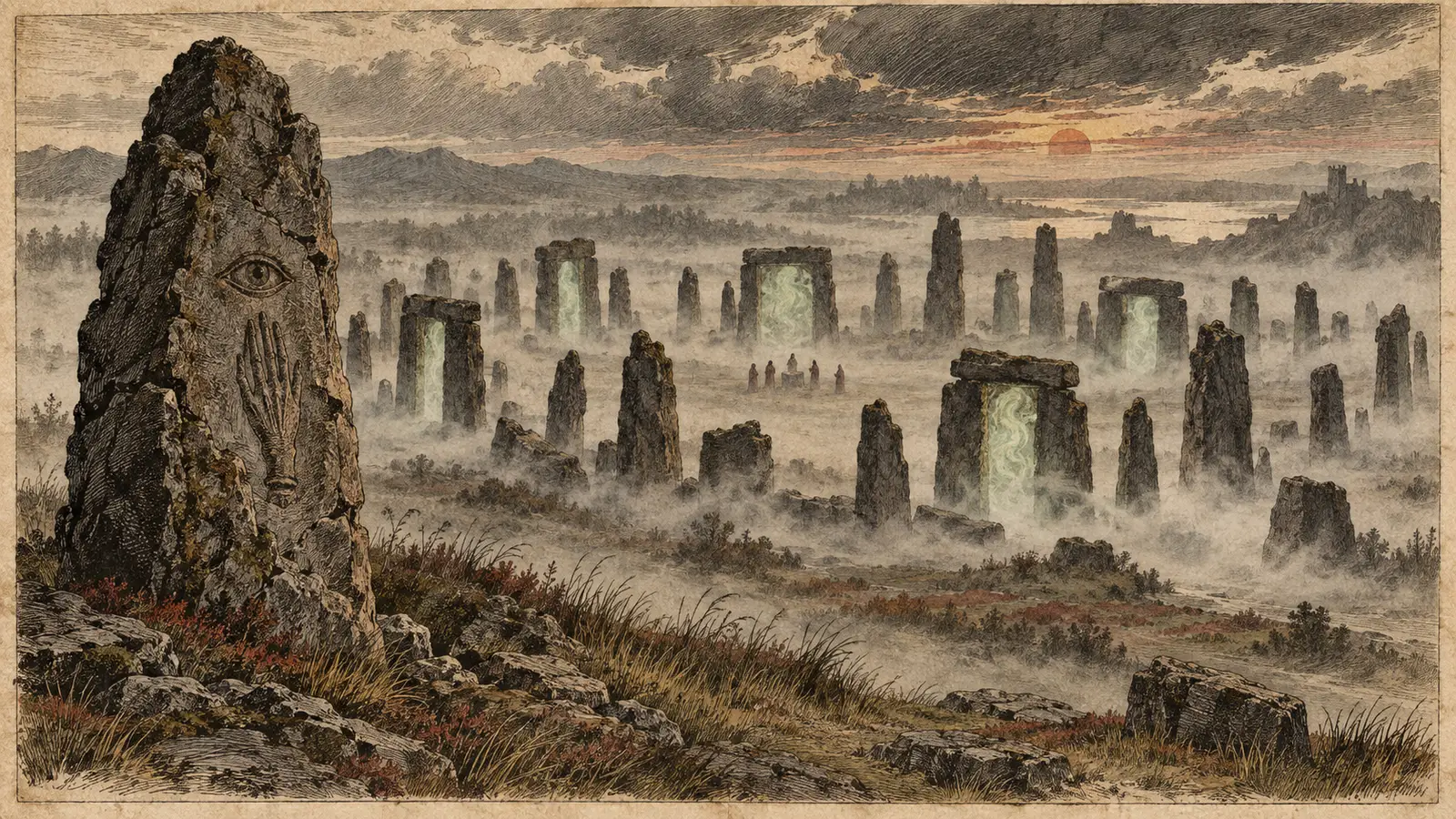
The adventure begins back at Tovag Baragu, the ring of portal stones from Vecna Lives! A death cult devoted to Vecna has taken it over and is reopening its gates. The congregation has been gathering pieces of their god's old body, which the adventure calls Vecna's bodily relics, of which the Hand and Eye are only the most famous. We'll come back to the rest of those pieces later in the evening, because they're a story of their own.
The adventure says plainly that two things in the world can stop Iuz, the same evil demigod the heroes of Vecna Lives! once summoned. Those two things are the Eye and the Hand of Vecna. But using them, it warns, carries fantastic risks. Nothing about the bargain has changed. Whoever means to use them must still give up a hand or an eye of their own.
Iuz learns what the cult is doing at Tovag Baragu, and he comes for it. He attacks the cult's temple with a small army, and he takes the Eye of Vecna. Then, carrying the Eye, he steps through one of the portals into Cavitius, Vecna's prison realm in Ravenloft. His aim is to destroy Vecna, the imprisoned lich-god, and take his power for himself.
So now the two relics are apart, with one god's enemy holding the Eye. The heroes come after him, and they carry the Hand.
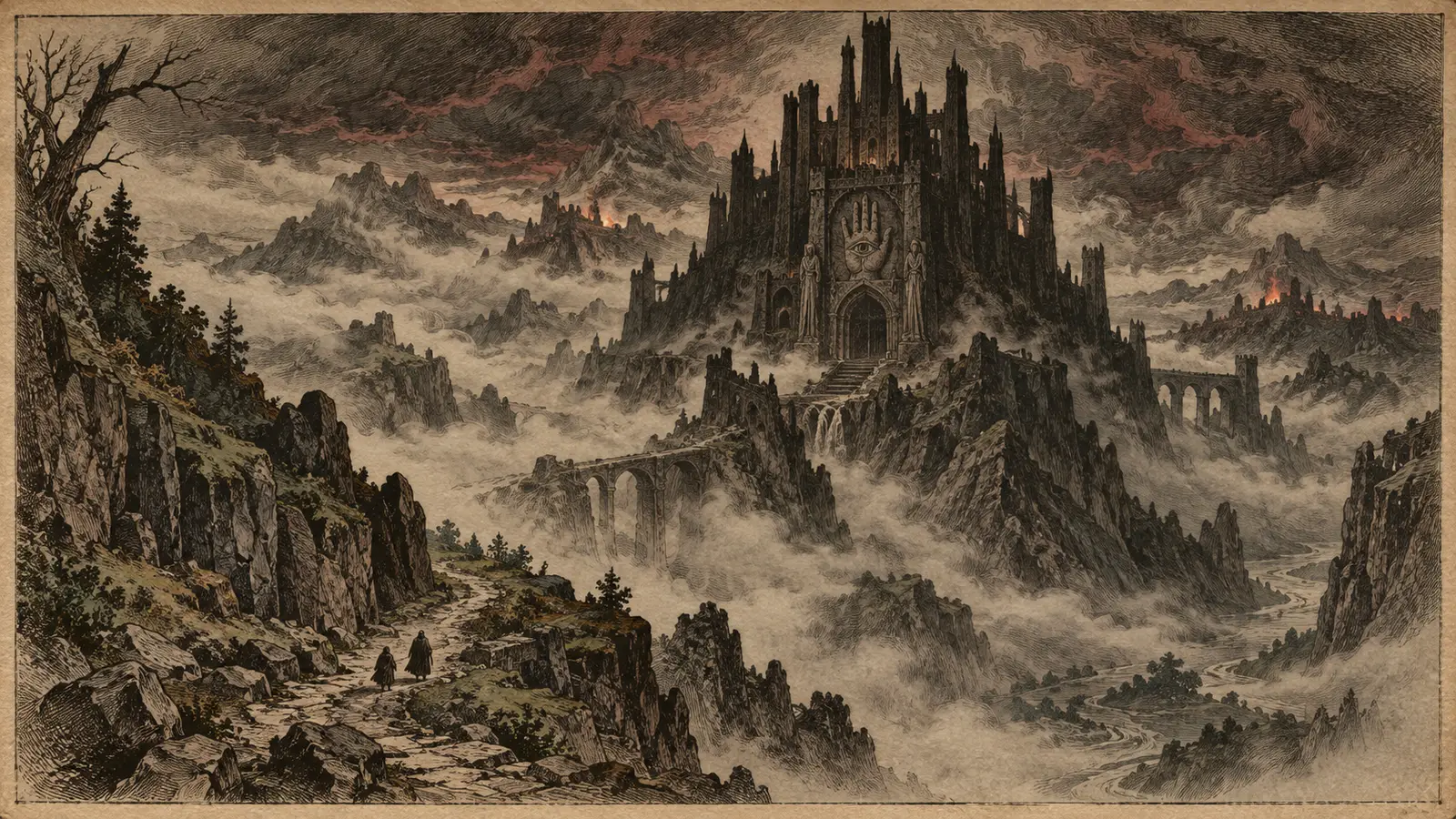
They pass into Ravenloft and arrive at Citadel Cavitius, Vecna's transplanted fortress, in time to watch the two powers meet. And here the adventure turns its trick. The battle was a trap. Iuz was never the one about to rise. Vecna defeats him and absorbs his power, and the heroes realise that the god about to ascend was Vecna all along. The cult, the gathering of relics, the reopened portals and the Eye in Iuz's grasp all led to the same place. Vecna's long plan stretched back to before his imprisonment, and the story says it was first suggested to him by the Serpent, a primordial being of magic who may or may not truly exist. He had prepared in other ways too, burying inscribed tablets of magic beyond any mortal spell at a distant dig site, waiting for the day they'd be needed.
Here the Hand becomes more than a prize. Vecna had surrounded himself with wards, magical protections that no ordinary intruder could cross. But the Hand of Vecna shields its bearers from Vecna's own wards. It is, after all, part of him, and his defences don't recognise his own flesh as an enemy. The heroes use that against him. The hand that served him for so long becomes the key that lets mortals walk past his guards.
There's a quiet poetry in that. The relic carries its maker's will, and that will has always been its curse. Now that same intimacy, the fact that it belongs to him, is what makes it the one tool able to reach him.
Even so, Vecna escapes. Swollen with Iuz's power, he bends the rules of his prison, slips free of Ravenloft, and enters Sigil with the strength of a god. That's a dangerous thing to do, because Sigil belongs to the Lady of Pain, and gods aren't permitted there. His presence alone begins tearing the planes apart.
The Lady can't simply destroy him or cast him out. The adventure says she and Vecna, or at least the secret at his core, are equally ancient powers, so all she can do is cause him great pain. She needs help, and she uses the adventurers. They destroy Vecna's avatar, the body he's wearing in the city, and that weakens him enough for the Lady to throw him out of Sigil.
The cost to the multiverse is written on a cosmic scale. Some of the Outer Planes drift away and are lost. Others collide and merge. At least one of the Inner Planes runs aground on a distant world, the way a ship runs onto a shore. The very nature of the world changes, and strange half-worlds like those linked to Tovag Baragu multiply beyond counting. All of that began with a cult gathering up the pieces of a body.
Afterwards Iuz was freed, and Vecna returned to weaker than he'd been, though still a god. When the third edition's Greyhawk was set down in the Living Greyhawk Gazetteer, published that same year, it began from there.
And the relics, once more, went back into the world. Each time, the same thing happens: a god reaches for them, a story ends, and the hand and eye slip away again into the , waiting for the next bearer.
Chapter VIII
Prices paid in the body
The third edition of Dungeons & Dragons arrived in 2000, with a new Dungeon Master's Guide by Monte Cook, Jonathan Tweet and Skip Williams. The Hand of and the Eye of Vecna both appear there as major artifacts, a category the third edition reserved for unique objects that could neither be made nor easily destroyed. Both carried over into the revised version of the rules three years later. The third edition described them as chaotic evil artifacts. In the wider world of the game, Vecna himself now stood in the default pantheon as the greater god of secrets.
The third edition added something new to the bargain, and it's a quiet, lasting cost. The earlier editions had taken a hand or an eye and given power back. Now each relic also took something you'd never get back, even if somehow you were freed of it.
Here is the third-edition Hand. It's a mummified, shriveled left hand, blackened and charred. To use it, you cut off your own left hand at the wrist and press the artifact to the stump. The rules put it vividly: the hand grafts itself to your arm and becomes a functioning appendage. It moves when you will it to move and grips when you close it. It's yours now, as much as anything ever was.
Its touch is cold, and it does harm with that cold, as though the chill of the long-dead lich ran through the fingers. Three times a day it can do something more unsettling. Its touch permanently drains a point of strength or wit or vigour, whichever quality the bearer chooses, from another creature, and for the rest of that day the bearer gains what was taken. So the Hand is a thief of the self, taking a little of someone and pouring it into you. Beyond that it can daze, weaken, paralyse or kill creatures that aren't evil. The holy and the decent fall before it in rising degrees.
And its lasting price: the bearer permanently loses some of their nimbleness, a measure of dexterity that can never be regained. Picture the bearer's whole body moving a little more stiffly ever after, as if some of the dead hand's dryness had crept up the arm.
Now the third-edition Eye. You gouge out your own eye and set the artifact in the socket, and there it stays until your death. Its constant gifts are darkvision, sight in any darkness however deep, and true seeing, sight through every illusion. Three times a day each it can cast eyebite and dominate a person. And once a day each it can work two dreadful pieces of magic. The first is destruction, a gaze that kills its target and reduces the body to ash, so the Eye now carries the ending of Vecna's tower in a single look. The second is unhallow, which desecrates a place, making the ground itself hostile to the holy.
The Eye's lasting price is a loss of the bearer's charm and presence, a portion of charisma that can never be restored. There's something apt in that. Whoever looks at the world through Vecna's eye becomes, in turn, harder for the world to look at. People turn away from the gaze. Something in the face has changed.
The shared curse stayed patient and steady. A bearer who wasn't already evil had to resist, every week, the pull toward evil, and sooner or later the resistance would fail. Someone holding both relics found every power harder for others to withstand. And the old flavour carried on: over time the bearer takes on Vecna's personality, and some come to believe they are Vecna. The third edition left open whether this is the god truly reaching into the bearer, or simply the relics remaking a mind in their old owner's image. Either way the corruption becomes total in the end.
So the third edition's lore is one of prices layered on prices. You pay the hand or the eye. Then you pay in the body, stiffer or more distant, permanently. Then you pay in the soul, week by week. And at the end, you pay with your self.
The third-edition years also gave the relics a living history in Greyhawk, through the Living Greyhawk campaign that the official players' network ran across many tables and many years. In its story, the Hand surfaced in the year 594 in the possession of a cultist named Pacanan. He performed an ancient ritual, a rite from the oldest sorcerous traditions of the Flan people, and proclaimed himself the Voice of Vecna. Over the following year he gained the Eye as well. Then, knowing what the relics wanted, he sent a servant to recover the Sword of Kas from an old fortress in the lands of the west.
The story of Pacanan's ritual at Tovag Baragu shows something lovely and strange about how Vecna's cult imagined itself. He seemed to summon, and to become, the Ruler of the Spider Throne, and the rite was overseen by two others. One was Wilf Hewitt, called a Thought of Vecna. The other was Diraq Malcinex, called the Heart of Vecna. The cult named its offices as pieces of its god's body: a voice, a thought, a heart. It's as though, missing his hand and eye, Vecna's worshippers had set out to make up the rest of him themselves, one person at a time. Later tellings would hold that the hand Pacanan carried was a false one, a copy made to deceive.
Copies are where the next bearer comes in. In 595, the Hand turned up with Darl Quethos, a powerful cleric of Vecna known as the Hand of the Lich-Lord. He used the relic to take control of a Vecnan sect called the Disciples of Darkness. He did it in an elegant way, by exposing that the hand and eye their previous leader carried were fakes. Imagine the scene. The old leader stands before the faithful with his black hand and red eye, and Quethos raises the true Hand, and every one of the faithful can feel the difference. The false relics are revealed for what they are, and the sect changes masters. Quethos now had the Hand, and he began hunting for the Eye.
He appears in an adventure called "The Library of Last Resort" by Nicolas Logue, the ninth chapter of the Age of Worms campaign that Paizo published in Dungeon magazine in 2006. There he's a mighty cleric carrying the Hand, racing the heroes to the Isle of Last Resort in search of the phylactery of , a dracolich who served the worm-god . He's described as perhaps Vecna's greatest mortal champion. A man who calls himself the Hand of the Lich-Lord, wearing the hand of the lich-lord, searching a library at the edge of the world for an undead dragon's soul: the relic has found its way into another story, as it always does.
Out of the third edition, then, come two images to keep. One is the body paying slowly, in stiffness and coldness, for what it carries. The other is a cult that names its leaders after parts of a god, as though they were all trying to become the pieces that are missing.
The next edition would take the idea of the relics as servants of a living god and make it the centre of everything.
Chapter IX
Harvesters of secrets
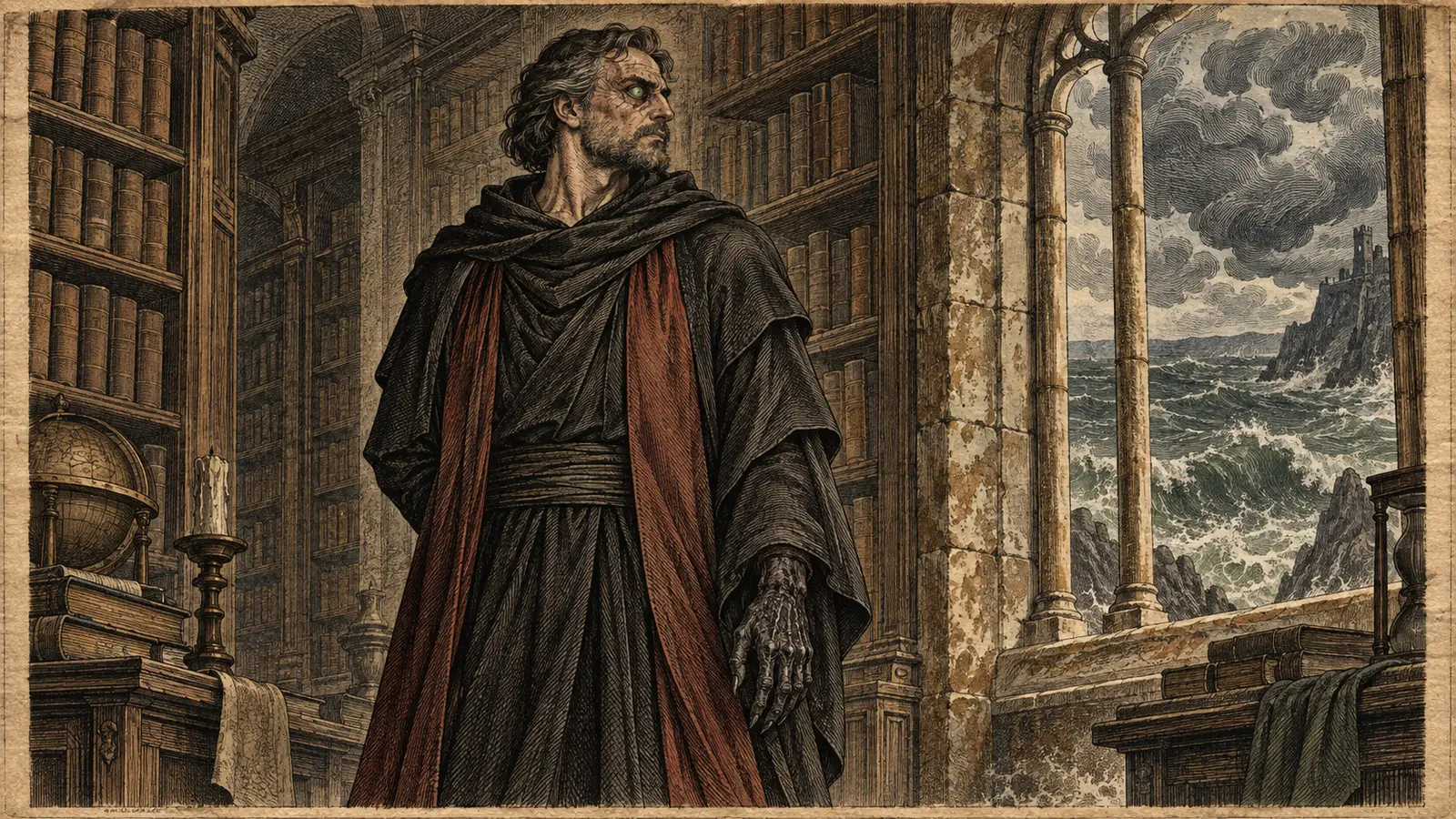
The fourth edition began in 2008, with a Dungeon Master's Guide led by James Wyatt. Here stood in the core pantheon as god of secrets and of undeath. The book told his old story briefly. A treacherous lieutenant named Kas ended his mortal rule in a terrible battle, and of Vecna, all that remained were one hand and one eye, grisly artifacts that still seek to work his will in the world.
Both relics appear as sample artifacts in that book, and the fourth edition placed them somewhat lower than before, in the middle reaches of a character's career rather than at its peak. In earlier days they had been the kind of treasure you found at the end of everything. Now they might find you halfway along the road.
The real change wasn't their power. It was what they were. In the fourth edition every artifact was an intelligent being with its own goals. Each had a measure called concordance, a kind of running tally of how well it got along with its bearer. A new owner usually began in the middle, and the tally rose or fell with what the bearer did. As it moved, the artifact passed through moods: pleased, satisfied, normal, unsatisfied, angered. A pleased relic gave more. An angered relic gave less, or turned on its bearer. And every artifact, sooner or later, would move on. Nobody kept an artifact forever. They passed through a campaign, the way weather passes through a valley.
The Hand and the Eye were made for this. Both preferred arcane spellcasters as hosts, wizards and warlocks and others who drew magic from study or pacts. And both shared the same goals. Each wanted to be reunited with the other in a single bearer. Each wanted to spread the worship of Vecna across the world. Each wanted to pry secrets from those who kept them and turn those secrets into weapons of betrayal. And each wanted to be set into a powerful living vessel.
Their concordance showed what pleased them, and it's an honest portrait of what they are. The Hand grew happier when its bearer grew in power, when they cast arcane spells, and when they set the Eye in place as well. It grew happier still when they betrayed a close friend in dire straits, or wrung important secrets from captives. And it grew displeased whenever its bearer, or one of the bearer's allies, destroyed an undead creature.
Think about what living with that would be like. Your companions are fighting the walking dead in some crypt, as adventurers do, and every skeleton that falls makes the hand at the end of your arm a little colder toward you. Meanwhile it warms to you whenever you let a friend down at the worst moment. The relic is teaching you, one small reward at a time, to become someone who betrays.
The fourth-edition Hand is described as blackened and mummified, icy cold, with long claw-like nails. It made its bearer stronger in feats of the body, and it granted dark warlock powers: a diabolic grasp that seizes and moves a foe, and a sign of ill omen that curses an enemy's fortune. When it was satisfied, it could hurl an exploding globe of necrotic energy that withered everyone it burst among. When it was pleased, it wrapped its host in an aura of death.
The Eye granted darkvision and sharpened its bearer's grasp of magic, their insight into others and their perception of the world. It gave gaze powers too: eyebite, a stare to mire the mind, and the eye of the warlock. As it grew more pleased, it gave more. Put plainly, the more evil the bearer did in its service, the more the Eye showed them.
Then comes the moment both relics are always heading toward, which is moving on. In the fourth edition, when a relic of Vecna moves on, it consumes its owner, body and mind. The bearer dies at once and crumbles to dust. The relic returns to Vecna. And Vecna gains everything that bearer ever knew, all their memories and all their secrets, and he savours them. If the bearer wore both relics, both return together.
Then, in time, the god sends the relic back out into the world, to find some other greedy or unwitting spellcaster and begin again.
This is the great fourth-edition change in the lore of the hand and eye. Before, they were remains, the leftover pieces of a lich who was gone or half-gone, working his will out of habit, so to speak, like an old clock still ticking in an empty house. Now they're tools in the hands of a living god. Each bearer is a harvest. The relic finds someone who knows things, lives with them, feeds them power while drawing out their secrets and teaching them to betray, and then, when the time comes, gathers them up entirely and carries everything they were home to its master. Then it goes out again.
It's a cycle: temptation, harvest and return. Picture it as a slow tide. A hand washes up on some shore, as one did once for a fisherman named . Someone picks it up. Years pass. Then the hand is gone, the someone is a little heap of dust, and somewhere far away a god of secrets knows one more life by heart.
A year later, in 2009, a book about the undead called Open Grave: Secrets of the Undead added one more twist to this edition's relics, by bringing the sword back into the story. If a single bearer wore the Hand of Vecna and also wielded the Sword of Kas, a new property woke, whatever either relic's mood. Every successful strike with the sword against Vecna, his servants, his cultists or anyone working directly for his ends became a critical blow, the strongest kind there is.
But there was a cost. Every such strike lowered the concordance of both the Hand and the Sword. They didn't like working together. And if either fell to nothing this way, both moved on at once.
So for a short time the betrayer's blade and the betrayed god's hand serve side by side, on one body, against Vecna's own. The hand grips the sword that cut it away. They work together, against everything they were made for, and then, inevitably, they reject each other and are gone. It's one of the more haunting small pictures in the relics' long history: two old enemies made briefly into allies by the person carrying both, until the old enmity wins.
The next edition would bring the sword and the relics together for good, in a single rule about how all three could finally end.
Chapter X
The sword, the vaults and the soul in the eye
The fifth edition of Dungeons & Dragons came in 2014, and its Dungeon Master's Guide gave the relics a single shared entry, the Eye and Hand of , an artifact of the highest rarity that has to be attuned to, meaning bound to its bearer. It sits in the book's gallery of artifacts beside the Sword of Kas, the Book of Vile Darkness and the Wand of .
The entry opens with the line we met at the very start of the evening: seldom is the name of Vecna spoken except in a hushed voice. Then it tells the old story in one flowing passage, bringing together pieces that had been scattered across decades of books. In his time, it says, Vecna was one of the mightiest of all wizards. He forged a terrible empire through dark magic and conquest. He feared death, and Orcus, demon prince of undeath, taught him a ritual to live on as a lich, and he became the greatest of all liches. His body withered while his dominion grew, and his temper was so hideous that his subjects feared to speak his name. The entry gives his titles: the Whispered One, the Master of the Spider Throne, the Undying King, the Lord of the Rotted Tower.
Then the betrayal, told as rumour. Some say Kas coveted the Spider Throne, it says, and some say the sword Vecna made for him seduced him into rebellion. Whatever the reason, Kas ended the Undying King's rule in a terrible battle that left the tower a heap of ash. All that remained of Vecna was one hand and one eye, grisly artifacts that still seek to work the Whispered One's will in the world.
This was the first time a core rulebook had set all of that down together. In fewer words than a short letter, it reached back to Eldritch Wizardry and gathered everything since.
The fifth edition describes the relics in a way that would stick. The Hand is a mummified, shriveled left hand. The Eye looks like a bloodshot organ torn from its socket, and once it's in place it becomes a golden eye with a slit pupil, like a cat's. The old cat's glow from 1976 and the golden eye from 1993 are both still here, carried forward.
The attunement is set out plainly. To attune to the Eye, you gouge out your own eye and press the artifact into the empty socket, and the Eye grafts itself to your head and stays there until you die. To attune to the Hand, you cut off your left hand at the wrist and press the artifact to the stump, and it grafts itself on and becomes a working limb. If either relic is ever removed, you die. And either one, once attuned, turns your alignment to neutral evil, just as the old first-edition Eye did.
The fifth edition also brought back the old idea that no two relics are quite alike. Each artifact carries random properties: one minor benefit, one major benefit and one minor drawback, chosen for the particular campaign. So even here, in the most widely played edition, one table's Eye of Vecna isn't exactly another's.
The Eye's gifts are sight above all. It grants truesight, seeing through illusion and darkness and into the true shape of things. With a moment's effort, its bearer can see through solid matter, as if wearing a ring of X-ray vision, looking through walls and doors into rooms beyond. And it holds charges, a store of power that refills with each dawn, which the bearer can spend on spells: clairvoyance, to see far places; crown of madness, to drive a mind into confusion; disintegrate, a ray that reduces its target to dust; dominate monster, to take hold of almost any will; and eyebite.
But there's something waiting in the Eye. Each time its bearer casts a spell from it, there's a small chance, about one in twenty, that Vecna tears out the bearer's soul, devours it, and takes over the body like a puppet. That's a remarkable rule to sit quietly in an item description. The fourth edition imagined a relic gathering its bearer up and carrying them home. The fifth edition imagines the god reaching through the Eye directly, without warning, whenever it's used. Every spell is a small door opened, and on the other side, sometimes, is Vecna.
The Hand's gifts are force. It sets the bearer's strength to a height few mortals reach. Anything the Hand strikes, whether with its own touch or with a weapon it holds, is bitten by an added cold. And it holds its own charges, renewed each dawn, for its own spells: finger of death, which slays outright; sleep; slow; and teleport, which carries the bearer far away in a moment. And whenever its bearer casts a spell from the Hand, the Hand speaks back. It casts a suggestion on the bearer, urging some evil act. The Eye might steal you all at once. The Hand works more patiently, one deed at a time.
Then come the gifts for wearing both. A creature with the Eye and the Hand both attached to the same body becomes immune to disease and poison. The X-ray sight no longer wearies them. They have premonitions of danger and can't be taken by surprise unless they're helpless. Their wounds close by themselves, a little every moment, so long as any life remains. The Hand's touch can turn a creature's bones to jelly, leaving them crumpled and helpless. And once every thirty days, the Eye can grant a wish, the mightiest spell there is.
That's the full Vecna, or as close as anyone comes: a body that can't be poisoned, can't be surprised, heals without rest and bends reality once a month. It's what the relics have wanted all along, to be reunited in a single living vessel.
And now we come to the heart of the fifth edition's lore, its answer to the oldest question about the relics. How do you get rid of them?
The Book of Artifacts had offered three paths: the god destroyed, the sun's heart, every shade at rest. The fifth edition offers one. The Eye and Hand are destroyed only if both are attached to the same creature, and that creature is slain by the Sword of Kas. Then both relics burst into flame, turn to ash, and are destroyed forever.
Any other attempt only seems to work. A bearer might burn the Hand, melt it, grind it, drop it into the sea. It will look destroyed. Then it will reappear in one of Vecna's many hidden vaults, and it will wait there to be found again.
Picture those vaults. The rulebook says only that there are many of them and that they're hidden. They're scattered somewhere across the worlds: dark rooms sealed under mountains, behind old doors, in places only the Whispered One remembers. In each a shelf or a plinth or an alcove waits, sometimes empty, and sometimes, suddenly, holding a black hand or a red-gold eye that a moment earlier someone was sure they'd ended. All the old patterns, the vanishings after , after Mace, after , after Vecna's defeats, have become a rule of the world. The relics always go home, and they always wait.
The Sword of Kas sits in the same book, and the fifth edition ties it to the relics more closely than ever. It's a sentient longsword, chaotic evil, with a mind and a voice of its own. When drawn, it craves blood, and if it isn't bathed in blood within a minute, it may take control of its wielder until it's fed. It strikes truly and deadly, and it's especially fierce against the undead. And its purpose is to bring ruin to Vecna. It seeks to destroy anyone corrupted by the Eye and Hand. Over time, that obsession becomes its wielder's own.
The relics have their answer to the sword. A creature attuned to both the Eye and the Hand can use their combined wish to try to unmake the Sword of Kas. The sword has to be close by, and it becomes a contest of wills between the bearer and the blade. If the sword wins, the wish is wasted. If it loses, it's destroyed.
So the fifth edition draws a perfect circle among the three relics left on that ashen battlefield. Only the sword can end the joined relics. Only the joined relics can end the sword. Each is the other's only death. The hand and eye want to be together in one body, and when they are, they become the one thing the sword is looking for. The sword wants to find that body, and when it does, it stands within reach of the one power that can unmake it. Whoever carries either half of this circle is drawn toward the other, as surely as water runs downhill.
In this edition, then, the relics are wills more than tools. They still seek to work the Whispered One's will, as the entry says. They speak to their bearers, they sometimes open a door for their god, and when anyone tries to end them in the wrong way, they simply go home and wait.
Ten years later, Vecna's own story would move to the centre of the whole multiverse, and the old maiming would sit at the heart of it.
Chapter XI
The wound that marks the god
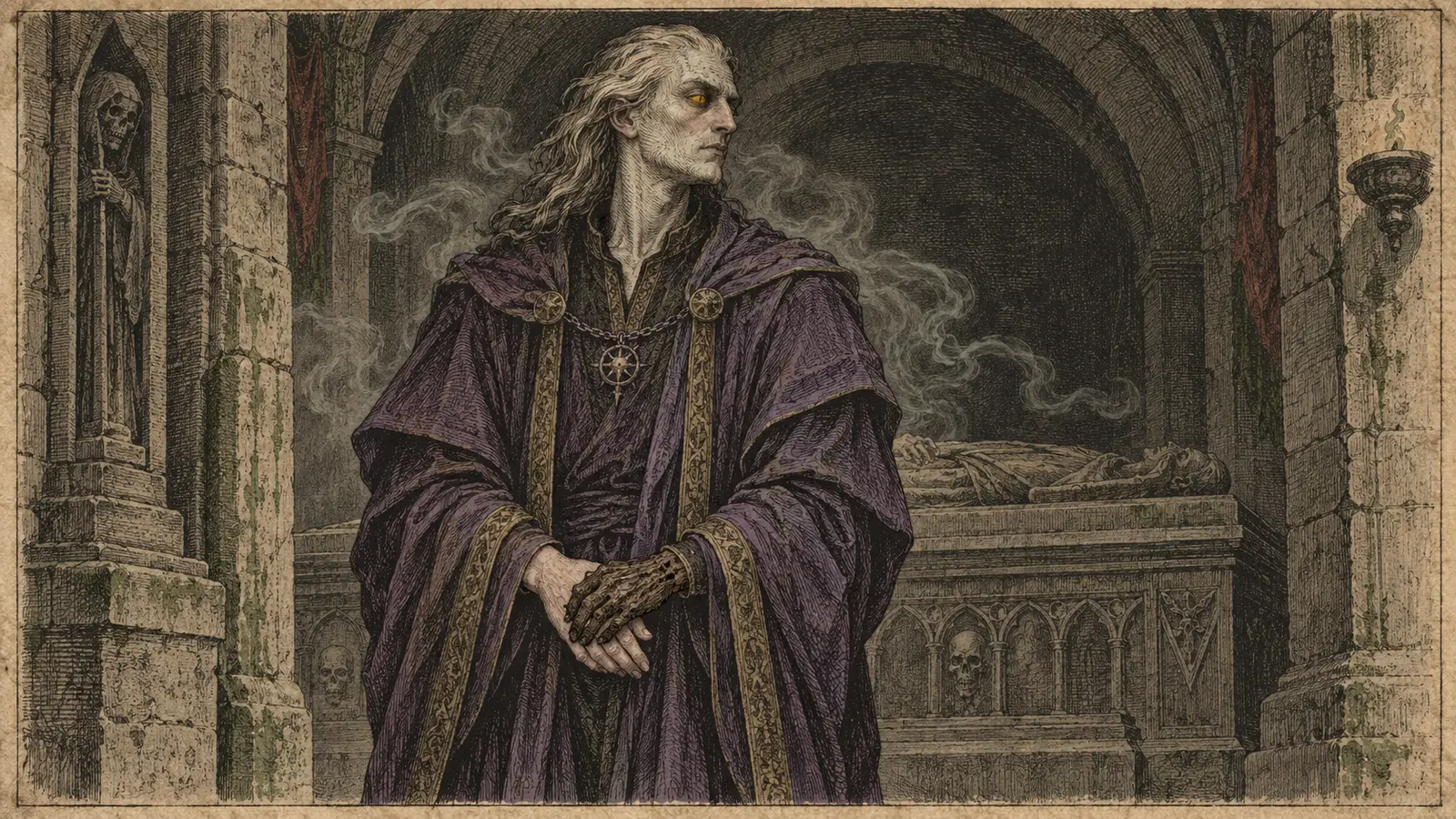
On May 21, 2024, Wizards of the Coast published Vecna: Eve of Ruin, a flagship adventure for the game's fiftieth anniversary, carrying characters from the middle of their careers all the way to the very top. Hamon led its design, with Makenzie De Armas, Ron Lundeen and Patrick . If you heard our earlier episode on the relics, you'll remember that we ended there, so tonight we'll stay with what this book adds to the hand and the eye themselves, which is mostly the meaning of their absence.
A small prelude came first. Vecna: Nest of the Eye was a digital one-shot for beginning characters, released that April. In it the lord of asks the heroes to find out what happened to an earlier band of adventurers, who've turned up dead. Among what they left behind is a corpse with a single desiccated eyeball. That's the first clue. It leads down to a cult of hidden beneath the city. Even here, at the doorstep of the great adventure, the story begins with an eye.
In Eve of Ruin itself, Vecna's cult works across many worlds and planes, gathering secrets. Those secrets fuel a vast working called the Ritual of Remaking, by which Vecna means to remake the multiverse in his own image. The heroes are sent across the settings by three archmages, Silverhand, and , to recover the scattered pieces of another old relic from Eldritch Wizardry, the Rod of Seven Parts.
Here the book looks back to the founding scene of our story and draws it in full. It retells the origin of the relics, with art of the battle itself. Kas, wielding the sword that Vecna made for him, a sword that held a portion of Vecna's own consciousness, fought his master. He cut off the lich's left hand and gouged out his left eye. And those severed pieces held such latent power that they became the artifacts we know as the Hand of Vecna and the Eye of Vecna.
The book gives Kas a fuller past as well. He was a fallen paladin who rose through Vecna's armies until he became regent of the empire. His attempt on his master's life cost Vecna his eye and his hand, and it cost Kas his own life. Kas became a vampire, trapped in a prison world, and he spent the ages that followed hungering for some power great enough to finish what he'd begun.
That hunger is the story's hidden spring. Late in the adventure, the heroes discover that the Mordenkainen who sent them out was never Mordenkainen at all. He was Kas in disguise. The betrayer had been using the heroes to gather the Rod of Seven Parts, believing that only the rod, and the dread entity it can release, could give him enough power to defeat Vecna. He strikes down the true archmages' allies and takes the assembled rod. The heroes have to face him, learn where Vecna is working his ritual, and win back the rod.
Reviewers often noted that this made the book as much Kas's story as Vecna's. The heart of its great twist is the ancient betrayal, the very act that made the hand and eye. Everything flows from that one moment on the ashen field.
At the end, the heroes find Vecna in a cavern on the plane of , weaving his ritual from stolen secrets. To work it he has set aside his godly power, and they face him as an immensely powerful lich, as he was long ago in his tower. With the rod's help they can weaken him enough to cast him back to Greyhawk.
So where are the hand and eye in all this? They aren't the treasure the heroes chase. That role belongs to the rod. In Eve of Ruin the relics are something else: the wound that marks the god. The book says that even as a god, Vecna is still missing his left hand and his left eye. Across the whole multiverse, through every world the heroes cross, the Whispered One remains a maimed figure. The two absences are part of who he is.
The book also reaches back to where it all began. Its background on Vecna quotes 's 1976 description, the dried, shriveled and blackened hand, the sole remains of an ancient lich who imbued his hand with wondrous and horrible powers. Fifty years after that one paragraph, the game's anniversary adventure pauses to read it aloud again, the way a family might bring out an old photograph.
Some of the art from this era shows the same idea from the other side. When Wizards released a free dossier on Vecna in 2022, with game statistics for the lich himself, one of his deadliest powers was a paralysing touch delivered with his left hand. It's a quiet reminder of what that hand once did, when it was still attached to the one it served.
Through all these grand events, the relics themselves have been lying somewhere, perhaps in a hidden vault, perhaps on a shelf in some lost room. Before we look at where they rest now, let's turn aside to the other pieces, the copies and cousins and echoes that grew up around the hand and eye over the years.
Chapter XII
Fingers, teeth and false heads
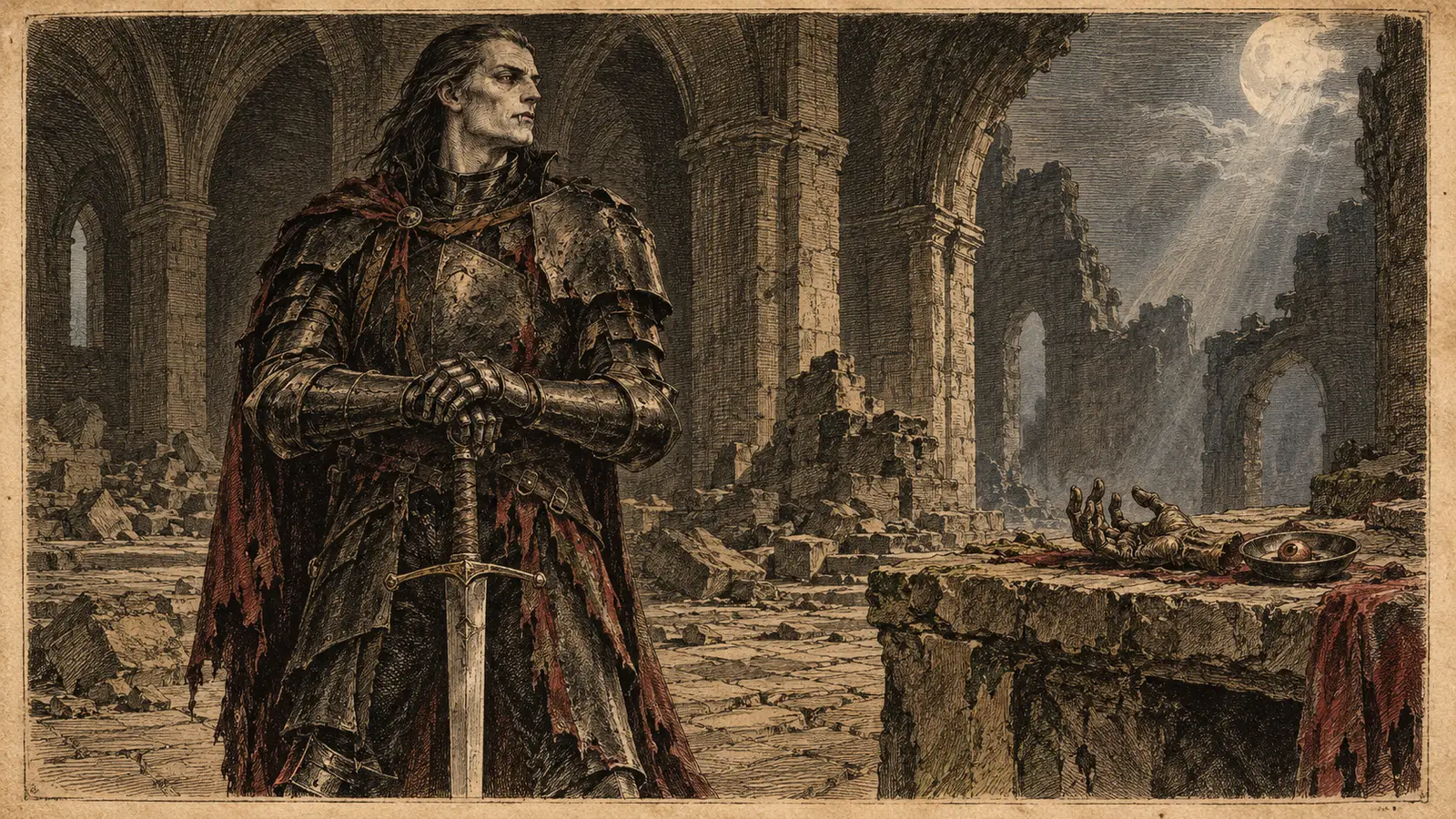
Begin with the oldest companion, the Sword of Kas. It was born in the same first generation of artifacts as the hand and eye, and over the years it has changed shape almost as often as the story around it. It has been a short sword, a longsword and a greatsword, depending on the edition. In the first edition simply procured it for his lieutenant. In later tellings he forged it himself and poured part of his consciousness into it, which is why it could seduce Kas, and why it knows its maker so well. It's honed by magic to a razor's edge. It strengthens whoever wields it and can call lightning down from storm clouds overhead. And it has a vile and murderous spirit. It has been the object of quests, carried back to its old master in Vecna Lives!, and in the fifth edition it became the only key that can unlock the relics' end. The hand and eye have always been in conversation with this sword, whether in hatred, in the ancient wound, or in that brief, uneasy alliance on a single bearer's body.
Then there are the false ones. In Vecna's palace in , the old tellings say, there stood a death knight who called himself Kas the Bloody-Handed. He wasn't the true Kas, but he believed he was, and he sought to atone for "his" betrayal of Vecna centuries before. There was also a false Sword of Kas that made whoever carried it believe they were Kas. That's an exact mirror of the relics' own curse. The hand and eye make their bearers believe they're Vecna, and the false sword makes its bearer believe they're the betrayer. Around this old wound, it seems, people are always being turned into the original players.
False hands and eyes appear too. We've already met the leader of the Disciples of Darkness, whose hand and eye Darl Quethos exposed as fakes, and Pacanan's hand, later held to be false as well. A cult once even made a false Head of Vecna, which went on to kill many adventurers who came seeking it. Wherever true relics are worshipped, forgeries follow, and some of them are deadly in their own right.
Then there are the other pieces of the body. In Die Vecna Die!, the cult at Tovag Baragu wasn't only gathering the hand and eye. It was collecting Vecna himself, fragment by fragment. The adventure describes many lesser relics, minor artifacts each holding a small part of the lich's power. Four fingers of his right hand were among them, each with its own name: the First Digit, which was the thumb; the Second Digit, the index finger; the Third Digit, the middle finger; and the Last Digit, the little finger. There were his Incisors, a pair of fang-like teeth, and a Molar. There was his Scalp, his Skin, his left Foot, and even his Right Eye. The famous relics, remember, are the left hand and the left eye. And there was his Heart.
Some of these come with lovely small details. The Heart, which came from Vecna's original body, looks like a large, heart-shaped piece of dried meat, the kind a traveller might carry in a saddlebag. The Scalp leaves its wearer with a white streak in their hair, a mark like a lock of frost. And the Molar has a strange, almost comic power: if whoever bears it eats another fragment of Vecna, that fragment is destroyed forever. Picture a cult carefully gathering the pieces of their god, and somewhere among them a single tooth that could undo his reassembly one bite at a time.
Taken together, these pieces make a quiet point. Vecna's body is scattered across the worlds, and the hand and eye are only the most famous parts of it, the ones that still have the most of him inside.
Even after that adventure, new pieces kept appearing. In 2007, in what turned out to be the last printed issue of Dragon magazine, the readers were offered a Left Ear of Vecna. It sharpened its bearer's hearing and guarded them against harm from sound. It let them listen to far places, strike others deaf, and loose blasts of sound. And it let its bearer understand any spoken language. So the god of secrets now had an ear in the world too, listening.
Some echoes come from outside the lich's own body. The first-edition Dungeon Masters Guide that gave the hand and eye their rules also introduced the Teeth of , which work on the same unsettling principle. There are usually thirty-two of them, though more are known. To use one, you pull out one of your own teeth and set the relic in its place, where it shrinks or grows to fit, though only just. Their origin is told in several ways: the teeth of a cleric revered by his followers after his death, teeth a cleric found in a red dragon's lair, or the teeth of a cleric who abandoned his god for pact magic. They returned to the game in Tasha's Cauldron of Everything in 2020. They're cousins of our relics, made from the same idea: give up something of your own body and something stranger takes its place.
There's another kind of variant too, a different telling rather than a different object. In 2002 a graphic novel called Vecna: Hand of the Revenant, written by Modi and drawn by Kevin McCann, told of Vecna's siege of , the city of his boyhood, with memories reaching back some nine hundred years. In this version Kas appears as a muscular, long-haired warrior in very little armour. But it isn't his sword that takes Vecna's hand and eye. They're lost to destructive holy magic, cast by the priests of , the god of light, during the siege. In this telling the maiming comes from the faith that opposed him rather than from a betrayer's blade. The book called itself Book One, and its story was never continued. So it stands as its own small path in the legend, one version where the light itself cut away the hand.
And then there's the most famous variant of all, though it never existed in any book. It's a story players tell, about a Head of Vecna. The usual telling places it in 1996, in a campaign run by a game master named Mark Steuer, where two rival parties were racing each other toward the same goal. One party decided to play a trick. Everyone knew how the hand and eye worked: you remove your own and attach Vecna's. So they spread rumours of a third relic, the Head of Vecna, which worked the same way. They took an ordinary head from an enemy they'd recently defeated and hid it behind magical traps, a trophy for their rivals to find.
The trick went wrong almost at once. A druid in their own party, who hadn't been told about the plan, believed the rumour, and in the way of those games he found a swift and unfortunate way to try it, and his part in the adventure ended there. Then the rival party found the head, believed the rumour just as fully, and followed the rule to its grim conclusion with their own wizard. When nothing happened, they decided they must have done it wrong.
It's told now as something close to a gamers' folk tale, passed around in letters and retellings for decades. Nobody laughs at it because of the grisly part. They laugh because of how completely the rule of the relics had settled into players' minds. The hand and eye had taught a whole generation that power comes after the sacrifice, and some of them took the lesson rather further than intended.
Let's carry that thought to the table itself, where the bargain is always made, one player at a time.
Chapter XIII
Taking the bargain at the table
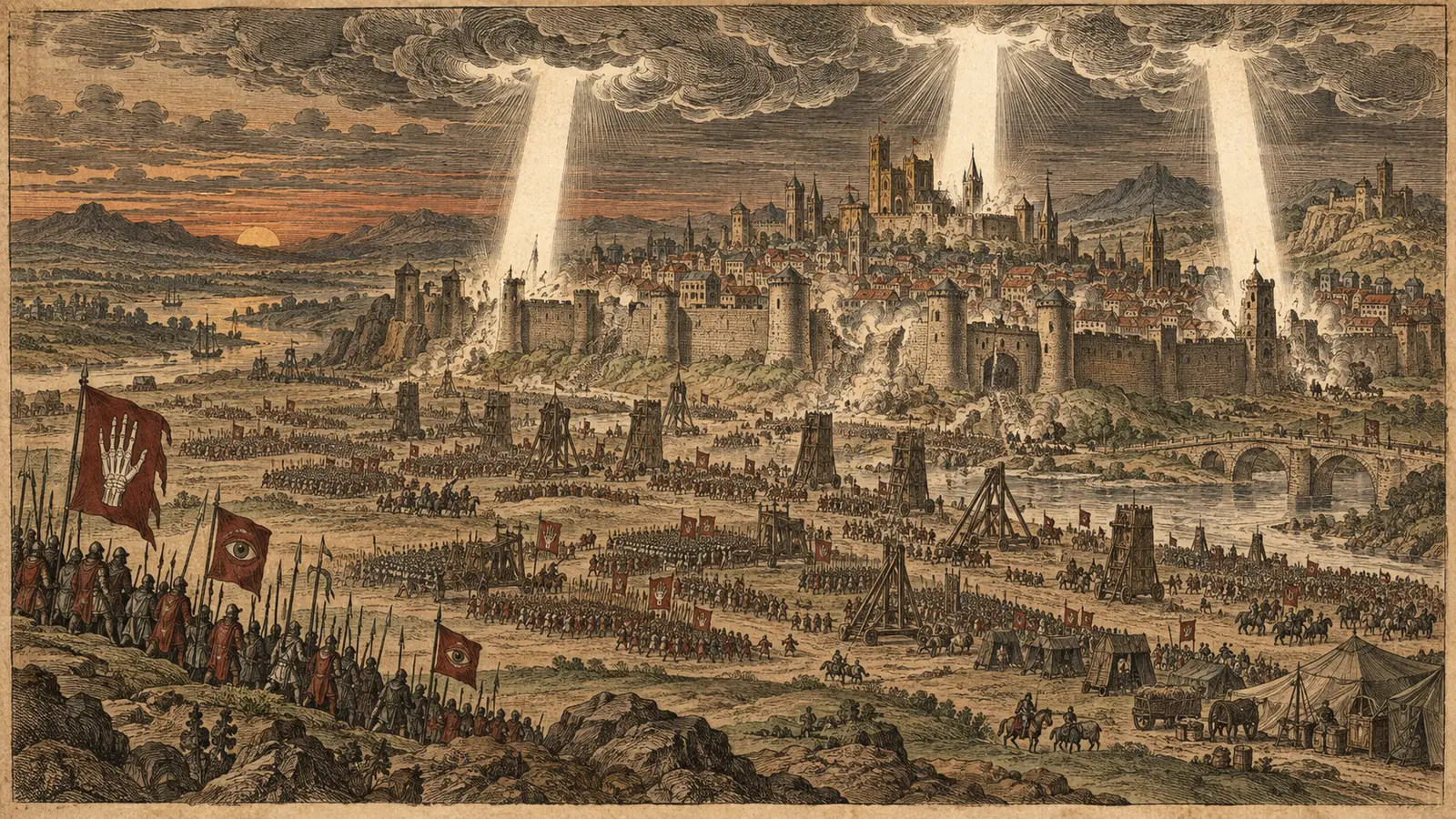
Every edition has kept the heart of the matter the same. To use either relic, the bearer has to remove their own hand or eye first, and only then is anything given back. At a real table, that means a player sits with the choice and has to decide to maim their character, with no guarantee of what will follow. In the earliest days they didn't even know what the relic would do. The referee knew, and the player could only hope.
That moment of choosing is the relic's real power in play. Imagine the scene. The party has fought its way to the bottom of some ancient vault. On a stone plinth, under dust, lies the black hand, or the small dark eye. The players look at it. Someone says, half joking, "Well, I suppose someone has to." And then the table goes quiet, because it isn't really a joke.
Over the decades, Dungeon Masters have learned what usually happens next. Players tend to treat the relics as the ultimate prize and are often sure they can outwit the curse. They'll use the power just a little, keep an eye on themselves, and stop before it's too late. But the relics have always worked more like a countdown. In the second edition, every use of the Hand's power tightened its grip a little more, until it could never be taken off. In the third, the turn to evil came for every bearer week by week. In the fourth, the relic grew fonder of you whenever you betrayed a friend. In the fifth, the Hand nudges you toward wickedness with each spell, and the Eye might simply let in.
So the common advice among those who run games is simple: if you put the Hand or Eye of Vecna into a campaign, have a plan for what happens when someone puts them on. They can end a story very quickly.
There's a story of exactly that kind that gets passed around among players, the sort of tale told across tables and online with a rueful shake of the head. A wizard, high in level after a long campaign, attuned to both relics in the middle of a final battle, sure the power would carry the party through. His alignment turned at once. The party's paladin had to strike down his own companion, and roughly two years of story came apart in about forty minutes. Whether every detail happened exactly so hardly matters. Tables tell it because it's true to the relics. They give everything, and then they take everything.
Some groups have played the long game with them instead. In the fifth edition, wearing both relics makes the bearer the one key that can destroy them, since only the Sword of Kas, striking down a bearer of both, can end them. That turns the relics into the endgame of a whole campaign. A character might carry them knowingly, as a kind of sacrifice, letting the corruption grow until the hand and eye are together in one body, so that a friend with the sword can end both relics, and the bearer, at once. Meanwhile, whoever carries the sword feels it pulling them toward that bearer, because the sword's obsession becomes its wielder's own. You can feel the shape of the story forming on its own: two companions bound for a final meeting, both knowing how it has to end.
Other games have used the relics without anyone touching them at all. Vecna Lives! had players take the roles of the doomed Circle of Eight, so they met the relics' power on the receiving end before their own characters ever saw them. That's a different lesson, and a sobering one: here is what these things can do to the wisest wizards in the world.
The fourth edition offered yet another kind of experience. Because the relics there rewarded betrayal and grew sullen whenever the party destroyed the undead, a player carrying the Hand would find themselves pulled, scene by scene, against their own companions. Every crypt cleared was a small grievance on the relic's side. Every secret wrung from a captive was a small delight. The player would feel the relic's moods as an ongoing presence at the table, almost a second character sitting just behind them.
As Eve of Ruin approached in 2024, advice writers suggested ways to plant the relics and the cult earlier in a campaign, as seeds that would grow toward the great adventure. A rumour of a hand in some museum, a cultist with a single strange eye, a missing finger on an old statue. The relics work beautifully as foreshadowing, because everyone at the table knows, without being told, that they lead somewhere dark.
And the relics have even found their way physically onto the table. Hobby shops and makers sell replicas, and a Dungeon Master can set a shriveled hand in front of the players and simply wait to see who reaches for it first.
What all of this shows is that the hand and eye are less about the powers on their pages, which have changed with every edition, than about a feeling: the long breath before a decision you can't take back. That feeling has spread far beyond the game.
Chapter XIV
A shriveled hand in the wider world
Over the years the hand and eye have become a kind of shorthand among people who play games, a byword for any power that costs too much. The writer Mordicai Knode, in an essay on the game's artifacts for Tor.com, opened by asking whether we all agree that the Hand and Eye of are the best artifacts. Lists of the game's most powerful artifacts, in English and in other languages, rarely leave them out. Part of their staying power is simply the image: a blackened left hand and a bloodshot eye, and a story everyone remembers, that you have to give up your own to use them.
They have travelled through video games, often with a wink. In Planescape: Torment, from 1999, the Eye of Vecna appears as a rare treasure carried by a greater glabrezu, a towering fiend. The same game has one of the gentlest jokes ever made about Vecna's scattered body. When a character asks , a talkative floating skull, what exactly he is, he replies, "Me? I'm the head of Vecna." It's a joke that only works because everyone knows Vecna survives in pieces.
In Baldur's Gate 3, from 2023, there's a circus in the game's third act where a genie named spins a wheel of prizes, and one of the things it can give out is called The Other Hand of Vecna. Its description says that it is not as powerful as its sister, yet still provides superior scratching capabilities. Presumably it's the right hand, the plain one that never became an artifact, and perhaps the only piece of Vecna that has ever been good for anything homely.
In the old dungeon games that grew from NetHack, the relics are treated more seriously. In some versions Vecna is a lich who drops either the hand or the eye when he falls. In one variant the Hand of Vecna is the prize for a whole chaotic quest, one of the most powerful artifacts in the game, granting regeneration among other things. In another, the Hand fuses permanently to the character's left arm and can never be taken off, a faithful echo of the tabletop curse, and the Eye can send death magic toward every monster in sight.
In Magic: The Gathering, the 2021 set Adventures in the Forgotten Realms turned the relics into cards, and the designers found elegant ways to put the curse into the rules. The Eye of Vecna lets you draw cards, gaining knowledge, but every draw costs you life. Knowledge at a price. The Hand of Vecna is a piece of equipment you pay for in life, and it grows stronger with every card you hold, so the more you know, the stronger the hand. And together with the Book of Vile Darkness, the two can be set aside to create Vecna himself, an indestructible god, as though the cards were gathering the scattered pieces back into their owner. It's a small, clever retelling of everything the relics have ever wanted.
In February 2021 WizKids released a display piece in its Icons of the Realms line called the Eye and Hand of Vecna. It's a lovely, macabre thing. A shriveled, mummified hand, about the length of a real one, holds a bloodshot golden-green eye between its fingers. They rest together on red satin under a glass bell jar, on a wooden base, the way an old museum might display a saint's relic. It was made to sit on a shelf in a game room, and it does, a little window into the vault.
The widest door the relics ever passed through, though, wasn't one they opened themselves. In 2022, the fourth season of Stranger Things gave its villain the name Vecna. In the show, a boy named Henry Creel becomes a terrible creature, and the children, who play Dungeons & Dragons, name him after the lich from their games, just as they'd earlier named other horrors after monsters from the same books. Suddenly millions of people wanted to know who Vecna was. When articles and explainers set out to answer, what they usually reached for were the relics: an ancient lich betrayed by his lieutenant Kas, with nothing left of him but a left hand and a left eye, which players had to graft onto themselves by cutting away their own. For many people the hand and eye were their first glimpse of the D&D Vecna. Wizards of the Coast followed with a free dossier on him, and two years later Eve of Ruin arrived into a world where his name was familiar far outside the hobby. The show ended its long run with its fifth season, released in parts across late 2025.
Vecna has wandered into other stories too. In the long-running show Critical Role, he was the great villain of one arc of its first campaign, and its warrior Grog came to carry the Sword of Kas, which remarked, when asked about its old master, that Vecna is powerful but arrogant, and that he likes to put on a show. The hand and eye themselves stayed in the shadows there. But the sword that took them was still talking.
Across all these places the relics keep one shape. However they're dressed, a joke on a wheel of prizes, a pair of cards, a prop under glass, they remain a hand and an eye that cost the one who takes them.
Chapter XV
Under the bell jar
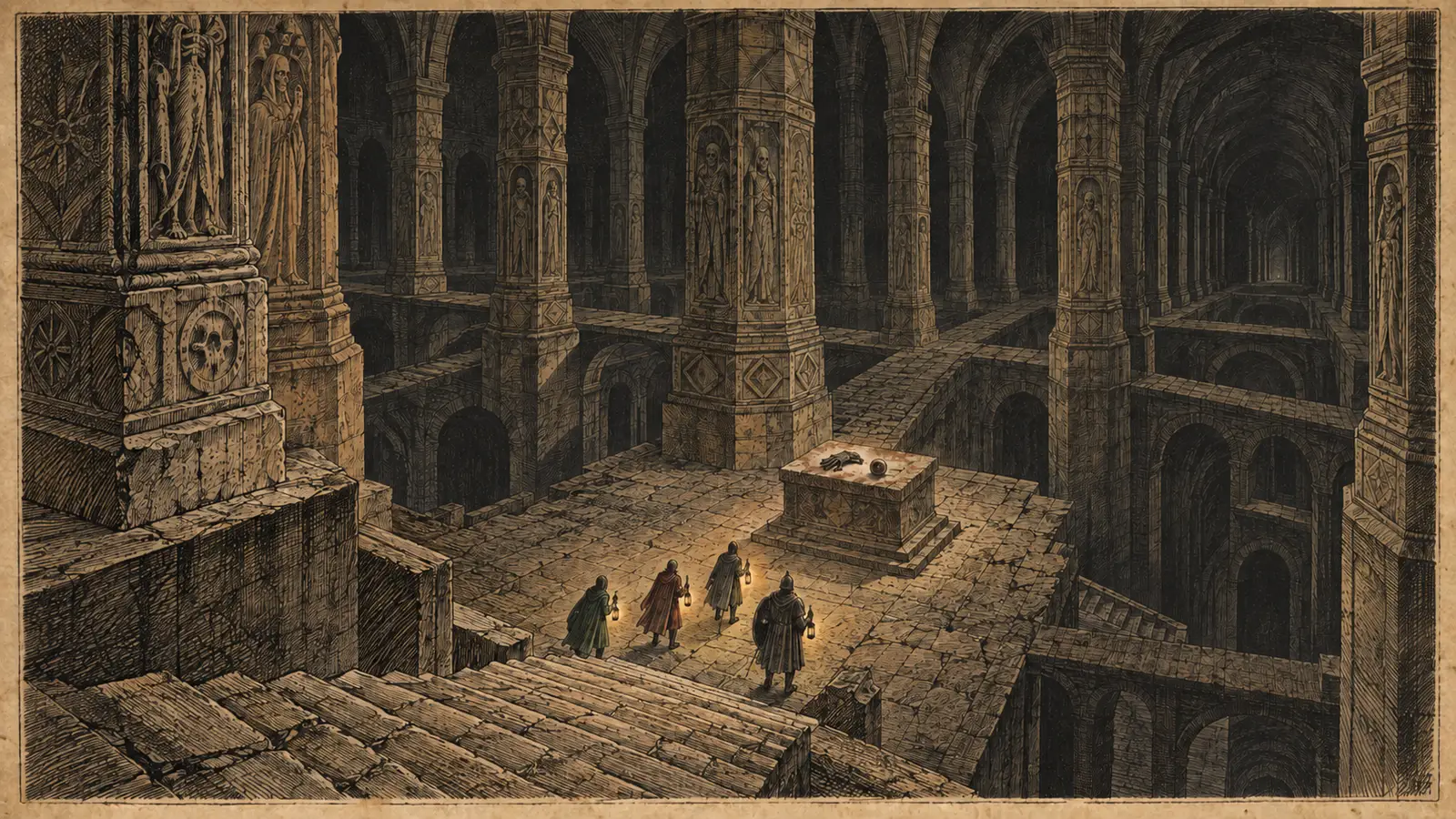
Today the relics live where they've always lived, in the Dungeon Master's Guide. The revised edition of that book, released in November 2024, keeps them among its artifacts, and its lore has hardly changed. The eye and the hand are grisly relics that still seek to work the Whispered One's will in the world. The Eye is a bloodshot organ torn from its socket, and the Hand is a mummified, shriveled left hand.
One small shift is that they're now treated as two separate artifacts that might be found together or apart. Each has its own entry, with a shared section for the gifts of carrying both. It's a small change in arrangement, but it suits their history. They were separate entries in 1979, they've so often gone their own ways in the stories, holding both, Iuz holding one, a cleric holding the other, that it feels right for each to have its own page again.
The bargain is as it has been. You press the Eye into your empty socket, and it grafts itself to your head and stays until you die. You press the Hand against the stump where your left hand was, and it becomes a working hand. If either is ever removed, you die. Both turn their bearer's heart toward a cold and calculating evil.
The Eye still sees through all illusion and darkness, now out to a great distance, still holds its charges renewed at dawn, and still casts the same old spells: clairvoyance, crown of madness, disintegrate, dominate monster, eyebite. And it still carries that small, steady chance, with every spell, that tears out the bearer's soul, devours it, and works the body like a puppet.
The Hand still grants great strength, still bites with added cold, still carries its charges. It gains one new power in this telling, Necrotic Reduction, a withering blast of death aimed at a creature close by, as though the old killing touch had been given a name of its own.
Carrying both still brings the fuller gifts. The bearer gains a sense of coming danger, quick to act before others can, and immunity to poison. A touch can still turn bones to jelly. And once every thirty days, the joined relics can still grant a wish.
And their ending is unchanged. The only true destruction is to slay a creature bearing both the eye and the hand with the Sword of Kas, so that both burst into flame and turn to ash forever. Any other attempt only seems to work. The relic reappears in one of Vecna's hidden vaults and waits to be found again.
So, half a century on, the core of what wrote is still there, a little more firmly fixed. A burned hand. An eye like a stone. A bargain that starts with a loss. A will that wouldn't die.
Out in the wider world, the relics have taken on one more, unexpectedly gentle form. In March 2026 a book called Dungeons & Dragons Crochet: A Book of Many Patterns, by Stacy King, offered twenty patterns for small crocheted creatures and objects from the game, and among them are the Eye and Hand of Vecna, as amigurumi, the soft, stuffed little figures crocheted from yarn. Somewhere, on some quiet evening, a person is sitting in a pool of lamplight with a hook and a ball of dark yarn, working stitch by stitch toward a small, soft hand, and setting beside it a round, stitched eye. The publisher has even posted corrections to those patterns, which means people have been making them carefully enough to notice when a row didn't come out right.
There's something peaceful in that. The relic that was cut from a lich in a burning tower, that drove a fisherman's brother to murder and a warlord into a living tomb, now rests on a shelf in a cosy room, soft to the touch, harmless, made with care by someone's own two hands.
Nothing new has been announced for the relics beyond the current rules. They're in the book. They're in their vaults. They're under the bell jar, and on the crocheter's shelf. And they're waiting, as they always have.
Chapter XVI
An eye in the palm of a hand
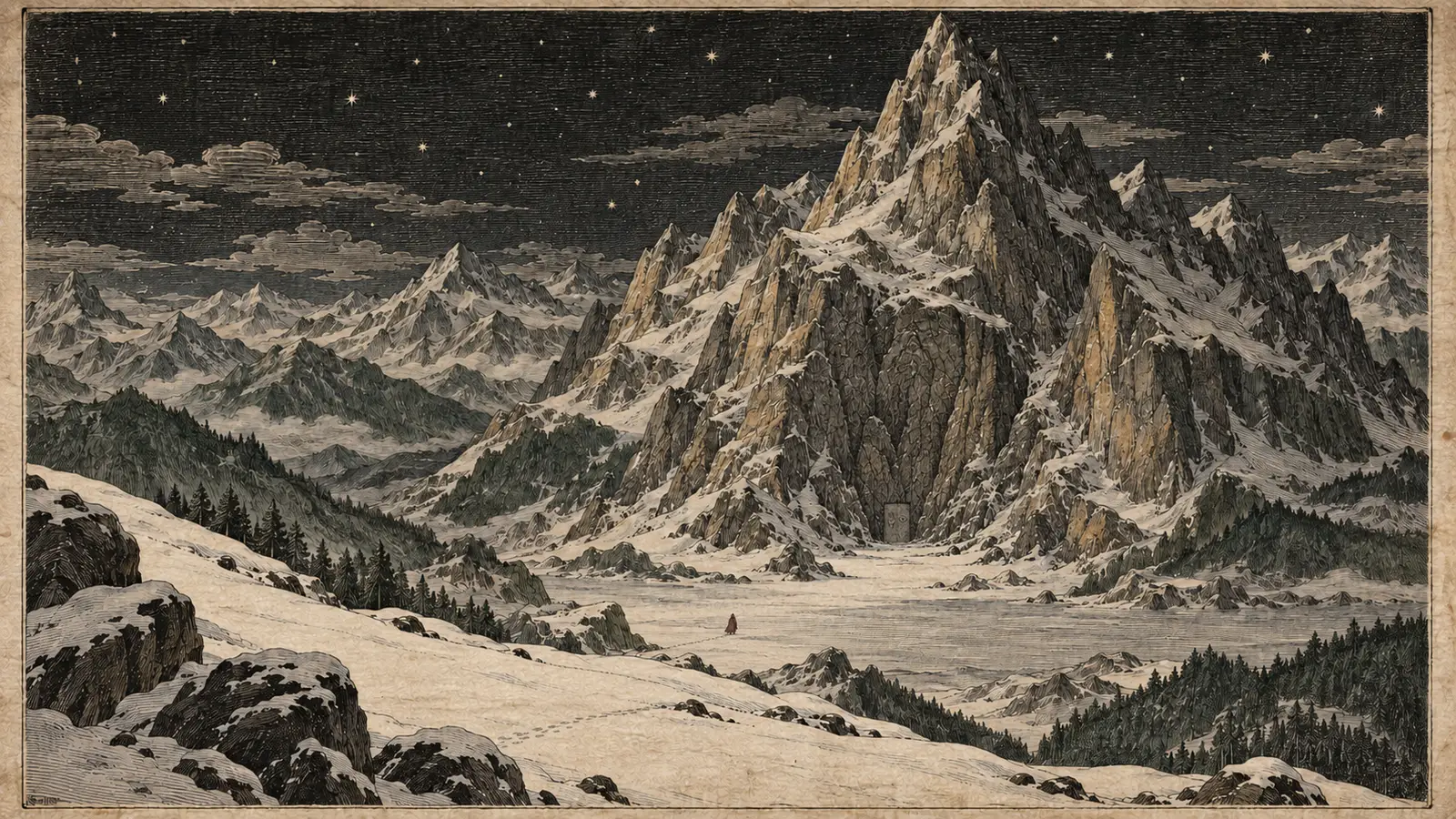
There's an image that belongs to 's faith, older than many of the books we've walked through tonight. His holy symbol is an eye set in the palm of a left hand. That's what his priests carve, and what his followers trace in secret. It's the emblem of a god, and it's made entirely of what he lost.
Think about that for a while. Most gods are shown by what they are, a sun, a hammer, a tree, a star. Vecna is shown by his missing pieces. Among his many names, the Whispered One, the Undying King, the Chained God, the Master of the Spider Throne, he is also called the Maimed God. Every time his faithful raise their symbol, they're raising the hand that isn't on his arm and the eye that isn't in his face.
Of the whole lich who once sat in the Rotted Tower, only those two small things remained. The great body withered and burned. The empire fell. The tower became ash. And yet these two pieces are the ones that lasted. They outlived the throne, the tower, the empire and the betrayal, and in a way they outlived Vecna himself, since the god he became is still missing them. The parts have outlasted the whole.
It's easy to read them as a pair of simple things. A hand is for doing, and an eye is for seeing. Vecna lost the part of him that reached into the world and the part of him that looked out at it, and those two parts went on reaching and looking without him, attached to fishermen and outlaws, warlords and clerics, wizards and heroes, each in turn, for longer than anyone can count. Hand and eye kept working long after the self that once guided them was gone, looking for a body to finish them.
And they're patient. That may be the quietest truth in all their long story. They waited more than a century before the found the Hand. They waited for years on 's shelf. They waited through 's long sleep in the mound. When anyone tries to end them in the wrong way, they simply go home to one of the hidden vaults and wait again. They're in no hurry. They never have been.
There's only one ending written for them, and it's a meeting. Somewhere ahead, in some world, a single bearer will carry both the hand and the eye, the two pieces joined at last in one living body, which is all they've ever wanted. And the sword that first cut them away will find them there. Then the relics will burst into flame and turn to ash, as the tower once did, and the long story that began in fire will end the same way.
Until then they rest. Picture one dark room among many, far beneath some mountain on a world you'll never visit. There's no light there, and no sound but the faint settling of dust. On a stone shelf lies a small black hand, its fingers curled loosely as if it had just finished some gesture long ago. Beside it, or perhaps in another room very far away, a small round stone sits, dull and red in the dark, the colour of an agate, waiting for the faintest touch of lantern light to show it's an eye.
Nobody is coming tonight. The hand is still. The eye is closed in its stone. The dust keeps settling, and the vault keeps its silence. Somewhere, a long way off, the one they belonged to is still missing them.